+(0* - - PDF document

0 primordia transplanted during pupal development
SMART_READER_LITE
LIVE PREVIEW

+(0* - - PDF document


slide-1
SLIDE 1
  • !

" # " $

  • %
  • &
  • Bidirectional selection

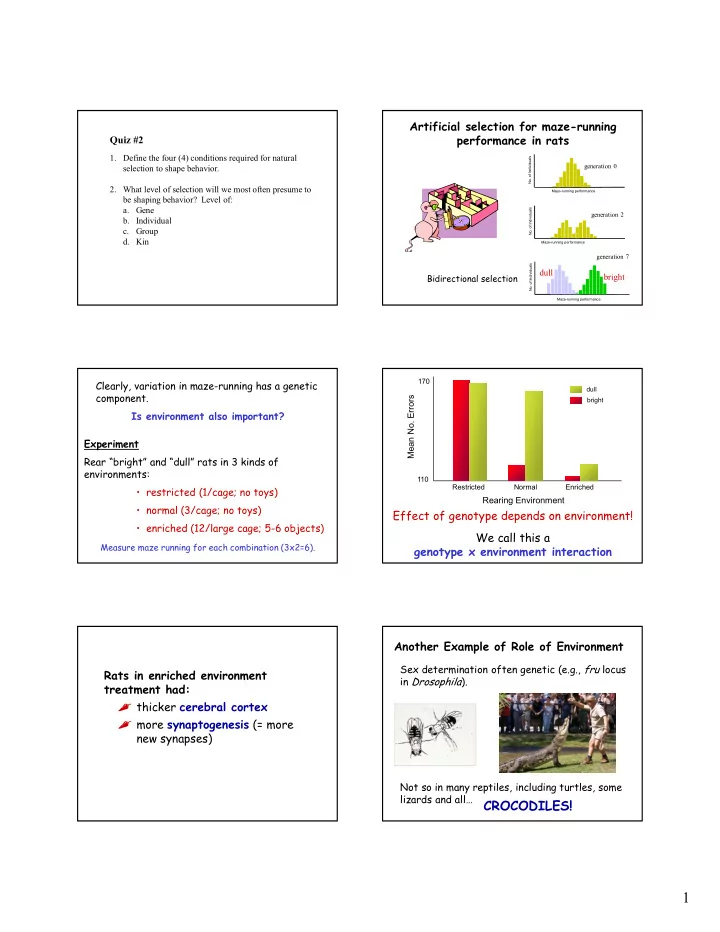
Clearly, variation in mazerunning has a genetic component.

  • Rear “bright” and “dull” rats in 3 kinds of

environments:

  • restricted (1/cage; no toys)
  • normal (3/cage; no toys)
  • enriched (12/large cage; 56 objects)

Measure maze running for each combination (3x2=6).

We call this a

  • Effect of genotype depends on environment!
  • thicker

more (= more

new synapses)

  • Sex determination often genetic (e.g., fru locus

in Drosophila). Not so in many reptiles, including turtles, some lizards and all…

!"#$

slide-2
SLIDE 2
  • %!

T ≤ 31.7oC females 31.7 < T < 34.5oC males T ≥ 34.5oC females

&#!'

  • Sex depends on the temperature at which egg is

incubated during a .

  • # is ~ 10 days long in middle

third of embryonic development

  • Involves activation of steroidproducing

and

  • Can lead to
  • Can be such as PCBs

()!*+

&,

  • environment consists of an animal’s
  • wn cells, tissues and organs.
  • environment is external to the animal.

+ .

. Development of target neurons in tobacco hornworm, Manduca sexta

+

  • M. sexta males fly upwind in plume of

produced by female.

  • '()*+,-.)

/ "

  • /

01

slide-3
SLIDE 3

2

+(0* Pupa has which develop into antennae. Developing primordia connect ‘downstream’ to

  • &

1

  • Primordia transplanted during pupal development
  • Antennae were male in appearance (as expected).

BUT… target neurons in female brain became male in appearance!

3

  • (
  • Despite being genetically female (WZ),

target neurons have potential to express either male or female morphology, depending on input from antennal primordia. target neuron development was affected by

  • Place 20 in wind tunnel with female

pheromone.

  • Mosaic moths moved upwind in response to

pheromone, even though mostly female!

  • complex interaction between gene

expression in developing neurons and the in which neurons develop.

1 deprived as infants of mother and other conspecifics develop social pathologies:

  • ,, from social interactions
  • selfclasping and other
  • ual behavior
  • for own

young, even abuse

.

#-Harry Harlow and “The Nature of Love”

slide-4
SLIDE 4
  • Harlow set about to define the

to which a rhesus infant responded.

4

!55(56)7*8)#

Adding just a few stimuli, like cloth and a face, had a profound effect on responses by infants.

  • experiment in which animal is deprived of particular

environmental cues for particular periods of time

Harlow’s monkey studies are examples of deprivation experiments.

#-Acoustic deprivation and song development in ,, , Male whitecrowned sparrows sing a complex song. # is shown below.

  • !

20

  • If a young wcs male is held in

from song of adult males, The male eventually sings a less complex . To sing a speciestypical song, young male must hear other males singing.

! !

slide-5
SLIDE 5

7

If a young male is actually from hatch, he doesn’t sing the isolate song. In fact, the male only - young male must hear himself practicing his own song.

  • : Whitecrowned sparrows are 2

0 their own song.

#

Mountain subspecies and coastal subspecies prefer to learn their own song. In other words, a subspecies bias in song learning. Males from a given population learn a in nature, But in lab will learn any dialect.

&,#

  • "!

#

  • $

$

  • 3#

4(!* ## 1 10 isolate song 10 50 normal song 50 death isolate song

  • Male begins to sing at ca. !567.

Young male first sings a . With practice, the song becomes a (= ).

slide-6
SLIDE 6

8

&/3##

  • %&
  • '
  • !

%

  • SENSORY PHASE

SENSORIMOTOR PHASE

Where’s the template? / Gene expression varies in timing in different regions.

  • 490: ;)

Don’t always need to know what the song ‘says’ in

  • rder for song to have meaning

#(

#8

)%

slide-7
SLIDE 7

&

9,

  • +:,

.:8

  • <!

=3!&%>'

& /#! &$

First, there are species differences in song learning.

  • 1. Effect of early deafening

sing normally

  • 2. Effect of acoustic isolation

, sing normal song

  • 3. Timing of memorization and motor phase

memorize other songs even as they are singing old ones

  • 4. Kind of song learned

1'' learn vocalizations

  • f other species
  • 5. Accuracy of copy

wcs copy almost perfect; , copy poor

%-

Song learning apparently evolved or lost 3 separate times. Similar regions are used for song in different lineages.

slide-8
SLIDE 8

?

Second, there were problems with acoustic isolation experiment.

A young wcs allowed to hear song of other wcs, but held with a ,,

Sang the FINCH song! Strawberry finch acted as .

@(A!

The last issue is more worrisome. Problem #1: experiments frequently deprive animal of more than the factor intended.

  • Acoustic isolation experiments deprive a songbird
  • f more than sound.

also deprive visual and tactile input from other birds. &.3! Problem #2 with deprivation experiments: Environmental factor may be important even if deprivation does not affect behavior.

  • Kittens deprived of mother express

speciestypical social behavior. Is mother unimportant? % $$ Rather, kittens deprived of mother play more with other kittens. .

!

animals may all develop speciestypical behavior through alternative routes ! to some extent from the environment. Problem #3 with deprivation experiments: It can be challenging to deprive an animal of all possible environmental input.

  • Ducklings isolated from mother

at egg stage prefer own species’ vocalizations. If devocalized , they fail to recognize

  • wn species’ vocalizations.

If isolated and devocalized at hatching, they still prefer own species call.

slide-9
SLIDE 9

B

%,:

Being surrounded by 2 females in womb (= 0M) causes male to be bathed in amniotic fluid which is higher in than in male surrounded by 2 males (= 2M). The ‘’ male mice are much less aggressive towards strangers at 90 days of age. Female mice also show an effect of embryonic environment on behavior. 4 of females surrounded in the womb by 2 males are larger (= more malelike).

genes development innate behavior environment development acquired behavior genes development environment %3/. ;!;3 "!;3

< gameteoforigin dependent modification of phenotype Or, the phenotype elicited from a given allele depends on the sex of the parent contributing that particular allele

<=8& < <,

  • Only paternal Mest gene

active in normal Mest+/+ mouse pup. Knocking out the paternal copy (= Mest+/) ,.

  • C5D

And… Mest+/ females for young.

slide-10
SLIDE 10

%

3 does an allele from the only

promote increased pup growth and increased care by the daughter ?

+1 Increased pup growth in current litter reduces number and fitness of future litters. Since father of current litter might not sire future litters, father’s genes favor investing more in growth of current litter (= the one he sired) than would mother’s genes. This is…

$

Genomic imprinting is an example of

  • a stable alteration in gene expression

without changes in DNA sequence Regulates whether genes are expressed and proteins produced

+ !%and alter gene expression by affecting how tightly coiled the DNA molecule is.

!%

!%(adding a methyl group) * Tightens coil * Helps turn gene OFF 4 * Loosens coil * Help turn gene ON +

%,

  • Some Norway rat mothers nurture

young more than other mothers ◊. than pups of neglectful mothers ◊Stress tolerance a function of

  • Contact between mother and pups
  • in pup’s hippocampus.

More glucocorticoids are bound. Pups are consequently -

very relaxed pups

slide-11
SLIDE 11
  • .!%-

At birth, promoter of glucocorticoid receptor gene is demethylated. Over time, the promoter in pups of neglectful mothers becomes more methylated than in pups of nurturing mothers. Receptor gene of neglected pups is expressed less, leading to more stress. If stress reduces nurturing, this process can cause inheritance of stress which is epigenetic, not genetic.

20 %,

Some Norway rat mothers nurture young more than other mothers

◊ wellnurtured pups become

nurturing mothers / ::: .<%&#- Nurturing α

α α α

in pup’s preoptic area (POA) of hypothalamus, By

  • Influences response to , a hormone

critical for maternal care.

future nurturing mothers

  • This process can cause inheritance of nurturing

which is epigenetic, not genetic. +$$