
SLIDE 1
PHENO 2010 1
Resonance search in
Yuri Oksuzian University of Florida
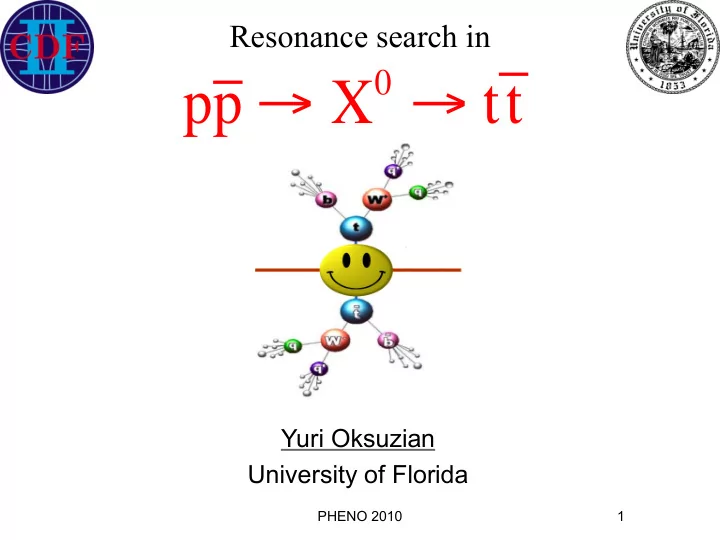
0 tt pp X Yuri Oksuzian University of Florida PHENO 2010 1 Why - - PowerPoint PPT Presentation
Resonance search in 0 tt pp X Yuri Oksuzian University of Florida PHENO 2010 1 Why and How? t Goal is to test production for possible new sources t such as a narrow resonance Top is very heavy, maybe indication of
PHENO 2010 1
Yuri Oksuzian University of Florida
PHENO 2010 2
such as a narrow resonance
– Understand SM fluctuation probabilities – Calculate UL(Upper Limits) – Compare data with our expectations(SM or with new physics)
t¯ t
PHENO 2010 3
– Large QCD background » Controlled with good event selection – More combinations
– Highest branching ratio » Most events are here – No missing information like neutrino » Better signal templates
– Combined result with lepton+jets channel » Higher sensitivity – Cross-check for a possible discovery
t¯ t
PHENO 2010 4
Excess ~500Gev Better agreement with SM :(
PHENO 2010 5
We calculate the a priori probability density for an event to be the result of Standard Model production and decay
P( j | Mtop) = 1 σ(Mtop)ε(Mtop)Ncombi Σ
combi
dzb
dzb f (za)f (zb)dσ(Mtop, p)TF( j | p)P
T (p)
t¯ t
ρ(x | j) = 1 σ(Mtop)ε(Mtop)Ncombi Σ
combi
dzb
∫
dzb f (za)f (zb)dσ(Mtop, p)TF(j | p)P
T (p)δ(x − Mtt (p))
To calculate the Mtt probability density, we modify the integral above: As Mtt estimator we use average of this distribution:
Mtt =< ρ(x | j) >
PHENO 2010 6
with masses 450, 500 ... 900 GeV
– Data driven
t¯ t
t¯ t
]
2
[GeV/c
tt
M 300 400 500 600 700 800 900 1000 1100 1200 0.02 0.04 0.06 0.08 0.1 0.12 0.14
All Hadronic Lepton + jets
CDF Run II MC preliminary
Signal Templates
500 700 900
PHENO 2010 7
cl≥15 GeV, ΣET≥125 GeV
jet≥10 GeV
– σ ≈ 14 nb, ~85% all hadronic efficiency
jet ≥ 15GeV, |η|<2.0
t¯ t
PHENO 2010 8
min - the minimum dijet mass
max - the maximum dijet mass
min - the minimum trijet mass
max - the maximum trijet mass
ET − ET 1
∑
− ET 2
M ab = P
a jP b j j
∑
/ r P j
j
∑
ET / ˆ s
∑
CDF Run II MC preliminary
PHENO 2010 9
for 1, 2 tagged events
using this procedure
PHENO 2010 10
200 400 600 800 1000 1200 1400 200 400 600 800 1000 1200 1400 1600
Mtt
200 400 600 800 1000 1200 1400 200 400 600 800 1000 1200 1400 1600
Chi2/NDF=25.4/39 prob=0.855
QCD QCD + SMtt 1,2 tag data SMtt, Norm to Data Z’(700GeV), NormMtt
/ ndf 2 ! 22.18 / 42 Prob 0.9949 p0 0.09418 ± 0.05098 p1 2.008e-04 ±200 400 600 800 1000 1200 1400
1 2 3
/ ndf 2 ! 22.18 / 42 Prob 0.9949 p0 0.09418 ± 0.05098 p1 2.008e-04 ±Chi2/NDF=25.7/39 prob=0.846
(Data-Model)/Model
Mtt
0.75<NNetOut<0.93. CDF Run 2 preliminary CDF Run 2 preliminary
PHENO 2010 11
Ncdf
tot =
Ldt ⋅(σ X 0AX 0 + σ tt Att )
+ NQCD
events in mass bin “i”:
µ(i) = N X 0TX 0(i) + NttTtt (i) + NQCDTQCD(i)
bin “i”, the likelihood is equal to:
L(σ X 0, r ν | r n) = e−µi
µi
ni
ni !
PHENO 2010 12
p(σ X 0, r n) = d r ν ⋅ L(σ X 0, r ν | r n)⋅π(σ, r ν)
limit(UL)
median after 1000 PE’s
1 Area p(σ | r n)dσ = 0.95
UL
∫
PHENO 2010 13
which both affect shape and acceptances, we:
cross-section by:
templates and fit them with nominal ones
systematics due to JES, ISR/FSR. PDF found to be negligible
[pb]
Xo
! 0.5 1 1.5 2 2.5 3 3.5 4 [pb]
Xo
! 0.5 1 1.5 2 2.5 3 3.5 4 [pb]
Xo
! " 0.2 0.4 0.6 0.8 1
Xo Mass 450 Xo Mass 500 Xo Mass 550 Xo Mass 600 Xo Mass 650 Xo Mass 700 Xo Mass 750 Xo Mass 800 Xo Mass 850 Xo Mass 900
CDF Run 2 preliminary, L=2.8fb
PDFSY S(σX0) = ∞ 1 δσX0 √ 2π exp
2 σX0 − σ′ δσX0 2 PDF(σ′) · dσ′
APS April Meeting 2009 14
, pb
Xo
! 1 2 3 4 5 6 7 8 likelihood 0.05 0.1 0.15 0.2 0.25
x10
Cross-section posterior p.d.f.
CDF preliminary
< 4.220 at 95% CL ! < 4.420 at 95% CL !
Cross-section posterior p.d.f.
PHENO 2010 15
]
2
[GeV/c
tt
M 300 400 500 600 700 800 900 1000 ]
2
[GeV/c
tt
M 300 400 500 600 700 800 900 1000
2
events/20GeV/c 100 200 300 400 500 300 400 500 600 700 800 900 1000 100 200 300 400 500
QCD t SM t CDF data, Nev=2086
CDF Run II preliminary, L=2.8fb ]
2
[GeV/c
tt
M 300 400 500 600 700 800 900 1000 ]
2
[GeV/c
tt
M 300 400 500 600 700 800 900 1000
2
events/20GeV/c 1 10
2
10 300 400 500 600 700 800 900 1000 1 10
2
10
QCD t SM t CDF data, Nev=2086
CDF Run II preliminary, L=2.8fb
PHENO 2010 16
]
2
[GeV/c
Xo
M 450 500 550 600 650 700 750 800 850 900 ) [pb] t t ! BR(X "
Xo
# 0.5 1 1.5 2 2.5 3 3.5 4
Expected limit at 95% C.L. # 1 ± Expected limit at 95% C.L. # 2 ± Expected limit at 95% C.L. Observed limit at 95% C.L.
Z’
=1.2% M
Z’
$ Leptophobic Z’,
PHENO 2010 17
new physics"
were found
PHENO 2010 18
PHENO 2010 19
which is about 1-1.5%
From Equtaion 4 we have, number of events in bin “i”: µ = σsAsTs + σttAttTtt + N pure
QCDT pure QCD
N pure
QCDT pure QCD = N cont QCDT cont QCD − σsAcont s
T cont
s
− σttAcont
tt
T cont
tt
Comparing signal templates of predicted and observed values we can assume: Ts = T cont
s
So, finally we get: µ = σs(As − Acont
s
)Ts + σttAttTtt + N cont
QCDT cont QCD − σttAcont tt
T cont
tt
PHENO 2010 20
integrals:
PHENO 2010 21
extra jets from radiation – results in better signal acceptance
Et – results in better signal templates
PHENO 2010 22
Integration
Normalization factor Jet-parton assignments Differential xsection Transfer functions Pt of ttbar system
P(j | Mtop) = 1 σ(Mtop)ε(Mtop)Ncombi Σ
combi
dzb
dzb f (za)f (zb)dσ(Mtop, p)TF(j | p)P
T (p)
PHENO 2010 23
Dirac matrices and spinors
PHENO 2010 24
Example of b-quark Transfer Function for 1.3≤|η| ≤ 2
PHENO 2010 25
More interesting: Why? Most of the events are lost on L2, which requires at least 4 clusters For higher resonance masses, decay products are boosted more=> higher chance to merge in
See backup slides for details
PHENO 2010 26
Blue 500 GeV resonance Red 900 GeV resonance.
PHENO 2010 27
PHENO 2010 28
PHENO 2010 29
FlaME gives the probability of an event to come from SM ttbar. Let’s take advantage of it! Here we plot -log(P) vs top mass for various samples. As you see there is a difference between ttbar and QCD Lets calculate -log(P) for 9 mass points: 155,160…195GeV. Decided to use their sum
PHENO 2010 30
Red lines correspond to data. Black lines correspond to SMtt Blue lines correspond to SMtt matched only
PHENO 2010 31
PHENO 2010 32
Black with FlaME, Red without FlaME, green kin. ev. sel.