02/05/2014 4.1.2 Built-in Potential N-type P-type (a) N d N d N - - PDF document

02 05 2014 4 1 2 built in potential
SMART_READER_LITE
LIVE PREVIEW

02/05/2014 4.1.2 Built-in Potential N-type P-type (a) N d N d N - - PDF document

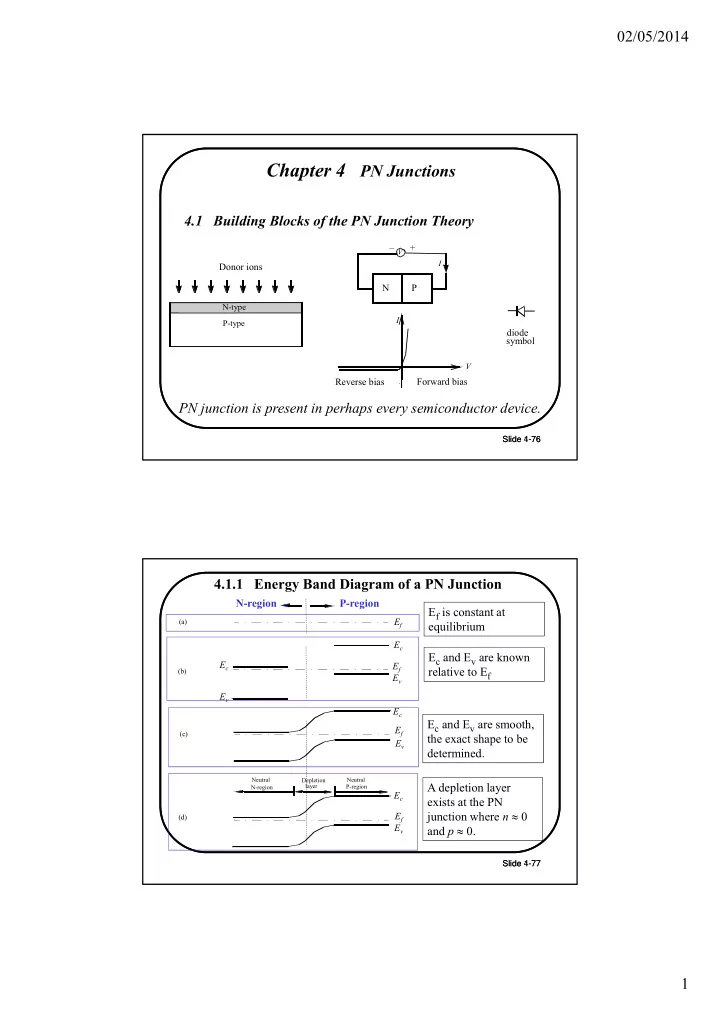
02/05/2014 Chapter 4 PN Junctions 4.1 Building Blocks of the PN Junction Theory + V I Donor ions N P N-type I P-type diode symbol V Forward bias Reverse bias PN junction is present in perhaps every semiconductor device. Slide


slide-1
SLIDE 1

02/05/2014 1

Slide 4-76

Chapter 4 PN Junctions

PN junction is present in perhaps every semiconductor device.

diode symbol N P

V I

– +

4.1 Building Blocks of the PN Junction Theory

V I

Reverse bias Forward bias Donor ions

N-type P-type Slide 1-76 Slide 4-77

4.1.1 Energy Band Diagram of a PN Junction

A depletion layer exists at the PN junction where n  0 and p  0. Ef is constant at equilibrium Ec and Ev are smooth, the exact shape to be determined. Ec and Ev are known relative to Ef

N-region P-region

(a)

Ef

(c)

Ec Ev Ef

(b)

Ec Ef Ev Ev Ec

(d)

Depletion layer Neutral P-region Neutral N-region

Ec Ev Ef

Slide 1-77

slide-2
SLIDE 2

02/05/2014 2

Slide 4-78

4.1.2 Built-in Potential

Can the built-in potential be measured with a voltmeter?

(b) (c) (a)

N-type

N d

P-type

N a

Nd Na Ef Ec Ev

q bi xN xP x

V bi

Slide 1-78 Slide 4-79

4.1.2 Built-in Potential

           

d c i a c bi

N N n N N q kT A B ln ln

2

d c kT A q c d

N N q kT A e N N n ln    

N-region

2

ln

i a d bi

n N N q kT  

2 2

ln

i a c kT B q c a i

n N N q kT B e N N n n    

P-region

Slide 1-79

slide-3
SLIDE 3

02/05/2014 3

Slide 4-80

4.1.3 Poisson’s Equation

Gauss’s Law: s: permittivity (~12o for Si) : charge density (C/cm3) Poisson’s equation

x

E(x) E(x + x) x

Slide 1-80 Slide 4-81

4.2.1 Field and Potential in the Depletion Layer On the P-side of the depletion layer,  = –qNa On the N-side,  = qNd

4.2 Depletion-Layer Model

s a

qN dx d    E ) ( ) (

1

x x qN C x qN x

P s a s a

       E ) ( ) (

N s d

x x qN x

  •  

E

N P

Depletion Layer Neutral Region

x

n x p

x x

p

x

n

qN

d

–qN

a

x E x

n xp

Neutral Region N N N P P P

Slide 1-81

slide-4
SLIDE 4

02/05/2014 4

Slide 4-82

4.2.1 Field and Potential in the Depletion Layer

The electric field is continuous at x = 0. Na |xP| = Nd|xN| Which side of the junction is depleted more? A one-sided junction is called a N+P junction or P+N junction N P

Depletion Layer Neutral Region

–xn

x p Neutral Region

N P

Slide 1-82 Slide 4-83

4.2.1 Field and Potential in the Depletion Layer

On the P-side, Arbitrarily choose the voltage at x = xP as V = 0. On the N-side,

2

) ( 2 ) ( x x qN x V

P s a

  

2

) ( 2 ) (

N s d

x x qN D x V    

2

) ( 2

N s d bi

x x qN     

x E x

n xp

E

c

E

f

E

v



bi, built-in potential

x

n x p

x bi V

N N P P

Slide 1-83

slide-5
SLIDE 5

02/05/2014 5

Slide 4-84

4.2.2 Depletion-Layer Width

V is continuous at x = 0 If Na >> Nd , as in a P+N junction, What about a N+P junction? where

density dopant lighter N N N

a d

1 1 1 1   

           

d a bi s dep N P

N N q W x x 1 1 2  

N d bi s dep

x qN W     2

qN W

bi s dep

  2 

N P

Depletion Layer Neutral Region

–xn

xp Neutral Region

 

a d N P

N N x x

| | | |

P N Slide 1-84 Slide 4-85

EXAMPLE: A P+N junction has Na=1020 cm-3 and Nd =1017cm-3. What is a) its built in potential, b)Wdep , c)xN , and d) xP ? Solution: a) b) c) d)

V 1 cm 10 cm 10 10 ln V 026 . ln

6 20 6 17 20 2

   

  i a d bi

n N N q kT 

μm 12 . 10 10 6 . 1 1 10 85 . 8 12 2 2

2 / 1 17 19 14

                

  d bi s dep

qN W   μm 12 .  

dep N

W x Å 2 . 1 μm 10 2 . 1

4

    

 a d N P

N N x x

Slide 1-85

slide-6
SLIDE 6

02/05/2014 6

Slide 4-86

4.3 Reverse-Biased PN Junction

density dopant lighter N N N

a d

1 1 1 1   

  • Does the depletion layer

widen or shrink with increasing reverse bias?

+

– V N P

qN barrier potential qN V W

s r bi s dep

       2 |) | ( 2

(b) reverse-biased

qV Ec Ec Efn Ev qbi + qV Efp Ev

(a) V = 0

Ec Ef Ev Ef Ev qbi Ec

Slide 1-86 Slide 4-87

4.4 Capacitance-Voltage Characteristics

  • Is Cdep a good thing?
  • How to minimize junction capacitance?

dep s dep

W A C  

N P

Nd Na Conductor Insulator Conductor Wdep

Reverse biased PN junction is a capacitor.

Slide 1-87

slide-7
SLIDE 7

02/05/2014 7

Slide 4-88

4.4 Capacitance-Voltage Characteristics

  • From this C-V data can Na and Nd be determined?

2 2 2 2 2

) ( 2 1 A qN V A W C

S bi s dep dep

     

Vr

1/Cdep

2

Increasing reverse bias Slope = 2/qNsA2

– bi

Capacitance data

Slide 1-88 Slide 4-89

EXAMPLE: If the slope of the line in the previous slide is 2x10²³ F-2 V-1, the intercept is 0.84V, and A is 1 m2, find the lighter and heavier doping concentrations Nl and Nh . Solution:

  ln

2 i l h bi

n N N q kT 

3 18 026 . 84 . 15 20 2

cm 10 8 . 1 10 6 10

     e e N n N

kT q l i h

bi

  • Is this an accurate way to determine Nl ? Nh ?

3 15 2 8 14 19 23 2

cm 10 6 ) cm 10 10 85 . 8 12 10 6 . 1 10 2 /( 2 ) /( 2

   

            A q slope N

s l

Slide 1-89

slide-8
SLIDE 8

02/05/2014 8

Slide 4-90

4.5 Junction Breakdown

A Zener diode is designed to operate in the breakdown mode.

V I VB, breakdown P N A R Forward Current Small leakage Current voltage

3.7 V

R IC A B C D Zener diode Slide 1-90 Slide 4-91

4.5.1 Peak Electric Field

2 / 1

|) | ( 2 ) (         

r bi s p

V qN   E E

bi crit s B

qN V     2

2

E

N+ P Na

Neutral Region

xp

(a) increasing reverse bias

x E xp

(b)

increasing reverse bias Ep

Slide 1-91

slide-9
SLIDE 9

02/05/2014 9

Slide 4-92

4.5.2 Tunneling Breakdown

Dominant if both sides of a junction are very heavily doped.

V/cm 10

6

 

crit p

E E

V I

Breakdown

Empty States Filled States - Ev Ec

p

ε e G J

/ H 

Slide 1-92 Slide 4-93

4.5.3 Avalanche Breakdown

  • impact ionization: an energetic

electron generating electron and hole, which can also cause impact ionization.

qN V

crit s B

2

2

E  

  • Impact ionization + positive

feedbackavalanche breakdown

d a B

N 1 N 1 N 1 V   

E

c

E

fn

E

c

E

v

E

fp

  • riginal

electron electron-hole pair generation

Slide 1-93

slide-10
SLIDE 10

02/05/2014 10

Slide 4-94

4.6 Forward Bias – Carrier Injection Minority carrier injection

+ V

N

P Ec Ef Ev Ec Efp Ev

V = 0

Efn

Forward biased

qbi

qV

  • +

qbi–qV

V=0 I=0 Forward biased

Drift and diffusion cancel out

Slide 1-94 Modern Semiconductor Devices for Integrated Circuits (C. Hu) Slide 4-95

4.6 Forward Bias – Quasi-equilibrium Boundary Condition

kT E E kT E E c kT E E c

fp fn fp c fn c

e e N e N x n

/ ) ( / ) ( / ) ( P)

(

    

 

kT qV P kT E E P

e n e n

fp fn

/ / ) (

 

  • The minority carrier

densities are raised by eqV/kT

  • Which side gets more

carrier injection?

Ec Efp Ev Efn 0N 0P x

Ec Efn Efp Ev

x Efn

xN xP

Slide 1-95

slide-11
SLIDE 11

02/05/2014 11

Slide 4-96

4.6 Carrier Injection Under Forward Bias– Quasi-equilibrium Boundary Condition

) 1 ( ) ( ) (     

kT qV P P P P

e n n x n x n ) 1 ( ) ( ) (     

kT qV N N N N

e p p x p x p

kT V q a i kT V q P

e N n e n n

2

) xP (  

kT V q d i kT V q N

e N n e p p

2

) (   xP

Slide 1-96 Slide 4-97

EXAMPLE: Carrier Injection

A PN junction has Na=1019cm-3 and Nd=1016cm-3. The applied voltage is 0.6 V. Question: What are the minority carrier concentrations at the depletion-region edges? Solution: Question: What are the excess minority carrier concentrations? Solution:

  • 3

11 026 . 6 .

cm 10 10 ) (     e e n x n

kT V q P P

  • 3

14 026 . 6 . 4

cm 10 10 ) (     e e p x p

kT V q N N

  • 3

11 11

cm 10 10 10 ) ( ) (      

P P P

n x n x n

  • 3

14 4 14

cm 10 10 10 ) ( ) (      

N N N

p x p x p

Slide 1-97

slide-12
SLIDE 12

02/05/2014 12

Slide 4-98

4.7 Current Continuity Equation

 p q x x J x x J

p p

       ) ( ) (  p x A q x x J A q x J A

p p

          ) ( ) (  p q dx dJ p   

 x

p

Jp(x + x)

x

a r e a A

Jp(x)

Volume = A·x

Slide 1-98 Slide 4-99

4.7 Current Continuity Equation

Minority drift current is negligible; Jp= –qDpdp/dx

Lp and Ln are the diffusion lengths

 p q dx dJ p   

p p

p q dx p d qD   

2 2 2 2 2 p p p

L p D p dx p d      

p p p

D L  

2 2 2 n

L n dx n d   

n n n

D L  

Slide 1-99

slide-13
SLIDE 13

02/05/2014 13

Slide 4-100

4.8 Forward Biased Junction-- Excess Carriers

2 2 2 p

L p dx p d    ) (    p ) 1 ( ) (

/

  

kT qV N N

e p x p

p p

L x L x

Be Ae x p

/ /

) (

  

 

N L x x kT qV N

x x e e p x p

p N

   

 

, ) 1 ( ) (

/ /

P N + xP

  • x N

x

Slide 1-100 Slide 4-101

 

P L x x kT qV P

x x e e n x n

n P

   

, ) 1 ( ) (

/ /

4.8 Excess Carrier Distributions

0.5 1.0 –3Ln

–2Ln –Ln 0 Lp 2Lp 3Lp 4Lp N-side Nd = 21017

cm-3

pN' e–x/L P-side nP' ex/L Na = 10

17cm -3

n p

 

N L x x kT qV N

x x e e p x p

p N

   

 

, ) 1 ( ) (

/ /

Slide 1-101

slide-14
SLIDE 14

02/05/2014 14

Slide 4-102

EXAMPLE: Carrier Distribution in Forward-biased PN Diode

  • Sketch n'(x) on the P-side.

3 13 026 . 6 . 17 20 / 2

cm 10 10 10 ) 1 ( ) 1 ( ) (

       e e N n e n x n

kT qV a i kT qV P P

N-type Nd = 5cm-3 Dp =12 cm2/s p = 1 s P-type Na = 1017 cm-3 Dn=36.4cm

2/s

n = 2 s

x N-side P-side

10

13cm

  • 3

2x n′ ( = p′ ) p′ (= n′ )

Slide 1-102 Slide 4-103

  • How does Ln compare with a typical device size?

μm 85 10 2 36

6 

   

 n n n

D L 

  • What is p'(x) on the P-side?

EXAMPLE: Carrier Distribution in Forward-biased PN Diode

Slide 1-103

slide-15
SLIDE 15

02/05/2014 15

Slide 4-104

4.9 PN Diode I-V Characteristics

 

p N

L x x kT V q N p p p pN

e e p L D q dx x p d qD J

 

     ) 1 ( ) (

 

n P

L x x kT V q P n n n nP

e e n L D q dx x n d qD J

    ) 1 ( ) ( x J e n L D q p L D q x J x J

kT V q P n n N p p P nP N pN

all at ) 1 ( ) ( ) ( current Total              

P-side N-side

Jtotal JpN JnP

x P-side N-side

J

total

JpN JnP Jn = Jtotal – Jp Jp = Jtotal – Jn

Slide 1-104 Slide 4-105

The PN Junction as a Temperature Sensor

What causes the IV curves to shift to lower V at higher T ? ) 1 (  

kT V q

e I I          

a n n d p p i

N L D N L D Aqn I

2 Slide 1-105

slide-16
SLIDE 16

02/05/2014 16

Slide 4-106

4.9.1 Contributions from the Depletion Region

dep dep i leakage

τ W qn A I I  

Space-Charge Region (SCR) current

kT qV ie

n p n

2 /

  ) 1 ( : rate n) (generatio ion recombinat Net

2 /

kT qV dep i

e n  ) 1 ( ) 1 (

2 / /

   

kT qV dep dep i kT qV

e τ W qn A e I I

Under forward bias, SCR current is an extra current with a slope 120mV/decade

Slide 1-106 Slide 4-107

4.10 Charge Storage

What is the relationship between s (charge-storage time) and  (carrier lifetime)?

x N-side P-side

1013cm-3

2

n' p’

I Q 

s

Q I  

s

I Q  

Slide 1-107

slide-17
SLIDE 17

02/05/2014 17

Slide 4-108

4.11 Small-signal Model of the Diode

kT qV kT qV

e I dV d e I dV d dV dI R G

/ /

) 1 ( 1     

What is G at 300K and IDC = 1 mA? Diffusion Capacitance:

q kT / I G dV dI dV dQ C

DC s s s

      

Which is larger, diffusion or depletion capacitance?

C R V I

q kT I e I kT q

DC kT qV

/ ) (

/

 

Slide 1-108 Slide 4-109

4.12 Solar Cells

  • Solar Cells is also known

as photovoltaic cells.

  • Converts sunlight to

electricity with 10-30% conversion efficiency.

  • 1 m2 solar cell generate

about 150 W peak or 25 W continuous power.

  • Low cost and high

efficiency are needed for wide deployment.

Part II: Application to Optoelectronic Devices

Slide 1-109

slide-18
SLIDE 18

02/05/2014 18

Slide 4-110

4.12.1 Solar Cell Basics

sc kT V q

I e I I    ) 1 (

V 0.7 V –Isc Maximum power-output Solar Cell IV I Dark IV Eq.(4.9.4) Eq.(4.12.1) N P

  • Short Circuit

light Isc

+

(a)

Ec Ev

Slide 1-110

Direct-Gap and Indirect-Gap Semiconductors

Slide 4-111

  • Electrons have both particle and wave properties.
  • An electron has energy E and wave vector k.

indirect-gap semiconductor direct-gap semiconductor

Slide 1-111

slide-19
SLIDE 19

02/05/2014 19

4.12.2 Light Absorption

) ( 24 . 1 (eV) Energy Photon m hc     

x

  • e

(x) intensity Light

α(1/cm): absorption coefficient 1/α : light penetration depth

Slide 4-112

A thinner layer of direct-gap semiconductor can absorb most

  • f solar radiation than indirect-gap semiconductor. But Si…

Slide 1-112

4.12.3 Short-Circuit Current and Open-Circuit Voltage

Slide 4-113

x

p

Jp(x + x)

x area A

Jp(x)

V

  • lume = A·x

If light shines on the N-type semiconductor and generates holes (and electrons) at the rate of G s-1cm-3 ,

p p

D G L p dx p d    

2 2 2

If the sample is uniform (no PN junction), d2p’/dx2 = 0  p’ = GLp

2/Dp= Gp

Slide 1-113

slide-20
SLIDE 20

02/05/2014 20 Solar Cell Short-Circuit Current, Isc

p

L x p p p p p

Ge L D q dx x p d qD J

/

) (

     G D G L p

p p p

    

2

) (

Slide 4-114

) 1 ( ) (

/

p

L x p

e G x p

    ) (   p

Assume very thin P+ layer and carrier generation in N region only. G AqL AJ I

p p sc

  ) (

x N P+ Isc x P' Lp

G

p

G is really not uniform. Lp needs be larger than the light penetration depth to collect most of the generated carriers.

Slide 1-114

Open-Circuit Voltage

G AqL e L D N n Aq I

p kT qV p p d i

   ) 1 (

/ 2 Slide 4-115

1) e (assuming

/ qVoc



kT

  • Total current is ISC plus the PV diode (dark) current:
  • Solve for the open-circuit voltage (V
  • c) by setting I=0

G L e L D N n

p kT qV p p d i

  • c

 

/ 2

) / ln(

2 i d p

  • c

n GN q kT V  

How to raise V

  • c ?

Slide 1-115

slide-21
SLIDE 21

02/05/2014 21

Modern Semiconductor Devices for Integrated Circuits (C. Hu) Slide 4-116

4.12.4 Output Power

FF V I

  • c

sc

   er Output Pow

  • Theoretically, the highest efficiency (~24%) can be obtained with

1.9eV >Eg>1.2eV. Larger Eg lead to too low Isc (low light absorption); smaller Eg leads to too low Voc.

  • Tandem solar cells gets 35% efficiency using large and small Eg

materials tailored to the short and long wavelength solar light. A particular operating point on the solar cell I-V curve maximizes the

  • utput power (I V).

  • Si solar cell with 15-20% efficiency

dominates the market now

Slide 1-116 Slide 4-117

Light emitting diodes (LEDs)

  • LEDs are made of compound semiconductors such as InP

and GaN.

  • Light is emitted when electron and hole undergo radiative

recombination.

Ec Ev

Radiative recombination Non-radiative recombination through traps

4.13 Light Emitting Diodes and Solid-State Lighting

Slide 1-117

slide-22
SLIDE 22

02/05/2014 22

Direct and Indirect Band Gap

Direct band gap Example: GaAs Direct recombination is efficient as k conservation is satisfied. Indirect band gap Example: Si Direct recombination is rare as k conservation is not satisfied

Trap

Slide 4-118 Slide 1-118 Slide 4-119

4.13.1 LED Materials and Structure

) ( 24 . 1 energy photon 24 . 1 m) ( h wavelengt LED eV Eg   

Slide 1-119

slide-23
SLIDE 23

02/05/2014 23

Slide 4-120

4.13.1 LED Materials and Structure

) (eV E

g red yellow blue Wavelength (μm)

Color

Lattice constant (Å)

InAs 0.36 3.44 6.05 InN 0.65 1.91

infrared

3.45 InP 1.36 0.92

violet

5.87 GaAs 1.42 0.87 5.66 GaP 2.26 0.55

5.46

AlP 3.39 0.51 5.45 GaN 2.45 0.37 3.19 AlN 6.20 0.20

UV

3.11

Light-emitting diode materials

compound semiconductors binary semiconductors:

  • Ex: GaAs, efficient emitter

ternary semiconductor :

  • Ex: GaAs1-xPx , tunable Eg (to

vary the color)

quaternary semiconductors:

  • Ex: AlInGaP , tunable Eg and

lattice constant (for growing high quality epitaxial films on inexpensive substrates)

Eg(eV)

Red Yellow Green Blue Slide 1-120 Slide 4-121

Common LEDs

Spectral range Material System Substrate Example Applications Infrared InGaAsP InP Optical communication Infrared

  • Red

GaAsP GaAs Indicator lamps. Remote control Red- Yellow AlInGaP GaA or GaP Optical communication. High-brightness traffic signal lights Green- Blue InGaN GaN or sapphire High brightness signal lights. Video billboards Blue-UV AlInGaN GaN or sapphire

Solid-state lighting

Red- Blue Organic semicon- ductors glass Displays

AlInGaP Quantun Well

Slide 1-121

slide-24
SLIDE 24

02/05/2014 24

Slide 4-122

4.13.2 Solid-State Lighting

Incandescent lamp Compact fluorescent lamp Tube fluorescent lamp White LED Theoretical limit at peak of eye sensitivity ( λ=555nm) Theoretical limit (white light)

17 60 50-100 90-? 683 ~340

luminosity (lumen, lm): a measure of visible light energy normalized to the sensitivity of the human eye at different wavelengths

Luminous efficacy of lamps in lumen/watt

Terms: luminosity measured in lumens. luminous efficacy,

Organic Light Emitting Diodes (OLED) :

has lower efficacy than nitride or aluminide based compound semiconductor LEDs.

Slide 1-122 Slide 4-123

4.14 Diode Lasers

(d) Net Light Absorption (e) Net Light Amplification Stimulated emission: emitted photon has identical frequency and directionality as the stimulating photon; light wave is amplified. (b) Spontaneous Emission (c) Stimulated Emission (a) Absorption

4.14.1 Light Amplification

Light amplification requires population inversion: electron

  • ccupation probability is

larger for higher E states than lower E states.

Slide 1-123

slide-25
SLIDE 25

02/05/2014 25

Slide 4-124

4.14.1 Light Amplification in PN Diode

g fp fn

E E E qV   

Population inversion is achieved when

Population inversion, qV > Eg Equilibrium, V=0

Slide 1-124 Slide 4-125

1

2 1

   G R R

  • R1, R2: reflectivities of the two ends
  • G : light amplification factor (gain)

for a round-trip travel of the light through the diode Light intensity grows until , when the light intensity is just large enough to stimulate carrier recombinations at the same rate the carriers are injected by the diode current.

1

2 1

   G R R

4.14.2 Optical Feedback and Laser

light

  • ut

Cleaved crystal plane

P+ N+

Laser threshold is reached (light intensity grows by feedback) when

Slide 1-125

slide-26
SLIDE 26

02/05/2014 26

Modern Semiconductor Devices for Integrated Circuits (C. Hu) Slide 4-126

4.14.2 Optical Feedback and Laser Diode

  • Distributed Bragg

reflector (DBR) reflects light with multi-layers of semiconductors.

  • Vertical-cavity surface-

emitting laser (VCSEL) is shown on the left.

  • Quantum-well laser has

smaller threshold current because fewer carriers are needed to achieve population inversion in the small volume of the thin small-Eg well.

Slide 1-126 Slide 4-127

4.14.3 Laser Applications

Red diode lasers: CD, DVD reader/writer Blue diode lasers: Blu-ray DVD (higher storage density) 1.55 m infrared diode lasers: Fiber-optic communication Photodiodes: Reverse biased PN diode. Detects photo- generated current (similar to Isc of solar cell) for optical communication, DVD reader, etc. Avalanche photodiodes: Photodiodes operating near avalanche breakdown amplifies photocurrent by impact ionization.

4.15 Photodiodes

Slide 1-127

slide-27
SLIDE 27

02/05/2014 27

Slide 1-128

Tunnel Diode

Slide 1-129

slide-28
SLIDE 28

02/05/2014 28

Slide 1-130 Slide 1-131

slide-29
SLIDE 29

02/05/2014 29

Slide 1-132 Slide 1-133

slide-30
SLIDE 30

02/05/2014 30

Slide 1-134