04-1 Option 3: Use Inheritance Class SavingsAccount (1) - - PDF document

04 1
SMART_READER_LITE
LIVE PREVIEW

04-1 Option 3: Use Inheritance Class SavingsAccount (1) - - PDF document

Example Domain: Bank Accounts CSE 143 Java We want to model different kinds of bank accounts A plain bank account: standard account information (name, account #, balance) Inheritance Example a savings account: like a generic bank


slide-1
SLIDE 1

04-1

10/11/2002 (c) University of Washington 04-1

CSE 143 Java

Inheritance Example

10/11/2002 (c) University of Washington 04-2

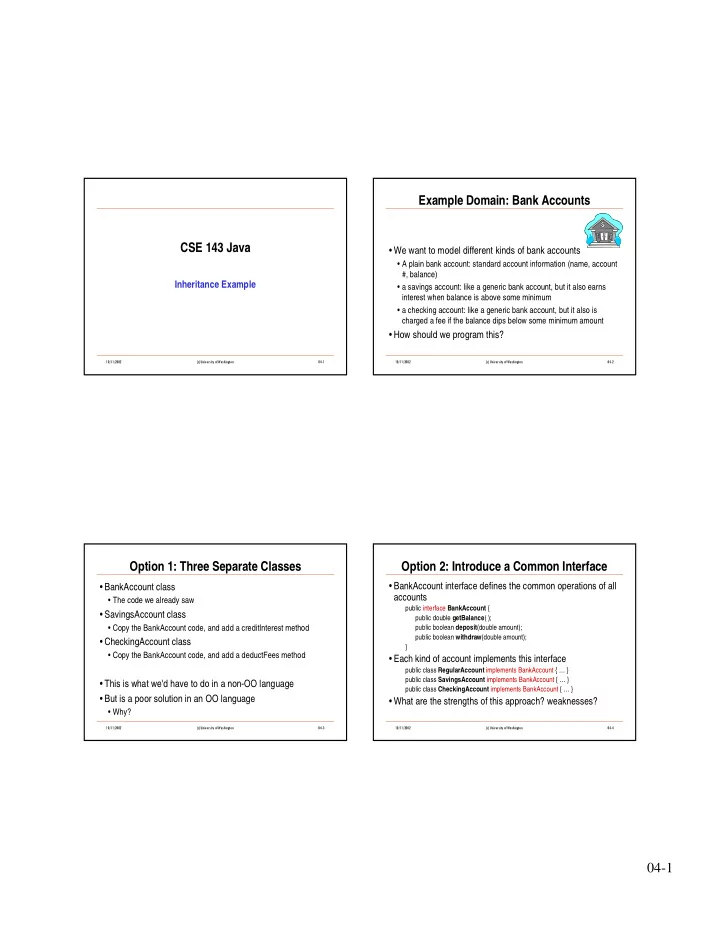
Example Domain: Bank Accounts

  • We want to model different kinds of bank accounts
  • A plain bank account: standard account information (name, account

#, balance)

  • a savings account: like a generic bank account, but it also earns

interest when balance is above some minimum

  • a checking account: like a generic bank account, but it also is

charged a fee if the balance dips below some minimum amount

  • How should we program this?

10/11/2002 (c) University of Washington 04-3

Option 1: Three Separate Classes

  • BankAccount class
  • The code we already saw
  • SavingsAccount class
  • Copy the BankAccount code, and add a creditInterest method
  • CheckingAccount class
  • Copy the BankAccount code, and add a deductFees method
  • This is what we'd have to do in a non-OO language
  • But is a poor solution in an OO language
  • Why?

10/11/2002 (c) University of Washington 04-4

Option 2: Introduce a Common Interface

  • BankAccount interface defines the common operations of all

accounts

public interface BankAccount { public double getBalance( ); public boolean deposit(double amount); public boolean withdraw(double amount); }

  • Each kind of account implements this interface

public class RegularAccount implements BankAccount { … } public class SavingsAccount implements BankAccount { … } public class CheckingAccount implements BankAccount { … }

  • What are the strengths of this approach? weaknesses?
slide-2
SLIDE 2

04-2

10/11/2002 (c) University of Washington 04-5

Option 3: Use Inheritance

  • Observation: SavingsAccount is a lot like RegularAccount; it

just adds some things, and makes a few other changes

  • Idea: define SavingsAccount not by itself, but rather by first

inheriting from RegularAccount and then making some small extensions

public class SavingsAccount extends RegularAccount { // inherits all of RegularAccount's instance variables and methods // now write whatever's different about SavingsAccount here … }

  • Likewise for CheckingAccount

10/11/2002 (c) University of Washington 04-6

Class SavingsAccount (1)

  • Class declaration and instance variables

public class SavingsAccount extends RegularAccount { // inherit balance, ownerName, and accountNumber from RegularAccount // additional instance variables private double interestRate; // interest rate; 0.05 means 5% private double minBalance; // minimum account balance to receive interest …

10/11/2002 (c) University of Washington 04-7

Class SavingsAccount (2)

  • Constructor [reminder: constructors are not inherited]

public SavingsAccount(String name, double interestRate, double minBalance) { // initialize inherited instance variables (copied from superclass constructor) this.ownerName = name; this.balance = 0.0; this.assignNewAccountNumber( ); // initialize new instance variables this.interestRate = interestRate; this.minBalance = minBalance; }

  • Doesn't compile!
  • Private instance variables can't be accessed, even in subclasses

10/11/2002 (c) University of Washington 04-8

Member Access in Subclasses

  • public: accessible anywhere the class can be accessed
  • private: accessible only inside the same class
  • Does not include subclasses – derived classes have no special

permissions

  • A new mode: protected

accessible inside the defining class and all its subclasses

  • Use protected for "internal" things that subclasses also may need to

access

  • Consider this carefully – often better to keep private data private

and provide appropriate (protected) set/get methods

slide-3
SLIDE 3

04-3

10/11/2002 (c) University of Washington 04-9

Using Protected

  • If we had declared the RegularAccount instance variables protected,

instead of private, then this constructor would now compile

public SavingsAccount(String name, double interestRate, double minBalance) { // initialize inherited instance variables (copied from superclass constructor) this.ownerName = name; this.balance = 0.0; this.assignNewAccountNumber( ); // initialize new instance variables this.interestRate = interestRate; this.minBalance = minBalance; }

  • But it's still poor code [why?]

10/11/2002 (c) University of Washington 04-10

Super

  • If a subclass constructor wants to call a superclass constructor, it can do that using

the syntax

super(<possibly empty list of argument expressions>)

as the first thing in the subclass constructor's body

public SavingsAccount(String name, double interestRate, double minBalance) { // initialize inherited instance variables super(name); // invokes RegularAccount(String) constructor // initialize new instance variables this.interestRate = interestRate; this.minBalance = minBalance; }

  • Good practice to always have a super(…) at the start of a subclass's constructor

10/11/2002 (c) University of Washington 04-11

Class SavingsAccount (3)

  • Inherit methods from RegularAccount

// getBalance(), deposit(), withdraw() inherited

  • Add a new method

/** Credit interest if current account balance is sufficient */ public void creditInterest( ) { if (this.balance >= this.minBalance) { this.deposit(this.balance * this.interestRate); } }

10/11/2002 (c) University of Washington 04-12

Overriding a Method

  • Override toString for SavingsAccount

/** Return a string representation of this SavingsAccount */ public String toString( ) { return "SavingsAccount#" + this.accountNumber + " (owned by " + this.ownerName + "): current balance: " + this.balance + "; interest rate: " + this.interestRate; }

  • Done!

} // end SavingsAccount

slide-4
SLIDE 4

04-4

10/11/2002 (c) University of Washington 04-13

Class CheckingAccount (1)

public class CheckingAccount extends BankAccount { // new instance variables protected double lowBalance; // lowest balance since account created or // last service charge was deducted /** Create a new checking account */ public CheckingAccount(String name, double initialBalance){ super(name); this.balance = initialBalance; this.lowBalance = this.balance; }

10/11/2002 (c) University of Washington 04-14

Class CheckingAccount (2)

  • Add a new method to deduct a service charge if the account

minimum balance went too low

/** Deduct a service charge if the account balance went too low */ public void deductFees(double minBalance, double serviceCharge){ if (this.lowBalance < minBalance) { this.withdraw(serviceCharge); } // reset low balance to current balance lowBalance = this.balance; }

10/11/2002 (c) University of Washington 04-15

Class CheckingAccount (3)

  • Override the updateBalance method (assuming it is protected, not

private) to keep track of the low balance

protected boolean updateBalance(double amount) { if (this.balance + amount < 0) { return false; } else { this.balance = this.balance + amount; if (this.balance < this.lowBalance) { this.lowBalance = this.balance; } return true; } }

  • But this is a poor approach! [Why?]

10/11/2002 (c) University of Washington 04-16

Super

  • New use for super: in any subclass, super.msg(args) can be

used to call the version of the method in the superclass, even if it has been overridden in the subclass

  • Can be done anywhere in the code – does not need to be at the

beginning of the calling method

protected boolean updateBalance(double amount) { boolean OK = super.updateBalance(amount); if (this.balance < this.lowBalance) { this.lowBalance = this.balance; } return OK; }

slide-5
SLIDE 5

04-5

10/11/2002 (c) University of Washington 04-17

Example

  • Consider this example:

CheckingAccount a1 = new CheckingAccount("George", 250.00); boolean OK = a1.withdraw(100.00);

  • What happens, from when the message is sent, to when it

finally returns an answer?

10/11/2002 (c) University of Washington 04-18

Summary

  • Main idea: use inheritance to reuse existing similar classes
  • Better modeling
  • Supports writing polymorphic code
  • Avoids code duplication
  • Other ideas:
  • Use protected rather than private for things that might be needed

by subclasses

  • Use overriding to make changes to superclass methods
  • Use super in constructors and methods to reuse superclass
  • perations