
SLIDE 1
Excercise INTROSPECT WORKSHOP Computer exercises 2017
1.1 Dynamics of a Cumulus topped Boundary Layer: an analysis of LES data
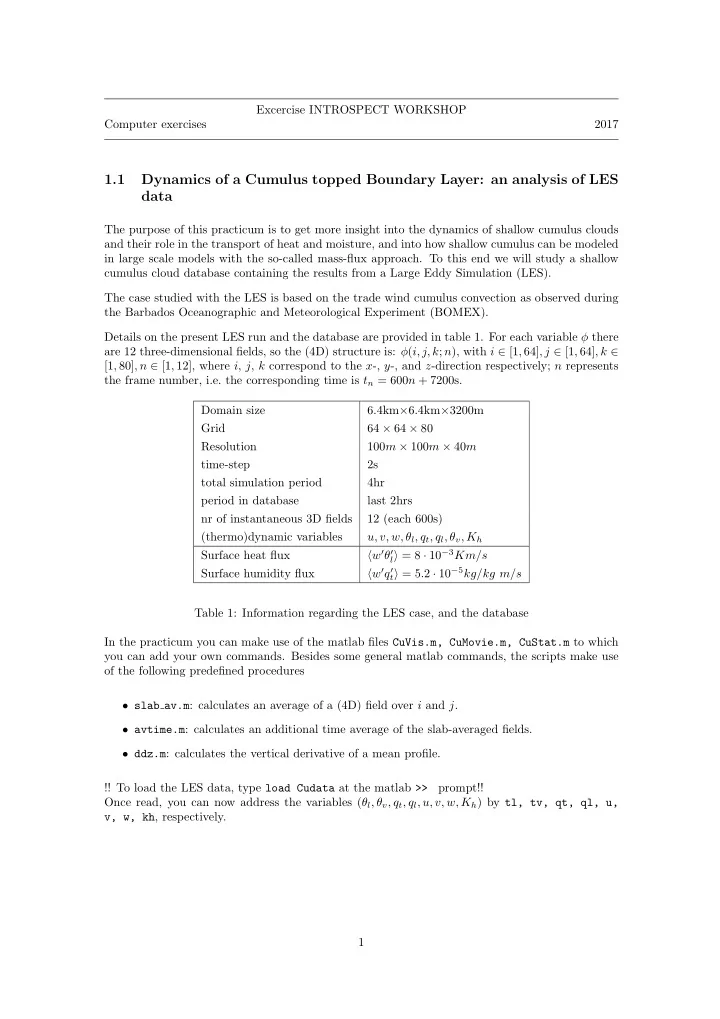
The purpose of this practicum is to get more insight into the dynamics of shallow cumulus clouds and their role in the transport of heat and moisture, and into how shallow cumulus can be modeled in large scale models with the so-called mass-flux approach. To this end we will study a shallow cumulus cloud database containing the results from a Large Eddy Simulation (LES). The case studied with the LES is based on the trade wind cumulus convection as observed during the Barbados Oceanographic and Meteorological Experiment (BOMEX). Details on the present LES run and the database are provided in table 1. For each variable φ there are 12 three-dimensional fields, so the (4D) structure is: φ(i, j, k; n), with i ∈ [1, 64], j ∈ [1, 64], k ∈ [1, 80], n ∈ [1, 12], where i, j, k correspond to the x-, y-, and z-direction respectively; n represents the frame number, i.e. the corresponding time is tn = 600n + 7200s. Domain size 6.4km×6.4km×3200m Grid 64 × 64 × 80 Resolution 100m × 100m × 40m time-step 2s total simulation period 4hr period in database last 2hrs nr of instantaneous 3D fields 12 (each 600s) (thermo)dynamic variables u, v, w, θl, qt, ql, θv, Kh Surface heat flux w′θ′
l = 8 · 10−3Km/s
Surface humidity flux w′q′
t = 5.2 · 10−5kg/kg m/s
Table 1: Information regarding the LES case, and the database In the practicum you can make use of the matlab files CuVis.m, CuMovie.m, CuStat.m to which you can add your own commands. Besides some general matlab commands, the scripts make use
- f the following predefined procedures
- slab av.m: calculates an average of a (4D) field over i and j.
- avtime.m: calculates an additional time average of the slab-averaged fields.
- ddz.m: calculates the vertical derivative of a mean profile.