1 2 3 4 5 6 REVISION BLOCK REV DESCRIPTION DATE INCORP. BY - - PowerPoint PPT Presentation

1 2 3 4 5 6
SMART_READER_LITE
LIVE PREVIEW

1 2 3 4 5 6 REVISION BLOCK REV DESCRIPTION DATE INCORP. BY - - PowerPoint PPT Presentation

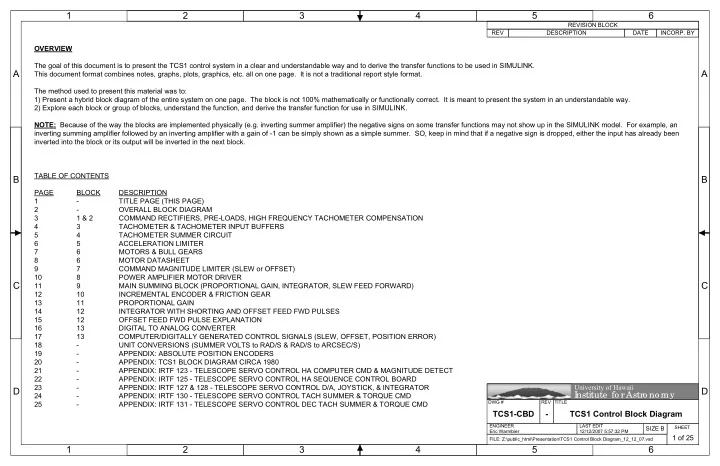
1 2 3 4 5 6 REVISION BLOCK REV DESCRIPTION DATE INCORP. BY OVERVIEW The goal of this document is to present the TCS1 control system in a clear and understandable way and to derive the transfer functions to be used in SIMULINK. A A


slide-1
SLIDE 1

A B C D A B C D 1 2 3 4 5 6 1 2 3 4 5 6

FILE: Z:\public_html\Presentation\TCS1 Control Block Diagram_12_12_07.vsd

TCS1 Control Block Diagram

University of Hawaii

I nstitute fo r Astro no my

TCS1-CBD

TITLE DWG #

  • REV

ENGINEER Eric Warmbier LAST EDIT 12/12/2007 5:57:32 PM SHEET

1 of 25

SIZE B REVISION BLOCK REV DESCRIPTION DATE

  • INCORP. BY

OVERVIEW The goal of this document is to present the TCS1 control system in a clear and understandable way and to derive the transfer functions to be used in SIMULINK. This document format combines notes, graphs, plots, graphics, etc. all on one page. It is not a traditional report style format. The method used to present this material was to: 1) Present a hybrid block diagram of the entire system on one page. The block is not 100% mathematically or functionally correct. It is meant to present the system in an understandable way. 2) Explore each block or group of blocks, understand the function, and derive the transfer function for use in SIMULINK. NOTE: Because of the way the blocks are implemented physically (e.g. inverting summer amplifier) the negative signs on some transfer functions may not show up in the SIMULINK model. For example, an inverting summing amplifier followed by an inverting amplifier with a gain of -1 can be simply shown as a simple summer. SO, keep in mind that if a negative sign is dropped, either the input has already been inverted into the block or its output will be inverted in the next block. TABLE OF CONTENTS PAGE BLOCK DESCRIPTION 1

  • TITLE PAGE (THIS PAGE)

2

  • OVERALL BLOCK DIAGRAM

3 1 & 2 COMMAND RECTIFIERS, PRE-LOADS, HIGH FREQUENCY TACHOMETER COMPENSATION 4 3 TACHOMETER & TACHOMETER INPUT BUFFERS 5 4 TACHOMETER SUMMER CIRCUIT 6 5 ACCELERATION LIMITER 7 6 MOTORS & BULL GEARS 8 6 MOTOR DATASHEET 9 7 COMMAND MAGNITUDE LIMITER (SLEW or OFFSET) 10 8 POWER AMPLIFIER MOTOR DRIVER 11 9 MAIN SUMMING BLOCK (PROPORTIONAL GAIN, INTEGRATOR, SLEW FEED FORWARD) 12 10 INCREMENTAL ENCODER & FRICTION GEAR 13 11 PROPORTIONAL GAIN 14 12 INTEGRATOR WITH SHORTING AND OFFSET FEED FWD PULSES 15 12 OFFSET FEED FWD PULSE EXPLANATION 16 13 DIGITAL TO ANALOG CONVERTER 17 13 COMPUTER/DIGITALLY GENERATED CONTROL SIGNALS (SLEW, OFFSET, POSITION ERROR) 18

  • UNIT CONVERSIONS (SUMMER VOLTS to RAD/S & RAD/S to ARCSEC/S)

19

  • APPENDIX: ABSOLUTE POSITION ENCODERS

20

  • APPENDIX: TCS1 BLOCK DIAGRAM CIRCA 1980

21

  • APPENDIX: IRTF 123 - TELESCOPE SERVO CONTROL HA COMPUTER CMD & MAGNITUDE DETECT

22

  • APPENDIX: IRTF 125 - TELESCOPE SERVO CONTROL HA SEQUENCE CONTROL BOARD

23

  • APPENDIX: IRTF 127 & 128 - TELESCOPE SERVO CONTROL D/A, JOYSTICK, & INTEGRATOR

24

  • APPENDIX: IRTF 130 - TELESCOPE SERVO CONTROL TACH SUMMER & TORQUE CMD

25

  • APPENDIX: IRTF 131 - TELESCOPE SERVO CONTROL DEC TACH SUMMER & TORQUE CMD
slide-2
SLIDE 2

DAC

  • 10

10 14 bit 1.96 (1.33)

Low Pass

1.59 kHz

Compensator

.839 (1.0)

Low Pass

338 Hz

Mag Limit

11

  • 11

+ + + + + +8V 0V FD FWD EAST

  • 8V

0V FD FWD WEST + + + + +

.839 (.513)

Low Pass

338 Hz

SWITCH

(active low)

SWITCH

(active low)

SLEW EAST/ SLEW WEST/ 0V 0V +8V

  • 8V

6.26 (12.1) 6.26 (12.1)

Low Pass

338 Hz

Low Pass

338 Hz

SWITCH

(active low)

Joystick Circuit 0V HA CLEAR INTEGRATOR Integrator

Ki=

dt t v Ki ) (

RESET

.002 Integrator

Ki=

dt t v Ki ) (

RESET

0.02 Integrator

Ki=

dt t v Ki ) (

RESET

0.02

4.7 (4.7)

Low Pass

338 Hz

Mag Limit

ADJ ADJ POSITIVE LIMIT NEGATIVE LIMIT

Low Pass

468 Hz

+ - Mag Limit

11

  • 11

1000 1000 Mag Limit

4.5

  • 4.5

Integrator

Ki=

dt t v Ki ) (

RESET

330k 680k SWITCH

(active low)

SWITCH

(active low)

0V BUF EAST SLEW DISABLE BUF EAST MOTION DISABLE Adj 0 to 0.5V Adj 0 to 8V G=5 SWITCH

(active low)

SWITCH

(active low)

0V BUF WEST SLEW DISABLE BUF WEST MOTION DISABLE Adj 0 to -0.5V Adj 0 to -8V G=5 HA CLEAR INTEGRATOR 0.35 V (on output)

  • Adj. pre-load

AMP Low Pass

240 Hz

Mag Limit

10

AMP Low Pass

240 Hz

Mag Limit

10

Low Pass

723 Hz

Low Pass

723 Hz

+ + Low Pass

3.77 Hz

Bandpass

8.6Hz 240Hz

Bandpass

8.6Hz 240Hz

+ + + + MOTOR MOTOR

Tele- scope Mount

.2105 .2105 5.36 5.36 Tach Tach

MECHANICAL

OPPOSING MOTORS - APPLY TORQUE IN ONE DIRECTION ONLY Compensator Compensator

2 1 2 1 2 1 2 1 2 1 2 1

WEST EAST

2 1 3 3 3 3 4 4 3 3 6 6

144:1 ratio (motor to bull gear)

Bull gear 10

Incremental Encoder ~180:1 friction gear ratio (encoder to bull gear)

8 8

+ -

2 1

  • 0.35 V

(on output)

  • Adj. pre-load

EAST WEST

G=-2 G=-2 + + + +

4

  • 1.2

0.488 SWITCH

(active low)

1

SWITCH

1

5 5 5 5 5 5 5 7 7 7 7 7 7 7 7 9 9 9 9 9 9 9 9 9 9 9 9 9 9 11 11 12 12 12 12 12 12 12 12 12 12 12

SWITCH

1

SWITCH

1

SWITCH

1

SWITCH

1

13

PEC B0:B12,B25

Digital position error CMD.

Counter

3 8 9 1 2 5 4 4

Desired Position

+ - PEC B0:B12,B25

14

A B C D E F A B C D E F

2 3 4 5 6 7 8 1 2 3 4 5 6 7 8 1

TCS1-CBD

DWG #

  • REV

SHEET

2 of 25

SIZE

D

SLEW

SLEW WEST/ SLEW WEST/

Active low SLEW signals present when SLEW commanded in a direction. When SLEW is nearly complete and deceleration is required, the SLEW signals are removed (high) and the control goes back to standard control. This is based on DIP switch settings representing when to begin deceleration in number of counts from the end of the SLEW. Integrator is also shorted during this event.

HA CLEAR INTEGRATOR BUF EAST SLEW DISABLE BUF WEST SLEW DISABLE FD FWD EAST

If an offset is commanded, variable amounts of pulses are added to the integrator of opposite polarity to remove charge from the integrator and reduce overshoot.

FD FWD WEST Half Wave Rectifier+ Half Wave Rectifier-

slide-3
SLIDE 3

TRANSFER FUNCTION(S) FOR SIMULINK

A B C D A B C D 1 2 3 4 5 6 1 2 3 4 5 6

TCS1-CBD

DWG #

  • REV

SHEET

3 of 25

BLOCK GROUP #1 & #2

Inverting Amp (Gain = -2) Half Wave Rectifier Output EAST=negative output (positive for WEST) Inverting Amp with low pass. Gain =-300k/100k =-3 f(-3dB) =1/(2πRC) =1/(2π*300k*2200pF) =240 Hz Inverting Amp with band pass. Gain =-300k/56k =-5.357 in pass band f(low) =1/(2πRC) =1/(2π*300k*2200pF) =240 Hz ~f(high) =1/(2πRC) =1/(2π*56k*0.33uF) =~8.58 Hz HOWEVER, the compensation up front will cause lower gain overall and will cause additional lower gain at lower

  • frequencies. Also, filter is not a “brick

wall” filter. Pass band will have lower gain than calculated as the simulation illustrates..

INVERTING SUMMING

Positive Values Only (EAST) Negative Values Only (WEST) Sets maximum output clamp, which must be less than the series Zeners, or ~10.7V. Low pass filter f(-3dB) =1/(2πRC) =1/(2π*100*0.1uF) =16 kHz This is really high compared to 240 Hz upstream filter. This is for high frequency electronic noise induced or picked up. ACTUAL GAIN (input signal is 1V)

Pass band, shorted C8,R33 Actual circuit

Adds a preload to the output and will be adjusted to add to the DAC output about: +0.35V (East) or -0.35 (West). Gain adjust

  • -

+ + 0.35 Mag Limit

10

G=-2 Mag Limit

12

  • -

+ +

  • 0.35

Mag Limit

  • 10

G=-2 Mag Limit

  • 12

Compensated Input Plot from Mathcad

EAST WEST

slide-4
SLIDE 4

A B C D A B C D 1 2 3 4 5 6 1 2 3 4 5 6

TCS1-CBD

DWG #

  • REV

SHEET

4 of 25

BLOCK GROUP #3

Clamp Gain= Rf/Rs 10k/47k 0.213 f(-3dB) =1/(2πRC) =1/(2π*10k*0.022uF) =723 Hz

DIFFERENTIAL AMP w/ filtering

Very high frequency passive filtering f(-3dB) =1/(2πRC) Where R is the line + source impedance which is low.

Identical amplifier input stage for EAST & WEST. TRANSFER FUNCTION(S) FOR SIMULINK Velocity (rad)

Tachometer

TCS Tachometer Voltage vs. Speed

y = 0.008654x - 0.001271 R2 = 0.999997 y = 0.008845x + 0.005803 R2 = 0.999922 y = 0.008764x R2 = 0.999979

  • 0.200

0.000 0.200 0.400 0.600 0.800 1.000 1.200 1.400 1.600 1.800 2.000 50 100 150 200 250 Speed (as/s) Voltage (V) East West Average Linear (West) Linear (East) Linear (Average) (Intercept set to Zero)

s rad V Tach s rad s arc s arc V Tach s rad s arc s arc V Tach / 704 . 1807 / sec/ 206264.81 sec/ 008764 . / sec/ sec/ = ⋅ = ⋅ = For the tachometer rad/s to volt conversion: NOTE: This conversion is from TELESCOPE axis rotational velocity to volts. The mechanical model in SIMULINK provides axis velocity in rad/s at each motor geared output (after the 1:144 ratio).

slide-5
SLIDE 5

A B C D A B C D 1 2 3 4 5 6 1 2 3 4 5 6

TCS1-CBD

DWG #

  • REV

SHEET

5 of 25

BLOCK GROUP #4

INVERTING SUMMING w/ filtering

Gain=

  • Rf/Rs

33.2k/68.1k

  • 0.4875

f(-3dB) =1/(2πRC) =1/(2π*33.2k*(1uF+0.27uF) =3.77 Hz

By adding together ~½ of two individual signals, the output is approximately the average. INVERTING SUMMING Gain = -120/100 Gain = -1.2 East Tach IN West Tach IN Velocity CMD

+ + Low Pass

3.77 Hz 4

+ -

4

  • 1.2

0.488

4 4 4

West Tach IN East Tach IN

TRANSFER FUNCTION(S) FOR SIMULINK

+ + + -

  • 1.2

West Tach IN East Tach IN VEL CMD VEL CMD

NOTE: Be careful with the polarity signs here. The equation will be worked through to demonstrate the polarities. )) ( 4875 . ( 2 . 1 )) ( 4875 . ( 2 . 1 ))) ( 4875 . ( ( 2 . 1 ) _ ( 2 . 1 Wtach Etach VCMD Vout Wtach Etach VCMD Vout Wtach Etach VCMD Vout amp Vsum VCMD Vout + − − = + + − ⋅ = + ⋅ − − − ⋅ = − − ⋅ =

slide-6
SLIDE 6

A B C D A B C D 1 2 3 4 5 6 1 2 3 4 5 6

TCS1-CBD

DWG #

  • REV

SHEET

6 of 25

BLOCK GROUP #5

+ - Mag Limit

11

  • 11

1000 1000 Mag Limit

4.5

  • 4.5

Integrator

Ki=

dt t v Ki ) (

RESET

330k 680k SWITCH

1

5 5 5 5 5 5 5

HA CLEAR INTEGRATOR

INVERTING AMP Gain = -1000 1n5240 are 10V Zener Diodes, so

  • utput is limited to

about: 10+0.7=10.7V. Roundoff to ~11V INVERTING AMP Gain = -1000 Output is clamped to about: 3.1+0.7+0.7 = ~4.5V INTEGRATOR Since the input to the integrator will always be either +/-4.5V due to the total gain of 1 million and the clamping diodes, the current going into the integrator will always be +/- a constant value (4.5V/ resistor) and the result is a signal with a +/- constant

  • slope. This slope is change in

velocity, which is acceleration. The integrator uses a capacitor. Where the capacitor voltage change over time: i=Cdv/dt i/C=dv/dt Therefore: 1010kΩ case: i=4.5V/1010kΩ i=4.46μA dv/dt=4.46μA/1μF dv/dt=4.46V/s 330kΩ case: i=4.5V/330kΩ i=13.64μA dv/dt=13.64μA/1μF dv/dt=13.64V/s TRANSFER FUNCTION(S) FOR SIMULINK Results, 330kΩ simulation: dv/dt=-1V/83.5ms dv/dt=~12V/s Notice the feedback and high gain of a million. This can be represented as a slew limited amplifier with a gain of +1. This circuit functions as an acceleration limiter.

Rate Limit

+/- 13.64V/s

Rate Limit

+/- 4.46V/s

SWITCH

1

HA CLEAR INTEGRATOR NOTE: In this simulation the first stage was unclamped (it just saturated) and a 3.3V (1n746A) Zener was used. The result will be nearly identical with the exception that the slope will be a slightly larger value. 330kΩ used for integrator in simulation. Mag Limit

12

  • 12

Op-amp supplies limit output to about +/- 12V.

slide-7
SLIDE 7

A B C D A B C D 1 2 3 4 5 6 1 2 3 4 5 6

TCS1-CBD

DWG #

  • REV

SHEET

7 of 25

MOTOR MOTOR

Tele- scope Mount 6 6

144:1 ratio (motor to bull gear)

Bull gear

BLOCK GROUP #6

The motors are driven by a current amplifier. The output of the motor has a 144:1 gear ratio to the HA Axis. Since the motor is driven by a current drive amplifier, the equations for the torque involve the torque constant of the motor, current, and gear ratio. The back EMF produced by the motor is used as feedback for the amplifier in the amplifier

  • model. The back EMF reduces the maximum current
  • utput of the amplifier. See the amplifier section for more
  • details. See next page for motor datasheet and parameter

values. Imai measured 1Ω and 1.3Ω across the motors at the junction box with the amplifiers off but still connected on 11/2/07. This suggests “A” version of motor. TRANSFER FUNCTION(S) FOR SIMULINK

761.427

Current (A) Torque (N•m/A) A m N I Torque ft lb A ft lb I Torque A ft lb I Torque A ft lb I Torque Ratio Gear IK Torque

T

⋅ ⋅ = ⎥ ⎦ ⎤ ⎢ ⎣ ⎡ ⋅ ⋅ ⋅ ⎥ ⎦ ⎤ ⎢ ⎣ ⎡ ⋅ = ⎥ ⎦ ⎤ ⎢ ⎣ ⎡ ⋅ = ⋅ ⎥ ⎦ ⎤ ⎢ ⎣ ⎡ ⋅ = ⋅ = 427 . 761 m N 952 817 1.355 6 . 561 6 . 561 ) 144 ( 90 . 3 _ MOTOR TORQUE s rad V EMF Back K EMF Back

M b M

/ 30 . 5 _ _ ⋅ = ⋅ = θ θ BACK EMF (used in amplifier section) MOTOR IMPEDANCE (@25C) Ω + Ω = + = 97 . ) 008 . (

_

s Z R Z Z

motor winding winding L motor

ORIGINAL, Model 12016A SPARE, Model 12016A A m N I Torque ft lb A ft lb I Torque A ft lb I Torque A ft lb I Torque Ratio Gear IK Torque

T

⋅ ⋅ = ⎥ ⎦ ⎤ ⎢ ⎣ ⎡ ⋅ ⋅ ⋅ ⎥ ⎦ ⎤ ⎢ ⎣ ⎡ ⋅ = ⎥ ⎦ ⎤ ⎢ ⎣ ⎡ ⋅ = ⋅ ⎥ ⎦ ⎤ ⎢ ⎣ ⎡ ⋅ = ⋅ = 04 . 2499 m N 952 817 1.355 2 . 1843 2 . 1843 ) 144 ( 8 . 12 _ MOTOR IMPEDANCE (@25C) Ω + Ω = + = 50 . 4 . ) 017 . (

_

s Z R Z Z

motor winding winding L motor

s rad V EMF Back K EMF Back

M b M

/ 4 . 17 _ _ ⋅ = ⋅ = θ θ BACK EMF (used in amplifier section)

slide-8
SLIDE 8

A B C D A B C D 1 2 3 4 5 6 1 2 3 4 5 6

TCS1-CBD

DWG #

  • REV

SHEET

8 of 25

BLOCK GROUP #6 CONTINUED

SPARE MOTOR

MOTOR MOTOR

Tele- scope Mount 6 6

144:1 ratio (motor to bull gear)

Bull gear

CURRENT MOTOR IN USE

Imai measured 1Ω and 1.3Ω across the motors at the junction box with the amplifiers off but still connected on 11/2/07. This implies model “A”.

slide-9
SLIDE 9

A B C D A B C D 1 2 3 4 5 6 1 2 3 4 5 6

TCS1-CBD

DWG #

  • REV

SHEET

9 of 25

BLOCK GROUP #7

Mag Limit

ADJ ADJ POSITIVE LIMIT NEGATIVE LIMIT

Low Pass

468 Hz

SWITCH

(active low)

SWITCH

(active low)

0V BUF EAST SLEW DISABLE BUF EAST MOTION DISABLE Adj 0 to 0.5V Adj 0 to 8V G=5 SWITCH

(active low)

SWITCH

(active low)

0V BUF WEST SLEW DISABLE BUF WEST MOTION DISABLE Adj 0 to -0.5V Adj 0 to -8V G=5

7 7 7 7 7 7 7 7

INVERTING Summing AMP with half wave rectifier. Only positive outputs allowed. Op-amp equation when Vcmd is ≤ -5*Vrefp: Vout=-Vrefp-0.2*Vcmd Else, Vout=0. INVERTING Summing AMP with half wave rectifier. Only negative outputs allowed. Op-amp equation when Vcmd is ≥ -5Vrefn: Vout=-Vrefn-0.2*Vcmd Else Vout=0. INVERTING summing amp. This stage subtracts the exact amount from the command that is required to clip it and keep it within 5*ref voltage . The final result is the inverted value. It also provides a filter. This is just a selectable magnitude limiter with a filter. The “BUF MOTION DISABLE” can be ignored since it is a personnel safety feature, which isn’t part of the servo analysis. Also, it can be assumed that EAST and WEST slewing will have equal magnitude limiting.

(-5*VREFP is the actual negative

  • utput voltage limit of Z9)

(-5*VREFN is the actual positive

  • utput voltage limit of Z9)

TRANSFER FUNCTION(S) FOR SIMULINK

(Velocity CMD input only, excludes limit refs)

Testing 11/7/07 Z8A-9= 160 mV (EAST track) Z8A-5= 717 mV (EAST slew) Z7A-5= -720 mV (WEST track) Z7A-9= -150 mV (WEST slew) For model, use +/- 160 mV for tracking/offset +/- 720 mV for SLEW

BUF EAST SLEW DISABLE 0.160 0.720 BUF WEST SLEW DISABLE

  • 0.160
  • 0.720

G=5 G=5 Mag Limit

ADJ ADJ POSITIVE LIMIT NEGATIVE LIMIT

SWITCH

1

SWITCH

1

slide-10
SLIDE 10

A B C D A B C D 1 2 3 4 5 6 1 2 3 4 5 6

TCS1-CBD

DWG #

  • REV

SHEET

10 of 25

BLOCK GROUP #8

Each of the two motors is operated by a dedicated power amplifier (CSR Contraves, NC307). These amplifiers are classic switching amplifiers, in that they utilize an alternating polarity square wave with an adjustable duty cycle, to control the equivalent DC current. Their switching frequency is 20 kHz. Functionally, the amplifier becomes a transconductance amplifier - with a transfer function of 10.5 amps of equivalent output current per volt of input command voltage. This is the nominal specified value. See test results

  • below. However, the amplifier output current is limited by the impedance it

is driving and its +90V supply used in the TCS. The motor impedance will change with frequency due to the inductance and the motor will also create a back EMF, which further reduces the available voltage to drive the motor. The CSR amp uses an H-Bridge driver. This means that it only uses a +90V supply but it can reverse the polarity on the motor, resulting in current flowing the opposite direction. In regards to modeling, it would appear as if the amplifier could supply +/- 90V to the motor. AMP

8

Ideal amplifier model: This model is a very simplified model of a transconductance amplifier. It does not take into account any frequency response of any kind. However, for the purposes of the TCS model, it should be

  • sufficient. The switching frequency of the amplifier is 20 kHz. The response of the amplifier is DC

to 1000 Hz at rated current. The TCS control system is limited to the hundreds of hertz.

10.5 A/V +

  • +90V

(supply voltage) BACK EMF (see motor modeling) Current CMD (in volts) 1/(Motor Inductance) (see motor)

  • +

Motor Drive Current (A) |Maximum current| that the amplifier can provide to the motor due to the back EMF and motor impedance. Desired command current Select the lower value between desired and available: IF desired < available, control value is positive “1”, use desired value IF desired > available, control value is negative “0”, use max value

SWITCH

1

TRANSFER FUNCTION(S) FOR SIMULINK

  • 6.2

+

  • +90V

Current CMD (in volts)

  • +

Motor Drive Current (A)

SWITCH

1

5.30

Rotational Speed (rad/s)

|ABS| |ABS|

The voltage could be positive or negative for the back

  • EMF. These blocks are used as a comparison to see if

the current magnitude requested can be supplied. Absolute value of power supply.

|ABS| |ABS|

970 . 008 . 1 + s

MOTOR & FLUKE Term 6 Term 8 Axis Tracking CMD Monitor AXIS Current (A) CMD (V) Monitor (V) Speed (as/s) (A/V) (A/V) WEST 4.9

  • 0.79

0.42 10 -6.202532 11.66667 WEST 5.3

  • 0.86

0.45 6 -6.162791 11.77778 WEST 5

  • 0.82

0.42 30 -6.097561 11.90476 NORTH 2.74

  • 0.448

0.16 15 -6.116071 17.125 NORTH 2.7

  • 0.45

0.162 30

  • 6

16.66667 NORTH 3.14

  • 0.48

0.17 50 -6.541667 18.47059 average

  • 6.18677

14.60191 WEST average 17.42075 NORTH Date Created: 11/28/07 Author: E. Warmbier DESCRIPTION Measurments taken at NC307 amplifiers to compare the volts to amps command conversion and the amps to volts current monitor. FLUKE DVM put in series with actual armature wire

  • riginating at the NC307. "+" of multimeter was hooke up to "+" armature, so current flow is

measured coming out of the amplifier.

slide-11
SLIDE 11

A B C D A B C D 1 2 3 4 5 6 1 2 3 4 5 6

TCS1-CBD

DWG #

  • REV

SHEET

11 of 25

BLOCK GROUP #9

JOYSTICK (ignore) SLEW WEST/ SLEW EAST/ (integrator output ->) (proportional output ->) TRANSFER FUNCTION(S) FOR SIMULINK Not using during servo modeling – ignore. INVERTING Summing Amp with filtering and output magnitude limiting to about +/- 10.7V or ~11V. w/ amp above w/ amp above INVERTING Summing Amp with filtering and output magnitude limiting to about +/- 10.7V or roundoff to ~+/-11V. However, the +/- 11V clamp may be ignored for the purposes of this model. There is another limiter of lower magnitude that follows this

  • stage. See block #7.

SWITCH

(active low)

SWITCH

(active low)

SLEW EAST/ SLEW WEST/ 0V 0V +8V

  • 8V

+ + + + +

(integrator output ->) (proportional output ->)

slide-12
SLIDE 12

A B C D A B C D 1 2 3 4 5 6 1 2 3 4 5 6

TCS1-CBD

DWG #

  • REV

SHEET

12 of 25

BLOCK GROUP #10

Teledyne Gurley Incrementel encoders, model 8626. Both of the current incremental encoders have a 3600 line count and associated electronics capable of 40x interpolation for a total of 144 000 pulses/ revolution.

Tele- scope Mount Bull gear 10

Incremental Encoder ~180:1 friction gear ratio (encoder to bull gear) 5035.762 Encoder

The encoder input is in terms of rotation position (radians) and output is in volts ultimately at the digital to analog converter. radians V Radians Voltage Output pulse bit bits V turns turns radians revolution revolution pulses Radians Voltage Output Radians pulse bit bits V turns turns radians revolution revolution pulses Voltage Output 762 . 5035 _ 2 20 1 180 ) 2 ( 40 3600 _ 2 20 1 180 ) 2 ( 40 3600 _

14 14

= ⎟ ⎟ ⎠ ⎞ ⎜ ⎜ ⎝ ⎛ ⋅ ⋅ ⋅ ⋅ ⋅ = ⋅ ⎟ ⎟ ⎠ ⎞ ⎜ ⎜ ⎝ ⎛ ⋅ ⋅ ⋅ ⋅ ⋅ = π π From BEI’s website gloassary: http://www.motion-control-info.com/encoder_glossary.html radians pulse pulse radians pulse radians revolution radians pulses revolution

9 9 9

10 41 . 242 1 10 41 . 242 10 41 . 242 180 1 ) 2 ( 40 3600

− − −

⋅ = ⋅ ⋅ ⋅ = ⋅ ⋅ ⋅ π Friction Gear Ratio A/D Scaling (see block #12) Encoder 1 encoder pulse increments position counter by 1 There is quantization of position due to the encoder. The encoder provides pulses, not a continuous output. The quantization is the number of radians that must be traveled before the next pulse. This is calculated as follows: TRANSFER FUNCTION(S) FOR SIMULINK

242.41E-9 quantization interval

slide-13
SLIDE 13

A B C D A B C D 1 2 3 4 5 6 1 2 3 4 5 6

TCS1-CBD

DWG #

  • REV

SHEET

13 of 25

BLOCK GROUP #11

1.96 (1.33)

Low Pass

1.59 kHz 11 11

HA TRANSFER FUNCTION(S) FOR SIMULINK

Inverting amplifier with filtering: Gain= Rf/Rs 10k/5.11k 1.96 f(-3dB) =1/(2πRC) =1/(2π*10k*0.01uF) =1.59 kHz

DEC TRANSFER FUNCTION(S) FOR SIMULINK DEC AXIS: HA AXIS This is proportional gain of the PID with a low pass filter.

slide-14
SLIDE 14

A B C D A B C D 1 2 3 4 5 6 1 2 3 4 5 6

TCS1-CBD

DWG #

  • REV

SHEET

14 of 25

BLOCK GROUP #12

INVERTING Summing Integrator under normal operation. Very low gain inverting summer with filter when R17 via switch is active (SLEW mode). Essentially the integrator is shorted out since 300Ω is a low value and therefore the gains become very small. Bottom line: “I” term for the PID controller is either active or it is shorted.

+8V 0V FD FWD EAST

  • 8V

0V FD FWD WEST HA CLEAR INTEGRATOR SWITCH

(active low)

1

TRANSFER FUNCTION(S) FOR SIMULINK 300Ω “Short” Normal 300Ω “Short” Normal

+ + + + +

Position Error Signal (from DAC)

SWITCH

1

SWITCH

1

SWITCH

1

SWITCH

1

slide-15
SLIDE 15

A B C D A B C D 1 2 3 4 5 6 1 2 3 4 5 6

TCS1-CBD

DWG #

  • REV

SHEET

15 of 25

CH1: “VOUT” TP CH2: Integrator Output TP2

CH3: FD FWD East MANUAL (finger pushing button), REPETITIVE +/- 60 ARCSEC OFFSETS, 11/7/07

BLOCK GROUP #12 Continued

From Ev Irwin Memo: “In addition to using the PEC D/A signal as an input, during offset or beam switching operations, the Integrator receives pulses of fixed amplitude but varying numbers. These pulses inject charge into the integrator of opposite polarity as is the direction of desired position change. The purpose of these pulses is to reduce overshoot and improve settling time. The number of pulses – and therefore total injected charge is one-for-one equal to the commanded number of steps required for relative position change. In other words, when the telescope is commanded to step 400 steps to the east, there is a delay while the telescope moves to the east. During that time, the integrator integrates the error so that when the telescope finally reaches the desired new position, there is excess charge in the integrator. To remove this charge, there would have to be an

  • vershoot with a negative error. The feed-forwarding pulses inject negative charge into the

integrator thereby shortening or eliminating the need for overshoot. NOTE – At first, one might wonder why not simply short out the integrator, as is done during slew operations? Unfortunately, during tracking, the integrator contains the amount of charge necessary to produce an output voltage equal to the value required to track the telescope. To short the integrator, would remove that charge, forcing the telescope to briefly stop and thereby worsening the settling time – not improving it.”

Below is a portion of the Ev Irwin memo about the offset

  • peration and how the FD FWD is used.

FD FWD pulse initially causes large jump in

  • pposite polarity of error

signal. Error signal is then integrated which brings

  • utput back close to

initial value. Remember: inverting amplifier configuration.

The scope plot seems to confirm the above statement. When the error reaches zero (CH1) the integrator output (CH2) is approximately the same as the value when the offset started. This is due to the charge injected by the FD FWD pulse (CH3). If this pulse did not exist, the integrator would have a positive value on its

  • utput due to integrating the error signal when the error reaches zero.

(Keep in mind that the op-amp is inverting.)

slide-16
SLIDE 16

A B C D A B C D 1 2 3 4 5 6 1 2 3 4 5 6

TCS1-CBD

DWG #

  • REV

SHEET

16 of 25

BLOCK GROUP #13

DAC

  • 10

10 14 bit 13

PEC B0:B12,B25

Digital position error CMD. Digital to analog converter. Voltage output. Note: no datasheet was located on the internet. (It’s an older obsolete DAC.) It is known from operation and the above schematic that the DAC uses +/- 15V supplies, outputs +/-10V, and is 14 bits. Given this information, the resolution can be calculated as: This value is used as the quantization interval for the quantization block in Simulink. In addition, the DAC can only output +/- 10V. A limiter can be placed on the output. bit mV bits V / 22 . 1 2 ) 10 ( 10

14

= − − DEC TRANSFER FUNCTION(S) FOR SIMULINK

PEC B0:B12,B25

Digital position error CMD.

Mag Limit

10

  • 10

DAC 1.22E-3 quantization interval

The digital to analog converter gain was lumped into the encoder

  • block. See block #10.
slide-17
SLIDE 17

A B C D A B C D 1 2 3 4 5 6 1 2 3 4 5 6

TCS1-CBD

DWG #

  • REV

SHEET

17 of 25

BLOCK GROUP #13 CONTINUED

The SIMULINK modeling of this will be much simpler than the large amounts of digital circuitry that were required to create these signals. SEE BLOCK #12 for more information on the offset pulses. (“FD FWD EAST” and “FD FWD WEST”) More work needs to done here. As of 11/27/07 two things are unknown: 1) Position error magnitude at which a slew ends 2) Offset pulse characteristics The model currently uses values that work well in the simulation.

slide-18
SLIDE 18

A B C D A B C D 1 2 3 4 5 6 1 2 3 4 5 6

TCS1-CBD

DWG #

  • REV

SHEET

18 of 25

CONVERSIONS

CONVERSION FOR SIMULINK

206264.81

sec sec 81 . 206264 sec min sec 60 deg min 60 deg 180 sec sec arc radians arc arc arc radian radian radians = ⋅ ⋅ ⋅ ⋅ = π In Simulink, some of the outputs will be displayed on a scope. Radians/second are used in the model for radial velocity, but arcsec/sec is what the telescope control displays and uses. Converting it makes it easier to understand and compare to actual telescope data. radians/sec arcsec/sec CONVERSION FOR SIMULINK

548.78

V s arc V Output radians s rad s rad V V Output radians s rad conversion s arc input tach Num gain summer Amp Diff conv Tach V Output arc sec/ 78 . 548 ) ( sec / rcsec/s 206264.81a 2 1 488 . 1 213 . 1 / 1808 1 ) ( sec / _ sec/ _ _ 1 _ 1 _ 1 _ 1 ) ( sec sec ⋅ = ⋅ ⋅ ⋅ ⋅ ⋅ = ⋅ ⋅ ⋅ ⋅ ⋅ = The tachometer summer circuit has a scaled, averaged, tachometer output in volts. In the SIMULINK simulation, it is convenient to display this in arcsec/sec. See conversion derivation for rad/s to arcsec/s used below. This is the feedback that the control system uses. tach summer out (volts) radian/sec

slide-19
SLIDE 19

A B C D A B C D 1 2 3 4 5 6 1 2 3 4 5 6

TCS1-CBD

DWG #

  • REV

SHEET

19 of 25 The current RA absolute position encoder (APE) is located in the North Pier. It is an inductosyn encoder with one half mounted on the yoke, and the other half mounted to the pier. The DEC APE is located in the west arm of the yoke. It is also an induction type encoder (identical to the RA encoder) with one half mounted to the telescope central section, and the

  • ther half mounted on the yoke.

Both of the current APEs have a resolution of 0.1 arcsec.

APPENDIX: ABSOLUTE POSITION ENCODERS

slide-20
SLIDE 20

PRECISION AMPLITUDE LIMITER PRECISION RAMP AMPLIFIER

3HZ HIGH FREQ FILTER

COMPENSATION NETWORK

LOW FREQ FILTER

LOW FREQ FILTER SUMMING AMP

+

  • SUMMING

AMP

+ + + + +

BUFFER AMP

INTEGRATOR

MANUAL SLEW JOYSTICK BUFFER, DUAL SLOP GENERATOR MCC2 JOYSTICK SIGNAL

  • 8V

+8V

COMPUTER SLEW EAST (SOUTH) COMMAND COMPUTER SLEW WEST (NORTH) COMMAND SUMMING AMP

+ +

SUMMING AMP & PREC RECTIFIER

+

  • SUMMING

AMP & PREC RECTIFIER

+

  • SUMMING

AMP & PREC RECTIFIER

+ +

SUMMING AMP & PREC RECTIFIER

+ +

CSR POWER AMP CSR POWER AMP DC TACH DC TACH

WEST (NORTH) DRIVE MOTOR EAST (SOUTH) DRIVE MOTOR

BULL GEAR

SWITCH SHORTED DURING SLEWS WEST (NORTH) DRIVE TACH SIGNAl ACCELERATION LIMITED VELOCITY LIMITED EAST (SOUTH) DRIVE TACH SIGNAl EAST DRIVE TACH SIGNAL WEST DRIVE TACH SIGNAL HIGH FREQ EAST DRIVE MOTOR TACH SIGNAL HIGH FREQ WEST DRIVE MOTOR TACH SIGNAL TORQUE SPLITTER PRODUCES WEST (NORTH) TORQUE COMMAND ONLY

EAST (SOUTH) DRIVE MOTOR TORQUE COMMAND

WEST (NORTH) DRIVE TORQUE CMD PRODUCES EAST (SOUTH) TORQUE COMMAND ONLY WEST (NORTH) PRE-LOAD EAST (SOUTH) PRE-LOAD EAST DRIVE TACH SIGNAL (SOUTH) WEST DRIVE TACH SIGNAL (NORTH) INLAND

DIGITAL TO ANALOG CONV. POSITION ERROR UP/DOWN COUNTER (PEC) (24 BITS) IRTF 125 HA IRTF 126 DEC POSITION ERROR WINDOW LOGIC IRTF 125 HA IRTF 126 DEC

INCREMENTAL ENCODER

PEC LOADER IRTF 122 ANTICOINCIDENCE SCANNER IRTF 125 HA IRTF 126 DEC DIVIDE BY 2 LOGIC (BINARY SHIFT) IRTF 123 HA IRTF 124 DEC ARITHMETIC SUBTRACTION LOGIC IRTF 123 HA IRTF 124 DEC DIGITAL SWITCH IRTF 123 HA IRTF 124 DEC RAMPDOWN DISTANCE SWITCH MEMORY IRTF 123 HA IRTF 124 DEC COMPUTER COMMAND MAGNITUDE ANALYSIS LOGIC IRTF 123 HA IRTF 124 DES SLEW MODE MINIMUM COMMAND SWITCH MEMORY IRTF 123 HA IRTF 124 DEC COMPUTER COMMAND TIMING AND MODE SEQUENCE CONTROL IRTF 125 HA IRTF 126 DEC DISTANCE BEFORE RAMPDOWN COUNTER IRTF 123 HA IRTF 124 DEC COMPUTER INTERFACE IRTF 122

Y X X - Y

BEGIN DECEL. LOAD AND COUNT

COMMAND > MINIMUM COMMAND SETTING FOR SLEW COMMAND ≥ 2 TIMES DECELERATING DISTANCE COMPUTER SLEW WEST (NORTH) COMMAND COMPUTER SLEW EAST (SOUTH) COMMAND EXCESS POSITION ERROR SELECT COMMAND MINUS DECEL. DISTANCE *OR* COMMAND / 2 24 BIT PARALLEL COMMAND MASTER CONTROL BUS (MCB)

HARDWARE CONTROLLED SLEW LOGIC

0 TO ±10 VOLT ANALOG POSITION ERROR SIGNAL COUNTDOWN OPERATION COMPLETE COUNT UP/DN CONTROL BITS 0 - 23 BIT 23 (MSB) BITS 0 - 12 ERROR NULL =10000000000000 0V = NULL EXCESS POSITION ERROR MANUAL SLEW CLEAR OPPOSING DRIVES LOW FREQUENCY TACH SUM EAST (SOUTH) TELESCOPE MOTION PULSES WEST (NORTH) TELESCOPE MOTION PULSES 19.9028 PULSES/ARC-SEC ≈ 0.05 ARC-SEC/PULSE 19.9472 PULSES/ARC-SEC ≈ 0.05 ARC-SEC/PULSE MCC TRACK WEST PULSES MCC TRACK EAST PULSES (MANUAL MODE AND COMPUTER SLEWS ONLY) (MANUAL MODE AND COMPUTER SLEWS ONLY) TELEDYNE GURLEY MODEL 8626 144,000 PULSES PER ENCODER REVOLUTION (TELESCOPE LIMIT SWITCH INITIATED) HARDWARE CONTROLLED SLEW LOGIC CONTROLS TELESCOPE DURING COMPUTER INITIATED SLEW OPERATIONS. IT INITIATES ACCELERATION, CALCULATES THE DECELERATION POINT, AND RETURNS THE SERVO TO LINEAR MODE. TELESCOPE WEST (NORTH) STOP LIMIT SWITCH TELESCOPE EAST (SOUTH) SLEW LIMIT SWITCH A B C D E F A B C D E F

2 3 4 5 6 7 8 1 2 3 4 5 6 7 8 1

TCS1-CBD

DWG #

  • REV

SHEET

20 of 25

SIZE

D APPENDIX: TCS1 BLOCK DIAGRAM CIRCA 1980

slide-21
SLIDE 21

A B C D E F A B C D E F

2 3 4 5 6 7 8 1 2 3 4 5 6 7 8 1

TCS1-CBD

DWG #

  • REV

SHEET

21 of 25

SIZE

D APPENDIX: IRTF 123 - TELESCOPE SERVO CONTROL HA COMPUTER CMD & MAGNITUDE DETECT

slide-22
SLIDE 22

A B C D E F A B C D E F

2 3 4 5 6 7 8 1 2 3 4 5 6 7 8 1

TCS1-CBD

DWG #

  • REV

SHEET

22 of 25

SIZE

D APPENDIX: IRTF 125 - TELESCOPE SERVO CONTROL HA SEQUENCE CONTROL BOARD

slide-23
SLIDE 23

A B C D E F A B C D E F

2 3 4 5 6 7 8 1 2 3 4 5 6 7 8 1

TCS1-CBD

DWG #

  • REV

SHEET

23 of 25

SIZE

D APPENDIX: IRTF 127 & 128 - TELESCOPE SERVO CONTROL D/A, JOYSTICK, & INTEGRATOR

slide-24
SLIDE 24

A B C D E F A B C D E F

2 3 4 5 6 7 8 1 2 3 4 5 6 7 8 1

TCS1-CBD

DWG #

  • REV

SHEET

24 of 25

SIZE

D APPENDIX: IRTF 130 - TELESCOPE SERVO CONTROL TACH SUMMER & TORQUE CMD

slide-25
SLIDE 25

A B C D E F A B C D E F

2 3 4 5 6 7 8 1 2 3 4 5 6 7 8 1

TCS1-CBD

DWG #

  • REV

SHEET

25 of 25

SIZE

D APPENDIX: IRTF 131 - TELESCOPE SERVO CONTROL DEC TACH SUMMER & TORQUE CMD