
SLIDE 1
1.3 Radon’s, Caratheodory’s and Colorful Caratheodory’s Theorems
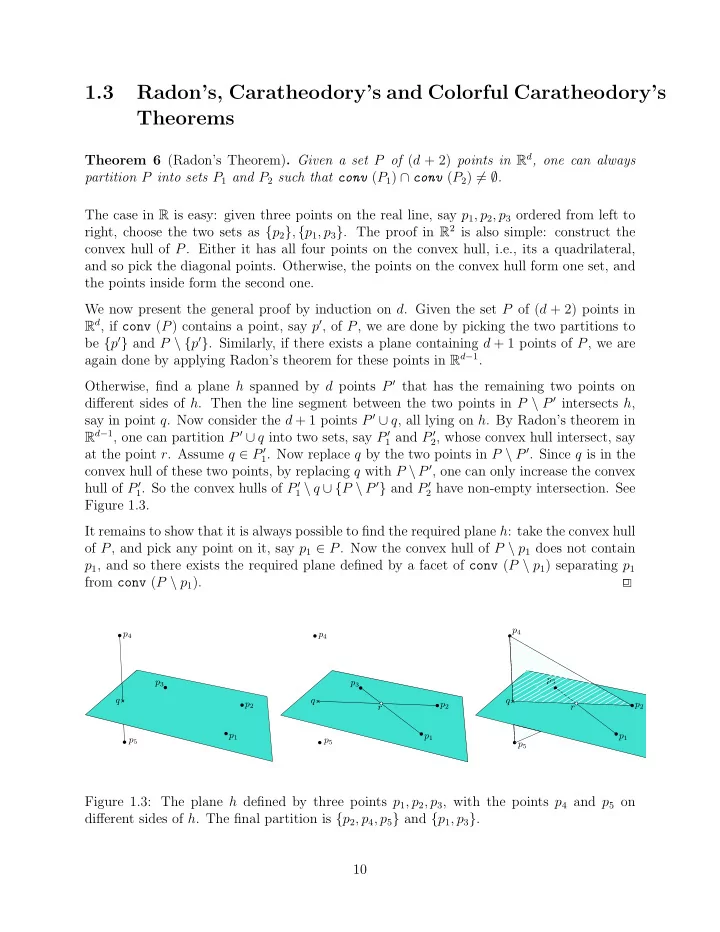
Theorem 6 (Radon’s Theorem). Given a set P of (d + 2) points in Rd, one can always partition P into sets P1 and P2 such that conv (P1) ∩ conv (P2) = ∅. The case in R is easy: given three points on the real line, say p1, p2, p3 ordered from left to right, choose the two sets as {p2}, {p1, p3}. The proof in R2 is also simple: construct the convex hull of P. Either it has all four points on the convex hull, i.e., its a quadrilateral, and so pick the diagonal points. Otherwise, the points on the convex hull form one set, and the points inside form the second one. We now present the general proof by induction on d. Given the set P of (d + 2) points in Rd, if conv (P) contains a point, say p′, of P, we are done by picking the two partitions to be {p′} and P \ {p′}. Similarly, if there exists a plane containing d + 1 points of P, we are again done by applying Radon’s theorem for these points in Rd−1. Otherwise, find a plane h spanned by d points P ′ that has the remaining two points on different sides of h. Then the line segment between the two points in P \ P ′ intersects h, say in point q. Now consider the d + 1 points P ′ ∪ q, all lying on h. By Radon’s theorem in Rd−1, one can partition P ′ ∪ q into two sets, say P ′
1 and P ′ 2, whose convex hull intersect, say
at the point r. Assume q ∈ P ′
- 1. Now replace q by the two points in P \ P ′. Since q is in the
convex hull of these two points, by replacing q with P \ P ′, one can only increase the convex hull of P ′
- 1. So the convex hulls of P ′
1 \ q ∪ {P \ P ′} and P ′ 2 have non-empty intersection. See
Figure 1.3. It remains to show that it is always possible to find the required plane h: take the convex hull
- f P, and pick any point on it, say p1 ∈ P. Now the convex hull of P \ p1 does not contain
p1, and so there exists the required plane defined by a facet of conv (P \ p1) separating p1 from conv (P \ p1).
p4 p5 p3 p2 p1 q p4 p5 p3 p2 p1 q p4 p5 p3 p2 p1 q r r