1. Consider the model in the section The first model . Suppose that - - PowerPoint PPT Presentation

1 consider the model in the section the first model
SMART_READER_LITE
LIVE PREVIEW

1. Consider the model in the section The first model . Suppose that - - PowerPoint PPT Presentation

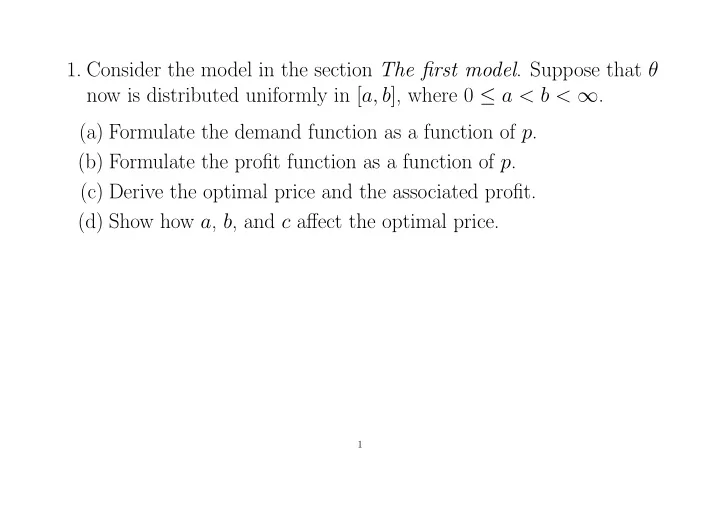
1. Consider the model in the section The first model . Suppose that now is distributed uniformly in [ a, b ], where 0 a < b < . (a) Formulate the demand function as a function of p . (b) Formulate the profit function as a function


slide-1
SLIDE 1
  • 1. Consider the model in the section The first model. Suppose that θ

now is distributed uniformly in [a, b], where 0 ≤ a < b < ∞. (a) Formulate the demand function as a function of p. (b) Formulate the profit function as a function of p. (c) Derive the optimal price and the associated profit. (d) Show how a, b, and c affect the optimal price.

1

slide-2
SLIDE 2
  • 2. Consider the model in the section Exogenous product quality. Sup-

pose that θ now is distributed uniformly in [a, b], where 0 ≤ a < b < ∞. (a) Formulate the demand function as a function of p. (b) Formulate the profit function as a function of p. (c) Derive the optimal price and the associated profit. (d) Show how a, b, c, and q affect the optimal price.

2

slide-3
SLIDE 3
  • 3. Consider the model in the section Exogenous product quality. Sup-

pose that θ now follows a continuous distribution characterized by the PDF f and CDF F. (a) Formulate the demand function as a function of p. (b) Formulate the profit function as a function of p. (c) Derive an optimality condition for an optimal price. (d) Prove that the optimal price increases in c and q or give a condi- tion under which this is true.

3

slide-4
SLIDE 4
  • 4. Consider the binary model in the section Endogenous product qual-
  • ity. Suppose that the product is an information good. While there

is no unit production cost, there is an R&D cost cq2

2 to reach the

product quality level q. (a) Formulate the two optimization problems for selling to all con- sumers or only the high-end consumers. (b) Solve the two optimization problems. (c) Give a condition under which serving all customers is better than serving only the high segment.

4

slide-5
SLIDE 5
  • 5. Consider the model in the section Exogenous product quality. Sup-

pose that now the product is a network good, and a consumer’s utility function of buying the product now becomes θq − p + tx, where x is the number of consumers buying the product and t is the degree of network externality. Assume that θ ∼ Uni(0, 1). (a) Formulate the demand function as a function of p. (b) Formulate the profit function as a function of p. (c) Derive the optimal price, if possible, or derive an optimality con- dition for an optimal price. (d) Show how c, q, and t affect the optimal price.

5