1 Contradictory observations in SLA 3 General predictions ! - - PowerPoint PPT Presentation

1 contradictory observations in sla 3 general predictions
SMART_READER_LITE
LIVE PREVIEW

1 Contradictory observations in SLA 3 General predictions ! - - PowerPoint PPT Presentation

The Overt Pronoun Constraint in L2 and L3 acquisition L1 L2 Cristbal Lozano University of Essex, England EUROSLA 11 [ ] [+F] Paderborn, Germany, September 2001 clozan@essex.ac.uk http://privatewww.essex.ac.uk/~clozan


slide-1
SLIDE 1

The Overt Pronoun Constraint in L2 and L3 acquisition

Doc: Durham PG conference presentation June 2001

page 1

Cristóbal Lozano University of Essex, England EUROSLA 11 Paderborn, Germany, September 2001 clozan@essex.ac.uk http://privatewww.essex.ac.uk/~clozan

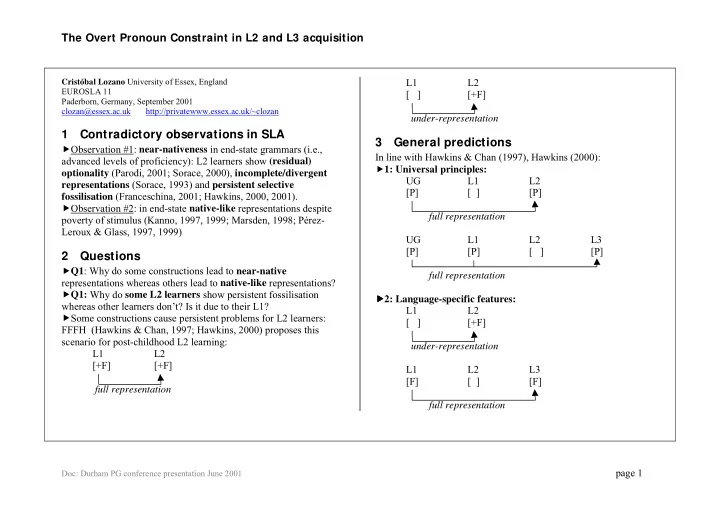
1 Contradictory observations in SLA

!Observation #1: near-nativeness in end-state grammars (i.e., advanced levels of proficiency): L2 learners show (residual)

  • ptionality (Parodi, 2001; Sorace, 2000), incomplete/divergent

representations (Sorace, 1993) and persistent selective fossilisation (Franceschina, 2001; Hawkins, 2000, 2001). !Observation #2: in end-state native-like representations despite poverty of stimulus (Kanno, 1997, 1999; Marsden, 1998; Pérez- Leroux & Glass, 1997, 1999)

2 Questions

!Q1: Why do some constructions lead to near-native representations whereas others lead to native-like representations? !Q1: Why do some L2 learners show persistent fossilisation whereas other learners don’t? Is it due to their L1? !Some constructions cause persistent problems for L2 learners: FFFH (Hawkins & Chan, 1997; Hawkins, 2000) proposes this scenario for post-childhood L2 learning: L1 L2 [+F] [+F] full representation L1 L2 [ ] [+F] under-representation

3 General predictions

In line with Hawkins & Chan (1997), Hawkins (2000): !1: Universal principles: UG L1 L2 [P] [ ] [P] full representation UG L1 L2 L3 [P] [P] [ ] [P] full representation ! ! ! !2: Language-specific features: L1 L2 [ ] [+F] under-representation L1 L2 L3 [F] [ ] [F] full representation

slide-2
SLIDE 2

The Overt Pronoun Constraint in L2 and L3 acquisition

Doc: Durham PG conference presentation June 2001

page 2

4 Distribution of overt/ null pronouns in Spanish

!Perlmutter (1971), then Chomsky (1981) and Rizzi (1997): [+pro-drop] languages

(1)

  • a. Yo voy al cine

(Spanish)

  • b. pro voy al cine

(2)

  • a. Ego pao sto sinema

(Greek)

  • b. pro pao sto sinema

BUT: [-pro-drop] languages

(3)

  • a. I go to the cinema

(English)

  • b. * pro go to the cinema

!Conclusion: overt and null pronouns seem to be in free alternation in Spanish and Greek languages…BUT is this really so?? !There are 2 constraints: (a) Universal principles: Overt Pronoun Constrain (OPC): !overt/null is determined by OPC. Since this is a universal principle, the computation and representation should be innate (i.e., common to all speakers). (b) Language-specific factors: Contrastive Focus Constraint (CFC): !overt/null is determined by discourse factors.

5 Overt Pronoun Constraint (OPC)

!Montalbetti (1984, 1986): Overt Pronoun Constrain (OPC): !Context: The government has published a report about students’ financial situation. The report concludes that... cada estudiantei dice que      

i i

pro él * tiene poco dinero each studenti says that      

i i

pro * he has little money !Facts: (i) OPC applies cross-linguistically and is claimed to be a universal invariant (see Kanno, 1997; Montalbetti, 1986). (ii) Poverty of stimulus: OPC constructions are about what cannot be said. (iii) L2 learners show sensitivity to OPC even though it is not instantiated in their L1s (e.g., Al-Kasey & Perez- Leroux, 1998; Perez-Leroux & Glass, 1997, 19999 for L1 Spanish; Kanno, 1997, 1998, Marsden, 1998, 2001 for L2 English) !Prediction: L2/L3 learners will show sensitivity to OPC due to its universal nature, despite their L1s.

6 Contrastive Focus Constraint (CFC)

!Context: Mr Lópezj and Ms Garcíak work at the university and at a famous publishers. However... cada estudiantei dice que      

j j

pro * él tiene poco dinero. each studenti says that      

j j

pro * he has little money !Facts: (i) the feature specification [+masc]/[-masc] of pro is language-specific.

slide-3
SLIDE 3

The Overt Pronoun Constraint in L2 and L3 acquisition

Doc: Durham PG conference presentation June 2001

page 3 (ii) pro in Spanish (3rd sing) is either [+masc] or [-masc], but not [±masc] due to ambiguity. (iii) L2 learners show PSS if a feature of the L2 is not instantiated in the L1 (Franceschina, 2001; Hawkins & Chan, 1997; Hawkins, 2000; Liszka, 2000). !Prediction: (i) if the category pro exists in the learners’ L1 and is also specified for [+masc]/[-masc], then they will be aware that pro cannot be [±masc] in their L2/L3 in CFC contexts. (ii) if the category pro doesn’t exist in the learners’ L1, then they may specify it for [±masc], which will cause ambiguity in CFC contexts.

7 Subjects

Control Spanish natives (n=9) L1 Spanish

  • Exp. 1

English natives (n=19) L1 English L2 Spanish

  • Exp. 2

Greek natives (n=20) L1 Greek L2 English L3 Spanish !Learners: all advanced level; two standardised placement tests:

  • ne in Spanish (University of Wisconsin, 1998), another in English

(Allan, 1992) for the Greek natives. !Their proficiency level was ! ! ! !80% in Spanish (and also !80% in English for the Greek natives). !Subjects who had a language configuration different from above were discarded.

8 Specific predictions

!1: Universal principles: OPC UG L1 English L2 Spanish [OPC] [ ] [OPC] full representation UG L1 Greek L2English L3 Spanish [OPC] [OPC] [ ] [OPC] full representation !IF both groups behave similarly, then UG (and not L1) is the privileged source of transfer in L3. ! ! ! !2: Language-specific features: CFC L1 English L2 Spanish       + [-masc] masc] [ pro       + [-masc] masc] [ pro under-representation

slide-4
SLIDE 4

The Overt Pronoun Constraint in L2 and L3 acquisition

Doc: Durham PG conference presentation June 2001

page 4 L1 Greek L2 English L3 Spanish       + [-masc] masc] [ pro       + [-masc] masc] [ pro       + [-masc] masc] [ pro full-representation !Note: even though [+masc] or [-masc] features in English can be present in some categories, they are certainly not present in pro since English does not allow pro.

9 Method

!Acceptability judgement test, 4 conditions: !TARGET STIMULI: !6 OPC stimuli !6 CFC stimuli !DISTRACTOR STIMULI: !6 other pronominal stimuli !6 other pronominal stimuli 1! ! ! !Overt Pronoun Constraint (OPC):

The government has published a report about students’ financial situation. The report concludes that... (a) cada estudiante dice que él tiene poco dinero. –2 –1 0 + 1 + 2 (b) cada estudiante dice que tiene poco dinero. –2 –1 0 + 1 + 2

2! ! ! !Contrastive Focus constraint (CFC):

Mr López and Ms García work at the university and at a famous publishers. However… (a) cada estudiante dice que él tiene poco dinero. –2 –1 0 + 1 + 2 (b) cada estudiante dice que tiene poco dinero. –2 –1 0 + 1 + 2

!2 different versions of the same test: version 1, version 2. Order

  • f presentation of items varies in each version to avoid

presentational effects. !Sentences were randomised (following Cowart’s 1997 ‘blocking’ procedure) in each version of the test. !Vocabulary was controlled (vocabulary for beginners). !Sentence length was controlled.

10 Results

!Normal distribution: our samples follow the Normal distribution (one-sample Kolmogorov Smirnov test, p!0.05 for each group in each condition).

! ! ! !SEE NEXT PAGE

slide-5
SLIDE 5

The Overt Pronoun Constraint in L2 and L3 acquisition

Doc: Durham PG conference presentation June 2001

page 5

1.OPC results : acceptance rates of overt/null pronouns

9 20 19 9 20 19 N =

Group

Spanish Greek English

95% CI

2 1

  • 1
  • 2

*[QDPi...OVERTi] [QDPi...NULLi]

!Within group: paired samples t-test: each pair (grammatical vs ungrammatical condition) is statistically significant for each group (p<0.05) !Between groups: (1-way ANOVA, post-hoc comparison Tukey HSD) !Grammatical [QDPi … NULLi] !no difference between groups (p>0.05) !Ungrammatical *[QDPi … OVERTi] ! no difference between groups: English = Spanish (p=0.169) Greek = Spanish (p=0.942)

  • 2. CFC results: acceptance rates of overt/null pronouns

9 20 19 9 20 19 N =

Group

Spanish Greek English

95% CI

2 1

  • 1
  • 2

[QDPi...OVERTj] ![QDPi...NULLj]

!Within group: paired samples t-test: each pair (grammatical vs ungrammatical condition) is statistically significant for each group (p<0.05) !Between groups: (1-way ANOVA, post-hoc comparison Tukey HSD) !Grammatical [QDPi … OVERTj] !no difference between groups (p>0.05) !Ungrammatical *[QDPi … NULLj] ! between groups: English ≠ Spanish (p=0.025) Greek = Spanish (p=1.000)

slide-6
SLIDE 6

The Overt Pronoun Constraint in L2 and L3 acquisition

Doc: Durham PG conference presentation June 2001

page 6

11 Conclusion

!Have the original questions been answered? !Q1: How to explain PSS at end-states? It can be explained with a feature-based model of SLA. !Q2: Why do some learners show PSS whereas others don’t? Due to L1, especifically: due to a mismatch of feature instantiation in L1 and L2/L3. !Q3: Is PSS due to a computational or representational deficit? Results suggest a representational deficit: English natives specify pro for [±masc] simultaneously when it should be specified for [+masc]/[-masc]. In the OPC cases, the computational mechanism is similar for all groups. !Overall: L1 seems to be the key to representational deficits. !OPC conclusion: L2/L3 learners show knowledge of OPC, at least in end-states. The OPC universality does NOT cause PSS. !CFC conclusion: L1 feature specification of pro causes PSS for English natives (not for Greek natives) due to its language- specificity. !***insert representation trees about here***

12 References

Allan, D. (1992): Oxford Placement Test. Oxford: OUP. Chomsky, N. (1981): Lectures on Government and Binding. Dordrecht: Foris. Chomsky, N. (1995). The Minimalist Program. Cambridge, Mass.: MIT Press. Cowart, W. (1997). Experimental Syntax: Applying Objective Methods to Sentence Judgments. Thousan Oaks, CA.: SAGE. Dewaele, J.-M. (1998). Lexical inventions: French interlanguage as L2 versus L3. Applied Linguistics, 19(4): 471-490. Franceschina, F. (2001). Morphological or syntactic deficit in near-native speakers? An assessment of some current proposals. Second Language Research, 17(3):213-147. Hawkins, R. (2000). Persistent selective fossilisation in second language acquisition and the optimal design of the language faculty. Essex Research Reports in Linguistics, 34:75-90. Hawkins, R. (2001). Linguistic explanations of fossilization in second language acquisition and the critical period hypothesis. Paper presented at the International Conference on Greek Linguistics, University of Thessaloniki (May). Hawkins, R. and Chan (1997). The partial availability of Universal Grammar in second language acquisition: the ‘failed functional features hypothesis’. Second Language Research, 13:187-226. Kanno, K. (1997). The acquisition of null and overt pronominals in Japanese by English speakers. Second Language Research, 13(3):265-287. Kanno, K. (1998). Consistency and variation in second language acquisition. Second Language Research, 14(4):376-388. Marsden, H. (1998). A study of L1 influence in the L2 acquisition of Japanese with respect to a ‘poverty of the stimulus’ phenomenon. Unpublished MA dissertation. University of Durham. Marsden, H. (2001). L1 transfer and UG in the L2 acquisition of Japanese. Paper presented at the Fourth Durham Postgraduate Conference in Theoretical and Applied Linguistics. Montalbetti, M. (1984). After binding. PhD dissertation, MIT. Montalbetti, M. (1986). How pro is it? In O. Jaeggli and C. Silva-Corvalán (eds). Studies in Romance

  • linguistics. Dordrecht: Foris. pp. 137-152.

Parodi, T. (2001). Optionality in developing grammars: clitics in L2 acquisition. Paper presented at the Department of Linguistics Seminar (June), University of Essex. Pérez-Leroux, A. T. and Glass, W. R. (1997). OPC effects on the L2 acquisition of Spanish, pp. 149-

  • 165. In A. T. Pérez-Leroux and W. R. Glass (Eds). Contemporary perspectives on the

acquisition of Spanish, volume 1: Developing grammars. Somervile, MA: Cascadilla Press. Pérez-Leroux, A. T. and Glass, W. R. (1999). Null anaphora in Spanish second language acquisition: probabilistic versus generative approaches. Second Language Research, 15(2): 220- 249. Perlmutter, D. (1971). Deep and surface structure constraints in syntax. New York: Holt, Rinehart and Winston. Rizzi, L. (1997). A parametric approach to comparative syntax. In L. Haegemand (ed). The New Comparative Syntax. London: Longman. Singleton, D. (1987). Mother and other tongue influence on learner French. Studies in Second Language Acquisition, 9: 327-346. Sorace, A. (1993). Incomplete vs. divergent representations of unaccusativity in non-native grammars

  • f Italian. Second Language Research, 9(1):22-47.

Sorace, A. (2000). Syntactic optionality in non-native grammars. Second Language Research, 16 (2): 93-102. University of Wisconsin (1998). The University of Wisconsin College-level Placement Tests (Form 96M). Madison, Wisconsin: University of Wisconsin Press.