SLIDE 1 “Urban Job Creation and Unemployment in LDCs” - Handout Group 8: Ye Chuen, Manuel Ludwig-Dehm, Yin Xiao, Zulma Barrail
2011
1
In his paper, Blomqvist considers two seminal papers on urban job creation and unemployment in LDCs,
- ne by Todaro (1969) and one by Harris and Todaro (1970), in the following for convenience referred to
as HT. While both of these papers were motivated by the curious economic phenomenon of sustained rural-urban migration in LDCs - despite significant levels of urban unemployment and positive marginal products in agriculture - Blomqvist synthesis is motivated by the apparent incoherence between the above mentioned papers and their results. While Todaro coined the notion of the “Todaro paradox”, which basically states that urban job creation in LDCs will lead to increased unemployment and is thus not a recommended policy, and claimed to observed it empirically [Todaro (1976)], HT find a payroll subsidy to be welfare improving even in the case of positive urban unemployment. In his analysis the author reveals that the different results stem from the different views of the authors regarding the interplay between migration and the urban labor market, and only to a much lesser extend from the emphasis on the short- and long-run effects, respectively. He thus suggests a new framework that combines the two models by taking into account the speed of reaction of migration, which is inherently different in Todaro’s and in the HT model. Furthermore, he explicitly models the turnover rate in existing jobs as this is the second main difference between the models examined.
- 2. Todaro vs. Harris and Todaro
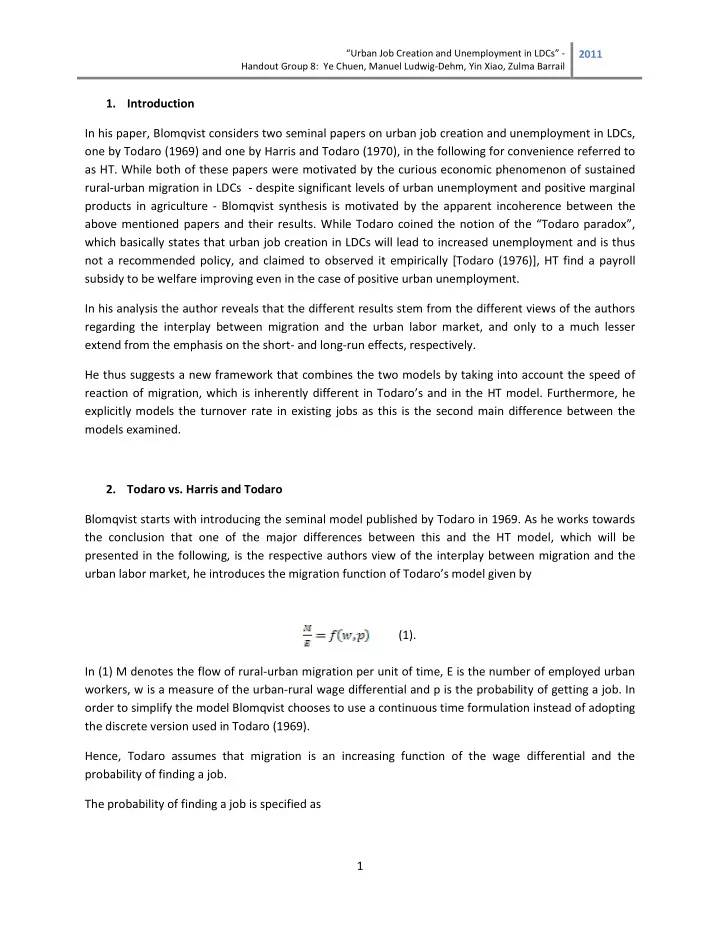
Blomqvist starts with introducing the seminal model published by Todaro in 1969. As he works towards the conclusion that one of the major differences between this and the HT model, which will be presented in the following, is the respective authors view of the interplay between migration and the urban labor market, he introduces the migration function of Todaro’s model given by (1). In (1) M denotes the flow of rural-urban migration per unit of time, E is the number of employed urban workers, w is a measure of the urban-rural wage differential and p is the probability of getting a job. In
- rder to simplify the model Blomqvist chooses to use a continuous time formulation instead of adopting
the discrete version used in Todaro (1969). Hence, Todaro assumes that migration is an increasing function of the wage differential and the probability of finding a job. The probability of finding a job is specified as
SLIDE 2
“Urban Job Creation and Unemployment in LDCs” - Handout Group 8: Ye Chuen, Manuel Ludwig-Dehm, Yin Xiao, Zulma Barrail
2011
2 (2), where U denotes the number of unemployed urban workers and is the proportional rate of growth in the number of urban jobs. Thus, strictly speaking, p is not the probability of finding a job, as it depends on the unit of time in which it is measured and thus can exceed unity. Blomqvist states that 1/p intuitively can be interpreted as the expected duration of unemployment for an immigrant arriving in the city, when assuming that everyone has the same chance of being picked for a job. Hence he assumes that workers are homogenous. Blomqvist subsequently introduces the model published by Harris and Todaro (1970) and contrast its assumption with those of the above introduced Todaro model. Harris-Todaro (1970) describe a two sector model of rural-urban migration which recognizes the existence of a politically determined minimum urban wage at levels substantially higher than agricultural earnings. The ‘’permanent’’ urban sector produces manufactured goods which partially are exported to the rural sector in exchange of agricultural goods. The rural sector has a choice of either use all available labor to produce an agricultural good (some of which is exported to the urban sector), or using only part of its labor to produce this good while exporting remaining labor to the urban sector. Furthermore the HT model considers that both sectors are perfectly competitive. Farmers in the rural sector maximize their profits and earn their marginal product, being restricted by a fix aggregate amount of land, and firms in the urban manufacturing sector do so with a fixed amount of capital. This implies that both sectors set the real wage according to the marginal productivity of labor, but in the urban case, the real wage is constrained to be equal to the institutionally (thus exogenously) fixed minimum urban wage. Though not of immediate importance at this point it is necessary to keep in mind that both the manufacturing as well as the agricultural sector are assumed to exhibit positive but decreasing marginal productivity with respect to labor. The hypothesis of this model is that migration to the urban area is a positive function of the urban-rural expected wage differential. A crucial assumption for individual rational behavior is that rural-urban migration will continue so long as the expected urban real income at equals the real agricultural marginal product. Thus, migration will cease only when the expected income differential is zero. This implies a hidden assumption as well: Individuals , since prospective migrants are indifferent between earning a given agricultural wage and earning an expected wage at the city, are risk neutral. These prospective rural migrants behave as maximizers of the expected utility. In other words, in equilibrium
SLIDE 3 “Urban Job Creation and Unemployment in LDCs” - Handout Group 8: Ye Chuen, Manuel Ludwig-Dehm, Yin Xiao, Zulma Barrail
2011
3 (4) Wage in agriculture. ‘’institutionally fixed’’ wage in manufacturing. : Measure of the probability that a randomly selected member of the urban labour force will be holding a job. The HT model additionally assumes that there is a random job selection process from the combined pool of urban workers (consisted by permanent urban workers without ties to the rural sector and available supply of rural migrants), in other words, they assume all workers to be homogeneous, thus having equal chances to be picked for a job. Furthermore, the authors justify the use of this measure of the probability by assuming that all urban jobs are reallocated between workers from the given combined pool at each instant of time. One can interpret this as if in each instant of time all urban workers that had been holding a job were fired or quitted their job. The industrial sector needs to hire new ones, which are then randomly drawn from the whole available labor force. This implies a variety
- f equivalent observations:
1) b (turnover rate) is infinitely large 2) The Todaro measure of the probability of getting a job would go to infinity. 3) The expected duration of unemployment used in Todaro, (1/p), would go to zero. 4) The expression measures the fraction of time any urban job seeker would be holding a job.Whereas Todaro’s analysis is focused on how the expected length of unemployment influences the flow of migration, the HT model states that this measure of p (presented above) plays an equilibrating role in their analysis of labor allocation. The authors prove that due to the imposition of a high minimum wage in the urban sector, equilibrium is
- nly achievable with unemployment and hence, loss of potential output of both goods. Therefore, a
policy instrument is needed to correct this market failure (wage level). However, one single market failure won’t be corrected as usual with a single policy instrument. This is because H-T model is based on the idea that urban wage wouldn’t only set the level of employment in the manufacturing sector but also it would determine the allocation between rural and urban areas. Even though a subsidy would change the urban employment level, it wouldn’t change the minimum wage perceived by the worker, so migration would still continue when the agricultural earnings are less than the expected urban wage and unemployment would still exist. On the other hand, restriction of migration prevents the minimum wage to have its effect on unemployment but does nothing to increase the level of industrial employment.
SLIDE 4 “Urban Job Creation and Unemployment in LDCs” - Handout Group 8: Ye Chuen, Manuel Ludwig-Dehm, Yin Xiao, Zulma Barrail
2011
4 Therefore, a combination of both instruments will have to be used. In the HT paper, their analysis of the resource allocation of labor effects of migration is based on the assumption that (4) always holds. This implies that the speed with which the stock of labour is reallocated, following some parameter change, is sufficiently great so that a comparison between situations of full stock equilibrium yields a sufficiently good approximation of these effects.
In this part, Blomqvist modifies the original Todaro model and tests whether the Todaro paradox still holds. In Todaro’s original model unemployed people can only get a job because new jobs are created, which is unrealistic as it ignores the possibility of getting a job due to turnover in existing ones. Hence, Blomqvist modifies the model and introduces the turnover rate b, which means that unemployed people can get employed not only because new jobs are created, but also because there are vacancies (such as firings and quits) in existing jobs. A natural generalization of “probability of getting a job” is thus (3) Clearly, if the number of available jobs exceeds the number of unemployed people, then p exceeds 1. So p cannot be used as a probability. As in the original, not augmented model, this model sets as a measure of the expected duration of unemployment for an immigrant arriving in the city; this clearly is a relevant variable in the migration decision. Then, π is postulated as the critical value for : Only if the probability is larger than the critical value π people start to migrate. If =π, then the flow of migration is
- zero. π is a decreasing function of the wage differential w, and it depends on the turnover rate b.
Intuitively the existence of such critical value seems to reflect reality, as it assumes a kinked migration function that is zero for low values of p. This low, critical value depends on the rural-urban wage differential, which seems plausible as well, as the prospect of a very high paid job will make people migrating to a city even if the chance of getting such job is very low. In a different context the decision
- f young soccer players in Europe, that forego the chance of getting a high school degree and higher
education and instead devote their time training given the prospect of the (very small) chance of becoming a high paid professional soccer player, might illustrate the underlying phenomenon. Thus the condition for zero migration can be written as (5)
SLIDE 5 “Urban Job Creation and Unemployment in LDCs” - Handout Group 8: Ye Chuen, Manuel Ludwig-Dehm, Yin Xiao, Zulma Barrail
2011
5 where M is the flow rate of migration at a point in time. This expression can be rewritten to obtain , which is correspondingly the critical number of unemployment when takes the critical value , where . Todaro’s analysis is taken as based on the implicit assumption that the speed with which the economy adjusts to full stock equilibrium is so slow that the policy maker can always have time to formulate policies by simply looking at the migration flow; HT’s analysis is taken on the basis that the speed of people reaction is so fast that the policy maker doesn’t have time to make important policies, so HT’s model only examines the case when M=0. Hence, the two models only deal with the extreme cases. Then Blomqvist combines these two models above by introducing a speed factor λ to control the different speed with which the economy adjusts to the stock-flow, shown below: (6) Or, (7) The linearity assumption here means the change in the migration does not depend on the level of the parameters on the RHS of (7). Now consider a point in time, (8) Hence, the change in unemployment corresponds to the excess migration over newly created jobs. Then we have, (9) Equation (9) can be used to study both the short-run and long-run effects of various parameter changes
- n migration and unemployment.
The notion of short-run effect is that given the values of the different parameters, and given the unemployment rate at a point of time, this expression may be used to study the impact of parameter changes on . The notion of long-run effect is that if time goes to infinity, the unemployment rate will converge to an equilibrium value . The mathematical prove is in the appendix.
SLIDE 6 “Urban Job Creation and Unemployment in LDCs” - Handout Group 8: Ye Chuen, Manuel Ludwig-Dehm, Yin Xiao, Zulma Barrail
2011
6 (10) The condition for this equilibrium is , and the proof is shown below: Now consider the short-run and long-run effects on unemployment of a change in the rate of job creation g. Differentiating (9) with respect to g, we have, (11) This result is positive if and only if . Hence, the conclusion whether an increase in the rate of job creation leads to an increase in the rate of growth of unemployment depends on the speed of the reaction of immigrants and the critical value of the probability of finding a job. The higher π, the lower alpha, and the lower the probability that an increase in g leads to an increase in the growth rate of
- unemployment. This is intuitive, as a high threshold π requires a large change in g to induce people to
leave their secure income in the rural areas and mive to the cities. The same holds for the speed of the reaction prospective immigrant. To find the long-run effect of job creation on unemployment, we differentiate (10) with respect to g. The result is : (12) Consider the case that b=0, as Todaro assumes. Then the condition for job creation to cause a long-run increase in its rate of unemployment is , which is the same as the condition for a short-run increase in its rate of change. So Blomqvist concludes that Todaro’s discussion of the difference
SLIDE 7 “Urban Job Creation and Unemployment in LDCs” - Handout Group 8: Ye Chuen, Manuel Ludwig-Dehm, Yin Xiao, Zulma Barrail
2011
7 between the short-run and long-run effects is misleading, as it depends on empirical values of the speed
- f reaction and the threshold probability whether the Todaro paradox holds or not.
Consider the case that b>0, which means that now the vacancies in existing jobs are considered, as in the HT model. In this case it is possible that the result of equation (12) is negative while the result of equation (11) is positive. Then the Todaro paradox does not hold in this situation. This possibility depends on the magnitude of b relative to λ and α. Now turn on the effect of changes in the rural-urban wage differential, it is easy to show that an increase in wage differential will have a positive impact both in the short-run and on the long-run. According to this result, if the governments do nothing to change the high wage differential between the rural and urban, this high wage differential will always induce more and more immigrants to the city, then the unemployment problem in city will become even severe. So the policy maker should make certain policies to develop the rural area to make the wage differential smaller. To exam the cross-effect on the impact of job creation on unemployment, we have: Since the result is always positive in short-run, then we can conclude that an increase in the wage differential will increase the effect of the rate of new job created (g) on the rate of growth of unemployment in the short-run. This expression is greater than zero whenever λ>b. If λ>b, increasing the wage differential will increase the effect of the rate of new job created (g) on the unemployment rate in the long-run. This touches
- n the widely used assumption that the elasticity of migration w.r.t. p is constant. By examining the
cross partials Blomqvist shows that this is not the case and and existing estimates of empirical elasticities should be questioned, as depending on the magnitude of the wage differential, people react differently to a an increase in the rate of job creation.
SLIDE 8 “Urban Job Creation and Unemployment in LDCs” - Handout Group 8: Ye Chuen, Manuel Ludwig-Dehm, Yin Xiao, Zulma Barrail
2011
8
- 4. Empirical migration functions, the Todaro paradox and the effects of employment subsidies
- a. Elasticity of the rural-urban migration rate with respect to urban employment
probabilities To evaluate the unemployment effect of job creation, it is necessary to analyze how people react to urban job creation, such as how fast they react, and how many rural workers migrate to cities. The migration speed , which indicates how fast they react, can be associated with the fraction of the gap between the equilibrium number of unemployed job searchers and the actual number that is closed by migration per unit time, while the latter factor, magnitude of migration based on per unit newly created job, can be considered as the , elasticity of the rural-urban migration flow with respect to the ‘probability’ of finding a job p , where p is the probability. Notice that Todaro and Blomqvist have different definitions of p . While p in Todaro’s model is
gE p U
by ignoring the turnover rate b , Blomqvist includes b into the probability p . As a result, Blomqvist’s probability derives from the expression that 8. Now we can consider derivation of elasticity . In Todaro’s 1976a paper, is defined as
dM M dp p
where m is the rate of rural-urban migration. However, through Todaro’s(1976a) it is proved that a simply expression holds, which is
dp dg p g
Hence we always have the expression holding as
dM dM M M dp dg p g
.
- b. Sufficient Conditions for Todaro’s paradox
If the Todaro’s paradox holds, it must satisfy that both level of unemployment and rate of unemployment move up simultaneously. Therefore, there are two constraints for Todaro’s paradox:
SLIDE 9 “Urban Job Creation and Unemployment in LDCs” - Handout Group 8: Ye Chuen, Manuel Ludwig-Dehm, Yin Xiao, Zulma Barrail
2011
9
* l
gE M
(15) and
*
( )
r
g E U M
(16) . Equation (15) refers to the paradox that job creation leads increment of level of unemployment, while (16) indicates that the job creation induces increment of rate of unemployment in rural area. The critical values of elasticity,
* l
and
* r
could be considered as thresholds for which Todaro’s paradox holds if
actual elasticity must be greater than these thresholds. Notice that we always have
* * r l
. Intuitively, elasticity presents magnitude of migration with respect to change in rate of job creation. Therefore the left-hand side of (15) is actually dM dg while the right-hand side is ( )
d E dg . Due to
U
M E
(8) we have (15)
( ) d E dM dg dg
dU dg
.
( ) d E dM dg dg
means that increment of migration magnitude is greater than the increment of employment, with respect to increasing job creation. On the other hand, whenever one job is created, more than one people are added to the set of unemployment in urban area, which is part of Todaro’s paradox. Since equation (16) has similar meaning with (15) except level of unemployment is included into the critical elasticity for consideration of “rate” instead of absolute number of unemployment, conclusion similar with above analysis can be drawn from (16).
- c. Criticism of Todaro’s model
Restriction 1): Small Changes in g Firstly recall that if level of unemployment moves up by job creation, elasticity must satisfy that
* l
gE M
(15) In Todaro’s study it can be shown that all developing countries he studied have the critical elasticity
* l
smaller than one, i.e. M
gE
, which is the sufficient condition for Todaro’s paradox. Also notice that all estimation of actual elasticity provided by Todaro satisfies that
1 . According
to the definition of elasticity, the increment of migration M is always less than in proportion to g
SLIDE 10 “Urban Job Creation and Unemployment in LDCs” - Handout Group 8: Ye Chuen, Manuel Ludwig-Dehm, Yin Xiao, Zulma Barrail
2011
10 whenever g moves up. In the same situation, M increases less than proportion of gE as well. If g is small, it is not a problem since we may still have M
gE
. But gE can exceeds M if g is large, due to the fact that g grows “faster” than M , in which situation the Todaro’s paradox does not hold any
- longer. Hence it is proved that Todaro’s paradox is restricted to the condition that g , rate of job
creation, should be relatively small. Restriction 2): Short-run Effect Although Todaro did not explicitly mention whether his migration model effected both short-run and long-run period, Blomqvist states that actually the unemployment might be improved via job creation in a long period, which reverses Todaro’s paradox. Firstly consider a short term period, in which two threshold values for elasticity is
* 1 l
and
* 1 r
,
- respectively. Then, in the second period following the first one, thresholds for elasticity become
* 2 l
and
* 2 r
. Todaro’s paradox requires
* * r l
Where is the actual elasticity of migration with respect to probabilities of find a job in city. From the very beginning to the end of each period, all parameters in the right-hand sides of equation (15) and (16), including M , g , E and U , move up according to Todaro’s paradox. However, numerator in
* r
is greater than
* l
, and
* r
should move up “faster” than
* l
. Consider series of
consecutive short periods, there exists a period at the end of which
* r
is so large that we have
* * r l
. Continuing this process there should be another period in future at the end of which we have
* * r l
since both
* l
and
* r
become larger and larger as time goes by.
If Todaro insists his paradox, analysis on migration should be restricted in a finite time period so that neither
* l
nor
* r
exceeds actual elasticity . When either
* l
or
* r
, or both of them exceeds in
long-run period, there can be reversed effect of Todaro’s paradox if we fix other parameters. Restriction 3): Turnover Rate
b
The most important argument Blomqvist made on Todaro’s paradox is that Todaro ignored turnover rate b implicitly. Let superscript denote all parameters defined by Todaro, and denote parameters defined by
- Blomqvist. Therefore, we can restate some of the parameters:
gE p U
( ) ( ) g b E g b p p U g
If look at how probability p changes by setting other variables constant but only vary g , we have
SLIDE 11 “Urban Job Creation and Unemployment in LDCs” - Handout Group 8: Ye Chuen, Manuel Ludwig-Dehm, Yin Xiao, Zulma Barrail
2011
11
dp dp E dg dg U
According to the definition of elasticity,
dM M dp p
, it is obviously that
dM p M dp dM p g M dp g b g g b
Todaro’s paradox requires
* * r l
. But must be replaced by
g g b
if turnover rate is positive, i.e.
b
. That is the proof for question 8 provided by Professor Charles Becker. Blomqvist’s elasticity , which comprehensively considers b , is strictly less than Todaro’s elasticity . If is used it is more difficult to reach Todaro’s paradox because the paradox only provides the lower bound for elasticity while is easy to be lower than two critical thresholds of elasticity
* l
and
* r
in this situation. Restriction 4): Underestimation of Actual Elasticity From restriction 3) it is already shown that Todaro understated the actual elasticity with a proportion factor
g g b
. Unfortunately, actual elasticity was further underestimated by Torado if a more sophisticated model is applied. Not only turnover rate b , but also speed that reflects how fast migrants react to job creation, and equilibrium is not considered in Todaro’s empirical test. Following Blomqvist’s new model, probability
p is defined as ( ) g b E p U
(3) While relationship between amount of migration M and speed factor is expressed as
(6) 1 (17) M g b E U pU U U p
As a result,
dM U dp
Hence,
SLIDE 12
“Urban Job Creation and Unemployment in LDCs” - Handout Group 8: Ye Chuen, Manuel Ludwig-Dehm, Yin Xiao, Zulma Barrail
2011
12
( ) ( ) dM p dp M g b E U UM g b E M
(18) Plug (17) into (18), we can get the second half of equation (18)
1 p p
(18) Whenever
1 p
, i.e.
M
, the elasticity satisfies
1 . Comparing actual elasticity values
estimated by Todaro, which are always less than unit, one can argue that Todaro did underestimate the actual elasticity by using his model, although this new estimated value tends to support conclusions from Todaro’s paradox. Blomqvist then moves on to examine the robustness of the conclusion that can be drawn from the HT model. In their paper HT focus on the effect of job creation on real income and the underlying welfare implications - in a steady state with zero migration. The question thus is whether the new model has implications for these central issues of the HT paper and whether the two authors’ results still hold. The central conclusion drawn in the HT paper is that a payroll subsidy increases aggregate income and improves welfare. To see why, keep in mind the assumption of diminishing but positive marginal productivity in agriculture, illustrated by a concave production function with a fixed amount of land available, and consider the equilibrium condition, equation (4). From this can be seen that in a state without payroll subsidy firms pay employees the fixed minimum wage and hire workers until the wage equals their marginal productivity, due to the competitiveness assumption that holds for both sectors. A payroll subsidy for firms reduces the labor cost. The wage received by workers is fixed and thus stays the same, but it is now paid by the firm and the state. To illustrate this consider , the wage which is received by workers employed in manufacturing. Unlike as in a state without subsidy, the part of the wage incurred by the firm under the assumption of a payroll subsidy from the state is now , where denotes the new wage that is paid by firms, and s the payroll subsidy. As it is clear from this equation, firms pay less with a subsidy and thus will hire more workers which leads to a decrease in the marginal productivity in manufacturing up to the point when it equals the
SLIDE 13 “Urban Job Creation and Unemployment in LDCs” - Handout Group 8: Ye Chuen, Manuel Ludwig-Dehm, Yin Xiao, Zulma Barrail
2011
13 firms’ cost of labor, . As a reaction to this increase in employment, which can be understood as increasing , people will migrate from rural to urban areas until their individual rationality condition holds again, i.e. (4), . While directly after the increase, the expected urban wage will be higher than the wage rate in agriculture, due to migration less people will be working in farming and the marginal productivity in farming will increase, until migration stops. This result stems from the assumption of decreasing but positive marginal productivity in agriculture. This is socially optimal as long as , where the RHS is obtained by rearranging (4), indicating the loss occurred in agriculture due to the migration of workers to the city in response to the creation of one new job.1 The left hand side is the gain in output in manufacturing due to the creation of one new job. When subsidies are set as such that the wage paid by firms equals the loss in agricultural production, such that , a social optimum is reached and welfare maximized. In Harris’ and Todaro’s words, up to this point “[…] aggregate welfare can be increased by expanding industrial employment through subsidy or public sector hiring.”2 One feature is especially noteworthy here. This is the observation that more than one person will migrate to the city in response to the creation of one new job, as . This result can be obtained from (4), as the minimum wage is higher than the wage from agriculture. Intuitively, the minimum wage
1 The proof of this optimality condition can be found in Appendix III (pp. 140-41) of the following paper:
Harris, John R. and Todaro, M. (1970), Migration, Unemployment and Development: A Two-Sector Analysis, in: The American Economic Review, Vol. 60, No. 1 (1970), pp. 126 – 142.
2 Harris/Todaro (1970), p. 134.
SLIDE 14 “Urban Job Creation and Unemployment in LDCs” - Handout Group 8: Ye Chuen, Manuel Ludwig-Dehm, Yin Xiao, Zulma Barrail
2011
14 per new job is essentially split between several workers as the assumed infinite turnover rate and unemployment lead to the result that a worker cannot expect to hold a job during the whole relevant time period, but only for a fraction of time, i.e. . Blomqvist makes the point that this conclusion entirely rests on the assumption of decreasing returns to labor in agriculture by comparing HT’s result to the case when the marginal product in the rural sector and thus is constant. In this case and without subsidy, creating one additional new job in manufacturing will lead to a gain in output and aggregate income of , while the loss in agricultural
- utput due to migration will be
. Thus, as the two expressions assemble (4), the net effect on aggregate output is zero. Hence, it follows that under the assumption of constant returns to labor in agriculture, which might be a quite realistic assumption in LDCs, a subsidy does not lead to an increase in welfare and it optimally should be zero. Furthermore it is noteworthy that even in the case of the existence of a welfare increasing subsidy, equilibrium unemployment is not zero. Thus, the market failure, i.e. the high wage due to the non competitive wage determination, and the resulting unemployment cannot be corrected by one policy
- instrument. The reason for this is that the urban wage has two functions. Firstly, it determines the level
- f unemployment in the industrial sector and secondly it determines the allocation of resources
between rural and urban areas, i.e. migration. Hence, only a twofold approach, i.e. a payroll subsidy with e.g. a physical restriction of migration is able to lead to a first-best solution. Blomqvist subsequently replicates the result of HT, i.e. a welfare increasing payroll subsidy, but under different assumptions than the ones used in the HT model. Namely, he relaxes the assumption of an infinite turnover rate, b. This relaxation has important implications, as under such circumstances the variance of income in the industrial sector is not zero anymore and the probability of finding a job, p, decreases from one to below one. Hence, new immigrants rationally expect an initial period of unemployment when moving to the city. Intuitively this change in assumption adds insecurity to the expected wage in the industrial sector. Immigrants are not longer sure they will earn the expected wage but rather take into the account a period of unemployment. Hence, one would expect that migration is zero at a expected wage in the industrial sector higher than the wage in agriculture, as individuals have to take into account additional insecurity. Thus, (19). Hence, when assuming that the economy is still in the state when , an increase in the number of jobs in manufacturing would, at least up to a certain level, not lead to migration and thus reduce urban unemployment and increasing aggregate income. This conclusion does not rest on the
SLIDE 15 “Urban Job Creation and Unemployment in LDCs” - Handout Group 8: Ye Chuen, Manuel Ludwig-Dehm, Yin Xiao, Zulma Barrail
2011
15 assumption of decreasing returns to labor in agriculture. Hence, Blomqvist successfully shows that when relaxing the strong assumption of a strictly concave agricultural production function of the original HT model, a payroll subsidy can still be welfare enhancing. However, this result is only strictly valid when there are no other divergences between social and private opportunity costs other than in the market for industrial labor. Blomqvist continues by pointing out that even though his model is able to synthesize the ones of Todaro and HT, it still lacks the possibility to analyze situations in which migration only gradually responds to employment opportunities and new jobs are generated continuously. It then occurs that migration and thus the loss in agricultural output from an increase in urban jobs does not only depend on the level of urban employment, E, but also on the rate of new job creation and turnover, i.e. g and b, or, put differently on the number of hirings per time. The evaluation of the welfare implications of the above proposed payroll subsidy does then require the use of a dynamic optimization model that examines the
- ptimal allocation of resources over time and derives the optimal subsidy by considering both the level
- f unemployment and the rate of hiring.
Already when only taking into account search costs for firms to find an appropriate employee, one might argue that a zero subsidy policy is optimal as long as unemployment in urban areas decreases search costs to a higher extend than it leads to a loss in agricultural output. In this case positive urban unemployment and a positive wage differential are compatible with a competitive labor market and might even be economically efficient. An oprimal solution could be formulated as well by using a comnined tax-subsidy policy, that includes a positive subsidy and a lump-sum tax for gross hiring, as this provides an incentive for firms to reduce the turnover rate, b, which in turn influences migration.