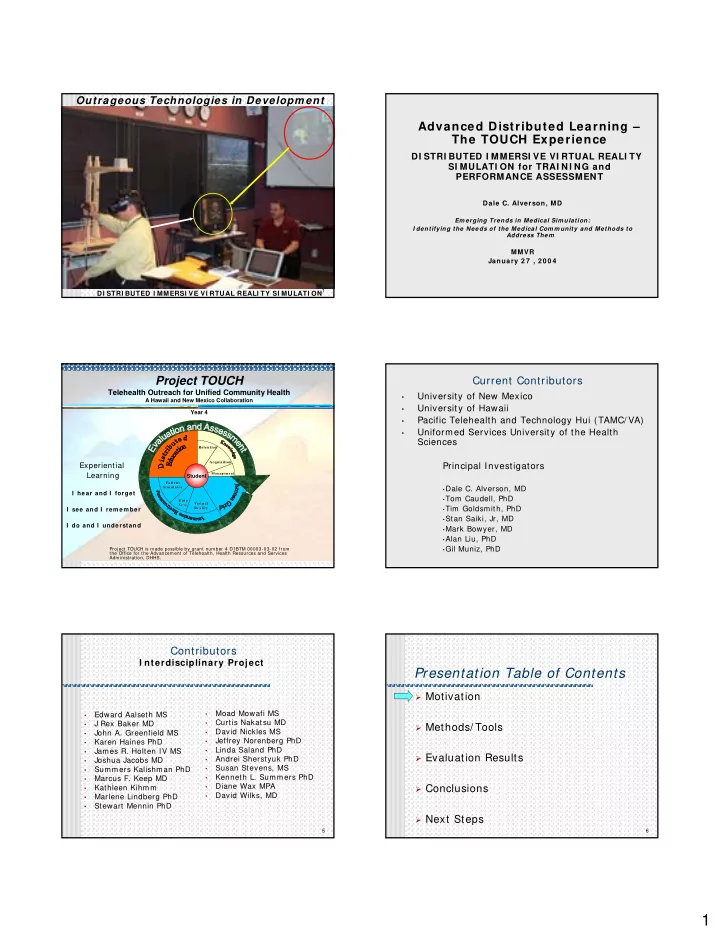
1 Motivation Motivation Errors in medicine (IOM reports) and need - - PDF document

1 motivation motivation
SMART_READER_LITE
LIVE PREVIEW

1 Motivation Motivation Errors in medicine (IOM reports) and need - - PDF document

Outrageous Technologies in Developm ent Advanced Distributed Learning The TOUCH Experience DI STRI BUTED I MMERSI VE VI RTUAL REALI TY SI MULATI ON for TRAI NI NG and PERFORMANCE ASSESSMENT Dale C. Alverson, MD Em erging Trends in Medical


slide-1
SLIDE 1

1

1

Outrageous Technologies in Developm ent

DI STRI BUTED I MMERSI VE VI RTUAL REALI TY SI MULATI ON

Advanced Distributed Learning – The TOUCH Experience

DI STRI BUTED I MMERSI VE VI RTUAL REALI TY SI MULATI ON for TRAI NI NG and PERFORMANCE ASSESSMENT

Dale C. Alverson, MD

Em erging Trends in Medical Sim ulation: I dentifying the Needs of the Medical Com m unity and Methods to Address Them

MMVR January 2 7 , 2 00 4

Project TOUCH

Telehealth Outreach for Unified Community Health

A Hawaii and New Mexico Collaboration Year 4

Retention Retention Patient Patient Sim ulator Sim ulator Managem en t Managem en t Acquisition Acquisition Virtual Virtual Reality Reality Data Data Sets Sets

Student

Project TOUCH is made possible by grant number 4 D1BTM 00003-03-02 from the Office for the Advancement of Telehealth, Health Resources and Services Administration, DHHS.

Experiential Learning

I hear and I forget I see and I rem em ber I do and I understand

Current Contributors

  • University of New Mexico
  • University of Hawaii
  • Pacific Telehealth and Technology Hui (TAMC/ VA)
  • Uniformed Services University of the Health

Sciences Principal Investigators

  • Dale C. Alverson, MD
  • Tom Caudell, PhD
  • Tim Goldsmith, PhD
  • Stan Saiki, Jr, MD
  • Mark Bowyer, MD
  • Alan Liu, PhD
  • Gil Muniz, PhD

5

Contributors

  • Edward Aalseth MS
  • J Rex Baker MD
  • John A. Greenfield MS
  • Karen Haines PhD
  • James R. Holten IV MS
  • Joshua Jacobs MD
  • Summers Kalishman PhD
  • Marcus F. Keep MD
  • Kathleen Kihmm
  • Marlene Lindberg PhD
  • Stewart Mennin PhD
  • Moad Mowafi MS
  • Curtis Nakatsu MD
  • David Nickles MS
  • Jeffrey Norenberg PhD
  • Linda Saland PhD
  • Andrei Sherstyuk PhD
  • Susan Stevens, MS
  • Kenneth L. Summers PhD
  • Diane Wax MPA
  • David Wilks, MD

I nterdisciplinary Project

6

Presentation Table of Contents

Motivation Methods/ Tools Evaluation Results Conclusions Next Steps

slide-2
SLIDE 2

2

7

Motivation

Errors in medicine (IOM reports) and need to improve

methods to train, assess competence and performance in

  • rder to decrease errors and improve patient safety

Each year m ore than 46 ,00 0 people die as a result of m edical errors. Medical sim ulation im proves patient safety by offering new w ays to “train and m aintain” skills.

Increased demand for simulation in lieu of using animals

  • r actual patients prior to further training

Responding to new approaches to how people learn by

creating interactive experiential training environments

8

Motivation

Creates environment for reification of abstract

concepts to improve human understanding

Opportunities to apply new methods in advanced

computing, visualization = “perceptualization” and advanced communication networks

Complements other methods of simulation

training such as standardized patients and robotic simulators

Allows interaction and collaborative learning and

training independent of distance (ADL)

9

Presentation Table of Contents

Motivation Methods/ Tools Evaluation Results Conclusions Next Steps

Flight Simulation Metaphor

Based on the concept of a distributable flight simulator in which individual trainees and instructors can work together virtually despite physical separation at different locations

11

Rules-based Artificial Intelligence

  • Simulations are driven by rules-

based artificial intelligence that are founded in principles of knowledge- based design to meet specific training/ learning goals, objectives and requirements

12

Artificial Intelligence

The simulation A. I. engine dynamically governs changes in physiology, physical findings, movement and events, as well as responses to the user

slide-3
SLIDE 3

3

13

Tool: Flatland

Perceptualization and Virtual

Environments development tool

Developed at ECE & HPC, UNM IRIX/ Linux/ Unix/ MacOSX/ Windows* Open source core

* Ported to Windows in conjunction with NCA SimCenter at USUHS

14

Typical rules

/* Bleeding rules *****************************************************************/ nantecedents = 1 ; r = make_rule( nantecedents, 5 * sizeof(float) ) ; sprintf(r->name,"%s_BP-%d",rs->name,rulecount++) ; set_antecedent_params( r, 0, prede, "string", "bandage_state", "on_head", "NULL" ) ; set_antecedent_params( r, 1, prede, "string", "bleeding_state", "TRUE", "NULL" ) ; r->consequencefunc = bleeding_off_consequence ; add_rule_to_ruleset(rs, r) ; nantecedents = 3 ; r = make_rule( nantecedents, 5 * sizeof(float) ) ; sprintf(r->name,"%s_BP-%d",rs->name,rulecount++) ; set_antecedent_params( r, 0, predge, "float", "timeminutes", "0.1", "NULL" ) ; set_antecedent_params( r, 1, prede, "string", "bandage_state", "on_gurney", "NULL" ) ; set_antecedent_params( r, 2, prede, "string", "gauze_state", "on_gurney", "NULL" ) ; r->consequencefunc = bleeding_on_consequence ; add_rule_to_ruleset(rs, r) ;

TOUCH contains approximately 500 rules extracted from three experts. Validation.

15

TOUCH

Patient Simulator Schematic

Multicast to AG HMD A I

  • Mr. Toma

User JoyWand Instruments “Flatland” 3 -D Virtual Environm ent Platform Tracker

16 17

Head Mounted Display (HMD) Joy Wand

Flatland I/ O for Immersion

Full Immersion VR Work Station

18

Inside the Virtual Environment

The Patient Simulator HMD 1st Person View

slide-4
SLIDE 4

4

19

Communication Backbone Access Grid

Next Generation Internet (NGI)

  • TCP/ I P based video

conferencing system using m ulticasting: sim ultaneous interactions w ith m ultiple sites using m ultiple applications

  • Supports collaborative VR

interaction

  • Lag tim e/ Latency

Minim ization

  • Open Source Code

Developed by the National Com putational Science Alliance and Argonne National Laboratory

20 21

AG Collaboration

Access Grid Interfaces

22

First Person Collaboration

23 24

UNM UH

Fully Immersive Interactive Virtual Reality

slide-5
SLIDE 5

5

25 26

Safe Environm ents to Make Mistakes

28

Presentation Table of Contents

Motivation Methods/ Tools Evaluation Results Conclusions Next Steps

29

Evaluation Methods

  • Usability
  • Validation; Face, content, concurrent,

construct and predictive

  • Changes in Knowledge Acquisition and

Knowledge Structure

1.

Comparative Experiments: 4 Comparison Study Groups using medical students and a standardized case; text-based only (“gold standard”) or VR enhanced, with or without distance using the Access Grid

2.

Knowledge structure relatedness ratings using individual students ranging from first year to fourth year in their programs

30

Knowledge Structure & Concept Mapping

Expert know ledge netw ork of the 2 5 core hem atom a concepts

slide-6
SLIDE 6

6

31

Presentation Table of Contents

Motivation Methods/ Tools Evaluation Results Conclusions Next Steps

Conclusions

  • 1. Virtual collaboration within VR is

possible with multiple participants independent of distance

  • 2. Students accept use of VR for education

and training

  • 3. Participants felt more engaged in VR
  • 4. Students feel they learned best from

their mistakes in VR

Conclusions

  • 1. In comparative experiments, post-

testing performance was similar between VR and non-VR Groups, as well as distributed and non-distributed groups, indicating VR or distance distribution “do no harm” and demonstrating concurrent validity with standard PBL-case methods

  • 2. Knowledge structure relatedness ratings

were significantly improved in those students with lower pre-VR relatedness ratings (p = 0.014)

34

Lessons learned – w hat w orked, w hat didn’t

Interdisciplinary and interinstitutional team effort is

synergistic and productive

Requires strong project management to coordinate and

insure appropriate progress (Hire a project coordinator)

Develop an agreed upon timeline and deliverables. Set

  • deadlines. Balance iteration and refinement with progress

to completion

Be realistic about achievement and completion of tasks.

Don’t try to do more than is likely possible with time and resources allotted (tends to require more time than anticipated)

35

Lessons learned – w hat w orked, w hat didn’t

Need to assign specific project components and tasks to

an individual point of contact (POC) who takes responsibility for organization, planning, implementation and completion of that task

Find funds to support individual contributors and

investigators in order to provide “protected time” and justify effort. This is an ongoing issue for sustainment of effort

You can’t please everyone and meet all needs so prepare

for negotiation and possibility of turn-over of participation

Address intellectual property rights and expectations Develop criteria for presentation, publication and

authorship and encourage presentation and publishing of results

36

Presentation Table of Contents

Motivation Methods/ Tools Evaluation Results Conclusions Next Steps

slide-7
SLIDE 7

7

37

Looking forward: What’s for the future?

Create “library” of simulations that are

scalable and modifiable based on level of training, discipline

Test proof of concept with multiple sites Need to validate each simulation scenario

and evaluate impact on learning; knowledge structure and concept mapping; comparing trainee to expert

38

Looking forward: What’s for the future?

Incorporating distributed learning and

interactive virtual reality simulation into the curriculum

Augments standardized patient actors and

  • ther simulators

Creates opportunity to teach and learn

difficult or complex concepts through “reification” (e.g. renal physiology and the nephron)

Reification of the AI

Mapping Concepts Representations Mental Model Perception Interaction Reification Learning & Discovery

Reification is the mapping of abstract concepts into concrete representations, which are then used in the learning and discovery processes and can be combined with physical and “continuous semantic zooming”

The “Reified” Nephron: Reification of anatomy and processes

slide-8
SLIDE 8

8

Reification of gradients and flows

46

Looking forward: What’s for the future?

Provide platform for performance

assessment

Avoid need to travel to a “simulation

center” by providing a distributable platform for training and assessment and opportunities for “just-in-time” training

Distributed Learning In Interactive Virtual Reality Environments Distributed Learning In Interactive Virtual Reality Environments via Next Generation Internet2 Grid Technology via Next Generation Internet2 Grid Technology

48

IVEC

(Interactive Virtual Environments Center) UWA, Perth, AU

Proof of Concept

slide-9
SLIDE 9

9

49

Looking forward: What’s for the future?

Setting a national agenda Forming partnerships Develop additional funding support

50

AI MS

Part of AIMS (Advanced Initiatives in

Medical Simulation): designed to set a national strategic agenda and pathway for simulation research, development and implementation

51

Industry Partnerships

  • Opportunities to partner with industry;

digital entertainment and video- gaming industry to create professional quality, high fidelity 3-D animated models more efficiently

52

The IMPACT Model

IMPACT (Integrated Medical Performance Assessment and Credentialing Trainer)

  • a model for “just-in-time” training
  • a model for Advanced Distributed

Learning (ADL)

  • Uses distributable, interactive, fully

immersive virtual reality and “multi- casting” for collaborative interaction independent of distance

  • Designed to create a “library” of

simulation scenarios to meet defined training and educational needs

53

Questions/ Discussion

http:/ / hsc.unm .edu/ telem edicine