
SLIDE 1
15-251: Great Theoretical Ideas in Computer Science
Generating Functions
Fall 2016 Lecture 27 December 1, 2016
1 (1-X)k =
n = 0
Xn
n +k -1 k-1
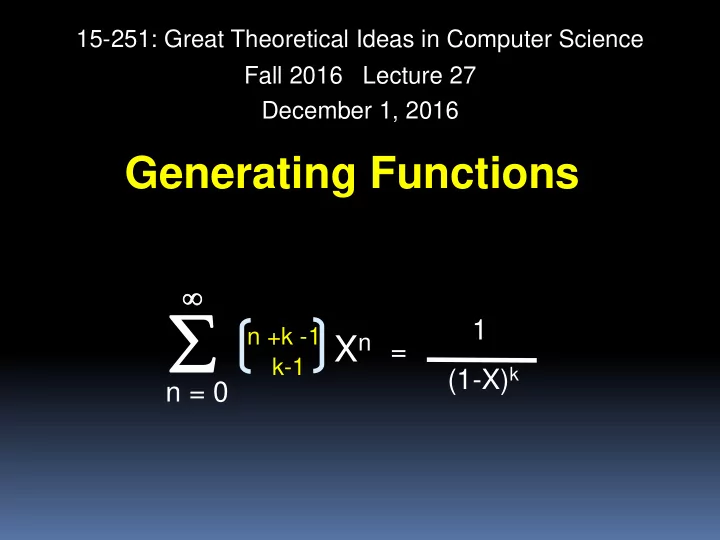
1 n +k -1 X n = k-1 (1-X) k n = 0 The Binomial Formula n n - - PowerPoint PPT Presentation
15-251: Great Theoretical Ideas in Computer Science Fall 2016 Lecture 27 December 1, 2016 Generating Functions 1 n +k -1 X n = k-1 (1-X) k n = 0 The Binomial Formula n n (1 x) n x k
15-251: Great Theoretical Ideas in Computer Science
Fall 2016 Lecture 27 December 1, 2016
1 (1-X)k =
n = 0
n +k -1 k-1
k n k n
The polynomial (1+x)n packages in convenient algebraic form information about the sequence
k=0,1,…,n Generating functions are a formal algebraic view for (infinite) sequences
Generating functions are a formal algebraic representation for (infinite) sequences (1+x)n is the “generating function” for the sequence k=0,1,…,n
Often, surprisingly powerful representation to understand the sequence!
1 + X1 + X2 + X3 + … + Xn-2 + Xn-1 = X - 1 Xn – 1 Recall the Geometric Series 1 - X 1 - Xn =
1 + X1 + X2 + X3 + … + Xn + … = 1 - X 1 the Infinite Geometric Series But also makes sense if we view the infinite sum on the left as a formal power series in variable X Holds when we plug X = a with |a| < 1
1 + X1 + X2 + X3 + … + Xn + … 1 - X 1
(1- X) P(X) = P(X) =
P(X) = 1
Just a particular representation of sequences… In general, when is a sequence…
n = 0
There are no worries about convergence issues. This is a purely syntactic object.
i = 0
If you want, think of as the infinite vector V = < a0, a1, a2, ..., an, … > But, as you will see, thinking of as a “polynomial” is very natural and powerful.
They're fun and powerful ! Solving recurrences precisely Solving (impossible looking) counting problems Proving identities
In Graham-Knuth-Patashnik’s text “Concrete Mathematics: A Foundation for Computer Science”, generating functions are described as
“the most important idea in this whole book.”
Generating functions transform problems about sequences into problems about functions, allowing us to put the piles of machinery available for manipulating functions to work for understanding sequences
A(X) = a0 + a1 X + a2 X2 + … B(X) = b0 + b1 X + b2 X2 + … adding them together (A+B)(X) = (a0+b0) + (a1+b1) X + (a2+b2) X2 + … like adding the vectors position-wise <4,2,3,…> + <5,1,1,….> = <9,3,4,…>
A(X) = a0 X0 + a1 X1 + a2 X2 + … multiplying by X X * A(X) = 0 X0 + a0 X1 + a1 X2 + a2 X3 + … like shifting the vector entries SHIFT<4,2,3,…> = <0,4,2,3,…>
Example: V = n’th row of Pascal’s triangle (binomial coefficients 𝑜
𝑙 )
Store: V = <1,0,0,0,…> V = <1,1,0,0,…> V = <1,2,1,0,…> V = <1,3,3,1,…> V := <1,0,0,…>; Loop n times V := V + SHIFT(V);
Example: V := <1,0,0,…>; Loop n times V := V + SHIFT(V); V = nth row of Pascal’s triangle (binomial coefficients 𝑜
𝑙 )
PV := 1; PV := PV*(1+X);
Example: V := <1,0,0,…>; Loop n times V := V + SHIFT(V);
PV = (1+ X)n As expected, the coefficients of PV give the binomial coefficients 𝑜
𝑙
i = 0
Given a sequence V = < a0, a1, a2, ..., an, … > associate a formal power series with it This is the “generating function” for V
i.e., the sequence <0,1,1,2,3,5,8,13…> is represented by the power series (generating function) 0 + 1X1 + 1X2 + 2 X3 + 3 X4 + 5 X5 + 8 X6 +… F0 = 0, F1 = 1, Fn = Fn-1 + Fn-2
A(X) = 0 + 1X1 + 1X2 + 2 X3 + 3 X4 + 5 X5 + 8 X6 +… F0 = 0, F1 = 1, Fn = Fn-1 + Fn-2 Can we write A(X) more succinctly?
A(X) = F0 + F1 X1 + F2 X2 + F3 X3 + … + Fn Xn +… = X1 + (F1 + F0)X2 + (F2+F1) X3 + … + (Fn-1 +Fn-2) Xn +… (1 – X – X2) X A(X) =
F0 = 0, F1 = 1, Fn = Fn-1 + Fn-2 (1 – X – X2) X A(X) = has the generating function i.e., the coefficient of Xn in A(X) is Fn
1 – X – X2 X X2 + X3
X 2X3 + X4
+ X2
+ 2X3 3X4 + 2X5 + 3X4
5X5 + 3X6 + 5X5
8X6 + 5X7 + 8X6
F0 = 0, F1 = 1, Fn = Fn-1 + Fn-2 (1 – X – X2) X A(X) = let’s factor (1 – X – X2) (1 – X – X2) = (1 – φ1 X)(1 – φ2 X) φ2 = 1 - √5 2 where φ1 = 1 + √5 2
F0 = 0, F1 = 1, Fn = Fn-1 + Fn-2 X A(X) = (1 – φ1X)(1 – φ2X) A(X) = 1 (1 – φ1X) 1 (1 – φ2X) √5 1 √5
+ some elementary algebra omitted…*
*you are not allowed to say this in your answers…
A(X) = 1 (1 – φ1X) 1 (1 – φ2X) √5 1 √5
+ 1 (1 – φ1X) = 1 + φ1 X + φ12 X2 + … + φ1n Xn + …
= 1 + Y1 + Y2 + Y3 + … + Yn + …
1 - Y 1
the Infinite Geometric Series
A(X) = 1 (1 – φ1X) 1 (1 – φ2X) √5 1 √5
+ 1 (1 – φ1X) = 1 + φ1 X + φ12 X2 + … + φ1n Xn + … the coefficient of Xn in A(X) is… √5 1 φ2n √5
+ φ1n 1 (1 – φ2X) = 1 + φ2 X + … + φ2n Xn + …
where φ = 1 + √5 2
“golden ratio”
i = 0
Given a sequence V = < a0, a1, a2, ..., an, … > associate a formal power series with it This is the “generating function” for V We just used this for solving the Fibonacci recurrence…
A(X) = a0 + a1 X + a2 X2 + … B(X) = b0 + b1 X + b2 X2 + … multiply them together (A*B)(X) = (a0*b0) + (a0b1 + a1b0) X + (a0b2 + a1b1 + a2b0) X2 + (a0b3 + a1b2 + a2b1 + a3b0 ) X3 + …
seems a bit less natural in the vector representation (it’s called a “convolution” there)
A(X) = a0 + a1 X + a2 X2 + … Special case: B(X) = 1 + X + X2 + … multiply them together (A*B)(X) = a0 + (a0 + a1) X + (a0 + a1 + a2) X2 + (a0 + a1 + a2 + a3) X3 + …
It gives us partial sums!
1 1-X =
What’s a closed form for the generating function
i.e., the sequence 𝑏𝑜 = 𝑜 for 𝑜 ≥ 0 ? 𝑌 + 2 𝑌2 + 3 𝑌3 + ⋯ + 𝑜 𝑌𝑜 + ⋯ equals 𝑌 1 − 𝑌 2
A(X) = a0 + a1 X + a2 X2 + … B(X) = 1 + X + X2 + … (A*B)(X) = a0 + (a0 + a1) X + (a0 + a1 + a2) X2 + (a0 + a1 + a2 + a3) X3 + …
It gives us partial sums.
1 1-X =
Apply with A(X)=B(X)
1 + 2𝑌 + 3𝑌2 + 4𝑌3 + ⋯ + 𝑜 𝑌𝑜−1 + ⋯ = 1 1 − 𝑌 2 To get generating function for naturals 〈0,1,2,3, … 〉, which is a shift of 1,2,3, … , multiply the G.F by 𝑌
Take 1 + 2X + 3X2 + 4X3 + … 1 (1-X)2 = Δ1 + Δ2 𝑌 + Δ3𝑌2 + ⋯ 1 (1-X)3 = multiplying through by 1/(1-X)
where Δ𝑜 =
𝑜+1 2
is the sequence of triangular numbers
<1,2,3,4,…> 1 (1-X)2 = 1 (1-X)3 = 1 1-X = <1,1,1,1,…>
1 (1-X)k = ??? <1,3,6,10,…>
1 (1-X)2 = 1 (1-X)3 = 1 1-X =
1 2 3
<1,2,3,4,…> <1,3,6,10,…> 1 (1-X)n = ???
, , , , …
1 (1-X)2 = 1 (1-X)3 = 1 1-X =
1 2 3
<1,3,6,10,…>
1 1 2 1 3 1 4 1
, , , , … , , , , … 1 (1-X)n = ???
1 (1-X)2 = 1 (1-X)3 = 1 1-X =
1 2 3 1 1 2 1 3 1 4 1
, , , , … , , , , …
2 2 3 2 4 2 5 2
, , , , … 1 (1-X)k = ???
1 (1-X)2 = 1 (1-X)3 = 1 1-X =
1 2 3 1 1 2 1 3 1 4 1
, , , , … , , , , …
2 2 3 2 4 2 5 2
, , , , … 1 (1-X)k =
n = 0
n+k-1 k-1
What is the coefficient of Xn in the expansion of: ( 1 + X + X2 + X3 + X4 + . . . . )k ?
To get 𝑌𝑜 we need to pick 𝑌𝑓𝑗 in 𝑗′𝑢ℎ factor, for 𝑗 = 1,2, … , 𝑙 with 𝑓1 + 𝑓2 + ⋯ + 𝑓𝑙 = 𝑜. Each exponent can be any natural number. ∴ coefficient of Xn is the number of non-negative solutions to:
e1 + e2 + . . . + ek = n
Another way to see it…
which is
A(X) = a0 + a1 X + a2 X2 + … B(X) = b0 + b1 X + b2 X2 + …
A and B disjoint Then, number of ways to select n items total from A B = a0bn + a1bn-1 + a2bn-2 + …. + anb0 GF for selecting items from set A GF for selecting items from set B Suppose there is a bijection between n-element selections from A B and ordered pairs of selections from A and B containing total of n els. ∴ GF for selecting items from disjoint union A B = A(X) B(X)
Let cn = number of ways to pick exactly n fruits. What is a closed form for cn? E.g., c5 = 6
If A(x), B(x), O(x) and P(x) are the generating functions for the number of ways to fill baskets using
Then the generating function for number of ways to fill basket using any of these fruits is given by C(x) = A(x)B(x)O(x)P(x)
Suppose we only pick bananas bn = number of ways to pick n fruits, only bananas. <1,0,1,0,1,0,…> B(x) = 1 + x2 + x4 + x6 + … 1 1-x2 =
Suppose we only pick apples an = number of ways to pick n fruits, only apples. <1,0,0,0,0,1,…> A(x) = 1 + x5 + x10 + x15 + … 1 1-x5 =
Suppose we only pick oranges
<1,1,1,1,1,0,0,0,…> O(x) = 1 + x + x2 + x3 + x4 1-x5 1-x =
Suppose we only pick pears pn = number of ways to pick n fruits, only pears. <1,1,0,0,0,0,0,…> P(x) = 1 + x 1-x2 1-x =
Let cn = number of ways to pick exactly n fruits of any type cn xn = A(x) B(x) O(x) P(x) = 1-x2 1-x 1 1-x5 1 1-x2 1-x5 1-x = 1 (1-x)2
1 (1-X)2 cn is coefficient of Xn in <1,2,3,4,…>
Let cn = number of ways to pick exactly n fruits of any type
A(X) = a0 + a1 X + a2 X2 + … differentiate it… A’(X) = a1 + 2a2 X + 3a3 X2 …
i = 0
i = 0
1 (1-X)k =
n = 0
n+k-1 k-1
1 (1-X)k =
n = 0
n+k-1 k-1
Fact: For a generating function 𝐵 𝑌 = 𝑜=0
∞
𝑏𝑜𝑌𝑜 𝑏𝑜 = 𝐵 𝑜 (0) 𝑜! where 𝐵 𝑜 (𝑌) is the 𝑜’th order derivative of 𝐵(𝑌) For 𝐵 𝑌 =
1 1−𝑌 𝑙, we have 𝐵 𝑜 𝑌 = 𝑙 𝑙+1 ⋯(𝑙+𝑜−1) 1−𝑌 𝑙+𝑜
Exercise: Prove that the generating function
for squares, i.e., the sequence an = n2, n=0,1,2…. equals One approach: Use differentiation + shifting twice 𝑌(1 + 𝑌) 1 − 𝑌 3
A(X) = a0 + a1 X + a2 X2 + … Integrating both sides ….
Evaluate the sum Substituting X=1, answer =
All the avenues numbered 0 through x, run north-south, and all streets, numbered 0 through y, run east-west. The number of [sensible] ways to walk from the corner of (0,0) to (x,y) (total x+y steps) equals:
(0,0) (x,y)
What if we require the Manhattan walk to never cross the diagonal? How many ways can we walk from (0,0) to (n,n) along the grid subject to this rule?
n n (n,n ,n) (0,0 ,0)
This number, say 𝑑𝑜, is called the 𝑜’th Catalan number
14 such walks for n=4 (c.f. total # Manhattan walks = = 70 )
4 8
never cross the diagonal (define c0=1).
(n,n ,n) (0,0) 0)
n n
The walk must hit the diagonal at least once
(perhaps only at the end). (k,k)
# walks that hit the diagonal at (k,k) for the first time? (1 ≤ k ≤ n) Answer: ck-1 cn-k
𝑑𝑜 = coefficient of xn-1 in C(x)2 Together with c0=1 we get
C(x) = 1 + x C(x)2
x C(x)2 – C(x) + 1 = 0
Using this, one can calculate Define 𝐸 𝑦 = 2𝑦 𝐷 𝑦 = 1 − 1 − 4𝑦 = 𝑜=0
∞
𝑒𝑜𝑦𝑜 𝑑𝑜 = 𝑒𝑜+1 2
Let E(X) be the GF for super non-crossing Manhattan walks on n x n grids that never touch the diagonal (except at endpoints) Fact 1: E(X) = X C(X) Fact 2: C(X) = 1 + E(X) + (E(X))2 + (E(X))3 + …. Together these imply
Let’s count # violating paths, that do cross the diagonal Will do so by a bijection. Find first step above the diagonal. “Flip” the portion of the path after that step.
Flip the portion of the path after the first edge above the diagonal.
Observe: New path goes to (n-1,n+1) Claim: The above is a bijection from crossing Manhattan walks in n x n grid to unconstrained Manhattan walks in (n-1,n+1) grid
Thus, number of noncrossing Manhattan walks on n x n grid =
How many sequences of balanced paranthesis with n (’s and n 1)’s are there? The n’th Catalan number
Answer:
Generating Function Sequence
Goal: derive a closed form using generating functions. Let
Let
Factorize denominator to break it into smaller pieces!
Formal Power Series Basic operations on Formal Power Series Solving recurrences using generating functions (handle base cases carefully!) Solving G.F. to get closed form G.F.s for common sequences Prefix sums using G.F.s Using G.F.s to solve counting problems
Study Guide