
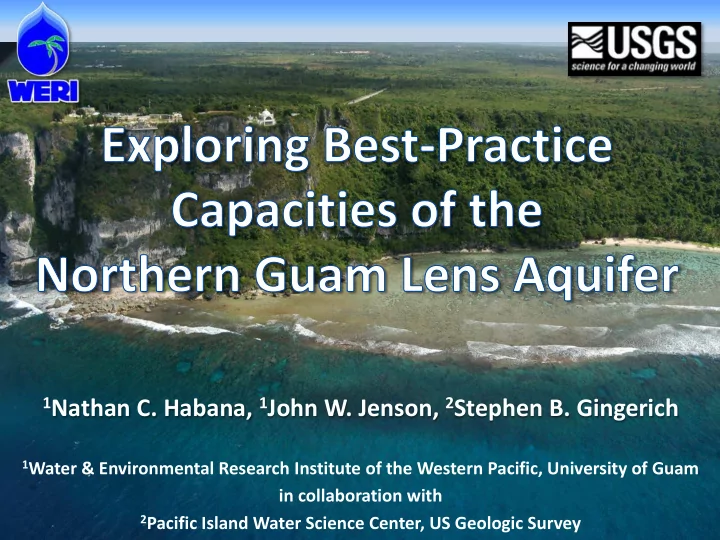
SLIDE 1
1Nathan C. Habana, 1John W. Jenson, 2Stephen B. Gingerich
1Water & Environmental Research Institute of the Western Pacific, University of Guam
in collaboration with
2Pacific Island Water Science Center, US Geologic Survey
1 Nathan C. Habana, 1 John W. Jenson, 2 Stephen B. Gingerich 1 Water - - PowerPoint PPT Presentation
1 Nathan C. Habana, 1 John W. Jenson, 2 Stephen B. Gingerich 1 Water & Environmental Research Institute of the Western Pacific, University of Guam in collaboration with 2 Pacific Island Water Science Center, US Geologic Survey Overview 1.
1Nathan C. Habana, 1John W. Jenson, 2Stephen B. Gingerich
1Water & Environmental Research Institute of the Western Pacific, University of Guam
in collaboration with
2Pacific Island Water Science Center, US Geologic Survey
AG-1 Chloride and Production History
Chloride concentrations (mg/l) Production rate, monthly average (GPM) Linear (Chloride concentrations (mg/l)) Linear (Production rate, monthly average (GPM))http://hi.water.usgs.gov/publications/pubsguam.html
The Effects of W ithdraw als and Drought on Groundw ater Availability in the Northern Guam Lens Aquifer, Guam
Gingerich (2013)
– More wells, higher pumping rates
(Jenson, Habana & Gingerich in prep.)
survivaltip.org
Timber High-Grade
Quality
Low-Grade
Readily refined by standard processes
No recoverable product with current processes
Crude oil Mineral ores Raw water
Quantity of raw material extracted
Refined Product = Drinking Water
Tight regulatory limit (say 250 mg/l) Seawater strength coming out of the tap…. Highest grade raw water (say 30 mg/ l) Generous regulatory limit (say 600 mg/l)
Highest Lowest
I ncreasing salinity is a natural consequence
extraction
Rainwater Seawater
70% 5% 20%
– Not susceptible to contamination by sea water – High quality—”upstream” from surface threats – More rapidly affected by wet-dry cycles than basal water – Hard to find (without an accurate map)
– Vulnerable to contamination by underlying sea water – “Downstream” from surface contaminant sources – Really easy to find
– I nvulnerable to sea water contamination – Very high quality water—headwaters of the catchment – Most responsive to wet-dry cycles – Very hard to find (even with a map; occurs in patches)
NAVFAC Final Report Apr 2010 Guam Water Well Testing Roff, Jenson & Schuman
limestone aquifer water table sea level volcanic basement
Saltwater 19,000
< 30 parabasal water
> 150 mixing zone
< 70 saltwater toe
basal water < 150 CDM (Mink), 1982 McDonald & Jenson, 2003
Chloride Benchmarks
#19
(GWA)
Actual vs. Simulated Systems
Actual* Simulated
Number of wells 118** 130
98** 130 Depth of wells (ft) mostly about 40 25 Pumping rates (gpm) 100-750 100-500 Basal wells 66 Para-basal wells 48 130 Supra-basal wells 3 Total production (MGD) 40*** 76 **includes 1 spring *GWA only; Does not include ~14 DOD wells. ***GWA + DOD production (36 + 4) Actual* Simulated Entire aquifer 1.00 200 36 76 18% 38% Supra-basal zone 0.20 40 2 Para-basal zones** 0.05 10 15 58 Basal zone 0.75 150 18 18 12% 12%
**Interior rise and southern fault zone
34% Simulated extraction (MGD) by zone *GWA only; does not include DOD production. Extraction as pecent of zonal recharge
Portion
aquifer
Recharge (MGD) by zone
Recharge & Extraction by zone
100% Actual extraction (MGD) by zone*
50 MGD
Supra-basal + para-basal
recharge 68 MGD extraction 8 MGD extraction for 200 MGD total recharge
50 MGD extraction 18 MGD Extraction (basal)
Total extraction: 76 MGD 38% of recharge Not yet harvesting the outer basal zone
– More wells, higher pumping rates