SLIDE 1 1 Parse Trees
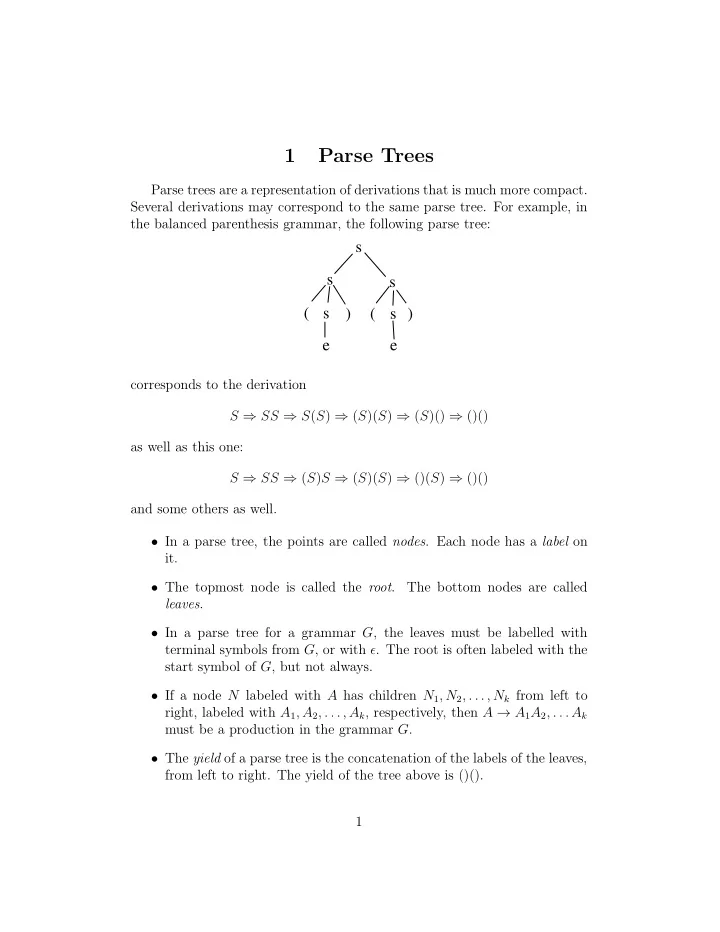
Parse trees are a representation of derivations that is much more compact. Several derivations may correspond to the same parse tree. For example, in the balanced parenthesis grammar, the following parse tree:
s s s s s ( ( ) ) e e
corresponds to the derivation S ⇒ SS ⇒ S(S) ⇒ (S)(S) ⇒ (S)() ⇒ ()() as well as this one: S ⇒ SS ⇒ (S)S ⇒ (S)(S) ⇒ ()(S) ⇒ ()() and some others as well.
- In a parse tree, the points are called nodes. Each node has a label on
it.
- The topmost node is called the root.
The bottom nodes are called leaves.
- In a parse tree for a grammar G, the leaves must be labelled with
terminal symbols from G, or with ǫ. The root is often labeled with the start symbol of G, but not always.
- If a node N labeled with A has children N1, N2, . . . , Nk from left to
right, labeled with A1, A2, . . . , Ak, respectively, then A → A1A2, . . . Ak must be a production in the grammar G.
- The yield of a parse tree is the concatenation of the labels of the leaves,
from left to right. The yield of the tree above is ()(). 1
SLIDE 2 1.1 Leftmost and Rightmost Derivations
- In a leftmost derivation, at each step the leftmost nonterminal is re-
- placed. In a rightmost derivation, at each step the rightmost nonter-
minal is replaced.
- Such replacements are indicated by
L
⇒ and
R
⇒, respectively.
- Their transitive closures are
L
⇒
∗
and
R
⇒
∗
, respectively. In the balanced parenthesis grammar, this is a leftmost derivation: S ⇒ SS ⇒ (S)S ⇒ ()S ⇒ ()(S) ⇒ ()() This is a rightmost derivation: S ⇒ SS ⇒ S(S) ⇒ S() ⇒ (S)() ⇒ ()() It is possible to obtain a derivation from a parse tree and vice versa. Here is an example of obtaining a derivation from a parse tree, going from left to right:
s s s s s ( ( ) ) e e = > s s ( ( ) ) s s = > (s) e e e => s ( s ) e e s ( s ) () ( s ) e () => () () =>
- In this case, we obtained a leftmost derivation, but we could also have
- btained a rightmost derivation in a similar way.
- Using the same diagram, going from right to left, starting with only an
arbitrary derivation, we can obtain a parse tree: 2
SLIDE 3 s s s s s ( ( ) ) e e = > s s ( ( ) ) s s = > (s) e e e => s ( s ) e e s ( s ) () ( s ) e () => () () =>
Thus from a parse tree, we can obtain a leftmost or a rightmost derivation, and from an arbitrary derivation, we can obtain a parse tree. This gives us theorem 3.2.1 in the text: Theorem 1.1 (3.2.1) Let G = (V, Σ, R, S) be a context-free grammar, A ∈ V − Σ, and w ∈ Σ∗. Then the following are equivalent (TFAE):
- 1. A ⇒∗ w
- 2. There is a parse tree with root labeled A and yield w
- 3. There is a leftmost derivation A L
⇒
∗
w
- 4. There is a rightmost derivation A R
⇒
∗
w Proof:
- We showed above how from a derivation one can construct a parse
- tree. This shows (1) implies (2).
- Also, we showed above how from a parse tree one can construct
a leftmost or a rightmost derivation. This shows that (2) implies (3) and (2) implies (4).
- Finally, leftmost and rightmost derivations are derivations, which
shows that (3) implies (1) and (4) implies (1).
- Thus all four conditions are equivalent.
3
SLIDE 4
1.2 Ambiguity
Some sentences in English are ambiguous: Fighting tigers can be dangerous. Time flies like an arrow. Humor is also often based on ambiguity. Example jokes: How do you stop an elephant from charging? Why did the student eat his homework? What ended in 1896? There is also a technical concept of ambiguity for context-free grammars. A context-free grammar G = (V, Σ, R, S) is ambiguous if there is some string w ∈ Σ∗ such that there are two distinct parse trees T1 and T2 having S at the root and having yield w. Equivalently, w has two or more leftmost derivations, or two or more rightmost derivations. Note that languages are not ambiguous; grammars are. Also, it has to be the same string w with two different (leftmost or rightmost) derivations for a grammar to be ambiguouos. Here is an example of an ambiguous grammar: E → E + E E → a E → E ∗ E E → b E → (E) E → c In this grammar, the string a + b ∗ c can be parsed in two different ways, corresponding to doing the addition before or after the multiplication. This is very bad for a compiler, because the compiler uses the parse tree to generate code, meaning that this string could have two very different semantics. Here are two parse trees for the string a + b ∗ c in this grammar: 4
SLIDE 5
E E E E E a b c + * E E c a E E E b + *
Ambiguity actually happened with the original Algol 60 syntax, which was ambiguous for this string: if x then if y then z else w; How is this string ambiguous? Which values of x, y, or z lead to the ambi- guity? There is a notion of inherent ambiguity for context-free languages; a context-free language L is inherently ambiguous if every context-free gram- mar G for L is ambiguous. As an example, the language {anbncmdm : n ≥ 1, m ≥ 1} ∪ {anbmcmdn : n ≥ 1, m ≥ 1} is inherently ambiguous. In any context-free grammar for L, some strings of the form anbncndn will have two distinct parse trees. Unfortunately, the problem of whether a context-free grammar is am- biguous, is undecidable. However, there are some patterns in a context-free grammar that frequently indicate ambiguity: 5
SLIDE 6
S → SS S → a S → A A → AA A → a S → AA A → S A → a S → SbS S → a S → AbA A → S A → a The following is not ambiguous: S → aS S → bS S → ǫ In general, a production A → AA causes ambiguity if it is reachable from the start symbol and some terminal string is derivable from A. 6