1 Locate set Cache Read Example: Direct Mapped Cache (E = 1) - - PDF document

1
SMART_READER_LITE
LIVE PREVIEW

1 Locate set Cache Read Example: Direct Mapped Cache (E = 1) - - PDF document

Today Cache memory organization and operation Performance impact of caches Cache Memories The memory mountain Rearranging loops to improve spatial locality Using blocking to improve temporal locality CSci 2021: Machine


slide-1
SLIDE 1

1

1 Bryant and O’Hallaron, Computer Systems: A Programmer’s Perspective, Third Edition

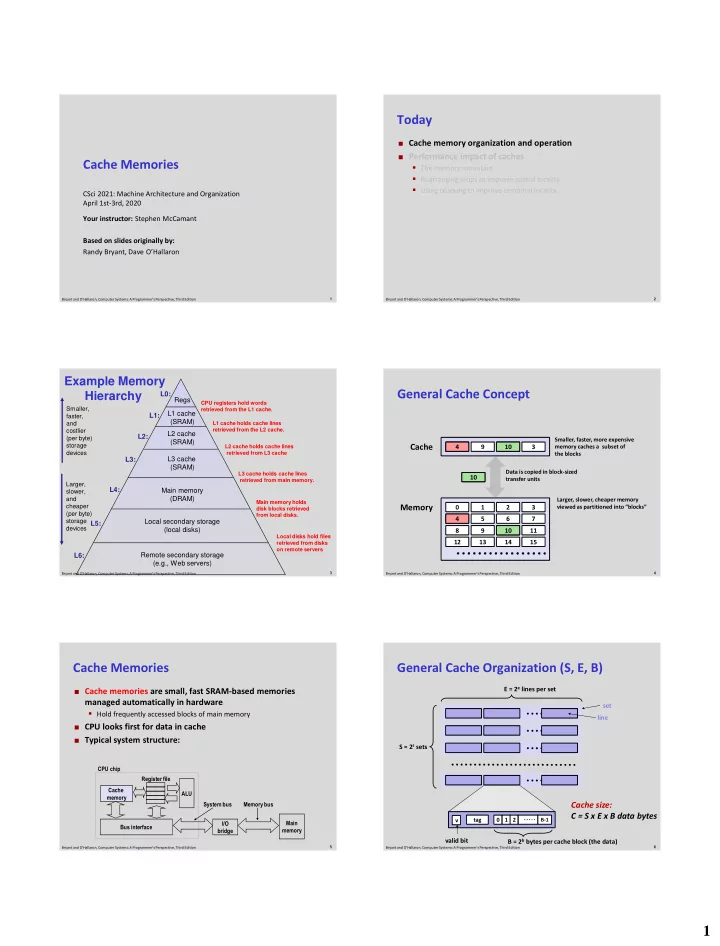
Cache Memories

CSci 2021: Machine Architecture and Organization April 1st-3rd, 2020 Your instructor: Stephen McCamant Based on slides originally by: Randy Bryant, Dave O’Hallaron

2 Bryant and O’Hallaron, Computer Systems: A Programmer’s Perspective, Third Edition

Today

 Cache memory organization and operation  Performance impact of caches

  • The memory mountain
  • Rearranging loops to improve spatial locality
  • Using blocking to improve temporal locality

3 Bryant and O’Hallaron, Computer Systems: A Programmer’s Perspective, Third Edition

Example Memory Hierarchy

Regs L1 cache (SRAM) Main memory (DRAM) Local secondary storage (local disks)

Larger, slower, and cheaper (per byte) storage devices

Remote secondary storage (e.g., Web servers)

Local disks hold files retrieved from disks

  • n remote servers

L2 cache (SRAM)

L1 cache holds cache lines retrieved from the L2 cache. CPU registers hold words retrieved from the L1 cache. L2 cache holds cache lines retrieved from L3 cache

L0: L1: L2: L3: L4: L5:

Smaller, faster, and costlier (per byte) storage devices

L3 cache (SRAM)

L3 cache holds cache lines retrieved from main memory.

L6:

Main memory holds disk blocks retrieved from local disks.

4 Bryant and O’Hallaron, Computer Systems: A Programmer’s Perspective, Third Edition

General Cache Concept

1 2 3 4 5 6 7 8 9 10 11 12 13 14 15 8 9 14 3

Cache Memory

Larger, slower, cheaper memory viewed as partitioned into “blocks” Data is copied in block-sized transfer units Smaller, faster, more expensive memory caches a subset of the blocks

4 4 4 10 10 10

5 Bryant and O’Hallaron, Computer Systems: A Programmer’s Perspective, Third Edition

Cache Memories

 Cache memories are small, fast SRAM-based memories

managed automatically in hardware

  • Hold frequently accessed blocks of main memory

 CPU looks first for data in cache  Typical system structure: Main memory I/O bridge Bus interface ALU Register file CPU chip System bus Memory bus Cache memory

6 Bryant and O’Hallaron, Computer Systems: A Programmer’s Perspective, Third Edition

General Cache Organization (S, E, B)

E = 2e lines per set S = 2s sets set line

1 2 B-1 tag v

B = 2b bytes per cache block (the data)

Cache size: C = S x E x B data bytes

valid bit

slide-2
SLIDE 2

2

7 Bryant and O’Hallaron, Computer Systems: A Programmer’s Perspective, Third Edition

Cache Read

E = 2e lines per set S = 2s sets

1 2 B-1 tag v

valid bit B = 2b bytes per cache block (the data)

t bits s bits b bits

Address of word: tag set index block

  • ffset

data begins at this offset

  • Locate set
  • Check if any line in set

has matching tag

  • Yes + line valid: hit
  • Locate data starting

at offset

8 Bryant and O’Hallaron, Computer Systems: A Programmer’s Perspective, Third Edition

Example: Direct Mapped Cache (E = 1)

S = 2s sets Direct mapped: One line per set Assume: cache block size 8 bytes

t bits 0…01 100

Address of int:

1 2 7 tag v 3 6 5 4 1 2 7 tag v 3 6 5 4 1 2 7 tag v 3 6 5 4 1 2 7 tag v 3 6 5 4

find set

9 Bryant and O’Hallaron, Computer Systems: A Programmer’s Perspective, Third Edition

Example: Direct Mapped Cache (E = 1)

Direct mapped: One line per set Assume: cache block size 8 bytes

t bits 0…01 100

Address of int:

1 2 7 tag v 3 6 5 4

match: assume yes = hit valid? + block offset

tag

10 Bryant and O’Hallaron, Computer Systems: A Programmer’s Perspective, Third Edition

Example: Direct Mapped Cache (E = 1)

Direct mapped: One line per set Assume: cache block size 8 bytes

t bits 0…01 100

Address of int:

1 2 7 tag v 3 6 5 4

match: assume yes = hit valid? + int (4 Bytes) is here block offset

If tag doesn’t match: old line is evicted and replaced

11 Bryant and O’Hallaron, Computer Systems: A Programmer’s Perspective, Third Edition

Direct-Mapped Cache Simulation

M=16 bytes (4-bit addresses), B=2 bytes/block, S=4 sets, E=1 Blocks/set Address trace (reads, one byte per read): [00002], 1 [00012], 7 [01112], 8 [10002], [00002] x t=1 s=2 b=1 xx x ? ? v Tag Block miss 1 M[0-1] hit miss 1 M[6-7] miss 1 1 M[8-9] miss 1 M[0-1]

Set 0 Set 1 Set 2 Set 3

12 Bryant and O’Hallaron, Computer Systems: A Programmer’s Perspective, Third Edition

E-way Set Associative Cache (Here: E = 2)

E = 2: Two lines per set Assume: cache block size 8 bytes

t bits 0…01 100

Address of short int:

0 1 2 7 tag v 3 6 5 4 0 1 2 7 tag v 3 6 5 4 0 1 2 7 tag v 3 6 5 4 0 1 2 7 tag v 3 6 5 4 0 1 2 7 tag v 3 6 5 4 0 1 2 7 tag v 3 6 5 4 0 1 2 7 tag v 3 6 5 4 0 1 2 7 tag v 3 6 5 4

find set

slide-3
SLIDE 3

3

13 Bryant and O’Hallaron, Computer Systems: A Programmer’s Perspective, Third Edition

E-way Set Associative Cache (Here: E = 2)

E = 2: Two lines per set Assume: cache block size 8 bytes

t bits 0…01 100

Address of short int:

0 1 2 7 tag v 3 6 5 4 0 1 2 7 tag v 3 6 5 4

compare both valid? + match: yes = hit block offset

tag

14 Bryant and O’Hallaron, Computer Systems: A Programmer’s Perspective, Third Edition

E-way Set Associative Cache (Here: E = 2)

E = 2: Two lines per set Assume: cache block size 8 bytes

t bits 0…01 100

Address of short int:

0 1 2 7 tag v 3 6 5 4 0 1 2 7 tag v 3 6 5 4

compare both valid? + match: yes = hit block offset short int (2 Bytes) is here

No match:

  • One line in set is selected for eviction and replacement
  • Replacement policies: random, least recently used (LRU), …

15 Bryant and O’Hallaron, Computer Systems: A Programmer’s Perspective, Third Edition

2-Way Set Associative Cache Simulation

M=16 byte addresses, B=2 bytes/block, S=2 sets, E=2 blocks/set Address trace (reads, one byte per read): [00002], 1 [00012], 7 [01112], 8 [10002], [00002] xx t=2 s=1 b=1 x x ? ? v Tag Block miss 1 00 M[0-1] hit miss 1 01 M[6-7] miss 1 10 M[8-9] hit

Set 0 Set 1

16 Bryant and O’Hallaron, Computer Systems: A Programmer’s Perspective, Third Edition

What about writes?

 Multiple copies of data exist:

  • L1, L2, L3, Main Memory, Disk

 What to do on a write-hit?

  • Write-through (write immediately to memory)
  • Write-back (defer write to memory until replacement of line)
  • Need a dirty bit (line different from memory or not)

 What to do on a write-miss?

  • Write-allocate (load into cache, update line in cache)
  • Good if more writes to the location follow
  • No-write-allocate (writes straight to memory, does not load into cache)

 Typical

  • Write-through + No-write-allocate
  • Write-back + Write-allocate

17 Bryant and O’Hallaron, Computer Systems: A Programmer’s Perspective, Third Edition

Intel Core i7 Cache Hierarchy

Regs L1 d-cache L1 i-cache L2 unified cache Core 0 Regs L1 d-cache L1 i-cache L2 unified cache Core 3

L3 unified cache (shared by all cores) Main memory Processor package L1 i-cache and d-cache: 32 KB, 8-way, Access: 4 cycles L2 unified cache: 256 KB, 8-way, Access: 10 cycles L3 unified cache: 8 MB, 16-way, Access: 40-75 cycles Block size: 64 bytes for all caches.

18 Bryant and O’Hallaron, Computer Systems: A Programmer’s Perspective, Third Edition

Cache Performance Metrics

 Miss Rate

  • Fraction of memory references not found in cache (misses / accesses)

= 1 – hit rate

  • Typical numbers (in percentages):
  • 3-10% for L1
  • can be quite small (e.g., < 1%) for L2, depending on size, etc.

 Hit Time

  • Time to deliver a line in the cache to the processor
  • includes time to determine whether the line is in the cache
  • Typical numbers:
  • 4 clock cycle for L1
  • 10 clock cycles for L2

 Miss Penalty

  • Additional time required because of a miss
  • typically 50-200 cycles for main memory (Trend: increasing!)
slide-4
SLIDE 4

4

19 Bryant and O’Hallaron, Computer Systems: A Programmer’s Perspective, Third Edition

Let’s think about those numbers

 Huge difference between a hit and a miss

  • Could be 100x, if just L1 and main memory

 Would you believe 99% hits is twice as good as 97%?

  • Consider:

cache hit time of 1 cycle miss penalty of 100 cycles

  • Average access time:

97% hits: 1 cycle + 0.03 * 100 cycles = 4 cycles 99% hits: 1 cycle + 0.01 * 100 cycles = 2 cycles

 This is why “miss rate” is used instead of “hit rate”

20 Bryant and O’Hallaron, Computer Systems: A Programmer’s Perspective, Third Edition

Writing Cache Friendly Code

 Make the common case go fast

  • Focus on the inner loops of the core functions

 Minimize the misses in the inner loops

  • Repeated references to variables are good (temporal locality)
  • Stride-1 reference patterns are good (spatial locality)

Key idea: Our qualitative notion of locality is quantified through our understanding of cache memories

21 Bryant and O’Hallaron, Computer Systems: A Programmer’s Perspective, Third Edition

Rows/Columns Example

int sum_array_rows(double a[16][16]) { int i, j; double sum = 0; for (i = 0; i < 16; i++) for (j = 0; j < 16; j++) sum += a[i][j]; return sum; }

32 B = 4 doubles assume: cold (empty) cache, a[0][0] goes here, 2-way set associative

int sum_array_cols(double a[16][16]) { int i, j; double sum = 0; for (j = 0; j < 16; j++) for (i = 0; i < 16; i++) sum += a[i][j]; return sum; }

Ignore the variables sum, i, j

22 Bryant and O’Hallaron, Computer Systems: A Programmer’s Perspective, Third Edition

Rows/Columns Example

int sum_array_rows(double a[16][16]) { int i, j; double sum = 0; for (i = 0; i < 16; i++) for (j = 0; j < 16; j++) sum += a[i][j]; return sum; }

32 B = 4 doubles

int sum_array_cols(double a[16][16]) { int i, j; double sum = 0; for (j = 0; j < 16; j++) for (i = 0; i < 16; i++) sum += a[i][j]; return sum; }

Ignore the variables sum, i, j

1 2 4 3 5 6 8 7

9 10 12 11 13 14 16 15

1 2 4 3 5 6 8 7 5 6 8 7 9

10 12 11 13 14 16 15

1 2 4 3

assume: cold (empty) cache, a[0][0] goes here, 2-way set associative

23 Bryant and O’Hallaron, Computer Systems: A Programmer’s Perspective, Third Edition

Rows/Columns Example

int sum_array_rows(double a[16][16]) { int i, j; double sum = 0; for (i = 0; i < 16; i++) for (j = 0; j < 16; j++) sum += a[i][j]; return sum; }

32 B = 4 doubles

int sum_array_cols(double a[16][16]) { int i, j; double sum = 0; for (j = 0; j < 16; j++) for (i = 0; i < 16; i++) sum += a[i][j]; return sum; }

Ignore the variables sum, i, j

1 2 4 3

15 16

1 2 4 3

assume: cold (empty) cache, a[0][0] goes here, 2-way set associative

24 Bryant and O’Hallaron, Computer Systems: A Programmer’s Perspective, Third Edition

Today

 Cache organization and operation  Performance impact of caches

  • The memory mountain
  • Rearranging loops to improve spatial locality
  • Using blocking to improve temporal locality
slide-5
SLIDE 5

5

25 Bryant and O’Hallaron, Computer Systems: A Programmer’s Perspective, Third Edition

The Memory Mountain

 Read throughput (read bandwidth)

  • Number of bytes read from memory per second (MB/s)

 Memory mountain: Measured read throughput as a

function of spatial and temporal locality.

  • Compact way to characterize memory system performance.

26 Bryant and O’Hallaron, Computer Systems: A Programmer’s Perspective, Third Edition

Memory Mountain Test Function

long data[MAXELEMS]; /* Global array to traverse */ /* test - Iterate over first "elems" elements of * array “data” with stride of "stride", using * using 4x4 loop unrolling. */ int test(int elems, int stride) { long i, sx2=stride*2, sx3=stride*3, sx4=stride*4; long acc0 = 0, acc1 = 0, acc2 = 0, acc3 = 0; long length = elems, limit = length - sx4; /* Combine 4 elements at a time */ for (i = 0; i < limit; i += sx4) { acc0 = acc0 + data[i]; acc1 = acc1 + data[i+stride]; acc2 = acc2 + data[i+sx2]; acc3 = acc3 + data[i+sx3]; } /* Finish any remaining elements */ for (; i < length; i++) { acc0 = acc0 + data[i]; } return ((acc0 + acc1) + (acc2 + acc3)); }

Call test() with many combinations of elems and stride. For each elems and stride:

  • 1. Call test()
  • nce to warm up

the caches.

  • 2. Call test()

again and measure the read throughput(MB/s) mountain/mountain.c

27 Bryant and O’Hallaron, Computer Systems: A Programmer’s Perspective, Third Edition

The Memory Mountain

128m 32m 8m 2m 512k 128k 32k 2000 4000 6000 8000 10000 12000 14000 16000 s1 s3 s5 s7 s9 s11 Size (bytes) Read throughput (MB/s) Stride (x8 bytes)

Core i7 Haswell 2.1 GHz 32 KB L1 d-cache 256 KB L2 cache 8 MB L3 cache 64 B block size

Slopes

  • f spatial

locality Ridges

  • f temporal

locality

L1 Mem L2 L3

Aggressive prefetching

28 Bryant and O’Hallaron, Computer Systems: A Programmer’s Perspective, Third Edition

Today

 Cache organization and operation  Performance impact of caches

  • The memory mountain
  • Rearranging loops to improve spatial locality
  • Using blocking to improve temporal locality

29 Bryant and O’Hallaron, Computer Systems: A Programmer’s Perspective, Third Edition

Matrix Multiplication Example

 Description:

  • Multiply N x N matrices
  • Matrix elements are

doubles (8 bytes)

  • O(N3) total operations
  • N reads per source

element

  • N values summed per

destination

  • but may be able to

hold in register

/* ijk */ for (i=0; i<n; i++) { for (j=0; j<n; j++) { sum = 0.0; for (k=0; k<n; k++) sum += a[i][k] * b[k][j]; c[i][j] = sum; } } Variable sum held in register matmult/mm.c

30 Bryant and O’Hallaron, Computer Systems: A Programmer’s Perspective, Third Edition

Miss Rate Analysis for Matrix Multiply

 Assume:

  • Block size = 32B (big enough for four doubles)
  • Matrix dimension (N) is very large
  • Approximate 1/N as 0.0
  • Cache is not even big enough to hold multiple rows

 Analysis Method:

  • Look at access pattern of inner loop

A

k i

B

k j

C

i j

= x

slide-6
SLIDE 6

6

31 Bryant and O’Hallaron, Computer Systems: A Programmer’s Perspective, Third Edition

Layout of C Arrays in Memory (review)

 C arrays allocated in row-major order

  • each row in contiguous memory locations

 Stepping through columns in one row:

  • for (i = 0; i < N; i++)

sum += a[0][i];

  • accesses successive elements
  • if block size (B) > sizeof(aij) bytes, exploit spatial locality
  • miss rate = sizeof(aij) / B

 Stepping through rows in one column:

  • for (i = 0; i < n; i++)

sum += a[i][0];

  • accesses distant elements
  • no spatial locality!
  • miss rate = 1 (i.e. 100%)

32 Bryant and O’Hallaron, Computer Systems: A Programmer’s Perspective, Third Edition

Matrix Multiplication (ijk)

/* ijk */ for (i=0; i<n; i++) { for (j=0; j<n; j++) { sum = 0.0; for (k=0; k<n; k++) sum += a[i][k] * b[k][j]; c[i][j] = sum; } }

A B C (i,*) (*,j) (i,j) Inner loop: Column- wise Row-wise Fixed

Misses per inner loop iteration: A B C 0.25 1.0 0.0

matmult/mm.c

33 Bryant and O’Hallaron, Computer Systems: A Programmer’s Perspective, Third Edition

Matrix Multiplication (jik)

/* jik */ for (j=0; j<n; j++) { for (i=0; i<n; i++) { sum = 0.0; for (k=0; k<n; k++) sum += a[i][k] * b[k][j]; c[i][j] = sum } }

A B C (i,*) (*,j) (i,j) Inner loop: Row-wise Column- wise Fixed

Misses per inner loop iteration: A B C 0.25 1.0 0.0

matmult/mm.c

34 Bryant and O’Hallaron, Computer Systems: A Programmer’s Perspective, Third Edition

Matrix Multiplication (kij)

/* kij */ for (k=0; k<n; k++) { for (i=0; i<n; i++) { r = a[i][k]; for (j=0; j<n; j++) c[i][j] += r * b[k][j]; } }

A B C (i,*) (i,k) (k,*) Inner loop: Row-wise Row-wise Fixed

Misses per inner loop iteration: A B C 0.0 0.25 0.25

matmult/mm.c

35 Bryant and O’Hallaron, Computer Systems: A Programmer’s Perspective, Third Edition

Matrix Multiplication (ikj)

/* ikj */ for (i=0; i<n; i++) { for (k=0; k<n; k++) { r = a[i][k]; for (j=0; j<n; j++) c[i][j] += r * b[k][j]; } }

A B C (i,*) (i,k) (k,*) Inner loop: Row-wise Row-wise Fixed

Misses per inner loop iteration: A B C 0.0 0.25 0.25

matmult/mm.c

36 Bryant and O’Hallaron, Computer Systems: A Programmer’s Perspective, Third Edition

Matrix Multiplication (jki)

/* jki */ for (j=0; j<n; j++) { for (k=0; k<n; k++) { r = b[k][j]; for (i=0; i<n; i++) c[i][j] += a[i][k] * r; } }

A B C (*,j) (k,j) Inner loop: (*,k) Column- wise Column- wise Fixed

Misses per inner loop iteration: A B C 1.0 0.0 1.0

matmult/mm.c

slide-7
SLIDE 7

7

37 Bryant and O’Hallaron, Computer Systems: A Programmer’s Perspective, Third Edition

Matrix Multiplication (kji)

/* kji */ for (k=0; k<n; k++) { for (j=0; j<n; j++) { r = b[k][j]; for (i=0; i<n; i++) c[i][j] += a[i][k] * r; } }

A B C (*,j) (k,j) Inner loop: (*,k) Fixed Column- wise Column- wise

Misses per inner loop iteration: A B C 1.0 0.0 1.0

matmult/mm.c

38 Bryant and O’Hallaron, Computer Systems: A Programmer’s Perspective, Third Edition

Summary of Matrix Multiplication

ijk (& jik):

  • 2 loads, 0 stores
  • misses/iter = 1.25

kij (& ikj):

  • 2 loads, 1 store
  • misses/iter = 0.5

jki (& kji):

  • 2 loads, 1 store
  • misses/iter = 2.0

for (i=0; i<n; i++) { for (j=0; j<n; j++) { sum = 0.0; for (k=0; k<n; k++) sum += a[i][k] * b[k][j]; c[i][j] = sum; } } for (k=0; k<n; k++) { for (i=0; i<n; i++) { r = a[i][k]; for (j=0; j<n; j++) c[i][j] += r * b[k][j]; } } for (j=0; j<n; j++) { for (k=0; k<n; k++) { r = b[k][j]; for (i=0; i<n; i++) c[i][j] += a[i][k] * r; } }

39 Bryant and O’Hallaron, Computer Systems: A Programmer’s Perspective, Third Edition

Core i7 Matrix Multiply Performance

1 10 100 50 100 150 200 250 300 350 400 450 500 550 600 650 700 Cycles per inner loop iteration Array size (n) jki kji ijk jik kij ikj

ijk / jik jki / kji kij / ikj

40 Bryant and O’Hallaron, Computer Systems: A Programmer’s Perspective, Third Edition

Today

 Cache organization and operation  Performance impact of caches

  • The memory mountain
  • Rearranging loops to improve spatial locality
  • Using blocking to improve temporal locality

41 Bryant and O’Hallaron, Computer Systems: A Programmer’s Perspective, Third Edition

Example: Matrix Multiplication

a b

i j

*

c

=

c = (double *) calloc(sizeof(double), n*n); /* Multiply n x n matrices a and b */ void mmm(double *a, double *b, double *c, int n) { int i, j, k; for (i = 0; i < n; i++) for (j = 0; j < n; j++) for (k = 0; k < n; k++) c[i*n + j] += a[i*n + k] * b[k*n + j]; }

42 Bryant and O’Hallaron, Computer Systems: A Programmer’s Perspective, Third Edition

Cache Miss Analysis

 Assume:

  • Matrix elements are doubles
  • Cache block = 8 doubles
  • Cache size C << n (much smaller than n)

 First iteration:

  • n/8 + n = 9n/8 misses
  • Afterwards in cache:

(schematic)

* =

n

* =

8 wide

slide-8
SLIDE 8

8

43 Bryant and O’Hallaron, Computer Systems: A Programmer’s Perspective, Third Edition

Cache Miss Analysis

 Assume:

  • Matrix elements are doubles
  • Cache block = 8 doubles
  • Cache size C << n (much smaller than n)

 Second iteration:

  • Again:

n/8 + n = 9n/8 misses

 Total misses:

  • 9n/8 * n2 = (9/8) * n3

n

* =

8 wide

44 Bryant and O’Hallaron, Computer Systems: A Programmer’s Perspective, Third Edition

Blocked Matrix Multiplication

c = (double *) calloc(sizeof(double), n*n); /* Multiply n x n matrices a and b */ void mmm(double *a, double *b, double *c, int n) { int i, j, k; for (i = 0; i < n; i+=B) for (j = 0; j < n; j+=B) for (k = 0; k < n; k+=B) /* B x B mini matrix multiplications */ for (i1 = i; i1 < i+B; i++) for (j1 = j; j1 < j+B; j++) for (k1 = k; k1 < k+B; k++) c[i1*n+j1] += a[i1*n + k1]*b[k1*n + j1]; }

a b

i1 j1

*

c

=

c

+

Block size B x B matmult/bmm.c

45 Bryant and O’Hallaron, Computer Systems: A Programmer’s Perspective, Third Edition

Cache Miss Analysis

 Assume:

  • Cache block = 8 doubles
  • Cache size C << n (much smaller than n)
  • Three blocks fit into cache: 3B2 < C

 First (block) iteration:

  • B2/8 misses for each block
  • 2n/B * B2/8 = nB/4

(omitting matrix c)

  • Afterwards in cache

(schematic)

* = * =

Block size B x B n/B blocks

46 Bryant and O’Hallaron, Computer Systems: A Programmer’s Perspective, Third Edition

Cache Miss Analysis

 Assume:

  • Cache block = 8 doubles
  • Cache size C << n (much smaller than n)
  • Three blocks fit into cache: 3B2 < C

 Second (block) iteration:

  • Same as first iteration
  • 2n/B * B2/8 = nB/4

 Total misses:

  • nB/4 * (n/B)2 = n3/(4B)

* =

Block size B x B n/B blocks

47 Bryant and O’Hallaron, Computer Systems: A Programmer’s Perspective, Third Edition

Blocking Summary

 No blocking: (9/8) * n3  Blocking: 1/(4B) * n3  Suggest largest possible block size B, but limit 3B2 < C!  Reason for dramatic difference:

  • Matrix multiplication has inherent temporal locality:
  • Input data: 3n2, computation 2n3
  • Every array elements used O(n) times!
  • But program has to be written properly

48 Bryant and O’Hallaron, Computer Systems: A Programmer’s Perspective, Third Edition

Cache Summary

 Cache memories can have significant performance impact  You can write your programs to exploit this!

  • Focus on the inner loops, where bulk of computations and memory

accesses occur.

  • Try to maximize spatial locality by reading data objects with

sequentially with stride 1.

  • Try to maximize temporal locality by using a data object as often as

possible once it’s read from memory.