1 Bezier Curve (with HW3 demo) Bezier Curve: (Desirable) properties - - PDF document
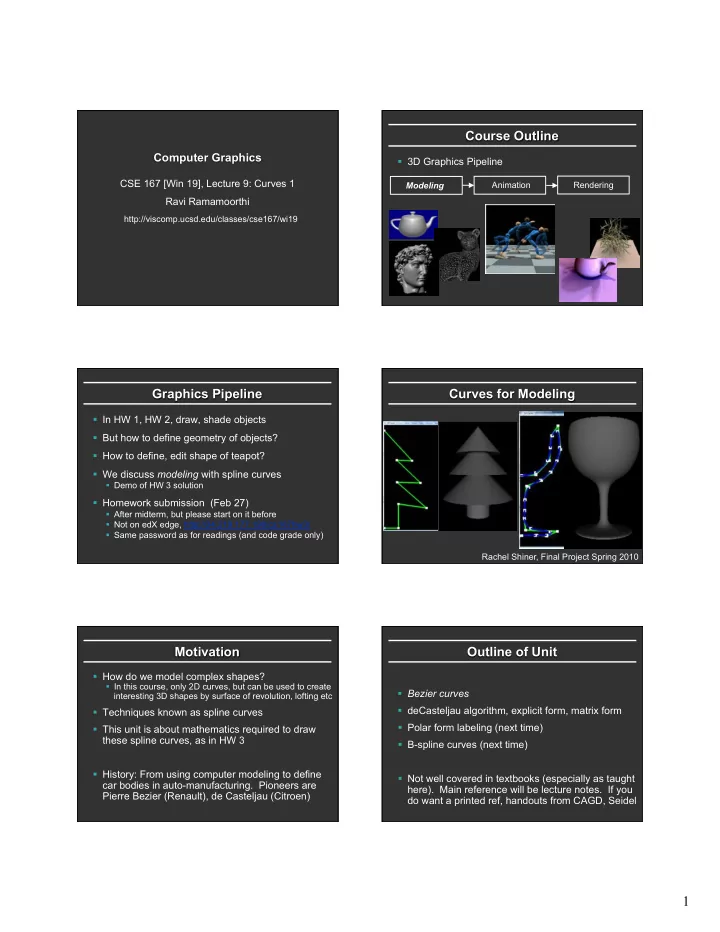
Course Outline Computer Graphics 3D Graphics Pipeline CSE 167 [Win 19], Lecture 9: Curves 1 Modeling Animation Rendering Ravi Ramamoorthi http://viscomp.ucsd.edu/classes/cse167/wi19 Graphics Pipeline Curves for Modeling In HW 1, HW 2,
2
Bezier Curve (with HW3 demo)
§ Motivation: Draw a smooth intuitive curve (or surface) given few key user-specified control points
Demo HW 3
Control points (all that user specifies, edits) Smooth Bezier curve (drawn automatically) Control polygon
Bezier Curve: (Desirable) properties
§ Interpolates, is tangent to end points § Curve within convex hull of control polygon Control points (all that user specifies, edits) Smooth Bezier curve (drawn automatically) Control polygon
Survey
§ Anonymous, know how things are going § Will try to use it to improve course
Issues for Bezier Curves
Main question: Given control points and constraints (interpolation, tangent), how to construct curve? § Algorithmic: deCasteljau algorithm § Explicit: Bernstein-Bezier polynomial basis § 4x4 matrix for cubics § Properties: Advantages and Disadvantages
deCasteljau: Linear Bezier Curve
§ Just a simple linear combination or interpolation (easy to code up, very numerically stable)
Linear (Degree 1, Order 2)
F(0) = P0, F(1) = P1 F(u) = ? P0 P1 P0 P1 1-u u F(u) = (1-u) P0 + u P1 F(0) F(u) F(1)
deCasteljau: Quadratic Bezier Curve
P0 P1 P2 Quadratic Degree 2, Order 3 F(0) = P0, F(1) = P2 F(u) = ? F(u) = (1-u)2 P0 + 2u(1-u) P1 + u2 P2 P0 P1 P2 1-u 1-u u u 1-u u
3
Geometric interpretation: Quadratic
u u u 1-u 1-u
Geometric Interpretation: Cubic
u u u u u u
deCasteljau: Cubic Bezier Curve
P0 P1 P2 P3 Cubic Degree 3, Order 4 F(0) = P0, F(1) = P3 P0 P1 P2 P3
1-u 1-u 1-u u u u u u u 1-u 1-u
F(u) = (1-u)3 P0 +3u(1-u)2 P1 +3u2(1-u) P2 + u3 P3
1-u
Summary: deCasteljau Algorithm
Linear Degree 1, Order 2 F(0) = P0, F(1) = P1
P0 P1 P0 P1 1-u u
F(u) = (1-u) P0 + u P1
P0 P1 P2
Quadratic Degree 2, Order 3 F(0) = P0, F(1) = P2
P0 P1 P2
F(u) = (1-u)2 P0 + 2u(1-u) P1 + u2 P2 1-u 1-u u u 1-u u
P0 P1 P2 P3
Cubic Degree 3, Order 4 F(0) = P0, F(1) = P3
P0 P1 P2 P3
1-u 1-u 1-u u u u u u u 1-u 1-u F(u) = (1-u)3 P0 +3u(1-u)2 P1 +3u2(1-u) P2 + u3 P3 1-u
DeCasteljau Implementation
§ Can be optimized to do without auxiliary storage
Summary of HW3 Implementation
Bezier (Bezier2 and Bspline discussed next time)
§ Arbitrary degree curve (number of control points) § Break curve into detail segments. Line segments for these § Evaluate curve at locations 0, 1/detail, 2/detail, … , 1 § Evaluation done using deCasteljau
§ Key implementation: deCasteljau for arbitrary degree
§ Is anyone confused? About handling arbitrary degree?
§ Can also use alternative formula if you want
§ Explicit Bernstein-Bezier polynomial form (next)
§ Questions?
4
Issues for Bezier Curves
Main question: Given control points and constraints (interpolation, tangent), how to construct curve? § Algorithmic: deCasteljau algorithm § Explicit: Bernstein-Bezier polynomial basis § 4x4 matrix for cubics § Properties: Advantages and Disadvantages
Recap formulae
§ Linear combination of basis functions § Explicit form for basis functions? Guess it?
Linear: F(u) = P
0(1− u) + P 1u
Quadratic: F(u) = P
0(1− u)2 + P 1[2u(1− u)]+ P 2u2
Cubic: F(u) = P
0(1− u)3 + P 1[3u(1− u)2]+ P 2[3u2(1− u)]+ P 3u3
Degree n: F(u) = P
k k
∑
Bk
n(u)
Bk
n(u) areBernstein-Bezier polynomials
Recap formulae
§ Linear combination of basis functions § Explicit form for basis functions? Guess it? § Binomial coefficients in [(1-u)+u]n
Linear: F(u) = P
0(1− u) + P 1u
Quadratic: F(u) = P
0(1− u)2 + P 1[2u(1− u)]+ P 2u2
Cubic: F(u) = P
0(1− u)3 + P 1[3u(1− u)2]+ P 2[3u2(1− u)]+ P 3u3
Degree n: F(u) = P
k k
∑
Bk
n(u)
Bk
n(u) areBernstein-Bezier polynomials
Summary of Explicit Form
Bk
n(u) =
n! k!(n − k)!(1− u)n−kuk
Linear: F(u) = P
0(1− u) + P 1u
Quadratic: F(u) = P
0(1− u)2 + P 1[2u(1− u)]+ P 2u2
Cubic: F(u) = P
0(1− u)3 + P 1[3u(1− u)2]+ P 2[3u2(1− u)]+ P 3u3
Degree n: F(u) = P
k k
∑
Bk
n(u)
Bk
n(u) areBernstein-Bezier polynomials
Issues for Bezier Curves
Main question: Given control points and constraints (interpolation, tangent), how to construct curve? § Algorithmic: deCasteljau algorithm § Explicit: Bernstein-Bezier polynomial basis § 4x4 matrix for cubics § Properties: Advantages and Disadvantages
Cubic 4x4 Matrix (derive)
F(u) = P
0(1− u)3 + P 1[3u(1− u)2]+ P 2[3u2(1− u)]+ P 3u3
= u3 u2 u 1
( )
M = ? ⎛ ⎝ ⎜ ⎜ ⎜ ⎜ ⎞ ⎠ ⎟ ⎟ ⎟ ⎟ P P
1
P
2
P
3
⎛ ⎝ ⎜ ⎜ ⎜ ⎜ ⎜ ⎞ ⎠ ⎟ ⎟ ⎟ ⎟ ⎟
5
Cubic 4x4 Matrix (derive)
F(u) = P
0(1− u)3 + P 1[3u(1− u)2]+ P 2[3u2(1− u)]+ P 3u3
= u3 u2 u 1
( )
−1 3 −3 1 3 −6 3 −3 3 1 ⎛ ⎝ ⎜ ⎜ ⎜ ⎜ ⎞ ⎠ ⎟ ⎟ ⎟ ⎟ P P
1
P
2
P
3