1 The Concept of Fork The Concept of Fork Example: Process - - PDF document

1
SMART_READER_LITE
LIVE PREVIEW

1 The Concept of Fork The Concept of Fork Example: Process - - PDF document

Nachos Exec/Exit/Join Example Nachos Exec/Exit/Join Example SpaceID pid = Exec(myprogram, 0); Create a new process running the Exec parent Exec child program myprogram. The Classical OS Model in Unix The Classical OS Model in Unix


slide-1
SLIDE 1

1

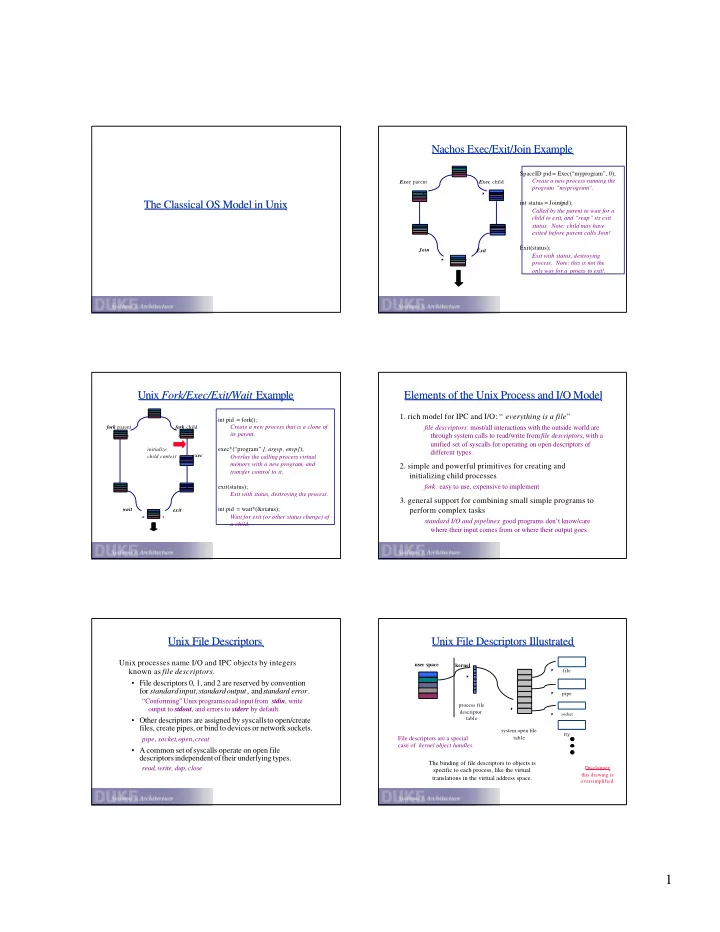
The Classical OS Model in Unix The Classical OS Model in Unix Nachos Exec/Exit/Join Example Nachos Exec/Exit/Join Example

Exec parent Exec child Join Exit

SpaceID pid = Exec(“myprogram”, 0); Create a new process running the program “myprogram”. int status = Join(pid); Called by the parent to wait for a child to exit, and “reap” its exit

  • status. Note: child may have

exited before parent calls Join! Exit(status); Exit with status, destroying

  • process. Note: this is not the
  • nly way for a proess to exit!.

Unix Unix Fork/Exec/Exit/Wait Fork/Exec/Exit/Wait Example Example

fork parent fork child wait exit

int pid = fork(); Create a new process that is a clone of its parent. exec*(“program” [, argvp, envp]); Overlay the calling process virtual memory with a new program, and transfer control to it. exit(status); Exit with status, destroying the process. int pid = wait*(&status); Wait for exit (or other status change) of a child.

exec initialize child context

Elements of the Unix Process and I/O Model Elements of the Unix Process and I/O Model

  • 1. rich model for IPC and I/O: “ everything is a file”

file descriptors: most/all interactions with the outside world are through system calls to read/write from file descriptors, with a unified set of syscalls for operating on open descriptors of different types.

  • 2. simple and powerful primitives for creating and

initializing child processes

fork: easy to use, expensive to implement

  • 3. general support for combining small simple programs to

perform complex tasks

standard I/O and pipelines: good programs don’t know/care where their input comes from or where their output goes

Unix File Descriptors Unix File Descriptors

Unix processes name I/O and IPC objects by integers known as file descriptors.

  • File descriptors 0, 1, and 2 are reserved by convention

for standard input,standard output, and standard error.

“Conforming” Unix programs read input from stdin, write

  • utput to stdout, and errors to stderr by default.
  • Other descriptors are assigned by syscallsto open/create

files, create pipes, or bind to devices or network sockets.

pipe, socket, open,creat

  • A common set ofsyscalls operate on open file

descriptors independent of their underlying types.

read, write, dup, close

Unix File Descriptors Illustrated Unix File Descriptors Illustrated

user space

File descriptors are a special case of kernel object handles.

pipe file

socket

process file descriptor table kernel system open file table tty Disclaimer: this drawing is

  • versimplified.

The binding of file descriptors to objects is specific to each process, like the virtual translations in the virtual address space.

slide-2
SLIDE 2

2

The Concept of Fork The Concept of Fork

The Unix system call for process creation is called fork(). The fork system call creates a child process that is a clone of the parent.

  • Child has a (virtual) copy of the parent’s virtual memory.
  • Child is running the same program as the parent.
  • Child inherits open file descriptors from the parent.

(Parent and child file descriptors point to a common entry in the system open file table.)

  • Child begins life with the same register values as parent.

The child process may execute a different program in its context with a separate exec() system call.

Example: Process Creation in Unix Example: Process Creation in Unix

int pid; int status = 0; if (pid= fork()) { /* parent */ ….. pid = wait(&status); } else { /* child */ ….. exit(status); }

Parent uses wait to sleep until the child exits; wait returns child pid and status. Wait variants allow wait on a specific child, or notification of stops and other signals. The fork syscall returns twice: it returns a zero to the child and the child process ID (pid) to the parent.

What’s So Cool About What’s So Cool About Fork Fork

  • 1. fork is a simple primitive that allows process creation

without troubling with what program to run,args, etc.

Serves some of the same purposes as threads.

  • 2. fork gives the parent program an opportunity to initialize

the child process…especially the open file descriptors.

Unix syscalls for file descriptors operate on the current process. Parent program running in child process context may open/close I/O and IPC objects, and bind them to stdin, stdout, and stderr. Also may modify environment variables, arguments, etc.

  • 3. Using the common fork/exec sequence, the parent (e.g., a command

interpreter or shell) can transparently cause children to read/write from files, terminal windows, network connections, pipes, etc.

Producer/Consumer Pipes Producer/Consumer Pipes

  • utput

input char inbuffer[1024]; char outbuffer[1024]; while (inbytes != 0) { inbytes = read(stdin, inbuffer, 1024);

  • utbytes= process data frominbuffer to outbuffer;

write(stdout, outbuffer, outbytes); } Pipes support a simple form of parallelism with built-in flow control. e.g.: sort <grades |grep Dan | mail sprenkle

Unix as an Extensible System Unix as an Extensible System

“Complex software systems should be built incrementally from components.”

  • independently developed
  • replaceable, interchangeable, adaptable

The power of fork/exec/exit/wait makes Unix highly flexible/extensible...at the application level.

  • write small, general programs and string them together

general stream model of communication

  • this is one reason Unix has survived

These system calls are also powerful enough to implement powerful command interpreters (shell).

The Shell The Shell

The Unix command interpreters run as ordinary user processes with no special privilege.

This was novel at the time Unix was created: other systems viewed the command interpreter as a trusted part of the OS.

Users may select from a range of interpreter programs available, or even write their own (to add to the confusion).

csh, sh,ksh, tcsh, bash: choose your flavor...or use perl.

Shells use fork/exec/exit/wait to execute commands composed

  • f program filenames,args, and I/O redirection symbols.

Shells are general enough to run files of commands (scripts) for more complex tasks, e.g., by redirecting shell’s stdin. Shell’s behavior is guided by environment variables.

slide-3
SLIDE 3

3

Limitations of the Unix Process Model Limitations of the Unix Process Model

The pure Unix model has several shortcomings/limitations:

  • Any setup for a new process must be done in its context.
  • Separated Fork/Execis slow and/or complex to implement.

A more flexible process abstraction would expand the ability

  • f a process to manage another externally.

This is a hallmark of systems that support multiple operating system “personalities” (e.g., NT) and “microkernel” systems (e.g., Mach).

Pipes are limited to transferring linear byte streams between a pair of processes with a common ancestor.

Richer IPC models are needed for complex software systems built as collections of separate programs.

Process Internals Process Internals

+ +

user ID process ID parent PID sibling links children

virtual address space process descriptor

resources

thread stack Each process has a thread bound to the VAS. The thread has a saved user context as well as a system context. The kernel can manipulate the user context to start the thread in user mode wherever it wants. Process state includes a file descriptor table, links to maintain the process tree, and a place to store the exit status. The address space is represented by page table, a set of translations to physical memory allocated from a kernel memory manager. The kernel must initialize the process memory with the program image to run.

Mode Changes for Exec/Exit Mode Changes for Exec/Exit

Syscall traps and “returns” are not always paired.

Exec “returns” (to child) from a trap that “never happened” Exit system call trap never returns system may switch processes between trap and return

In contrast, interrupts and returns are strictly paired.

Exec call Exec entry to user space Exit call Exec return Join call Join return parent child transition from user to kernel mode ( callsys) transition from kernel to user mode ( retsys)

Exec enters the child by doctoring up a saved user context to “return” through.

A Typical Unix File Tree A Typical Unix File Tree

/ tmp usr etc File trees are built by grafting volumes from different volumes

  • r from network servers.

Each volume is a set of directories and files; a host’s file tree is the set of directories and files visible to processes on a given host.

bin vmunix ls sh project users packages (volume root) tex emacs In Unix, the graft operation is the privileged mount system call, and each volume is a filesystem. mount point

mount ( coveredDir, volume) coveredDir: directory pathname volume: devicespecifier or network volume volume root contents become visible at pathname coveredDir

Filesystems Filesystems

Each file volume (filesystem) has a type, determined by its disk layout or the network protocol used to access it.

ufs (ffs), lfs, nfs, rfs, cdfs, etc. Filesystemsare administered independently.

Modern systems also include “logical” pseudo-filesystems in the naming tree, accessible through the file syscalls.

procfs: the /proc filesystem allows access to process internals. mfs: the memory file system is a memory -based scratch store.

Processes access filesystems through common system calls.

Questions Questions

A process is an execution of a program within a private virtual address space (VAS).

  • 1. What are the system calls to operate on processes?
  • 2. How does the kernel maintain the state of a process?

Processes are the “basic unit of resource grouping”.

  • 3. How is the process virtual address space laid out?

What is the relationship between the program and the process?

  • 4. How does the kernel create a new process?

How to allocate physical memory for processes? How to create/initialize the virtual address space?