1 Nearest Neighbor Heuristic Nearest Neighbor Heuristic Start at - - PDF document

1
SMART_READER_LITE
LIVE PREVIEW

1 Nearest Neighbor Heuristic Nearest Neighbor Heuristic Start at - - PDF document

Algorithms: definition &6($OJRULWKPVDQG &RPSXWDWLRQDO&RPSOH[LW\ Procedure to accomplish a task or solve a well-specified problem $OJRULWKPVDQG(IILFLHQF\ Well-specified: know what


slide-1
SLIDE 1

1

1

&6($OJRULWKPVDQG &RPSXWDWLRQDO&RPSOH[LW\ $OJRULWKPVDQG(IILFLHQF\

Winter 2002 Instructor: Larry Ruzzo TA: Justin Campbell TA: Bill Pentney

2

Algorithms: definition

❚ Procedure to accomplish a task or solve a well-specified problem

❙ Well-specified: know what all possible inputs look like and what output looks like given them ❙ Ex: sorting names ❙ Ex: checking for primality

3

Algorithms: an example problem

❚ Printed circuit-board company has a robot arm that solders components to the board ❚ Time to do it depends on

❙ total distance the arm must move from initial rest position around the board and back to the initial positions

❚ For each board design, must figure out good order to do the soldering

4

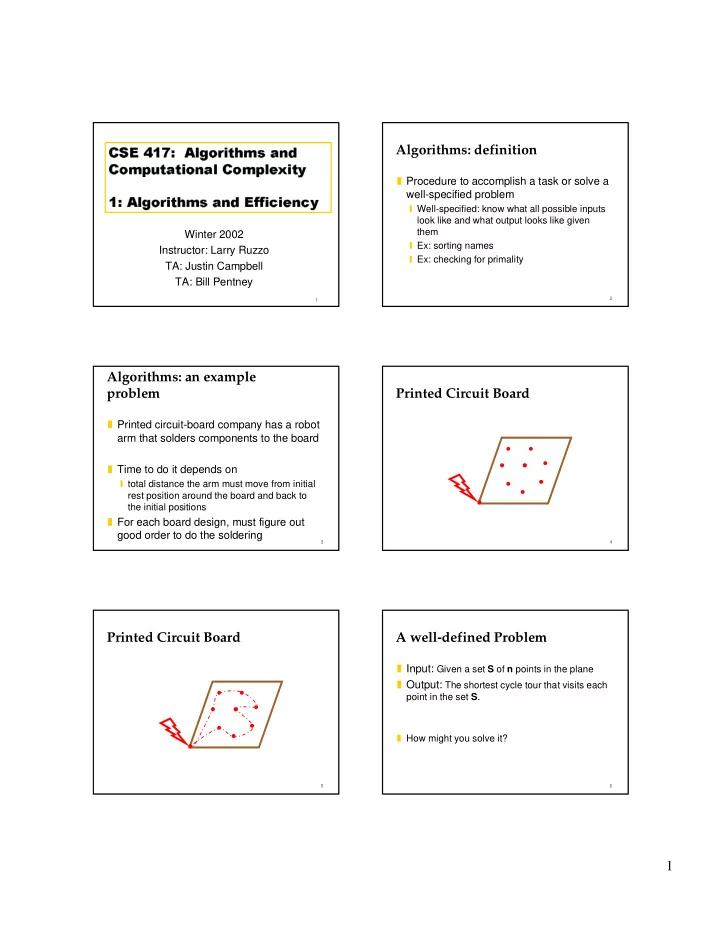
Printed Circuit Board

5

Printed Circuit Board

6

A well-defined Problem

❚ Input: Given a set S of n points in the plane ❚ Output: The shortest cycle tour that visits each

point in the set S. ❚ How might you solve it?

slide-2
SLIDE 2

2

7

Nearest Neighbor Heuristic

❚ Start at some point p0 ❚ Walk first to its nearest neighbor p1 ❚ Repeatedly walk to the nearest unvisited neighbor until all points have been visited ❚ Then walk back to p0

8

Nearest Neighbor Heuristic

p0 p1 p6

9

An input where it works badly

p0 1 1 2 4 8 16

10

Revised idea - Closest Pairs first

❚ Repeatedly pick the closest pair of points to join so that the result can still be part of a single loop in the end

❙ can pick endpoints of line segments already created

❚ How does this work on our bad example?

11

Another bad example

1 1.5 1.5

12

Another bad example

1 1.5 1.5 1+√10 vs 3

slide-3
SLIDE 3

3

13

Something that works

❚ For each of the n! orderings of the points check the length of the cycle you get ❚ Keep the best one

14

Efficiency

❚ The two incorrect algorithms were greedy

❙ they made choices and never reconsidered their choices ❙ often it does not work

❘ when it does the algorithms are typically efficient

❚ Our correct algorithm is incredibly slow

❙ 20! is so large that counting to one billion in a second it would still take 2.4 billion seconds

❘ (around 70 years!)

15

Measuring efficiency: The RAM model

❚ RAM = Random Access Machine ❚ Time ≈ # of instructions executed in an ideal assembly language

❙ each simple operation (+,*,-,=,if,call) takes

  • ne time step

❙ each memory access takes one time step

❚ No bound on the memory

16

We left out things but...

❚ Things we’ve dropped

❙ memory hierarchy

❘ disk, caches, registers have many orders of magnitude differences in access time

❙ not all instructions take the same time in practice

❚ However,

❙ the RAM model is useful for designing algorithms and measuring their efficiency ❙ one can usually tune implementations so that the hierarchy etc. is not a huge factor

17

Efficiency: What kind of analysis?

❚ Problem size n

❙ Worst-case complexity: max # steps algorithm takes on any input of size n ❙ Best-case complexity: min # steps algorithm takes on any input of size n ❙ Average-case complexity: avg # steps algorithm takes on inputs of size n

18

Pros and cons:

❚ Best-case

❙ unrealistic overselling ❙ can tune an algorithm so it works on one easy input

❚ Worst-case

❙ a fast algorithm has a comforting guarantee ❙ no way to cheat by hard-coding special cases ❙ maybe too pessimistic

❚ Average-case

❙ over what distribution? ❙ different people may have different average problems