1 Related Work Related Work State-based Specifications Timed - - PDF document

1
SMART_READER_LITE
LIVE PREVIEW

1 Related Work Related Work State-based Specifications Timed - - PDF document

Motivation Deep space exploration: Mars Polar Lander (NASA) highly uncertain environment Timed Model-based Programming: require highly robust system Executable Specifications for Mission-critical sequences: Robust Critical Sequences


slide-1
SLIDE 1

1

Timed Model-based Programming: Executable Specifications for Robust Critical Sequences

Michel D. Ingham Brian C. Williams

Model-based Embedded Robotic Systems Group MIT Space Systems Laboratory MIT Artificial Intelligence Laboratory June 10th, 2003

Deep space exploration:

  • highly uncertain environment
  • require highly robust system

Mission-critical sequences:

  • launch & deployment
  • planetary fly-by
  • orbital insertion
  • entry, descent & landing

Motivation

Mars Polar Lander (NASA)

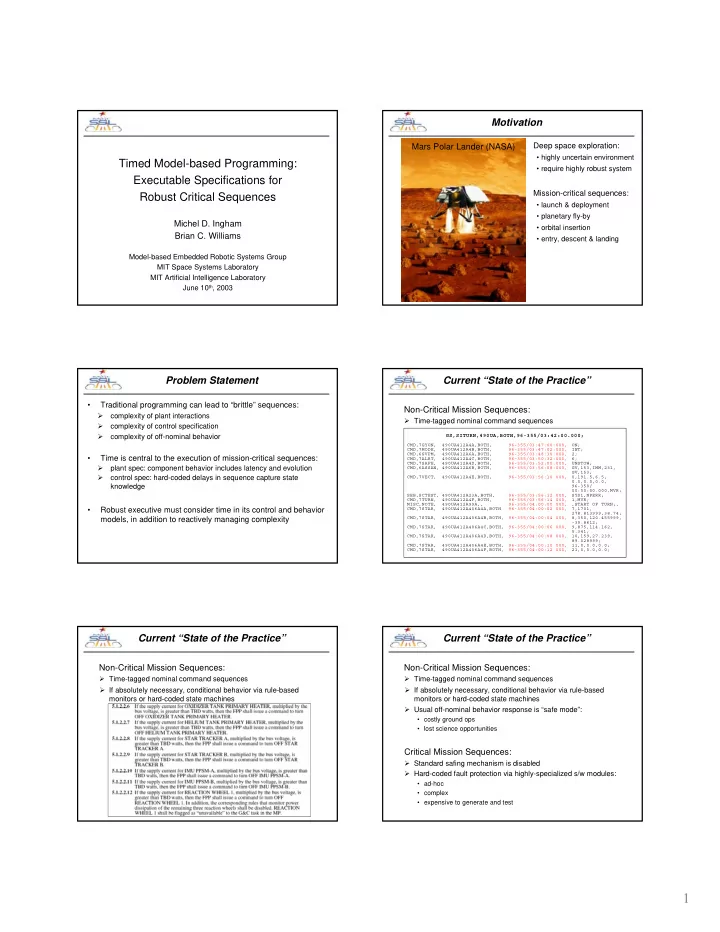
Problem Statement

  • Traditional programming can lead to “brittle” sequences:
  • complexity of plant interactions
  • complexity of control specification
  • complexity of off-nominal behavior
  • Time is central to the execution of mission-critical sequences:
  • plant spec: component behavior includes latency and evolution
  • control spec: hard-coded delays in sequence capture state

knowledge

  • Robust executive must consider time in its control and behavior

models, in addition to reactively managing complexity

Current “State of the Practice”

Non-Critical Mission Sequences:

Time-tagged nominal command sequences

GS,SITURN,490UA,BOTH,96-355/03:42:00.000;

CMD,7GYON, 490UA412A4A,BOTH, 96-355/03:47:00:000, ON; CMD,7MODE, 490UA412A4B,BOTH, 96-355/03:47:02:000, INT; CMD,6SVPM, 490UA412A6A,BOTH, 96-355/03:48:30:000, 2; CMD,7ALRT, 490UA412A4C,BOTH, 96-355/03:50:32:000, 6; CMD,7SAFE, 490UA412A4D,BOTH, 96-355/03:52:00:000, UNSTOW; CMD,6ASSAN, 490UA412A6B,BOTH, 96-355/03:56:08:000, GV,153,IMM,231, GV,153; CMD,7VECT, 490UA412A4E,BOTH, 96-355/03:56:10.000, 0,191.5,6.5, 0.0,0.0,0.0, 96-350/ 00:00:00.000,MVR; SEB,SCTEST, 490UA412A23A,BOTH, 96-355/03:56:12.000, SYS1,NPERR; CMD,7TURN, 490UA412A4F,BOTH, 96-355/03:56:14.000, 1,MVR; MISC,NOTE, 490UA412A99A,, 96-355/04:00:00.000, ,START OF TURN;, CMD,7STAR, 490UA412A406A4A,BOTH 96-355/04:00:02.000, 7,1701, 278.813999,38.74; CMD,7STAR, 490UA412A406A4B,BOTH, 96-355/04:00:04.000, 8,350,120.455999,

  • 39.8612;

CMD,7STAR, 490UA412A406A4C,BOTH, 96-355/04:00:06.000, 9,875,114.162, 5.341; CMD,7STAR, 490UA412A406A4D,BOTH, 96-355/04:00:08.000, 10,159,27.239, 89.028999; CMD,7STAR, 490UA412A406A4E,BOTH, 96-355/04:00:10.000, 11,0,0.0,0.0; CMD,7STAR, 490UA412A406A4F,BOTH, 96-355/04:00:12.000, 21,0,0.0,0.0;

If absolutely necessary, conditional behavior via rule-based monitors or hard-coded state machines

Current “State of the Practice”

Non-Critical Mission Sequences:

Time-tagged nominal command sequences

Critical Mission Sequences:

Standard safing mechanism is disabled Hard-coded fault protection via highly-specialized s/w modules:

  • ad-hoc
  • complex
  • expensive to generate and test

Usual off-nominal behavior response is “safe mode”:

  • costly ground ops
  • lost science opportunities

If absolutely necessary, conditional behavior via rule-based monitors or hard-coded state machines

Current “State of the Practice”

Non-Critical Mission Sequences:

Time-tagged nominal command sequences

slide-2
SLIDE 2

2

Related Work

Model-based Programming Timed Formal Modeling TMBP Timed Control Programs, Timed Plant Models, Semi-Markov Semantics RMPL and Control Sequencer State-based Specifications Robotic Execution Constraint Programming Synchronous Programming Model-based Execution Deductive Estimation & Control Constraint Modeling Goal-driven, Closed-loop Control Visual Representations Embedded Programming Constructs Mission Data System Non-deterministic Timed Transitions

Related Work

  • State-based Specifications

– StateCharts (Harel, ‘87) – Timed StateCharts (Kesten & Pnueli, ‘92)

  • Synchronous Programming

– Esterel (Berry & Gonthier, ‘92) – Lustre (Halbwachs, ‘93)

  • Constraint Programming

– TCC (Saraswat, Jagadeesan & Gupta, ‘94)

  • Robotic Execution

– RAPs (Firby, ‘89) – ESL (Gat, ‘96) – TDL (Simmons, ‘98)

  • Timed Formal Modeling

– Timed Transition Systems (Henzinger, Manna, & Pnueli, ‘92) – Timed Automata (Alur & Dill, ‘94)

  • Model-based Execution

– GDE, Sherlock (deKleer & Williams, ‘87-’89) – Livingstone (Williams & Nayak, ‘96- ‘97) – Livingstone2 (Kurien & Nayak, ‘00)

  • Model-based Programming

– RBurton (Williams & Gupta, ‘99) – Titan (Williams, Ingham, Chung & Elliott, ‘03)

  • Mission Data System

– MDS (Dvorak, Rasmussen, et al., ‘00)

Principal Contributions

  • 1. Language definition
  • Textual & graphical programming languages for control spec
  • Extension of plant modeling language to capture timed effects
  • 2. Formal execution semantics
  • Plant modeled as factored Partially Observable Semi-Markov Decision

Process (POSMDP)

  • Control program expressed as timed deterministic automaton
  • Execution defined in terms of legal plant state evolutions
  • 3. Algorithm specification & implementation
  • Execution of timed control specifications
  • Reasoning on timed plant models (for estimation and reconfiguration)
  • 4. Architecture design & implementation
  • Modular, state-based & fault-aware
  • Demonstrated on representative mission scenario

Objectives & Outline

  • Timed Model-based Execution “in a nutshell”
  • Timed Model-based Programming:

a visual programming paradigm

  • Illustration of Timed Model-based Execution
  • Execution semantics
  • Executive implementation
  • Contributions and future directions

Capability Overview Technical Details

Objectives & Outline

  • Timed Model-based Execution “in a nutshell”
  • Timed Model-based Programming:

a visual programming paradigm

  • Illustration of Timed Model-based Execution
  • Execution semantics
  • Executive implementation
  • Conclusions

Objectives & Outline

  • Timed Model-based Execution “in a nutshell”
  • Timed Model-based Programming:

a visual programming paradigm

  • Illustration of Timed Model-based Execution
  • Execution semantics
  • Executive implementation
  • Conclusions
slide-3
SLIDE 3

3

Mars Entry Sequence: State-based Specification

engine to standby planetary approach switch to inertial nav rotate to entry-orient & hold attitude separate lander

(Loosely based on Mars Polar Lander Entry Sequence) Descent engine to “standby”: heating

Mars Entry Sequence: State-based Specification

engine to standby planetary approach separate lander switch to inertial nav rotate to entry-orient & hold attitude

  • ff

standby Descent engine to “standby”: heating 30-60 sec

  • ff

standby

Mars Entry Sequence: State-based Specification

engine to standby planetary approach separate lander switch to inertial nav rotate to entry-orient & hold attitude

Mars Entry Sequence: State-based Specification

engine to standby

Spacecraft approach:

  • 270 mins delay
  • Relative position wrt Mars not
  • bservable
  • Based on ground computations
  • f cruise trajectory

planetary approach separate lander switch to inertial nav rotate to entry-orient & hold attitude

Mars Entry Sequence: State-based Specification

engine to standby planetary approach separate lander switch to inertial nav rotate to entry-orient & hold attitude

Switch navigation mode:

“Earth-relative” = Star Tracker + IMU

Switch navigation mode:

“Inertial” = IMU only

Mars Entry Sequence: State-based Specification

engine to standby

Rotate spacecraft:

  • Command ACS to entry orientation

planetary approach separate lander switch to inertial nav rotate to entry-orient & hold attitude

slide-4
SLIDE 4

4

Mars Entry Sequence: State-based Specification

engine to standby

Rotate spacecraft:

  • Once entry orientation achieved,

ACS holds attitude

planetary approach separate lander switch to inertial nav rotate to entry-orient & hold attitude

Mars Entry Sequence: State-based Specification

engine to standby

Separate lander from cruise stage:

planetary approach separate lander switch to inertial nav rotate to entry-orient & hold attitude

cruise stage lander stage pyro latches

Mars Entry Sequence: State-based Specification

engine to standby planetary approach separate lander switch to inertial nav rotate to entry-orient & hold attitude

Separate lander from cruise stage:

  • When entry orientation achieved,

fire primary pyro latch

cruise stage lander stage pyro latches

Mars Entry Sequence: State-based Specification

engine to standby planetary approach separate lander switch to inertial nav rotate to entry-orient & hold attitude

Separate lander from cruise stage:

  • When entry orientation achieved,

fire primary pyro latch

cruise stage lander stage

Mars Entry Sequence: State-based Specification

engine to standby planetary approach separate lander switch to inertial nav rotate to entry-orient & hold attitude

Separate lander from cruise stage:

  • In case of failure of primary latch,

fire backup pyro latch

cruise stage lander stage

Mars Entry Sequence: State-based Specification

engine to standby planetary approach separate lander switch to inertial nav rotate to entry-orient & hold attitude

Separate lander from cruise stage:

  • In case of failure of primary latch,

fire backup pyro latch

cruise stage lander stage

slide-5
SLIDE 5

5

Key Features of Executive

engine to standby planetary approach switch to inertial nav rotate to entry-orient & hold attitude separate lander

  • Simple state-based control

specifications

  • Models are writable/inspectable by

systems engineers

  • Handle timed plant & control behavior
  • Automated reasoning through low-

level plant interactions

  • Fault-aware (in-the-loop recoveries)

TMBP for Mars Science Lab MSL Mission (2009)

courtesy NASA JPL

Objectives & Outline

  • Timed Model-based Execution “in a nutshell”
  • Timed Model-based Programming:

a visual programming paradigm

  • Illustration of Timed Model-based Execution
  • Execution semantics
  • Executive implementation
  • Conclusions

Plant

Commands Observations

Timed Model-based Program Timed Model-based Executive

System Clock

Timed Model-based Program Timed Model-based Program

Plant

Commands Observations

Timed Model-based Program Timed Model-based Executive

System Clock Plant Model Timed Control Program

Timed Hierarchical Constraint Automata

nav= inertial t2 < 4 mins lander= separated att=entry-orient att=entry-orient t2 >= 4 mins att= entry-

  • rient

MAINTAIN entry = initiated t2=0 t1 < 270mins t1 >= 270mins t1=0 engine= standby 1 2 3 4 5 6 7 8 9 10 11 12

  • Graphical specification language for control programs,

in spirit of Timed StateCharts

  • Writable, inspectable by systems engineers

composite locations primitive locations compact encoding: multiple locations can be simultaneously marked

Mars Entry control program

slide-6
SLIDE 6

6

Timed Hierarchical Constraint Automata

nav= inertial t2 < 4 mins lander= separated att=entry-orient att=entry-orient t2 >= 4 mins att= entry-

  • rient

MAINTAIN entry = initiated t2=0 t1 < 270mins t1 >= 270mins t1=0 engine= standby 1 2 3 4 5 6 7 8 9 10 11 12

  • Graphical specification language for control programs,

in spirit of Timed StateCharts

  • Writable, inspectable by systems engineers

goal constraint (hidden state) clock initialization act on hidden state clocks provide timing mechanism

Mars Entry control program

Timed Hierarchical Constraint Automata

nav= inertial t2 < 4 mins lander= separated att=entry-orient att=entry-orient t2 >= 4 mins att= entry-

  • rient

MAINTAIN entry = initiated t2=0 t1 < 270mins t1 >= 270mins t1=0 engine= standby 1 2 3 4 5 6 7 8 9 10 11 12

  • Graphical specification language for control programs,

in spirit of Timed StateCharts

  • Writable, inspectable by systems engineers

conditioned on time & state constraints transition transition guard maintenance constraint

Mars Entry control program

Plant

Commands Observations

Timed Model-based Program Timed Model-based Executive

System Clock Plant Model Timed Control Program

Timed Model-based Program Concurrent Constraint Automata

  • Variant of Factored POMDP (state not directly observable,

next state depends on current state)

Engine:

Off Firing Standby cmd = standby cmd = fire Failed cmd =

  • ff

Camera:

cmd = standby

(power = off) AND (thrust = zero) (power = on) AND (thrust = zero) AND (temp = nominal) (power = on) AND (thrust = full) AND (temp = nominal)

Heating

(power = on) AND (thrust = zero)

cmd = off temp = nominal Inactive Taking Picture Idle cmd = camOn cmd = takePicture Stuck Shutter cmd = camOff

(power = off) AND (shutter = closed) (power = on) AND (shutter = open) (power = on) AND (shutter = closed) (power = on) AND (shutter = closed) unconstraned

modal constraints nominal modes fault modes modal rewards guarded probabilistic transitions Pτ = 99.9% Pτ = 0.1%

Timed Concurrent Constraint Automata

  • Variant of Factored POSMDP (state not directly observable,

next state depends on current state & time spent in state)

  • Extend Concurrent Constraint Automata to timed behavior

Engine:

Off Firing Standby cmd = standby cmd = fire Failed cmd =

  • ff

Camera:

cmd = standby

(power = off) AND (thrust = zero) (power = on) AND (thrust = zero) AND (temp = nominal) (power = on) AND (thrust = full) AND (temp = nominal)

Heating

(power = on) AND (thrust = zero) AND (temp = increasing)

cmd = off tE>=30 & tE<=60 Inactive Taking Picture Idle cmd = camOn cmd = takePicture Stuck Shutter cmd = camOff

(power = off) AND (shutter = closed) (power = on) AND (shutter = open)

tC>=0.1 & tC<=0.2

(power = on) AND (shutter = closed) (power = on) AND (shutter = closed) unconstraned

pτ(t) t

0.1 0.2

Objectives & Outline

  • Timed Model-based Execution “in a nutshell”
  • Timed Model-based Programming:

a visual programming paradigm

  • Illustration of Timed Model-based Execution
  • Execution semantics
  • Executive implementation
  • Conclusions
slide-7
SLIDE 7

7

Timed Model-based Executive Architecture

Plant

Commands Configuration goals Observations

Control Sequencer

State estimates

Plant Model Timed Control Program

Deductive Controller Timed Model-based Program Timed Model-based Executive

System Clock

Mode Estimation Mode Reconfiguration estimates State

Clocks Timers

Mars Entry Example

nav= inertial t2 < 4 mins lander= separated att=entry-orient att=entry-orient t2 >= 4 mins att= entry-

  • rient

MAINTAIN entry = initiated t2=0 t1 < 270mins t1 >= 270mins t1=0 engine= standby 1 2 3 4 5 6 7 8 9 10 11 12

engine to standby planetary approach switch to inertial nav rotate to entry-orient & hold attitude separate lander

Mars Entry Example

nav= inertial t2 < 4 mins lander= separated att=entry-orient att=entry-orient t2 >= 4 mins att= entry-

  • rient

MAINTAIN entry = initiated t2=0 t1 < 270mins t1 >= 270mins t1=0 engine= standby 1 2 3 4 5 6 7 8 9 10 11 12

engine to standby planetary approach switch to inertial nav rotate to entry-orient & hold attitude separate lander

Control Sequencer executes THCA

Mars Entry Example

nav= inertial t2 < 4 mins lander= separated att=entry-orient att=entry-orient t2 >= 4 mins att= entry-

  • rient

MAINTAIN entry = initiated t2=0 t1 < 270mins t1 >= 270mins t1=0 engine= standby 1 2 3 4 5 6 7 8 9 10 11 12

engine to standby planetary approach switch to inertial nav rotate to entry-orient & hold attitude separate lander

Engine:

Off Firing Standby cmd = standby cmd = fire Failed cmd = off cmd = standby

(power = off) AND (thrust = zero) (power = on) AND (thrust = zero) AND (temp = nominal) (power = on) AND (thrust = full) AND (temp = nominal)

Heating

(power = on) AND (thrust = zero)

cmd = off temp = nominal

Deductive Controller provides state estimates and command sequences that achieve goals

Obs: Goal: Standby

Mars Entry Example

nav= inertial t2 < 4 mins lander= separated att=entry-orient att=entry-orient t2 >= 4 mins att= entry-

  • rient

MAINTAIN entry = initiated t2=0 t1 < 270mins t1 >= 270mins t1=0 engine= standby 1 2 3 4 5 6 7 8 9 10 11 12

engine to standby planetary approach switch to inertial nav rotate to entry-orient & hold attitude separate lander

Engine:

Off Firing Standby cmd = standby cmd = fire Failed cmd = off cmd = standby

(power = off) AND (thrust = zero) (power = on) AND (thrust = zero) AND (temp = nominal) (power = on) AND (thrust = full) AND (temp = nominal)

Heating

(power = on) AND (thrust = zero) AND (temp = increasing)

cmd = off tE>=30 & tE<=60

Deductive Controller provides state estimates and command sequences that achieve goals

t

30 60

pτ(t) Obs: Goal: Standby

Mars Entry Example

nav= inertial t2 < 4 mins lander= separated att=entry-orient att=entry-orient t2 >= 4 mins att= entry-

  • rient

MAINTAIN entry = initiated t2=0 t1 < 270mins t1 >= 270mins t1=0 engine= standby 1 2 3 4 5 6 7 8 9 10 11 12

engine to standby planetary approach switch to inertial nav rotate to entry-orient & hold attitude separate lander

slide-8
SLIDE 8

8

Mars Entry Example

nav= inertial t2 < 4 mins lander= separated att=entry-orient att=entry-orient t2 >= 4 mins att= entry-

  • rient

MAINTAIN entry = initiated t2=0 t1 < 270mins t1 >= 270mins t1=0 engine= standby 1 2 3 4 5 6 7 8 9 10 11 12

engine to standby planetary approach switch to inertial nav rotate to entry-orient & hold attitude separate lander

Mars Entry Example

nav= inertial t2 < 4 mins lander= separated att=entry-orient att=entry-orient t2 >= 4 mins att= entry-

  • rient

MAINTAIN entry = initiated t2=0 t1 < 270mins t1 >= 270mins t1=0 engine= standby 1 2 3 4 5 6 7 8 9 10 11 12

engine to standby planetary approach switch to inertial nav rotate to entry-orient & hold attitude separate lander

Mars Entry Example

nav= inertial t2 < 4 mins lander= separated att=entry-orient att=entry-orient t2 >= 4 mins att= entry-

  • rient

MAINTAIN entry = initiated t2=0 t1 < 270mins t1 >= 270mins t1=0 engine= standby 1 2 3 4 5 6 7 8 9 10 11 12

engine to standby planetary approach switch to inertial nav rotate to entry-orient & hold attitude separate lander

Mars Entry Example

nav= inertial t2 < 4 mins lander= separated att=entry-orient att=entry-orient t2 >= 4 mins att= entry-

  • rient

MAINTAIN entry = initiated t2=0 t1 < 270mins t1 >= 270mins t1=0 engine= standby 1 2 3 4 5 6 7 8 9 10 11 12

engine to standby planetary approach switch to inertial nav rotate to entry-orient & hold attitude separate lander

Mars Entry Example

nav= inertial t2 < 4 mins lander= separated att=entry-orient att=entry-orient t2 >= 4 mins att= entry-

  • rient

MAINTAIN entry = initiated t2=0 t1 < 270mins t1 >= 270mins t1=0 engine= standby 1 2 3 4 5 6 7 8 9 10 11 12

engine to standby planetary approach switch to inertial nav rotate to entry-orient & hold attitude separate lander

Mars Entry Example

nav= inertial t2 < 4 mins lander= separated att=entry-orient att=entry-orient t2 >= 4 mins att= entry-

  • rient

MAINTAIN entry = initiated t2=0 t1 < 270mins t1 >= 270mins t1=0 engine= standby 1 2 3 4 5 6 7 8 9 10 11 12

engine to standby planetary approach switch to inertial nav rotate to entry-orient & hold attitude separate lander

slide-9
SLIDE 9

9

Mars Entry Example

nav= inertial t2 < 4 mins lander= separated att=entry-orient att=entry-orient t2 >= 4 mins att= entry-

  • rient

MAINTAIN entry = initiated t2=0 t1 < 270mins t1 >= 270mins t1=0 engine= standby 1 2 3 4 5 6 7 8 9 10 11 12

engine to standby planetary approach switch to inertial nav rotate to entry-orient & hold attitude separate lander

Mars Entry Example

nav= inertial t2 < 4 mins lander= separated att=entry-orient att=entry-orient t2 >= 4 mins att= entry-

  • rient

MAINTAIN entry = initiated t2=0 t1 < 270mins t1 >= 270mins t1=0 engine= standby 1 2 3 4 5 6 7 8 9 10 11 12

engine to standby planetary approach switch to inertial nav rotate to entry-orient & hold attitude separate lander

Mars Entry Example

nav= inertial t2 < 4 mins lander= separated att=entry-orient att=entry-orient t2 >= 4 mins att= entry-

  • rient

MAINTAIN entry = initiated t2=0 t1 < 270mins t1 >= 270mins t1=0 engine= standby 1 2 3 4 5 6 7 8 9 10 11 12

engine to standby planetary approach switch to inertial nav rotate to entry-orient & hold attitude separate lander

Mars Entry Example

nav= inertial t2 < 4 mins lander= separated att=entry-orient att=entry-orient t2 >= 4 mins att= entry-

  • rient

MAINTAIN entry = initiated t2=0 t1 < 270mins t1 >= 270mins t1=0 engine= standby 1 2 3 4 5 6 7 8 9 10 11 12

engine to standby planetary approach switch to inertial nav rotate to entry-orient & hold attitude separate lander

Model-based executive provides robustness in the goal-driven control loop

Obs: Goal: Separated Lander:

Connected pyro_cmd = fire-primary Failed Separated

0.0001

(primary_pyro = not-fired) AND (backup_pyro = not-fired)

Unsuccessful Attempt

(primary_pyro = fired) OR (backup_pyro = fired) (primary_pyro = misfired) AND (backup_pyro = not-fired)

pyro_cmd = fire-backup

0.001 0.0001

primary pyro misfired! backup pyro fired

Mars Entry Example

nav= inertial t2 < 4 mins lander= separated att=entry-orient att=entry-orient t2 >= 4 mins att= entry-

  • rient

MAINTAIN entry = initiated t2=0 t1 < 270mins t1 >= 270mins t1=0 engine= standby 1 2 3 4 5 6 7 8 9 10 11 12

engine to standby planetary approach switch to inertial nav rotate to entry-orient & hold attitude separate lander

Mars Entry Example

nav= inertial t2 < 4 mins lander= separated att=entry-orient att=entry-orient t2 >= 4 mins att= entry-

  • rient

MAINTAIN entry = initiated t2=0 t1 < 270mins t1 >= 270mins t1=0 engine= standby 1 2 3 4 5 6 7 8 9 10 11 12

engine to standby planetary approach switch to inertial nav rotate to entry-orient & hold attitude separate lander

slide-10
SLIDE 10

10

Mars Entry Example

nav= inertial t2 < 4 mins lander= separated att=entry-orient att=entry-orient t2 >= 4 mins att= entry-

  • rient

MAINTAIN entry = initiated t2=0 t1 < 270mins t1 >= 270mins t1=0 engine= standby 1 2 3 4 5 6 7 8 9 10 11 12

engine to standby planetary approach switch to inertial nav rotate to entry-orient & hold attitude separate lander

Complete EDL Scenario

  • Proof-of-concept on a representative mission scenario:

“Full” Entry, Descent and Landing scenario

  • Control program (57 locations, 16 state vars, 6 clock vars)
  • Plant model (~25 components, avg. 3-4 modes per component)

alt: 4600 km

guidance system initialization

alt: 3000 km

command turn to entry attitude

alt: 2300 km

cruise ring separation

alt: 125 km

atmospheric entry

alt: 8800 m

parachute deployment

alt: 7500 m

heatshield jettison

alt: < 7500 m

leg deployment

alt: 2500 m

radar ground acquisition

alt: 1300 m

backshell separation

alt: 40 m

radar power off

alt: 0 m

touchdown

EDL Scenario Highlights Key Capabilities

  • Nominal operations:

– Execution conditioned on state constraints – Execution conditioned on time constraints – Nominal mode tracking through commanded and timed transitions – Accept configuration goal and generate appropriate command sequence (single-step, multi-step reconfigurations)

  • Operations in the presence of faults:

– Fault diagnosis through commanded transitions – Fault diagnosis through timed transitions – Recovery by repair (deductive controller) – Recovery by leveraging physical/functional redundancy (control sequencer, deductive controller)

Objectives & Outline

  • Timed Model-based Execution “in a nutshell”
  • Timed Model-based Programming:

a visual programming paradigm

  • Illustration of Timed Model-based Execution
  • Execution semantics
  • Executive implementation
  • Conclusions

Plant

Commands Configuration goals Observations

Control Sequencer

State estimates

Plant Model Timed Control Program

Deductive Controller Timed Model-based Program Timed Model-based Executive

System Clock

Mode Estimation Mode Reconfiguration estimates State

Clocks Timers

TMBP Semantics Plant Model

  • Variables:
  • Factored POMDP:

, , , , , PM P P P R

Θ Τ Ο

= Σ Τ

{ }

, ,

s c

  • Π = Π Π Π

state vars control vars

  • bs

vars

transitions

:

s

τ Σ → Σ

initial state prob ( ) P s

Θ

transition prob ( '| , ) P s s µ

Τ

  • bs prob

( | ) P o s

Ο

state reward ( ) R s

Σ: full assignments σ

  • ver all vars in Π

Σs: plant states s Σc: control actions µ Σo: observations o

slide-11
SLIDE 11

11

  • Variables:
  • Factored POSMDP:

Timed Plant Model

, , , , , TPM P P P R

Θ Τ Ο

= Σ Τ

{ }

, , ,

s c t

  • Π = Π Π Π

Π

add Σt , set of assignments ν

  • ver all plant

timers in Πt transitions conditioned on ν upon transition, subset

  • f timers are reset

:

s t

τ Σ → Σ ×Σ

transition prob ( '| , , ) P s s µ ν

Τ

timer vars

Mode Estimation

  • Given latest commands and observations, what is the

most likely current state?

  • Belief state update to estimate state for POMDPs:

s(0) s(1) s(t-1) s(t) ^ ^ ^ ^

( 1 ) 1

[ ]

i

p s

+ • ( 1 ) 2

[ ]

i

p s

+ • ( 1 ) 3

[ ]

i

p s

+ •

most likely state sj chosen as s(t) ^

( 1) ( ) 1 ( 1) ( 1 ) ( 1) ( 1) ( 1) 1

[ ] [ ]P ( | , ) P ( | ) [ ] [ ] [ ]P ( | )

n i i l k l k k i i i l l l n i i k k k

p s p s s s

  • s

p s p s p s

  • s

µ

  • +
  • Τ

= + + •

  • +

Ο

  • +

+ Ο =

= =

∑ ∑

current belief state

Mode Reconfiguration

  • Given current belief state and configuration goal, what is

the first control action from a policy that maximizes expected reward?

  • Solve Bellman equation to compute optimal policy for

POMDPs:

* 1 * * T

( ) max π π ( ) arg max ( ) P ( '| ,µ) V ( ') µ '

i i i g

V s E r s R s s s s s S γ γ

∞ =

⎡ ⎤ = ⎢ ⎥ ⎣ ⎦ ⎡ ⎤ ⎢ ⎥ = + ⎢ ⎥ ∈ ⎣ ⎦

∑ ∑

s(0) s(1) s(t-1) s(t) ^ ^ ^ ^

µ Optimal policy π∗:

goal state sg is max-reward reachable state that satisfies the

  • config. goal

Timed ME & MR

  • Problem:

For factored POSMDP, next state depends on current state, current control actions AND current timer values

  • Key Insight:

Define “system state” = plant states ∪ plant timers

  • Timed ME can now use same belief state update

equations, where s is now the system state

  • Timed MR finds optimal policy based on system state,

defines “wait” actions to accommodate non-deterministic timed transitions

Timed Control Program

  • Control program:

– program locations: – clocks: – deterministic automaton:

, , , , , ,

cp cp cp cp cp s cp

TCP L g λ τ ι = Σ Ω

t cp

Π

cp

L

initial program location transitions between locations, conditioned on state & current clock values

  • config. goal

( )

cp s

g l ⊂ Σ

clock init.

( )

t cp cp

l ι ⊂ Π

assignments ω to all clocks in

t cp

Π

Executive Semantics

  • Interleaving model of execution

cycle = discrete event + continuous phase

  • Legal execution of TMBP:

Such that: 1. initial conditions are valid 2. next state is legal 3. next program location is legal 4. next clock values are legal Pgm clocks Pgm location Plant state … Cycle start time

l ω ˆ s t

1

t ( )

( )

ˆ 0, for all clocks

cp t t

P s l x x λ ω

Θ

> = =

slide-12
SLIDE 12

12

Executive Semantics

  • Interleaving model of execution

cycle = discrete event + continuous phase

  • Legal execution of TMBP:

Such that: 1. initial conditions are valid 2. next state is legal 3. next program location is legal 4. next clock values are legal Pgm clocks Pgm location Plant state … Cycle start time

l ω ˆ s t

1

t

1

ˆ s ( ) ( )

1 1

( ) ˆ , , ˆ ˆ , , , ,

cp

g g l MR PM s g s ME PM s

  • µ

µ ω = = =

Executive Semantics

  • Interleaving model of execution

cycle = discrete event + continuous phase

  • Legal execution of TMBP:

Such that: 1. initial conditions are valid 2. next state is legal 3. next program location is legal 4. next clock values are legal Pgm clocks Pgm location Plant state … Cycle start time

l ω ˆ s t

1

t

1

ˆ s

1

ˆ ( , , )

cp

l l s τ ω =

1

l

→ →

Executive Semantics

  • Interleaving model of execution

cycle = discrete event + continuous phase

  • Legal execution of TMBP:

Such that: 1. initial conditions are valid 2. next state is legal 3. next program location is legal 4. next clock values are legal Pgm clocks Pgm location Plant state … Cycle start time

l ω ˆ s t

1

t

1

, where

ME MR CS

t t t t t ω ω = +∆ ∆ = + +

1

ω

1

l

1

ˆ s

1

l

→ →

1

ˆ s

Executive Semantics

  • Interleaving model of execution

cycle = discrete event + continuous phase

  • Legal execution of TMBP:

Such that: 1. initial conditions are valid 2. next state is legal 3. next program location is legal 4. next clock values are legal Pgm clocks Pgm location Plant state … Cycle start time

l ω ˆ s t

1

t

1

ω

1

l

… … …

1

ˆ s

→ → 1

ˆ s

1

l

→ → 2

ˆ s

2

l

Implementation Approximations

Mode Estimation:

  • Full belief state update is computationally infeasible
  • Assume probability of a few most-likely states dominates probability
  • f other possible states
  • Track a limited set of most-likely states, from one cycle to the next

Mode Reconfiguration:

  • Assume probability of nominal behavior dominates off-nominal
  • Assume reward of being in goal state dominates reward of getting

to goal state

  • Perform MR in 2 steps:

– Goal Interpretation: find the max-reward goal state, reachable via nominal transitions, that satisfies the configuration goal – Reactive Planning: returns series of control actions that achieve the goal state

Objectives & Outline

  • Timed Model-based Execution “in a nutshell”
  • Timed Model-based Programming:

a visual programming paradigm

  • Illustration of Timed Model-based Execution
  • Execution semantics
  • Executive implementation
  • Conclusions
slide-13
SLIDE 13

13

Plant

Commands Configuration goals Observations

Control Sequencer

State estimates

Plant Model Timed Control Program

Deductive Controller Timed Model-based Program Timed Model-based Executive

System Clock

Mode Estimation Mode Reconfiguration estimates State

Clocks Timers

Control Sequencer Implementation THCA Execution Algorithm

  • 1. update active clocks
  • 2. check maintenance constraints
  • 3. assert clock initializations & state goals
  • 4. request MR to take action
  • 5. obtain new state estimate from ME
  • 6. await incomplete goals
  • 7. take enabled transitions
  • 8. mark new set of locations
  • 9. return to step 1

nav= inertial t2 < 4 mins lander= separated att=entry-orient att=entry-orient t2 >= 4 mins att= entry-

  • rient

MAINTAIN entry = initiated t2=0 t1 < 270mins t1 >= 270mins t1=0 engine= standby 1 2 3 4 5 6 7 8 9 10 11 12

reactive preemption goal-driven execution closed-loop execution progress due to goal achievement or preemption

Plant

Commands Configuration goals Observations

Control Sequencer

State estimates

Plant Model Timed Control Program

Deductive Controller Timed Model-based Program Timed Model-based Executive

System Clock

Mode Estimation Mode Reconfiguration estimates State

Clocks Timers

Deductive Controller Implementation Mode Estimation

  • Mode Estimation tracks a limited set of most-likely states
  • Explores state space in best-first order:

– Formulate Optimal Constraint Satisfaction Problem (OCSP), to identify “k-best” extensions to current trajectories (“shortest path” from set of current possible states to next possible states) – Solve using OPSAT engine:

best-first search best-first search most most-

  • likely

likely candidate candidate

  • ptimal
  • ptimal

feasible feasible modes modes conflicts (infeasible modes) conflicts (infeasible modes) consistent with model & obs? consistent with model & obs? conflict database conflict database

Timed Mode Estimation

t0

Off Heat

t1 action: cmd=stby action: none

Heat

t1+dt ...

Heat

action: none

Heat

t1+30+2dt t1+30+dt

Stand by

action: none

Heat

t1+30+3dt

Stand by

action: cmd=off

Off

action: none

tE := 0

0.99 0.99

Failed Failed Failed Failed Failed Failed Failed Failed Failed Failed Failed Failed Failed Failed Failed Failed Failed tE := 0 tE := 0 tE := 0 tE := 0 tE := 0

1 1 1 1 1 1 1 1 1 1

tE = dt tE = 30 tE = 30+dt tE = dt tE = 30+dt tE = 30+2dt tE = 30+2dt tE = 30+3dt tE = 30+3dt

0.01 0.01 0.99(1- PT(30+dt)) 0.99 PT(30+dt)

Stand by

0.01 0.99(1- PT(30+2dt)) PT(30+2dt) 0.01 0.01 0.99 0.99 0.01 0.99 0.01 0.01 0.99

tE := 0 tE = 30+4dt tE = 2dt tE = dt tE = dt tE = dt tE = 30+dt tE = 30+2dt tE := 0

  • For physical plants modeled as TCCA (POSMDP):

Good news: can leverage existing OPSAT engine! Bad news: state space gets much larger…

TCCA Mode Estimation Algorithm (k = 1)

Given current system state s(i), control action µ(i), observation

  • (i+1) & current time tabs:
  • 1. Update timer values for s(i)
  • 2. Compute probability associated with each possible next

system state

  • 3. Choose highest-probability system state
  • 4. In this system state, reinitialize to zero any timers

associated with components with changed modes

  • 5. Return resulting system state

Perform steps 2 & 3 in best- first order, by framing as an Optimal Constraint Satisfaction Problem, then solving using OPSAT

slide-14
SLIDE 14

14

TCCA Mode Estimation as OCSP Setup OCSP < x, f, C >:

  • decision vars x, such that dom[xj] = reachable target modes
  • objective function f(x) = prior probability of state x, i.e.:
  • constraint C(x), such that is consistent

Solve using OPSAT

( ) ( )

(x | , , )

i i j j j j P

s t µ

Τ

( 1) x

x

i M

C

  • +

∧ ∧ Objectives & Outline

  • Timed Model-based Execution “in a nutshell”
  • Timed Model-based Programming:

a visual programming paradigm

  • Illustration of Timed Model-based Execution
  • Execution semantics
  • Executive implementation
  • Conclusions

Conclusions

  • TMBP paradigm for visual programming of embedded systems:

– THCA unify features of StateCharts, synchronous programming, constraint programming, timed automata and robotic execution languages – CCA allow constraint-based, probabilistic modeling of physical plants – (TCCA extend CCA to capture timed effects)

  • Semantic specification for TMBP:

– Physical plants modeled as factored PO(S)MDPs – ME as belief state update, MR as decision theoretic planning – Control programs modeled as deterministic automata – Control Sequencer steps control program location based on state & time – Execution of TMBP defined in terms of legal plant state evolutions

  • Design & implementation of Timed Model-based Executive:

– Execution architecture is modular, state-based & fault-aware – Control Sequencer executes THCA – ME performs approximate belief state update for (T)CCA – MR performs reactive planning for (T)CCA

Directions for Future Work

Theory:

  • Formal verification (model checking) for timed plant

models, timed control programs

  • Extension to Hybrid Model-based Programming

– Control programs can specify trajectories in terms of continuous and/or discrete states – Fold continuous estimators & controllers into Deductive Controller

Implementation:

  • Improve Timed ME

– Move costly M-B deduction offline, through compilation of the timed models

  • Improve Timed MR

– Consider time to reach goal to be included in cost

Backup Slides

Mars EDL: RMPL Code Excerpt

MarsEDL():: { do { EntrySequence(), DescentLandingSequence() } watching (landing = success) } EntrySequence():: { engine = standby; t1 = 0; when (t1 >= 16200.0) donext { nav = inertial; t2 = 0; when (t2 >= 240.0) donext { do { always (att = entry-orient), when (att = entry-orient) donext (lander = separated) } watching (entry = initiated) } } }

slide-15
SLIDE 15

15

TCCA Mode Reconfiguration Algorithm Extensions

Tank 2 Tank 1 PDE Valve1 Valve2 Engine

commands

  • Untimed MR algorithms have been

extended to address:

– timed transitions – irreversible actions

Desired MR behavior, given config. goal Engine = Firing… GI should return the goal state:

{PDE = Off, Valve1 = Open, Valve2 = Open, Engine = Firing}

Thus, it must realize that the Firing mode is reachable, through the “uncontrollable” nominal timed transition from Heating to Standby. RP should return the following control sequence:

{PDE-cmd = Turn-on, Engine-cmd = Standby, Wait until Standby mode is achieved, Valve1-cmd = Turn-on, Valve2-cmd = Turn-on, Engine-cmd = Fire, PDE-cmd = Turn-Off}

Assumptions/Limitations

  • 1. Executive is “fast enough” to keep up with plant evolution

– Mode of a component cannot change more than once per execution cycle, for ME algorithm to function correctly. – From Control Seq’s perspective, transitions assumed to occur at execution cycle start times, and plant state is assumed to hold constant through to the time of the next execution cycle. – Duration of execution cycle is dictated by Ded. Contr. computation time, so require this computation time to be short. – This assumption limits effective resolution of time constraints in control programs and plant models.

  • 2. Observations are provided to executive in a timely manner

– In the absence of observations to refute nominal behavior, current exec implementation assumes nominal behavior. – In case of timed transitions, executive will take transition at “expected” nominal transition time (mean of transition PDF). – Observation associated with a transition should be received within the execution cycle that the triggering command was issued.

Soundness Arguments

  • Deductive controller

– founded on proven model-based reasoning techniques – timed language extensions have properties similar to formal real-time specification languages, to allow for straightforward verification – algorithms implement a tractable approximation of factored POSMDP semantics – despite worst-case exponential performance of on-line reasoning, practical experience has shown adequate performance for typical engineered systems – deductive controller enables in-the-loop robustness

Soundness Arguments (cont.)

  • Control Sequencer

– graphical language for control programs unifies:

  • representational efficiency of Timed Statecharts,
  • executable computational model for, and
  • verifiability properties of formal RT specification languages

– execution algorithm provides the capabilities of robotic execution languages:

  • conditional execution
  • goal-driven execution
  • closed-loop execution
  • reactive preemption

– execution algorithm is linear in # of THCA locations – implemented algorithm proven to conform to specified control sequencer semantic model

Soundness Arguments (cont.)

  • Overall Executive

– “traditional” model-based control architecture, familiar to spacecraft control and system engineers – control program provides “set points” for deductive controller – executive reacts to feedback from plant under control – modular and expandable architecture – can interface with existing system-level planning technologies (e.g. Kirk, ASPEN, EUROPA)

Execution Architecture

Control Sequencer

Monitor Adapter Control Adapter

Physical Plant / Simulation MR

state estimate goal, MR request

MR request command

command command

  • bservation
  • bservations

command, ME request

command,

  • bservation,

ME request state estimate

ME

MR dispatcher

M R q u e u e MR_RTAPI

ME dispatcher

M E q u e u e ME_RTAPI state estimate 2 3 4 5 6 7 8 12 14 15

System Clock

current time current time 1 11 13 9 10

slide-16
SLIDE 16

16

ME in MDS

Model-based Mode Estim. System State Vars Local State Vars Sensor Adapters H/W Devices Actuator Adaptors

Commands (from controllers) Measurements System States Qualitative Observations Qualitative Commands

Local Estimators

Local States State Feedback Commands issued

“State of the Art” Solutions

Complexity of Plant Interactions Timed M-B Exec Titan Livingstone/L2 CIRCA-II TDL ESL SCL Complexity of Control Spec. Complexity of Fault Behavior Timed Plant Behavior Timed Control Spec.

  • ad-

hoc ad- hoc

  • “State of the Art” Solutions

Complexity of Plant Interactions Timed M-B Exec MDS Titan Livingstone/L2 CIRCA-II TDL ESL SCL Complexity of Control Spec. Complexity of Fault Behavior Timed Plant Behavior Timed Control Spec. Executable Visual Spec.

  • f/w

ad- hoc ad- hoc

  • f/w*
  • * f/w: provides framework for addressing the issue, but no explicit solution

Motivation

Linear Complex High Low COMPLEXITY URGENCY Post Office Most manufacturing Junior college Trade schools Nuclear plant Military early-warning Space missions Chemical plants Aircraft Universities Mining R&D firms Military actions Power grids Airways Dams Rail transport Marine transport Adapted from Charles Perrow, “Normal Accidents: Living with High-Risk Technologies”, 1984.

High-risk systems

Control Sequencer Semantics

  • input:

– timed control program TCP – sequence of plant state estimates – sequence of cycle start times from system clock

  • output:

– sequence of config goals

  • internally:

– updates clock variables according to – advances current TCP location according to

Deductive Controller Semantics

  • input:

– plant model TPM – sequence of config goals – sequence of observations – sequence of observation times from system clock

  • output:

– sequence of state estimates – sequence of control actions

  • internally:

– composition of Mode Estimation and Mode Reconfiguration semantic specifications

slide-17
SLIDE 17

17

“Standard” POSMDP

  • vs. “TCCA” Factored POSMDP
  • TCCA model is “Factored”:

– state depends on multiple timer values, not just single “time” parameter

  • Fundamental difference due to type of problem each

is meant to address

– Standard POSMDP model for systems where state changes are more frequent than “decision epochs” (opportunities to take an action) – TCCA model for composite system where decision epochs are more frequent than state changes

“Standard” POSMDP

  • vs. “TCCA” Factored POSMDP

time state time state

D.E. 1 D.E. 2 D.E. 3 D.E. 4 D.E. 1 D.E. 2 D.E. 3 D.E. 4 …