
SLIDE 1
Last Revised August 2015
1 Lighting Ergonomics
The right lighting for you!
Workplace Health
Troy Collins, BSc Ergonomics Advisor
Vision
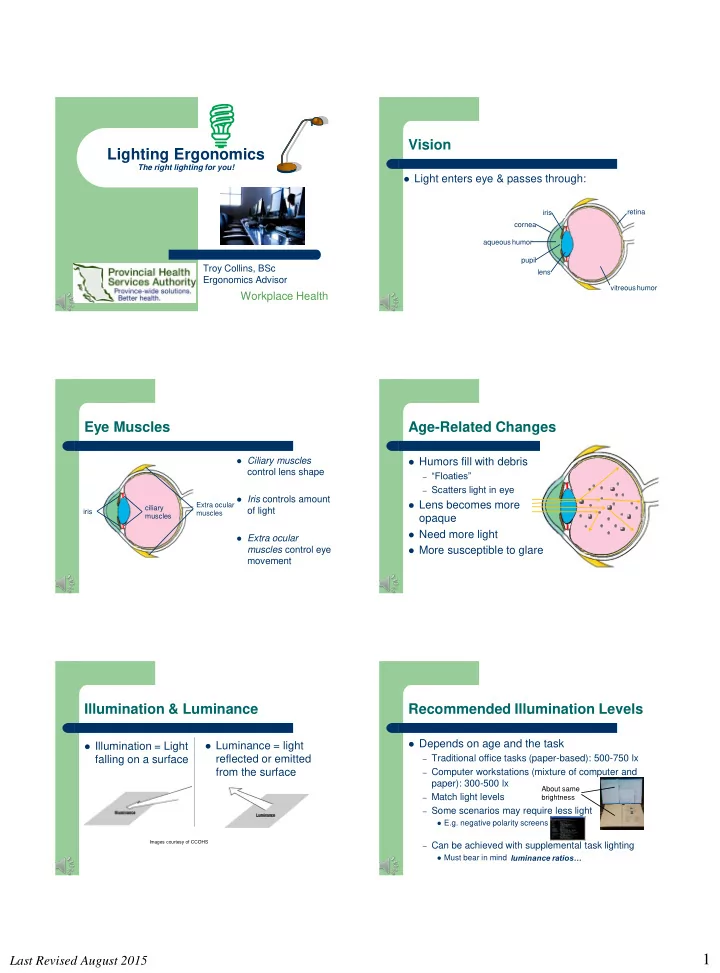
Light enters eye & passes through:
iris pupil lens cornea aqueous humor vitreous humor retina Extra ocular muscles
Eye Muscles
Ciliary muscles
control lens shape
Iris controls amount
- f light
Extra ocular
muscles control eye movement
ciliary muscles iris
Age-Related Changes
Humors fill with debris
– “Floaties” – Scatters light in eye
Lens becomes more
- paque
Need more light More susceptible to glare
Illumination & Luminance
Illumination = Light
falling on a surface
Luminance = light
reflected or emitted from the surface
Images courtesy of CCOHS
Recommended Illumination Levels
Depends on age
– Traditional office tasks (paper-based): 500-750 lx – Computer workstations (mixture of computer and
paper): 300-500 lx
– Match light levels – Some scenarios may require less light
E.g. negative polarity screens
– Can be achieved with supplemental task lighting
Must bear in mind
and the task
luminance ratios…
About same brightness