1 Who here in this room is familiar with Regional Haze? The - - PDF document

1
SMART_READER_LITE
LIVE PREVIEW

1 Who here in this room is familiar with Regional Haze? The - - PDF document

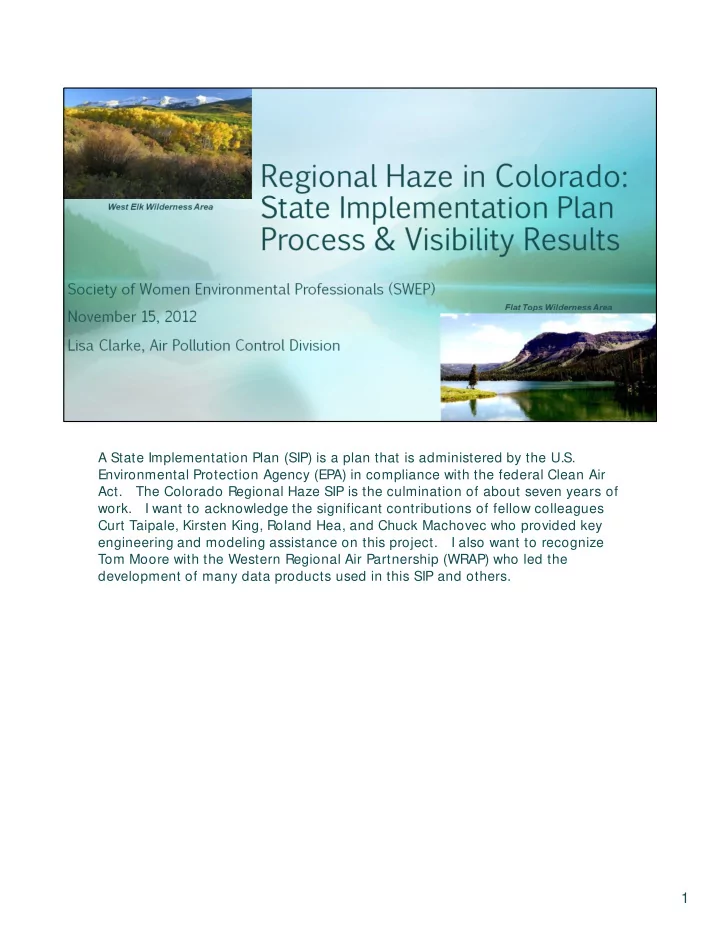
A State Implementation Plan (SIP) is a plan that is administered by the U.S. Environmental Protection Agency (EPA) in compliance with the federal Clean Air Act. The Colorado Regional Haze SIP is the culmination of


slide-1
SLIDE 1

A State Implementation Plan (SIP) is a plan that is administered by the U.S. Environmental Protection Agency (EPA) in compliance with the federal Clean Air

  • Act. The

Colorado Regional Haze SIP is the culmination

  • f

about seven years

  • f
  • work. I

want to acknowledge the significant contributions

  • f

fellow colleagues Curt Taipale, Kirsten King, Roland Hea, and Chuck Machovec who provided key engineering and modeling assistance

  • n

this

  • project. I

also want to recognize Tom Moore with the Western Regional Air Partnership (WRAP) who led the development of many data products used in this SIP and others.

1

slide-2
SLIDE 2

Who here in this room is familiar with Regional Haze? The Colorado experience with Regional Haze is a monstrous topic to cover in 30 minutes, so I am going to focus mostly

  • n

the emission control process and ultimate visibility benefits from

  • ne

pollutant – Nox (nitrogen

  • xides). I

will also cover some background and history to start us

  • ff. Please

feel free to ask me questions as I go if you don’t understand something

  • r

if you would like to know more about a particular item.

2

slide-3
SLIDE 3

In the 1977 Clean Air Act, Congress set a national goal

  • f

preventing future visibility impairment and remedying any existing visibility impairment at Class I federal

  • areas. What is

a Class I federal area you might be

  • wondering. The

answer is a bit complicated (of course, has anyone read environmental regulations?), but basically these area include national parks, national wilderness areas, and national

  • monuments. These

areas are designated by Congress to have special air quality protections under the CAA. This goal is ambitious and probably won’t be realized in

  • ur

lifetimes for most Class I area in the Western states, because

  • f

international pollution transport and events such as dust storms and wildfires that are

  • ccurring

more and more frequently. Regional Haze visibility protection is a goal-based aesthetic program unlike the National Ambient Air Quality Standards (NAAQS) which are health-based standards, so the rules

  • f

the game are much different for regulations and processes. Another challenge in determining which impacts are from man-made pollution versus natural

  • pollution. Living

in Colorado, we have all walked out in the

  • forests. That wonderful
  • rganic

“foresty” smell? Volatile

  • rganic

compounds,

  • r

VOCs, which contribute to regional

  • haze. The

current visibility monitoring network doesn’t provide information

  • n

air pollution sources,

  • nly

levels

  • f

various particulates, which I will explore further later.

3

slide-4
SLIDE 4

There are 156 Class I areas in the

  • nation. About 72% of

these areas are west of the Mississippi. This is a map

  • f

Colorado that shows the location

  • f

the 12 Class I areas in

  • ur

state including 4 national parks denoted in blue and 8 wilderness areas (in light green) The visibility conditions are monitored by six IMPROVE sites (denoted by the little red boxes). IMPROVE is a cooperative measurement effort governed by a steering committee composed of representatives from Federal and regional-state

  • rganizations. It was

established in 1985 to aid the creation

  • f

Federal and State implementation plans for visibility protection. Website: http:/ / vista.cira.colostate.edu/ improve/ Default.htm Some monitors represent more than

  • ne

Class I

  • area. Every

IMPROVE site deploys an aerosol sampler to measure speciated fine aerosols and PM10 mass. Certain sites also deploy Transmissometer and nephelometers to measure light extinction and scattering respectively, as well as automatic camera systems to measure the “scene” The equipment has the ability to measure

  • ver

long distances, which is why

  • ne

monitor can represent multiple areas.

4

slide-5
SLIDE 5

Most visibility impairment is caused by particulate scattering, absorption, and reflection

  • f

image forming

  • light. There

are six primary particulate components that are measured by the IMPROVE monitors. Sulfate is a secondary particle formed form gaseous SO2 emission reacting with ammonia to form Ammonium Sulfate. Similarly, Nox emissions react with ammonia to form a secondary Ammonium Nitrate particle. Organic Carbon can be directly emitted as a particle

  • r

formed as a secondary particulate. Elemental Carbon, Soil, and Coarse Mass are assumed to be directly emitted as particulates.

5

slide-6
SLIDE 6

This map shows the 2004 annual data for the 20% worst days at each IMPROVE monitor in the nation. The different colors denote the six primary particulates: Sulfate in yellow, Nitrate in red, Organic Carbon in green, Elemental Carbon, Soil in light brown, and Coarse Mass in dark brown. The diameter

  • f

the pie indicates the magnitude

  • f

the visibility extinction (basically degradation). Generally, the intermountain west has some

  • f

the best visibility in the country.

6

slide-7
SLIDE 7

7

I mentioned the equipment that each IMPROVE monitor uses, but how do they actually work? Each monitor has a number

  • f

cartridges that sample the air every 3-dyas that are sent to a variety

  • f

labs to determine speciation

  • f

the particulates. The resultant data is processed through an equation – called the IMPROVE equation that yields “reconstructed light extinction” in the metric

  • f

inverse mega meters. The conversion equation is used to convert reconstructed light extinction to haze index in deciviews. The colored bar indicates the conversion to other visibility metrics including visual range in kilometers and the Haze Index in

  • deciviews. The

deciview is how we track progress under the Regional Haze Rule.

slide-8
SLIDE 8

This photo shows a visual side-by-side comparison

  • f

the modeled visibility impairement using the WinHaze Model. Can you see the difference? The scene is divided along the center

  • f

the summit of Longs Peak and shows a 2 dv change between the 14 dv on the right (the hazier perception) and 12 dv on the left (the clearer perception). The main advantage

  • f

the Haze Index is that one deciview of change is generally considered perceptible by most people. I should note that for the SIP that Colorado just completed, the change for Rocky was 1 dv for the worst days (2002

  • vs. 2018).

8

slide-9
SLIDE 9

It is hard to discuss Regional Haze without talking about past litigation. I wanted to show a little history because it provides context about what transpired in Colorado. Colorado did submit a partial Regional Haze SIP back in 2008, but EP A indicated it wasn’t approvable. In 2009, EP A made a national finding

  • f

failure-to- submit a RH SIP

  • n

a number

  • f

states that started a two-year clock for a Federal Implementation Plan. In 2011, environmental groups entered into a consent decree with EP A involving Colorado, Montana, North Dakota, and Wyoming (all

  • f

these states are part of

  • ne

EP A Region) And EP A entered into another consent decree with remaining states,

  • etc. the

next year

9

slide-10
SLIDE 10

In late 2009, EPA indicated that they would withhold a significant amount of Colorado Air Grant money to pay for the RH FIP work that would be done by consultants. Colorado then avoided a FIP by agreeing to work closely with EPA

  • n

developing an approvable RH plan. For a period

  • f

approximately 6 months, the state had weekly meetings with EPA to coordinate the SIP development work. In early 2010, coincident with the RH SIP work, the Colorado Legislature approved the CACJ act that encouraged the use

  • f

natural gas and

  • ther

cleaner energy sources, which ultimately became a large component of the Colorado’s RH SIP. On September 10, 2012, EPA formally approved Colorado’s Regional Haze

  • Plan. It has

not been published in the Federal Register yet.

10

slide-11
SLIDE 11

The Regional Haze Rule requires that each state establish reasonable progress goals (in deciviews) for each Class I area based on future projections

  • f

modeled visibility impairment for the 20% worst days. The 20% cleanest days (or Best Days) must be maintained, which is addressed in the long-term strategy (LTS). The LTS specifies the

  • ngoing

air pollution control programs the state has implemented to protect air quality – including some you may be familiar with, new source review (NSR), prevention

  • f

signification deterioration (PSD), smoke management and other initiatives. The monitoring strategy evaluates the effectiveness

  • f

the IMPROVE monitoring network to ensure the data continues to be representative for all class I areas. The state must also consult with Federal Land Managers (National Park Service, Bureau Land Management, Forest Service) to ensure that they have input in the plan development process that affects the Class I areas they manage. Regional Haze is a 60-year program, so periodic plan updates are necessary every 10-years and progress reports are required every 5 years.

11

slide-12
SLIDE 12

How do we decide how much visibility progress is needed in each planning cycle? The upper graph shows the uniform rate

  • f

progress glide slope for the 20% worst days (in deciviews) at Mesa Verde National Park. The 2004 baseline period is 13.0 dv and the 2064 Natural Conditions is 6.8

  • dv. The

2018 uniform rate

  • f

progress goal is 11.6

  • dv. The

little green plus sign about the URP glide slope denotes the modeled 2018 reasonable progress goal

  • f

12.5 dv. The lower graph shows the URP glide slope for the 20% worst days for the six components

  • f

visibility

  • extinction. This

allows for assessing progress for each

  • pollutant. Y
  • u

can see that for

  • rganic

carbon (in green), the RPG is well above the URP goal, whereas for sulfate (in yellow), the RPG is much closer to the URP goal. The take way from these glide slops is that we are not on schedule for achieving natural conditions by 2064, not only in Mesa Verde, but in all

  • f

Colorado’s Class I

  • areas. Based
  • n

the current rate

  • f

progress for Mesa Verde, we expect to reach natural conditions by 2168, which is 164 years from the 2004 baseline

  • year. The

earliest we can hope to meet natural conditions in Colorado is in the Eagles Nest, Flat Tops, Maroon Bells, and West Elk Wilderness Areas in 2083 (79 years from baseline year). 12

slide-13
SLIDE 13

OK, well that was a super quick tutorial

  • f

visibility and Regional Haze. Now

  • nto a

discussion

  • f

source controls. The first group

  • f

point sources evaluated for emission controls under the visibility are what we called BART (Best Available Retrofit Technology)

  • sources. These

stationary sources have potential to emit over 100 tons per year and belong to a defined “list of 26” major emitting

  • facilities. The

source must have units built between 1962 and 1977 and the sources modeled impact must be greater than 0.5 deciviews at a Class I

  • area. There

are 15 units that meet this criteria in Colorado. The next group

  • f

sources the state evaluated are called Reasonable Progress sources that have actual emission

  • ver

100 tpy and have a “Q over d” ratio over

  • 20. Where

“Q” is the sum

  • f

SO2, Nox, and PM10 actual emissions in tpy and “d” is the distance from the centroid of the source to the boundary

  • f

a C1A in

  • kilometers. If

a source exceeds 20, the source is subject-to-RP. Any units at sources that have already been evaluated under the BART review process are excluded from the RP

  • review. The

number

  • f

RP units is 15.

13

slide-14
SLIDE 14

This map shows the location

  • f

the sources relative to the 12 Class I areas. The 30 BART & RP units are located at the 16 sources identified on the

  • map. The

C1As are denoted in green and populated areas are gray.

14

slide-15
SLIDE 15

Back in 2005, the EPA promulgated a Best Available Retrofit Technology (BART) rule that requires a 5-step process for systematically evaluating emission controls. The steps include identifying all emission controls for a particular pollutant, eliminating the technically infeasible

  • ptions,

evaluating the cost and effectiveness

  • f

controls, looking at the impacts and assessing the modeled visibility improvement from the various control

  • ptions. The

RP review process is similar except that time necessary for compliance is also a factor. It is important to note that in this first planning period, the state decided to focus

  • n

3

  • f

the 6 components

  • f

visibility extinction: sulfate, nitrate, and particulate matter. The

  • ther

3 components – OC, EC, and soil are less understood and the emission sources are not well

  • characterized. This

is an important decision because it narrowed the emission review process down to SO2, Nox, and PM10.

15

slide-16
SLIDE 16

In the interest of time, I will focus

  • n
  • ur

largest group

  • f

sources, the coal-fired boilers that are used for generating electricity and limit the discussion to Nox controls because this pollutant has received the most scrutiny (and has the most potential for reduction after

  • ther

CAA rules controlled other pollutants) in the Regional Haze process. EGUs comprise

  • ver

90% of the sources involved in the BART and RP emission control evaluation and range in size from 20 MW to over 500 MW. The 5-factor evaluation involves a case-by-case analysis

  • f

all technically feasible Nox controls. The state decided two of the 5-factors should be given more weight in the Nox evaluation process – control cost and degree

  • f

visibility improvement. All BART/ RP EGUs in the state have some variety

  • f

low Box burners, but none have any post combustion controls such as Selective Catalytic Reduction (SCR), which the top tier Nox control,

  • r

Selective Non-Catalytic Reduction. MAYBE SAY: Basically, an SCR reduces Nox through a reaction with ammonia

  • n

the surface

  • f

a catalyst to produce elemental nitrogen and water. The ammonia is injected upstream of the catalyst where the exhaust temperature is around 700ºF/ An SNCR lacks the catalyst so the exhaust temperature needs to be much higher, around 2000ºF, to get the desired reaction.

16

slide-17
SLIDE 17

This graph plots the top-tier SCR control costs for 15 units, in dollars per ton

  • n

the x-axis and the degree

  • f

visibility improvement, in deciviews,

  • n

the y-axis. There are 13 EGUs missing from this chart because 9 units are shutting down, SCR was determined to be technically infeasible

  • n
  • ne

unit and three units were part of a better-than-BAR T alternative plan where the costs were not shared (one

  • f

these units did install SCR and two converted to natural gas). The little blue box reflects the state’s review criteria for SCR controls (under $5,000 per ton and over 0.5 dv of visibility improvement). Y

  • u

can see that 2

  • f

the units satisfy the SCR control

  • criteria. These

are units 1 and 2 at the Hayden Power Plant in the northwest corner

  • f
  • ur

state, about 30 miles west of Steamboat Springs.

17

slide-18
SLIDE 18

This graph plots the second tier SNCR control costs for 13 units (minus the two Hayden units) in dollars per ton and degree

  • f

visibility improvement in deciviews. The blue box represents the states review criteria for SNCR controls (under $5,000 per ton and

  • ver

0.2 dv of visbiility improvement). Y

  • u

can see that 6 units fall into the SNCR control

  • criteria. These

are units 1, 2, and 3 at the Craig Power Plant in the northwest portion

  • f

Colorado (40 miles west of Steamboat Springs), unit 5 at Colorado Energy Nations Company (which powers Coors Brewing in Golden), unit 1 at Rawhide (the main power plant for Fort Collins), and unit 7 at Drake (in central Colorado Springs). 3

  • f

the 6 units ended up using different controls that resulted in equivalent or better visibility improvements at a lower cost except for the Craig Power

  • Plant. TriState,
  • wners
  • f

Craig, reached an agreement with the Environmental Coalition group during negotiations that resulted in use

  • f

SCR controls

  • n

Craig unit 2.

18

slide-19
SLIDE 19

I realize that this table might be a little to read (and understand!) but it is a complete summary

  • f

the final Nox and SO2 determinations for the 30 BART/ RP units evaluated for controls along with the control costs and modeled visibility improvement. The existing controls are denoted in italics and new controls are in bolded text.

19

slide-20
SLIDE 20

In closing, I should mention that comparing visibility benefits realized through the BAR T and RP emission controls are not directly comparable to the modeled Reasonable Progress goals for each Class I area because the models are different. So, we really don’t know the total visibility improvement at all! It is difficult to discern because each Class I area has unique geographical constraints and pollutant contributions. Although, I think it is reasonable to conclude that over 44,000 tons

  • f

additional Nox and SO2 reductions should lower the RPGs for most of Colorado’s CIAs. The total capital cost for installing all

  • f

the SO2 and Nox emission controls, including shutdowns and replacements

  • n

30 units, is around 1.75 billion

  • dollars. Wow.

20

slide-21
SLIDE 21

21