1 Major Progress in Activities Evaluations 2nd Cycle (2005 2010) - - PDF document

1
SMART_READER_LITE
LIVE PREVIEW

1 Major Progress in Activities Evaluations 2nd Cycle (2005 2010) - - PDF document

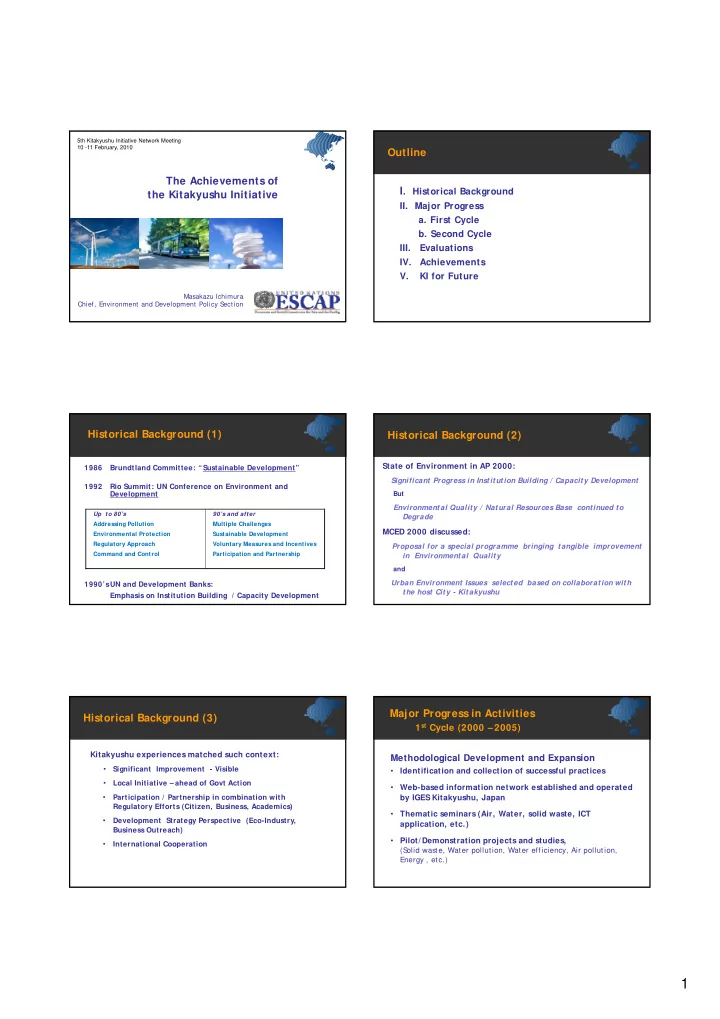
5th Kitakyushu Initiative Network Meeting 10 -11 February, 2010 Outline The Achievements of I . Historical Background the Kitakyushu Initiative II. Major Progress a. First Cycle b. Second Cycle III. Evaluations IV. Achievements V. KI


slide-1
SLIDE 1

1

The Achievements of the Kitakyushu Initiative

5th Kitakyushu Initiative Network Meeting 10 -11 February, 2010

Masakazu Ichimura Chief, Environment and Development Policy S ection

  • I. Historical Background
  • II. Major Progress
  • a. First Cycle

Outline

  • b. Second Cycle

III. Evaluations IV. Achievements V. KI for Future

Historical Background (1)

1986 Brundtland Committee: “Sustainable Development” 1992 Rio Summit: UN Conference on Environment and Development 1990’sUN and Development Banks: Emphasis on Institution Building / Capacity Development

Up to 80’s Addressing Pollution Environmental Protection Regulatory Approach Command and Control 90’s and after Multiple Challenges Sustainable Development Voluntary Measures and Incentives Participation and Partnership

State of Environment in AP 2000:

Significant Progress in Institution Building / Capacity Development

But

Environmental Quality / Natural Resources Base continued to

Historical Background (2)

Environmental Quality / Natural Resources Base continued to Degrade

MCED 2000 discussed:

Proposal for a special programme bringing tangible improvement in Environmental Quality

and

Urban Environment Issues selected based on collaboration with the host City - Kitakyushu

Kitakyushu experiences matched such context:

  • Significant Improvement - Visible
  • Local Initiative – ahead of Govt Action

Historical Background (3)

  • Participation / Partnership in combination with

Regulatory Efforts (Citizen, Business, Academics)

  • Development Strategy Perspective (Eco-Industry,

Business Outreach)

  • International Cooperation

Major Progress in Activities

1st Cycle (2000 – 2005) Methodological Development and Expansion

  • Identification and collection of successful practices
  • Web-based information network established and operated

by IGES Kitakyushu, Japan

  • Thematic seminars (Air, Water, solid waste, ICT

application, etc.)

  • Pilot/Demonstration projects and studies,

(S

  • lid waste, Water pollution, Water efficiency, Air pollution,

Energy , etc.)

slide-2
SLIDE 2

2

Major Progress in Activities

2nd Cycle (2005 – 2010)

Strengthened Focus on Environmental and Socio-economic Cobenefits in the context of Green Growth Increasing highlights on Climate Change

  • Replication Accelerated

k Ch C

  • Networking / Assistance to Champion Cities
  • S

tudy Tours / Thematic Workshop

  • Promotion of Supportive National Mechanisms
  • Involvement of Central Govt / National-level Actions, etc.
  • Incubation of Innovative Approaches
  • CDM Guidebook / Takakura Method Manual, etc.
  • Demonstration Proj ects (MS

W, Energy efficiency, Parnerships etc.)

  • Incentivizing Member Actions
  • Commitments
  • Monitoring / Assistance by KI Network S

ecretariat

Evaluations

  • Acknowledged by WSSD (2002) as a major regional initiative in

Johannesburg Plan of Implementation (JPOI)

  • MCED5 (2005) evaluated positively “Practical Approach” and

“Significant Progress” and recommended extension up to 2010

  • ESCAP Programme Evaluation (2007) “Noting insufficient

financial and programme supports, demonstration of policy impacts should be strengthened”

  • ESCAP Committee on Environment and Development (Dec 2009)

recommended to develop a new Sustainable Urban Development programme based on KI outcomes,

  • Final Review Report to be submitted to MCED6 to be held in

Astana, Kazakhstan, Sept/Oct 2010, with view to establishing a new SUD programme

Achievements (1)

  • Cities agreed to

Cities agreed to play key roles play key roles in promoting in promoting environmental stewardship in their cities, environmental stewardship in their cities, and in fact and in fact achieved tangible improvements achieved tangible improvements

Quantitative targets communicated by KI member cities

Qua t tat ve ta gets co u cated by e be c t es

(S

  • lid Waste / Air Pollution / Water Pollution / S
  • cio-Economic

Development / International City-to-city Cooperation)

Achievement of such targets monitored and assisted by

KI Network Secretariat

Achievement (2)

  • Network

Network of

  • f Aware / Motivated Leaders

Aware / Motivated Leaders

Regional / National level Champions with exemplar

Leadership

Momentum of Mutual Cooperation established

p

Evidence in more City-to-City Cooperation cases developed Enthusiasm in inviting other cities for exchanging

experiences

Interactions amongst Networks enhanced

Achievement (3)

  • Knowledge Base

Knowledge Base Established Established

Policy / Technical I nformation collected, compiled and

Policy / Technical I nformation collected, compiled and provided for broader use provided for broader use

W b it ith d t b / N l tt / St d T

  • Website with database / Newsletters / Study Tours

> Useful vehicles of information transfer

  • Guidebooks / Manuals / I nformation Kits on

emerging subjects

  • Readiness for policy / practice replication

Achievement (4)

  • Policy / Programme / Business Models

Policy / Programme / Business Models Developed and Replicated Developed and Replicated

Incubation of Innovative Approaches

Incubation of Innovative Approaches

  • Low cost / low

Low cost / low-

  • tech management options

tech management options

  • Cobennefits

Cobennefits and CDM and CDM

  • Public Private Partnership
  • Use of ICT
  • Broader S

takeholder Participation through Eco-money, etc.

Tested / proved and Disseminated through Demonstration

Tested / proved and Disseminated through Demonstration Project Project

Replication through Training, Study Tours, etc.

Replication through Training, Study Tours, etc.

Showcased Modality for

Showcased Modality for Upscaling Upscaling, e.g. Access to external , e.g. Access to external funds / investment, etc. funds / investment, etc.

slide-3
SLIDE 3

3

Achievement (5)

  • Supportive National Policies/ Measures

Supportive National Policies/ Measures identified and identified and promoted promoted

KI Approaches expanded through National Networking,

evidences shown in Indonesia, Thailand, Philippines, etc.

  • S

t f N ti l G t A i i d i th

  • S

upport of National Government Agencies pioneered in the Philippines and Indonesia

  • Partnerships between National Agencies and LGUs

strengthened development of effective support mechanism

Collaboration with regional Govt-Govt mechanisms sought

(e.g. Asia Cooperation Dialogue, AWGS C under EAS Process, etc.)

Achievement (6)

  • “KI Approach / Methodologies”

“KI Approach / Methodologies” = A basket full of useful ideas of international cooperation on sustainable urban development

Emphasis on the leadership role of Local Governments Holistic approach to sustainable development –

Highlighting the role of local government in comprehensively addressing environmental as well as socio-economic aspects of human life

A package / combination of interrelated actions

(Achievements 2-5), altogether resulted in tangible

  • utcome (Achievement 1)
  • Internationally recognized, utilized and replicated (e.g. UNCRD

EST Mayors Forum, Citynet, UNEP/IETC, ESCAP’s Energy Forum, ASEAN WG on Sustainable Cities)

KI for Future

  • A Common Asset to be shared by Everyone
  • ESCAP will take full advantage of the outcome in

developing its future programme

  • Encourage others to do so
  • Sprit of Kitakyushu Initiative - Activities should be,

coordinated, interrelated, and interacting so as to be complementary and mutually supportive.

Thank you for your attention

Environment and Development Policy Section (EDPS) Environment and Development Division(EDD)

United Nations ESCAP

Cover slide pictures courtesy of ManagEnergy (European Commission)

UN Building, Rajadamnern Nok Ave.

10200 Bangkok, Thailand Tel: +66 2 288 1234 Fax: +66 2 288 1025