1 Arthroscopy Dec 2015 Included all Meta-analyses before 2015 7 - - PDF document

1
SMART_READER_LITE
LIVE PREVIEW

1 Arthroscopy Dec 2015 Included all Meta-analyses before 2015 7 - - PDF document

Use of Biologics in Rotator Cuff Repair Jason L. Dragoo, MD Associate Professor Department of Orthopaedic S urgery Biologics in RTC Repair Much attention has been given to optimizing: Implant design S uture configuration S


slide-1
SLIDE 1

1

Use of Biologics in Rotator Cuff Repair

Jason L. Dragoo, MD Associate Professor Department of Orthopaedic S urgery

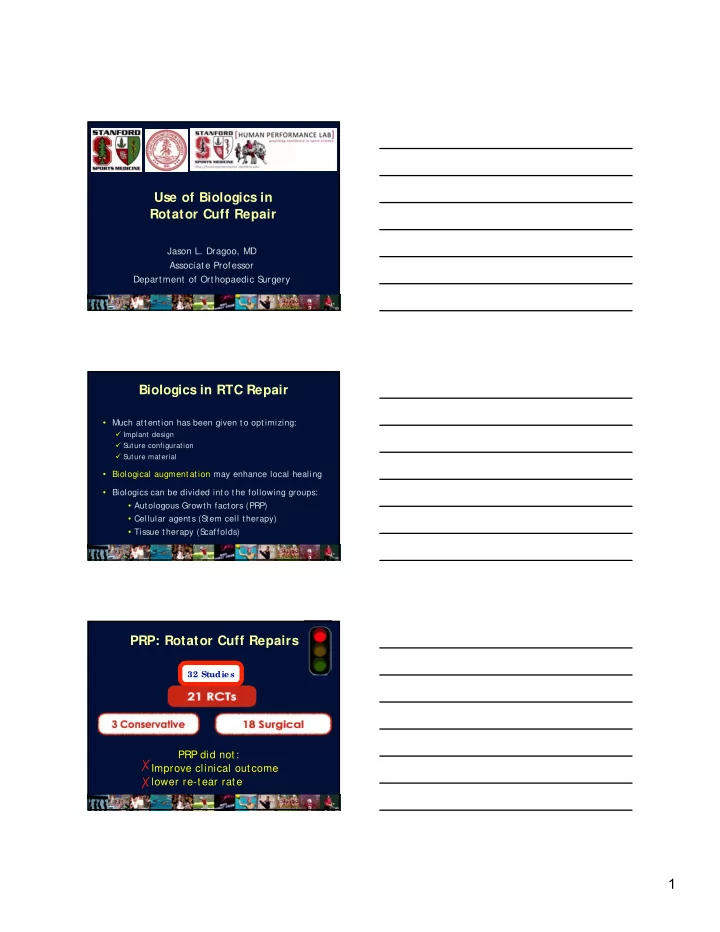
Biologics in RTC Repair

  • Much attention has been given to optimizing:

 Implant design  S uture configuration  S uture material

  • Biological augmentation may enhance local healing
  • Biologics can be divided into the following groups:
  • Autologous Growth factors (PRP)
  • Cellular agents (S

tem cell therapy)

  • Tissue therapy (S

caffolds)

PRP: Rotator Cuff Repairs

32 Studie s

PRP did not: Improve clinical outcome lower re-tear rate

✗ ✗

slide-2
SLIDE 2

2

  • Included all Meta-analyses before 2015
  • 7 meta-analyses with 3,193 patients
  • S

ubgroup analysis: some evidence of outcomes:

  • S

maller and medium-sized tears

  • Double-row fixation techniques
  • PRP clot inj ected at bone-tendon interface

Arthroscopy Dec 2015

Fundamental Question?

  • Are cells necessary to

improve RTC healing?

  • Why?
  • Atrophic cuff tendon
  • Displaced local MS

Cs

  • Direct repair process

Insertion Site Preparation

  • Methods to improve

local environment

 Bed abrasion  Crimson Vail  Microfracture

  • Think Biology!
slide-3
SLIDE 3

3

  • Patients with tear had

lower levels of MS Cs

  • Patients with local bone

marrow edema

Tear= 214 ±128 No tear= 564 ±216 MS Cs

Marrow Stimulation

MS 78% Control 55%

Taniguchi et al, JSES 2 0 1 3

MS > Control MS > Control

S lide Courtesy of Brian Cole

Stem Cell Therapy

  • Only 3 clinical studies have been published
  • Mesenchymal stem cell (MS

Cs) therapy may improve healing by:

  • S

ecreting growth factors

  • Providing cellularity
  • Local paracrine activity
slide-4
SLIDE 4

4

RTC Repair: S tem Cells

  • 45 patients BMAC + RCR
  • 45 matched control RCR
  • 10 year follow-up
  • MS

Cs drawn from AS IS and placed at tendon interface

  • 87%

healing (BM-MS C) vs. 44 % (Non BM-MS C)

  • Control group 4x as likely to have “ poor outcome”

Where should stem cells be harvested?

Proximal Humerus Iliac Crest

  • 125 patients with tear

75 w/ o cuff tear

  • Marrow aspirated from

greater tuberosity

  • Patients with tear had

significantly lower levels

  • f MS

Cs

Tear= 214 ±128 No tear= 564 ±216 MS Cs

slide-5
SLIDE 5

5

Stem Cell Summary

  • Clinical evidence to support the use of cells to

augment RTC repair is promising

  • More RCTs will be necessary to verify

Hernigou’ s findings

RTC Scaffolds RTC Scaffolds

  • Difficult to evaluate
  • Many types

 Allograft  Xenograft (Bovine)  S ynthetic

 Many uses…

slide-6
SLIDE 6

6

RTC Scaffold Uses

Augment repair

  • Improve mechanics
  • Improve biology

Interposition

  • Lengthen tendon
  • S

uperior capsular reconstruction

Scaffold Augmentation

N=42, Human Allograft 85% * (augmentation) vs 40% repair N=30, Xenograft 27% (augmentation) vs 60% repair Erythema and/ or drainage seen in 3 of 15 cases of augmentation *statistically significant Level of Evidence II

Scaffold Interposition

N=68 58% * Interposition vs 26% tensioned repair N=48 Re-tear rate: 8% * Interposition vs 42% tensioned repair

*statistically significant Level of Evidence III

slide-7
SLIDE 7

7

Scaffolds Summary

  • May be useful in clinically tough scenarios
  • Routine use may be questioned due to

 Cost  Lack of consistent literature  Unclear biologic benefit

Summary

  • Give biology the same attention as you give

implant and repair techniques

  • Think about the local biological environment

and optimize it when possible

  • This may lead to improved healing rates and

clinical outcomes