1 OLEMAS - OLEMAS - Agent Architecture Learning algorithm (I) - - PDF document

1
SMART_READER_LITE
LIVE PREVIEW

1 OLEMAS - OLEMAS - Agent Architecture Learning algorithm (I) - - PDF document

4.4. Evolutionary learning of Evolutionary Algorithms: cooperative behavior: OLEMAS (I) Genetic Algorithms Denzinger and Fuchs (1996) Basic Idea: Use the biological model of evolution to improve solutions of problems OLEMAS: OffLine


slide-1
SLIDE 1

1

Multi-Agent Systems

Jörg Denzinger

4.4. Evolutionary learning of cooperative behavior: OLEMAS (I)

Denzinger and Fuchs (1996) OLEMAS: OffLine Evolution of Multi-Agent Systems Basic Problems tackled: n How can we specify tasks on a high and abstract level and let the concrete problem solution be done by learning by the MAS? n How can we use combined training of agents to have them show cooperative behavior without needing much communication but relying on instinctive reactive behavior?

Multi-Agent Systems

Jörg Denzinger

Evolutionary Algorithms: Genetic Algorithms

Basic Idea: Use the biological model of evolution to improve solutions of problems

  • 1. Generate an initial set of (not very good) solutions to

your problem (initial population)

  • 2. Repeat until an end condition is fulfilled:
  • Generate out of actual population new solutions

(using genetic operators), such that better solutions in the population are used with higher probability (quality F fitness)

  • Generate the next population out of the old and

the new individuals

Multi-Agent Systems

Jörg Denzinger

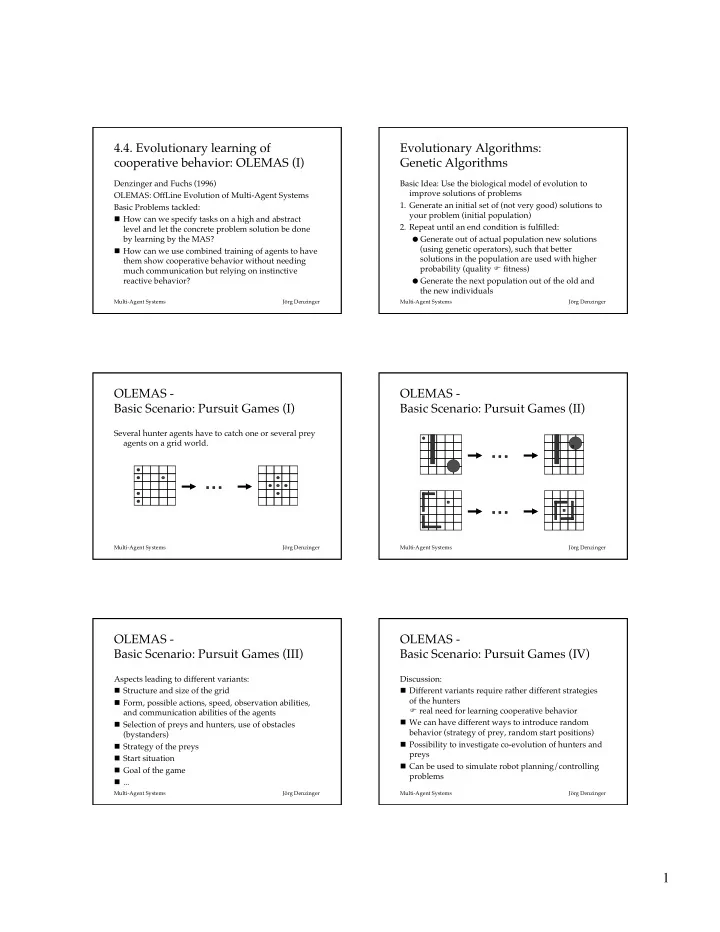
OLEMAS - Basic Scenario: Pursuit Games (I)

Several hunter agents have to catch one or several prey agents on a grid world.

Multi-Agent Systems

Jörg Denzinger

OLEMAS - Basic Scenario: Pursuit Games (II)

Multi-Agent Systems

Jörg Denzinger

OLEMAS - Basic Scenario: Pursuit Games (III)

Aspects leading to different variants: n Structure and size of the grid n Form, possible actions, speed, observation abilities, and communication abilities of the agents n Selection of preys and hunters, use of obstacles (bystanders) n Strategy of the preys n Start situation n Goal of the game n ...

Multi-Agent Systems

Jörg Denzinger

OLEMAS - Basic Scenario: Pursuit Games (IV)

Discussion: n Different variants require rather different strategies

  • f the hunters

F real need for learning cooperative behavior n We can have different ways to introduce random behavior (strategy of prey, random start positions) n Possibility to investigate co-evolution of hunters and preys n Can be used to simulate robot planning/controlling problems

slide-2
SLIDE 2

2

Multi-Agent Systems

Jörg Denzinger

OLEMAS - Agent Architecture

Use of prototypical situation-action pairs and the nearest-neighbor rule (see 2.2.1) Situation: relative position of all other agents to agent plus type and orientation of other agents (x1,y1,o1,t1,…,xn,yn,on,tn) Why? n Very expressive n Strategy can be easily changed by adding/modifying a pair

Multi-Agent Systems

Jörg Denzinger

OLEMAS - Learning algorithm (I)

Evolutionary approach using GA: Individuals (solution candidates): For one agent we have a set of situation-action pairs (SAPs) and an individual has one such set for each agent for which we have to learn a strategy. Fitness of an individual: Basic idea: try out the strategy by doing a simulation of the behavior of the team. If the simulation leads to success, then count the number of moves (rounds).

Multi-Agent Systems

Jörg Denzinger

OLEMAS - Learning algorithm (II)

If the simulation is unsuccessful, then compute for each round the sum of the distances of all hunters to the nearest prey agent and sum up this result over all

  • rounds. If there are random influences in the game,

use the mean value of several simulations. Therefore an individual is the better the lower its fitness is. Note that this fitness measure is not without problems (agents blocking each other do not contribute, neither do obstacles), but applicable for a wide range of problems.

Multi-Agent Systems

Jörg Denzinger

OLEMAS - Learning algorithm (III)

Realizing the Genetic Operators: We have a Crossover-Operator that randomly selects SAPs for each agent from the strategies of this agent in two parent individuals. Mutation can exchange an SAP in a strategy by a randomly generated other SAP, it can just add a random SAP to a strategy and it can delete a random SAP from a strategy.

Multi-Agent Systems

Jörg Denzinger

OLEMAS - Learning algorithm (IV)

Generating the initial population: All SAPs in an individual are generated randomly. The number of SAPs in a strategy is also a random number between a pre-defined minimal and maximal value. Since the crucial steps in the hunt are coordinating several hunters around a prey (i.e. all agents are close to each other), we modified the random number generator so that smaller numbers are generated with a higher probability.

Multi-Agent Systems

Jörg Denzinger

OLEMAS - Learning algorithm (V)

Generating offspring: Select the r percent best individuals (“elite selection”) Select out of this pool always two individuals randomly. Then perform a crossover and with a given probability you additionally perform a mutation. Next Generation: Add to the selected r percent of the old generation 100-r percent newly generated individuals.

slide-3
SLIDE 3

3

Multi-Agent Systems

Jörg Denzinger

Characterization of the learning

The behavior of all hunter agents is n learned offline, n using one learner and n without a teacher. The learning is achieved by experiences gained in simulating the task to do and it involves random influences.

Multi-Agent Systems

Jörg Denzinger

Discussion (I)

✚ For many game variants requiring only small situation vectors very good strategies can be evolved, even if the variant contains random influences. ✚ The concept is rather general for reactive MAS ✚ Resulting agents are simple and fast ✚ Only little problem specific knowledge is necessary:

✚ defining the situation vector ✚ some components in the fitness function

Multi-Agent Systems

Jörg Denzinger

Discussion (II)

  • Bigger situation vectors result in enormous search

spaces

  • Only measuring the team is rather coarse:

F good single agents or good SAPs can get lost due to being in a bad individual

  • Nearly no problem specific knowledge was used

F lot of space for improvement (fitness measure!)

  • The GA has a lot of “obscure” parameters for which

good values are difficult to predict without performing experiments

Multi-Agent Systems

Jörg Denzinger

Evolutionary learning of cooperative behavior: OLEMAS (II)

Denzinger and Kordt (2000) OLEMAS: OnLine Evolution of Multi-Agent Systems Basic Problems tackled: n How can we use offline learning in online learning? n How can we model other agents to use them in the

  • wn decision making (more precisely in simulations

used by learning)?

Multi-Agent Systems

Jörg Denzinger

OLEMAS - Online Learning

Agents act in a pursuit game (the real world) and have to learn while trying to win the game Basic Ideas: n Use a special action “learn” n Use models of other agents n As “learn”: use offline learning with shorter simulations, the models of the other agents, and the current situation as start situation

Multi-Agent Systems

Jörg Denzinger

OLEMAS - “learn”

n Takes a fixed amount of rounds n Performed after at least min and at most max rounds n Each positive action lengthens the time to “learn”, each negative action shortens it n First uses current situation, models of other agents and duration of learn to predict situation after “learn” n Then performs offline learning with this situation as start and a very limited length of the simulations n Best found strategy is combined with current strategy to get new strategy

slide-4
SLIDE 4

4

Multi-Agent Systems

Jörg Denzinger

OLEMAS - Modeling other agents

n Most accurate model: communicate and ask for strategy of other agent n If not possible: Use observed situation action pairs in real world so far as the SAPs of the other agent and assume it uses SAPs and the nearest-neighbor rule as agent model

Multi-Agent Systems

Jörg Denzinger

Characterization of the learning

The behavior of the individual hunter agents is n learned online, n each using its own learner (of same type) and n without a teacher. The learning is achieved by experiences gained in simulating the task to do and it involves random influences. Learning (by heart) is also used to model other agents.

Multi-Agent Systems

Jörg Denzinger

Discussion (I)

✚ Can deal with much more complex game variants ✚ Can automatically divide the problem into subproblems (or steps) and learns strategies for the current step only ✚ Can deal with changing game scenarios ✚ Results in much smaller search spaces (due to limited simulation length and having to learn for one agent

  • nly)

Multi-Agent Systems

Jörg Denzinger

Discussion (II)

  • Online learning can result in bad early decisions that

cannot be unmade later and therefore will not allow the team to win

  • What if other agents learn/change their behavior?
  • What if our models are not accurate?

Multi-Agent Systems

Jörg Denzinger

Evolutionary learning of cooperative behavior: OLEMAS (III)

Denzinger and Ennis (2002) Basic Problems tackled: n How can we use strategies of agents in successful teams to help a new agent replacing an old one to fit into the team much quicker than learning from scratch (if the new agent has different abilities)?

Multi-Agent Systems

Jörg Denzinger

OLEMAS - The new guy in an experienced team

Basic idea: modify GA to make use of strategy of old agent while still allowing for enough flexibility to deal with new abilities. Difference in abilities: n different forms n different moves n different speeds

slide-5
SLIDE 5

5

Multi-Agent Systems

Jörg Denzinger

OLEMAS - Dealing with the old strategy

n Compare the abilities of old and new agent n If they are too different, let the whole team re-learn the task n Otherwise, if the abilities are identical (or the new agent can do everything the old can), use the strategy

  • f the old agent

n Otherwise, filter out the SAPs in the old’s strategy with actions the new one cannot perform F results in seed strategy n Apply improved learning using seed strategy

Multi-Agent Systems

Jörg Denzinger

OLEMAS - Learning with a seed strategy (I)

Modify GA so that all newly generated individuals contain at least pseed percent SAPs from the seed strategy. Initial population: n Randomly select appropriate number of SAPs from seed strategy n Randomly generate new SAPs to fill the rest

Multi-Agent Systems

Jörg Denzinger

OLEMAS - Learning with a seed strategy (II)

Crossover: n Two parents s1,s2 n Randomly select the appropriate number of SAPs out

  • f the SAPs in s1,s2 that are also in the seed strategy

n Randomly select the appropriate number of SAPs out

  • f the SAPs in s1,s2 that are not in the seed strategy

n Randomly select the remaining SAPs out of the SAPs

  • f the parents

F New individual has at least certain percentage SAPs from seed strategy

Multi-Agent Systems

Jörg Denzinger

OLEMAS - Learning with a seed strategy (III)

Mutation: n Just delete an SAP, or n Replace a SAP that is in the seed strategy by a random one from the seed strategy n Replace a SAP that is not in the seed strategy by a randomly generated one n Replace a SAP that is in seed strategy by a randomly generated one if pseed allows it n Replace a SAP that is not in the seed strategy by a randomly selected SAP in the seed strategy

Multi-Agent Systems

Jörg Denzinger

Characterization of the learning

The behavior of the hunter agent replacing the old one is n learned online, n using its own learner and n with some help of a teacher. The learning is achieved by experiences gained in simulating the task to do, it involves random influences and usage of additional knowledge.

Multi-Agent Systems

Jörg Denzinger

Discussion

✚ Much faster than learning from scratch in the targeted application ✚ Reuse of experiences ✚ No early mistakes

  • Slower than old agent
  • How to find appropriate pseed-value?
  • When is difference in abilities too big?
  • What if adaptation of the new agent is not enough?