1 Cerebrum Pre- frontal Cortex Cerebellum Brain Stem - - PDF document

1
SMART_READER_LITE
LIVE PREVIEW

1 Cerebrum Pre- frontal Cortex Cerebellum Brain Stem - - PDF document

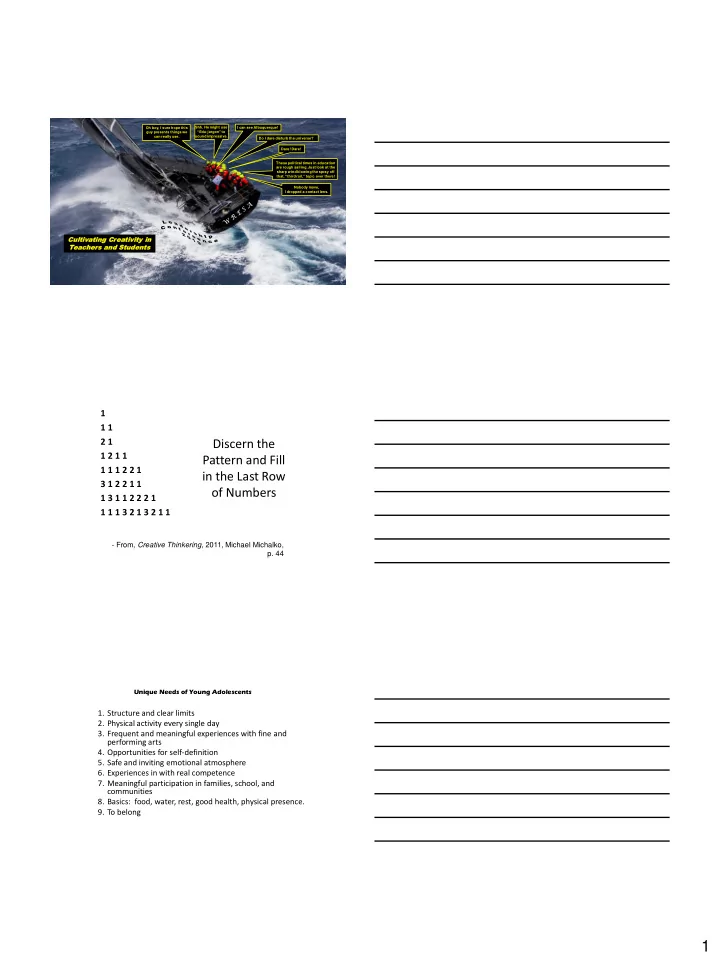
Oh boy , I sure hope this Shh. He might use I can see Albuquerque! guy presents things we Edu - jargon to can really use. sound impressive. Do I dare disturb the universe? Dare! Dare! These political times in education are rough


slide-1
SLIDE 1

1

Cultivating Creativity in Teachers and St Students

Oh boy , I sure hope this guy presents things we can really use.

  • Shh. He might use

“Edu-jargon” to sound impressive. These political times in education are rough sailing. Just look at the sharp wind blowing the spray off that, “third rail,” topic over there! Do I dare disturb the universe? I can see Albuquerque! Nobody move, I dropped a contact lens. Dare! Dare!

Discern the Pattern and Fill in the Last Row

  • f Numbers

1 1 1 2 1 1 2 1 1 1 1 1 2 2 1 3 1 2 2 1 1 1 3 1 1 2 2 2 1 1 1 1 3 2 1 3 2 1 1

  • From, Creative Thinkering, 2011, Michael Michalko,
  • p. 44

Unique Needs of Young Adolescents

  • 1. Structure and clear limits
  • 2. Physical activity every single day
  • 3. Frequent and meaningful experiences with fine and

performing arts

  • 4. Opportunities for self-definition
  • 5. Safe and inviting emotional atmosphere
  • 6. Experiences in with real competence
  • 7. Meaningful participation in families, school, and

communities

  • 8. Basics: food, water, rest, good health, physical presence.
  • 9. To belong
slide-2
SLIDE 2

2

Cerebrum Cerebellum Brain Stem Pre- frontal Cortex

Moral/Abstract Reasoning Empathy Working memory Awareness of Consequences Planning Adjusting to changing situations Impulsivity control

Input by-passes cognition centers; goes directly to emotional response centers

slide-3
SLIDE 3

3

◼ “a lot” – Running to

each wall to shout, “a” and “lot,” noting space between

◼ Comparing

Constitutions – Former Soviet Union and the U.S. – names removed

◼ Real skeletons, not

diagrams

◼ Simulations ◼ Writing Process

described while sculpting with clay

Build Less sson

  • n Vivid

idness ss:

Several daydreams become real…

What tethers us to ineffectiveness and minimal creativity?

slide-4
SLIDE 4

4

Removing students from p.e./fine and performing arts for test preparation Thinking we have to replicate learning conditions in later classes in order to prepare them for those classes Not being creative because it makes others look bad Grades and Grading

Critical Thinking Creative Thinking

analytic generative convergent divergent vertical lateral probability possibility judgment suspended judgment focused diffuse

  • bjective

subjective answer an answer left brain right brain verbal visual linear associative reasoning richness, novelty yes but yes and

From www.virtualsalt.com

Samples of Inductive Reasoning:

  • Every NJAMLE conference has been helpful to teachers,

therefore, this year’s conference will be as well.

  • A teacher recommended a new author to students each of the

last four days, therefore, she’ll mention another new author today.

  • Barracuda, sharks, and mackerel are all fish. They can all live in

the water. Therefore, all fish can live in the water. Inductive Reasoning: ‘Based on observations of other cases, we can generalize a conclusion about a new case. Conclusions lean toward something being “probably true,” but not incontrovertibly so.

slide-5
SLIDE 5

5

Samples of Deductive Reasoning:

  • Students are writers. Jamal is a student. Therefore, Jamal is a

writer.

  • All fish can swim. A shark is a fish. Therefore, sharks can swim.
  • All students must take four years of physical education. You are a
  • student. You will have to take four years of physical education.

Deductive Reasoning: Reasoning from one (or more) true statements, and if all premises are true and follow logically, then the conclusion is also true.

How about a logic puzzle? (Start with www.logic-puzzles.org) Logical Fallacies Originally from: members.aol.com/jimn469897/skeptic.htm (Jim Morton)

  • Ad Hominem (Argument To The Man) -- Attacking the person instead of attacking his
  • argument. For example, "Von Daniken's books about ancient astronauts are worthless

because he is a convicted forger and embezzler." (Which is true, but that's not why they're worthless.) Or, attack the speaker’s sincerity: “How can you argue for vegetarianism when you wear leather shoes?"

  • Straw Man (Fallacy of Extension) -- Attacking an exaggerated or caricatured version of your
  • pponent's position. Example: "Senator Jones says that we should not fund the attack

submarine program. I disagree entirely. I can't understand why he wants to leave us defenseless like that."

  • Argument From Adverse Consequences -- Saying an opponent must be wrong, because if

he is right, then bad things would ensue. "My home in Florida is six inches above sea level. Therefore I am certain that global warming will not make the oceans rise by one foot."

slide-6
SLIDE 6

6

  • Special Pleading (Stacking The Deck) -- Using the arguments that support your

position, but ignoring or even denying the arguments against.

  • The Excluded Middle (False Dichotomy, Faulty Dilemma) -- Assuming there are only

two alternatives when in fact there are more.

  • Short Term Versus Long Term -- This is a particular case of the Excluded Middle. For

example, "We must deal with crime on the streets before improving the schools." (But why can't we do some of both?)

  • Fallacy Of The General Rule -- Assuming that something true in general is true in every

possible case. For example, "All chairs have four legs." Except that rocking chairs don't have any legs.

  • Argument To The Future -- Arguing that evidence will someday be discovered which

will (then) support your point.

  • Poisoning The Wells -- Discrediting the sources used by your opponent.
  • Appeal To Pity (Appeal to Sympathy, The Galileo Argument) -- For example,

"Scientists scoffed at Copernicus and Galileo; they laughed at Edison, Tesla and Marconi; they won't give my ideas a fair hearing either. But time will be the judge. I can wait; I am patient; sooner or later science will be forced to admit that all matter is built, not of atoms, but of tiny capsules of TIME."

  • Begging The Question (Assuming The Answer, Tautology) -- Reasoning in a
  • circle. The thing to be proved is used as one of your assumptions. For

example: "We must have a death penalty to discourage violent crime". (This assumes it discourages crime.)

  • Argument From False Authority -- A strange variation on Argument From
  • Authority. For example, the TV commercial which starts "I'm not a doctor,

but I play one on TV." Just what are we supposed to conclude?

  • Appeal To Authority -- "Albert Einstein was extremely impressed with this theory." (But a

statement made by someone long-dead could be out of date. Or perhaps Einstein was just being polite.)

  • Misquote a real authority. Chevy Chase: "Yes, I said that, but I was singing a song written by

someone else at the time."

  • Bad Analogy -- Claiming that two situations are highly similar, when they aren't. For example,

"The solar system reminds me of an atom, with planets orbiting the sun like electrons

  • rbiting the nucleus. We know that electrons can jump from orbit to orbit; so we must look to

ancient records for sightings of planets jumping from orbit to orbit also."

  • False Cause -- Assuming that because two things happened, the first one caused the second
  • ne. (Sequence is not causation.) For example, "Before women got the vote, there were no

nuclear weapons." Or, "Every time my brother Bill accompanies me to Fenway Park, the Red Sox are sure to lose." We confuse correlation and causation -- Earthquakes in the Andes were correlated with the closest approaches of the planet Uranus. Therefore, Uranus must have caused them. (But Jupiter is nearer than Uranus, and more massive too.)

slide-7
SLIDE 7

7

  • Appeal To Widespread Belief (Bandwagon Argument, Peer Pressure) -- The claim, as

evidence for an idea, that many people believe it, or used to believe it. In the 1800's there was a widespread belief that bloodletting cured sickness. All of these people were not just wrong, but horribly wrong, because in fact it made people sicker. Clearly, the popularity of an idea is no guarantee that it's right.

  • Fallacy Of Composition -- Assuming that a whole has the same simplicity as its constituent
  • parts. Example: "Atoms are colorless. Cats are made of atoms, so cats are colorless."
  • Fallacy Of Division -- Assuming that what is true of the whole is true of each constituent
  • part. For example, human beings are made of atoms, and human beings are conscious, so

atoms must be conscious.

  • Argument By Half Truth (Suppressed Evidence) -- A book on the Bermuda Triangle might tell

us that the yacht Connemara IV was found drifting crewless, southeast of Bermuda, on September 26, 1955. None of these books mention that the yacht had been directly in the path of Hurricane Iona, with 180 mph winds and 40-foot waves.

  • Argument By Generalization -- Drawing a broad conclusion from a small

number of perhaps unrepresentative cases. For example, "They say 1 out

  • f every 5 people is Chinese. How is this possible? I know hundreds of

people, and none of them is Chinese." So, by generalization, there aren't any Chinese anywhere.

  • Non Sequitur -- Something that just does not follow. For example, "Tens
  • f thousands of Americans have seen lights in the night sky which they

could not identify. The existence of life on other planets is fast becoming certainty!"

  • Argument By Prestigious Jargon -- Using big complicated words so that

you will seem to be an expert. Why do people use "utilize" when they could utilize "use"?

  • Argument By Gibberish (Bafflement) -- An invented vocabulary helps the
  • effect. Perfectly ordinary words can be used to baffle. For example,

"Each autonomous individual emerges holographically within egoless

  • ntological consciousness as a non-dimensional geometric point within

the transcendental thought-wave matrix."

  • Euphemism -- The use of words that sound better. The lab rat wasn't

killed, it was sacrificed.

  • Least Plausible Hypothesis -- Example: "I left a saucer of milk outside
  • vernight. In the morning, the milk was gone. Clearly, my yard was visited

by fairies."

slide-8
SLIDE 8

8

To dive deeply into logical fallacies, visit these Websites:

  • www.theskepticsguide.org/resources/logical-

fallacies

  • utminers.utep.edu/omwilliamson/ENGL1311/fa

llacies.htm

Teach Debate! https://speechanddebate.org/ National Speech and Debate Association

Meeting of Minds

  • Students portray historical figures who’ve been called together

to discuss modern world issues and complex ideas. This debate is moderated by the teacher.

  • Each team of students researches the figure and shares a

summary of what they discover with the class prior to the debate.

  • Prior to the debate, each team identifies how their figure would

probably respond to several the identified modern issues, and what “holes” they can poke in other figures’ responses.

  • Each team has 5 - 6 members: 1 performing as the historical

figure, 1 – 3 who design a personalized backdrop for the figure during the debate, 1- 3 who design and prepare an accurate costume and props for the figure.

  • All team members research and discuss responses, citing

evidence for how the group determined the figure’s responses to the issues.

slide-9
SLIDE 9

9

Meeting of Minds

Potential Topics for Discussion:

  • Should Earth have one language or many? What are

the roles of men and women in society?

  • Should students be required to wear uniforms in

school?

  • What are the qualities of a good leader?
  • Should rap music lyrics be censored?
  • Should our country have gone to war?
  • wher

What does this depict?

“We went to school. We were not taught how to think; we were taught to reproduce what past thinkers thought…. …Instead of being taught to look for possibilities, we were taught to exclude them. It’s as if we entered school as a question mark… …and graduated as a period.”

  • - Michael Michalko,

Creative Thinkering, 2011, p. 3

slide-10
SLIDE 10

10

“Do they know how to ask good questions?”

  • - Tony Wagner, The Global

Achievement Gap, 2008

It’s not an answer chase. It’s a question journey.

Our future depends on this one here.

slide-11
SLIDE 11

11

If we find ways for colleagues and ourselves to experience curiosity, awe, induction, deduction, analysis, synthesis, resilience, empathy, extrapolation, juxtaposition, and other mental dexterities in their own development, they are better thinkers of our

  • discipline. They can solve their own problems, connect with others and

among ideas, innovate their way to meaningful contributions, and persevere in the midst of challenge. Embrace the fact that, “[l]earning is fundamentally an act of creation, not consumption of information.”

  • - Sharon L. Bowman, Professional Trainer
slide-12
SLIDE 12

12

Active Creators, NOT Passive Consumers!

Creativity is making connections between dissimilar things in such a way as to create something new. It’s often about recombining old ideas and things for new purposes or perspectives. From Professor Alane Starko in her book, Creativity in the Classroom:

Gutenberg developed the idea of movable type by looking at the way coins were stamped. Eli Whitney said he developed the idea for the cotton gin while watching a cat trying to catch a chicken through a fence.

slide-13
SLIDE 13

13

Pasteur began to understand the mechanisms of infection by seeing similarities between infected wounds and fermenting grapes.

Einstein used moving trains to gain insight into relationships in time and space.

“Consider Einstein’s Theory of

  • Relativity. He did not invent the concepts
  • f energy, mass, or speed of light. Rather

he combined these ideas in a new and useful way.”

  • - Michael, Michalko, Creative Thinkering,

Machalko, 2011, p. xvii,

Combination and Re-Combinination

  • Hall duty and Teacher Advisory
  • Service Learning and Students in danger of dropping
  • ut
  • Miniature Golf and lesson sequence
  • Students’ cafeteria behavior and architecture
  • Unmotivated faculty and farming, astronomy,

marble tabletops.

  • Parental involvement and medicine
slide-14
SLIDE 14

14

  • 1. LOCK — PIANO
  • 2. SHIP — CARD
  • 3. TREE — CAR
  • 4. SCHOOL — EYE
  • 5. PILLOW — COURT
  • 6. RIVER — MONEY
  • 7. BED — PAPER
  • 8. ARMY — WATER
  • 9. TENNIS — NOISE
  • 10. EGYPTIAN — MOTHER
  • 11. SMOKER — PLUMBER

In each pair, find a third word that is connected or associated with both

  • f these two words.

From, https://sharpbrains.com/brainteasers/ and, https://sharpbrains.com/blog/2014/06/20/brain- teaser-to-exercise-your-cognitive-skills-where- do-words-go/

William’s Taxonomy

Fluency Flexibility Originality Elaboration Risk Taking Complexity Curiosity Imagination

Frank Williams’ Taxonomy of Creative Thinking

Fluency – We generate as many ideas and responses as we can

Example Task: Choose one of the simple machines we’ve studied (wheel and axle, screw, wedge, lever, pulley, and inclined plane), and list everything in your home that uses it to operate, then list as many items in your home as you can that use more than one simple machine in order to operate.

  • Flexibility – We categorize ideas, objects, and

learning by thinking divergently about them

Example Task: Design a classification system for the items on your list.

slide-15
SLIDE 15

15

Frank Williams’ Taxonomy of Creative Thinking

Originality – We create clever and often unique responses to a prompt

Example Task: Define life and non-life.

  • Elaboration – We expand upon or stretch

an idea or thing, building on previous thinking

Example: What inferences about future algae growth can you make, given the three graphs

  • f data from our experiment?

Frank Williams’ Taxonomy of Creative Thinking Risk Taking – We take chances in our thinking, attempting tasks for which the outcome is unknown

Example: Write a position statement on whether or not genetic engineering of humans should be funded by the United States government.

  • Complexity – We create order from chaos, we explore

the logic of a situation, we integrate additional variables or aspects of a situation, contemplate connections

Example: Analyze how two different students changed their lab methodology to prevent data contamination.

Frank Williams’ Taxonomy of Creative Thinking

Curiosity – We pursue guesses, we wonder about varied elements, we question.

Example: What would you like to ask someone who has lived aboard the International Space Station for three months about living in zero-gravity?

  • Imagination – We visualize ideas and objects,

we go beyond just what we have in front of us

Example: Imagine building an undersea colony for 500 citizens, most of whom are scientists, a kilometer below the ocean’s

  • surface. What factors would you have to consider when

building and maintaining the colony and the happiness of its citizens?

slide-16
SLIDE 16

16

Analyze… Construct… Revise… Rank… Decide between… Argue against… Why did… Argue for… Defend… Contrast… Devise… Develop… Identify… Plan… Classify… Critique… Define… Rank… Compose… Organize… Interpret… Interview… Expand… Predict… Develop… Categorize… Suppose… Invent… Imagine… Recommend…

Ways for Students to Transcend Rubric Criteria:

  • Demonstrate divergent thinking.
  • Add your own voice: If we left your name
  • ff the project, would we know it was you

that created it?

  • Make meaningful connections that the rest
  • f us did not consider.
  • Extend your investigation beyond the

parameters put forth in the descriptors Ways for Students to Transcend Rubric Criteria:

  • Give the teacher alternative proposals for how to demonstrate

evidence of your learning.

  • Teach the teacher and your classmates something they did not

know about the topic.

  • Express content from a different perspective or through a

different domain: ❑‘Norse mythology expressed through careful cultivation of Bonsai trees? ❑ Debate as a form of dance? ❑The human circulatory system could be used as a form of cryptography? ❑Cultures, furniture, languages, and technology experience entropy?

slide-17
SLIDE 17

17

Ways for Students to Transcend Rubric Criteria:

  • Make the content your own, not something you borrow from the

teacher and return passively at the end of the unit. Let the teacher see what YOU bring to learning’s table. Don’t subordinate who you are for the sake of what a previous generation thought was salient. And best of all: There are no penalties for giving all of these a try, even when you fail in the first attempts.

To Increase (or Decrease) a Task’s Complexity, Add (or Remove) these Attributes:

Manipulate information, not just echo it

Extend the concept to other areas

Integrate more than one subject or skill

Increase the number of variables that must be considered; incorporate more facets

Demonstrate higher level thinking, i.e. Bloom’s Taxonomy, William’s Taxonomy

Use or apply content/skills in situations not yet experienced

Make choices among several substantive ones

Work with advanced resources

Add an unexpected element to the process or product

Work independently

Reframe a topic under a new theme

Share the backstory to a concept – how it was developed

Identify misconceptions within something

To Increase (or Decrease) a Task’s Complexity, Add (or Remove) these Attributes:

Identify the bias or prejudice in something

Negotiate the evaluative criteria

Deal with ambiguity and multiple meanings or steps

Use more authentic applications to the real world

Analyze the action or object

Argue against something taken for granted or commonly accepted

Synthesize (bring together) two or more unrelated concepts or

  • bjects to create something new

Critique something against a set of standards

Work with the ethical side of the subject

Work in with more abstract concepts and models

Respond to more open-ended situations

Increase their automacity with the topic

Identify big picture patterns or connections

Defend their work

slide-18
SLIDE 18

18

◼ Manipulate information, not just echo it:

◼ “Once you’ve understood the motivations and viewpoints of

the two historical figures, identify how each one would respond to the three ethical issues provided.”

◼ Extend the concept to other areas:

◼ “How does this idea apply to the expansion of the railroads

in 1800’s?” or, “How is this portrayed in the Kingdom Protista?”

◼ Work with advanced resources:

◼ “Using the latest schematics of the Space Shuttle flight

deck and real interviews with professionals at Jet Propulsion Laboratories in California, prepare a report that…”

◼ Add an unexpected element to the process or

product:

◼ “What could prevent meiosis from creating four haploid

nuclei (gametes) from a single haploid cell?” ◼ Reframe a topic under a new theme:

◼ “Re-write the scene from the point of view of the

antagonist,” “Re-envision the country’s involvement in war in terms of insect behavior,”

  • r, “Re-tell Goldilocks and the Three Bears so that

it becomes a cautionary tale about McCarthyism.”

◼ Synthesize (bring together) two or more

unrelated concepts or objects to create something new:

◼ “How are grammar conventions like music?”

◼ Work with the ethical side of the subject:

◼ “At what point is the Federal government justified

in subordinating an individual’s rights in the pursuit of safe-guarding its citizens?”

q c d p

Which letter does not belong, and why?

slide-19
SLIDE 19

19

Suspend judgment.

Humans naturally categorize and judge. Fight the urge to label or automatically dismiss something – which are both hard to do when in survival mode, agreed. Discern between exploring and judging, and lean toward exploration only. “Tell me more about…” “What would happen if we…?” “Have you considered…?” Choose “Yes, and…” over, “Yes, but….” comments.

One way to embrace creativity…is to let go of

  • comparison. If you are

concerned about conforming or about how you measure up to others’ successes, you won’t perform the risk taking and trailblazing inherent in creative endeavors.

  • - P. 57, Creative Confidence,

Kelley and Kelley, 2014

Share freely.

We are often better served by connecting ideas than we are by protecting them. (P. 22, Johnson) P.61 – “Instead, most important ideas emerged during regular lab meetings, where a dozen or so researchers would gather and informally present and discuss their latest work. If you looked at the map of idea formation…., the ground zero of innovation was not the microscope. It was the conference table.” The Fox televsion show, “House,” used this model frequently.

slide-20
SLIDE 20

20

(Sampling from Innocentive.com, page 1, downloaded June 24, 2012)

❑Seeking Orthogonally Functionalized Cyclobutanes ❑Navigating the Inside of an Egg Without Damaging It ❑Cleveland Clinic: Method to Reconnect Two Tissues Without Using Sutures ❑Seeking 1H-pyrazolo[3,4-b]pyridin-3-amides ❑Synthetic Route to a Benzazepinone ❑My Air, My Health: An HHS/EPA Challenge ❑Mechanistic Proposals for a Vanadium-Catalyzed Addition

  • f NMO to Imidazopyridazines

❑Seeking Highest and Best Commercial Application for Breakthrough Innovation in Building Technology/Structural Optimization ❑Desafio da Educação: Como atrair pessoas talentosas para se tornar professor na rede pública brasileira “The problem solvers...were most effective when working at the margins of their fields….While these people were close enough to understand the challenges, they weren’t so close that their knowledge held them back and cause them to run into the same stumbling blocks as the corporate scientists.” (p. 121, Lehrer)

Check out InnoCentive at www.innocentive.com/ar/challenge/browse What would this look like in education?

Regularly do automatic tasks and let the mind roam.

Walk, run, drive a long distance without listening to music, take an extended shower or bath, wash a lot of dishes, mow the lawn, weed the garden, paint a room, crochet, clean gutters, shovel snow, stare at the ocean, watch birds for 45 minutes, swim freestyle, water walk, or tread water for an extended time. All of these put us in a more associative state.

slide-21
SLIDE 21

21

Sleep.

Seriously, ‘a lot. Sleep aids creativity in many ways: It creates the relaxed, associative state of

  • mind. It improves alertness, working and long-

term memory, and positive, “Can do” attitude. It may be one of the most influential factors in thinking.

Exposure to a wide array of experiences creates is the basis for creative solutions. Insulation embalms the sentiment that the world we know is the

  • nly one that matters.

Line-up

  • Groups of students line up according to
  • criteria. Each student holds an index card

identifying what he or she is portraying.

  • Students discuss everyone’s position with
  • ne another -- posing questions,

disagreeing, and explaining rationales.

slide-22
SLIDE 22

22

Line-up

Students can line-up according to: chronology, sequences in math problems, components of an essay, equations, sentences, verb tense, scientific process/cycle, patterns: alternating, category/example, increasing/decreasing degree, chromatic scale, sequence

  • f events, cause/effect, components of a larger topic,
  • pposites, synonyms

Human Continuum

A D

Human Continuum

Use a human continuum. Place a long strip of masking tape across the middle of the floor, with an "Agree" or “Yes” taped at one end, and "Disagree" or “No” at the

  • ther end. Put a notch in the middle for those unwilling

to commit to either side. Read statements about the day’s concepts aloud while students literally stand where they believe along the continuum. Be pushy – ask students to defend their positions.

slide-23
SLIDE 23

23

_________[Intangible thing] _____________ is a __[Tangible thing]_______________ because _______________________________________.

Include something intangible, such as suspicion or a virtue, in the first blank. The tangible comparison---a combination lock or an elliptical trainer---would fit in the second section.

Metaphors Break Down

“You can’t think of feudalism as a ladder because you can climb up a ladder. The feudal structure is more like sedimentary rock: what’s

  • n the bottom will always be on the bottom

unless some cataclysmic event occurs.”

  • - Amy Benjamin, Writing in the Content Areas, p. 80

Common Analogous Relationships

  • Antonyms
  • Synonyms
  • Age
  • Time
  • Part : Whole
  • Whole : Part
  • Tool : Its Action
  • Tool user : Tool
  • Tool : Object It’s Used With
  • Worker: product he creates
  • Category : Example
  • Effect : Cause
  • Cause : Effect
  • Increasing Intensity
  • Decreasing Intensity
  • Person : closely related

adjective

  • Person : least related adjective
  • Math relationship
  • Effect : cause
  • Action : Thing Acted Upon
  • Action : Subject Performing the Action
  • Object or Place : Its User
  • Object : specific attribute of the object
  • Male : Female
  • Symbol : what it means
  • Classification/category : example
  • Noun : Closely Related Adjective
  • Elements Used : Product created
  • Attribute : person or object
  • Object : Where it’s located
  • Lack (such as drought/water – one thing

lacks the other)

slide-24
SLIDE 24

24

Descriptions With and Without Metaphors

Friendship Family Infinity Imperialism Solving for a variable Trust Euphoria Mercy Worry Trouble Obstructionist Judiciary Honor Immigration Homeostasis Balance Temporal Rifts Economic Principles Religious fervor Poetic License Semantics Heuristics Tautology Embarrassment Knowledge Same Concept, Multiple Domains The Italian Renaissance: Symbolize curiosity, technological advancement, and cultural shifts through mindmaps, collages, graphic organizers, paintings, sculptures, comic strips, political cartoons, music videos, websites, computer screensavers, CD covers, or advertisements displayed in the city subway system. The economic principle of supply and demand: What would it look like as a floral arrangement, in the music world, in fashion, or dance? Add some complexity: How would each

  • f these expressions change if were focusing on a bull market
  • r the economy during a recession?

Creating and interpreting patterns of content, not just content itself, creates a marketable skill in today’s students. A look at data as indicating “peaks and valleys”

  • f growth over time, noticing a trend runs parallel to another, or that a new

advertising campaign for dietary supplements merges four distinct worlds -- Greco- Roman, retro-80’s, romance literature, and suburbia – is currency for tomorrow’s employees. To see this in a math curriculum, for example, look at algebraic patterns. Frances Van Dyke’s A Visual Approach to Algebra (Dale Seymour Publications, 1998)

slide-25
SLIDE 25

25

A submarine submerges, rises up to the surface, and submerges again. Its depth d is a function of time t. (p.44)

d t d t

Consider the following graphs. Describe a situation that could be appropriately represented by each graph. Give the quantity measured along the horizontal axis as well as the quantity measured along the vertical axis.

Examples of Sponges and Thinking Critically/Creatively

▪ Using only base numbers with exponents, generate five equations that all equal 24. ▪ Give evidence to support or refute “capitalist” as an appropriate description of the main character. ▪ Create two great test questions on this topic we could use for tomorrow’s test. ▪ Categorize the 26 elements in three ways with no one category consisting of less than three elements. ▪ Rewrite these four measures to express a different dynamic. ▪ Explain to your partner why integers are also rational.

slide-26
SLIDE 26

26

▪ Using your hands and arms, demonstrate the difference between diffusion and endocytosis (pinocytosis and phagocytosis) in a cell. ▪ With a partner, identify three arguments against what I just taught you. ▪ Ask students to identify content/skills that weren’t on the test, or ask students to come up with a great additional question for the test and to call on someone to answer it. ▪ Announce to students: “Be ready to say three ways in which the Civil War and Revolutionary War are exactly the same...” [Insert whatever topics you’re about to study for the comparison]

▪ Ask students to come up with alternative titles to a book or event, or, “If [insert a real person under study] were to write a book, what would its title be? ▪ Ask students who they would cast in the role of ________ in this book and why? ▪ Use a new term in two situations, one correct and one incorrect. Students discern which is which. ▪ Ask students to generate as many words as they can think of that mean the opposite of ________. ▪ Give students five vocabulary terms but make sure one of them doesn’t fit the category or theme of the terms, and ask students to identify which word doesn’t belong and a reason why it doesn’t belong. ▪ With content, play Charades or Pictionary ▪ Ask students to identify one word that best describes something under study and to defend that word as a good word to describe it. Ask others to argue against the word as a good word to describe the topic.

In-Out Game: Students determine the classification a teacher’s statements exemplify, then they confirm their hypothesis by offering elements “in the club” and elements “out of the club.” They don’t identify the club, just the items in and out of it. If the students’ suggestions fit the pattern, the teacher invites them to be a part of the club. The game continues until everyone is a member.

Example: She is in the club but the class is not. They are in the club, but the penguins are not. You are in the club, but the donuts are not. Give me something in and out of the club.” A student guesses correctly that the club is for personal pronouns, so she says, “We are in the club, but moon rocks are not.” To make it a bit more complex, announce the club’s elements and non-elements in unusual ways that must also be exemplified by the students, such as making all the items in and out of the club alliterative or related in some way. This can be as obvious or as complex as you want it to be.

slide-27
SLIDE 27

27

3-2-1

3 – Identify at least three differences between acids and bases 2 – List two uses of acids and two uses

  • f bases

1 – State one reason why knowledge of acids and bases is important to citizens in our community

Backwards Summaries

▪ “Make the web from which this paragraph came.” ▪ “Here’s the completed math solution. What would happen if I had never considered the absolute value of x?” ▪ “Here’s the final French translation of this sentence. What if I had not checked the tense of each verb?” ▪ “Here’s a well done concerto. What happens if I remove the

  • boe’s eight measures on page 4?”

▪ “Here’s a well-done lab procedure. What happens if I don’t use distilled water?”

Exclusion Brainstorming

The student identifies the word/concept that does not belong with the others, then either orally or in writing explains his reasoning: ▪ Mixtures – plural, separable, dissolves, no formula ▪ Compounds – chemically combined, new properties, has formula, no composition ▪ Solutions – heterogeneous mixture, dissolved particles, saturated and unsaturated, heat increases ▪ Suspensions – clear, no dissolving, settles upon standing, larger than molecules

slide-28
SLIDE 28

28

Sorting Cards

Teach something that has multiple categories, like types of government, multiple ideologies, cycles in science, systems of the body, taxonomic nomenclature, or multiple theorems in geometry. Then display the categories. Provide students with index cards or Post-it notes with individual facts, concepts, and attributes of the categories recorded on them. Ask students to work in groups to place each fact, concept, or attribute in its correct category. The conversation among group members is just as important to the learning experience as the placement of the cards, so let students defend their reasoning orally and often. The summarization occurs every time a student lifts an individual card and makes a decision on where to place the card. He’s weighing everything he’s been taught as he considers his

  • ptions. If others question his placement, the discussion furthers

the impact. If there is great dissent, and it results in students referencing their notes and textbooks for more information – ‘learning Nirvana. ☺

One-Word Summaries

“The new government regulations for the meat- packing industry in the 1920’s could be seen as an

  • pportunity…,”

“Picasso’s work is actually an argument for….,” “NASA’s battle with Rockwell industries over the warnings about frozen temperatures and the O- rings on the space shuttle were trench warfare….” Basic Idea: Argue for or against the word as a good description for the topic. “Word Link”

  • 1. Each student gets a word.
  • 2. In partners, students share the link(s)

between their individual words.

  • 3. Partner team joins another partner team,

forming a “word cluster.”

  • 4. All four students identify the links among

their words and share those links with the class.

  • - Yopp, Ruth Helen. “Word Links: A Strategy for Developing Word

Knowledge,” Voices in the Middle, Vol. 15, Number 1, September 2007, National Council Teachers of English

slide-29
SLIDE 29

29

Warm-up Activity: Decide at least three ways to use the economic concept of, “Supply and Demand,” congruency, a young adult novel, or a thermostat (choose only one) in student learning, with each use in a separate domain or subject area. Example: Chess can be used to describe strategies employed during a military campaign or hierarchal strata during the middle ages in history class, logic in a computer class, and use of motif when analyzing plot in suspense novels.

Petals Around the Rose

The name of the game is, “Petals Around the Rose.” The name is very important. For each roll of the game, there is one answer, and I will tell you that answer.

Petals Around the Rose

Answer:

6 10

slide-30
SLIDE 30

30

Petals Around the Rose

Clues to give students if they struggle:

  • 1. All the math you need to slve this

problem you learn in kindergarten or before.

  • 2. The sequence of the dice patterns

has no bearing on the answer.

In some schools, there is a pervading, anti-intellectual bias.

It is more effective to build teacher professi ssionalism sm and intellect than it is to enslave teachers s to thoughtless ss automations.

slide-31
SLIDE 31

31

Build It, and They Will Think – A Starter Kit for the Intellectual Life of Teachers: Start or participate in an Edcamp experience. It’s the

  • rganic, unconference for

those of us tired of unmeaningful in-service training where one listens passively to someone at the front of the room for hours. To find a dynamic Edcamp experience near you, visit http://edcamp.wikispaces.com/.

For these and more ideas, check out Rick’s article on developing the intellectual life of teachers at www.rickwormeli.com/articles!

For your own Professional Development, Write Education Articles and Blogs

  • Create an actual committee dedicated to the intellectual life of teachers in the school or district.

Identify courses at local museums/universities, invite guest speakers on diverse, innovative topics, and provide programs to cultivate teachers’ robust intellectual engagement as a companion to the many courses already offered in the district’s staff development catalog. Encourage teachers to take courses unrelated to the subjects they taught and to try something with which they have no previous experience.

  • Play Minecraft and other world-building,

interactive, on-line or single-player games.

  • Study video production (you can get editing suites fairly cheaply today, even for Smart

phones), then write and produce short education videos you and others can use in the

  • classroom. Invite former students join you. If ambitious, begin your own channel of

instructional videos on Youtube.com or use the videos to provide some on-line tutorials and flipped classroom experiences.

slide-32
SLIDE 32

32

  • Get exercise. Getting the heart rate up,

endorphins pumping, muscles loose, and

  • xygen to the brain does wonders for the mind.

Walk, hike, jog, kayak, climb, bike, blade, dance, swim, lift weights, jump rope, play basketball, do workout DVD’s, or do yoga, but get moving for 45 minutes or more at least three times a week. It might be time to get a personal trainer, if you can.

  • Hydrate. Seriously, water your brain and it will

grow.

  • Change your physical location. When we’re in

different countries or different regions of our own country or town, it stimulates the mind. On a smaller scale, rotate classrooms and meeting spaces for department/faculty meetings. Try bike tourism. There are many agencies that facilitate bike tours, even for the occasional biker. Explore new geographic regions, cities, historical sites, and more.

  • Change to a heart-healthy diet. It turns out

what’s good for the heart is often good for the mind.

  • Learn to use at least five technologies new

for you: Twitter, virtual tours, VideoScribe, QR codes, apps, on-line tutorials, Google Docs, MOOCS, crowd-sourcing, MIT Open Courseware, screencasts, Voicethread, Fivver, Moodle, Prezi, iMovie, Edmodo, Promethean/Smartboards. Take an on-line course.

  • Learn to play a new musical instrument,

incorporate a new art technique, or speak a foreign language.

slide-33
SLIDE 33

33

Learn to play chess or

  • Bridge. Contact the

American Contract Bridge League for instructors in your area.

  • Get involved in a community theater

production, summer youth sports programs, or play in a local musical performance.

  • Turn off the t.v. Listen to audio books or

radio theater productions. Cultivate the theater of the mind.

  • Try your hand at stand-up

comedy at a local club.

  • Participate in a group ropes

course with colleagues and friends.

Consider Using Google’s Policy

For every four hours spent working on

…official company projects, we are required to work for one hour on something that really interests us.

slide-34
SLIDE 34

34

“I used to think…, but now I think…”

rick@rickwormeli.onmicrosoft.com @rickwormeli2 www.rickwormeli.com