1 Why Study Machine Learning? Why Study Machine Learning? - - PDF document

1
SMART_READER_LITE
LIVE PREVIEW

1 Why Study Machine Learning? Why Study Machine Learning? - - PDF document

What is Learning? Herbert Simon: Learning is any process by which a system improves performance from CS 391L: Machine Learning experience. Introduction What is the task? Classification Problem solving / planning /


slide-1
SLIDE 1

1

1

CS 391L: Machine Learning Introduction Raymond J. Mooney

University of Texas at Austin

2

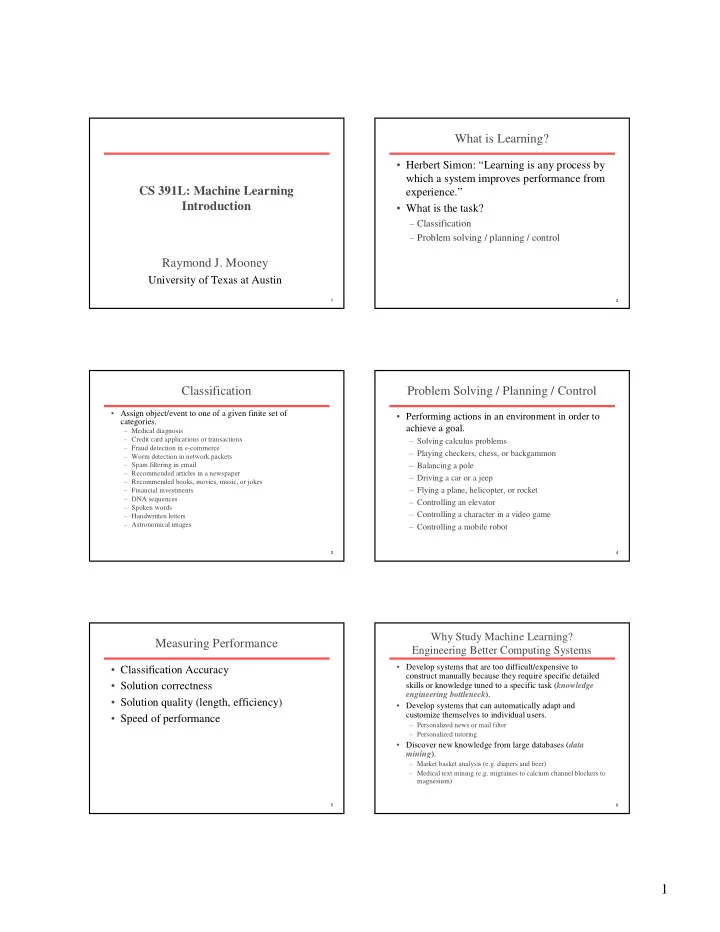
What is Learning?

  • Herbert Simon: “Learning is any process by

which a system improves performance from experience.”

  • What is the task?

– Classification – Problem solving / planning / control

3

Classification

  • Assign object/event to one of a given finite set of

categories.

– Medical diagnosis – Credit card applications or transactions – Fraud detection in e-commerce – Worm detection in network packets – Spam filtering in email – Recommended articles in a newspaper – Recommended books, movies, music, or jokes – Financial investments – DNA sequences – Spoken words – Handwritten letters – Astronomical images

4

Problem Solving / Planning / Control

  • Performing actions in an environment in order to

achieve a goal.

– Solving calculus problems – Playing checkers, chess, or backgammon – Balancing a pole – Driving a car or a jeep – Flying a plane, helicopter, or rocket – Controlling an elevator – Controlling a character in a video game – Controlling a mobile robot

5

Measuring Performance

  • Classification Accuracy
  • Solution correctness
  • Solution quality (length, efficiency)
  • Speed of performance

6

Why Study Machine Learning? Engineering Better Computing Systems

  • Develop systems that are too difficult/expensive to

construct manually because they require specific detailed skills or knowledge tuned to a specific task (knowledge engineering bottleneck).

  • Develop systems that can automatically adapt and

customize themselves to individual users.

– Personalized news or mail filter – Personalized tutoring

  • Discover new knowledge from large databases (data

mining).

– Market basket analysis (e.g. diapers and beer) – Medical text mining (e.g. migraines to calcium channel blockers to magnesium)

slide-2
SLIDE 2

2

7

Why Study Machine Learning? Cognitive Science

  • Computational studies of learning may help us

understand learning in humans and other biological organisms.

– Hebbian neural learning

  • “Neurons that fire together, wire together.”

– Human’s relative difficulty of learning disjunctive concepts vs. conjunctive ones. – Power law of practice

log(# training trials) log(perf. time)

8

Why Study Machine Learning? The Time is Ripe

  • Many basic effective and efficient

algorithms available.

  • Large amounts of on-line data available.
  • Large amounts of computational resources

available.

9

Related Disciplines

  • Artificial Intelligence
  • Data Mining
  • Probability and Statistics
  • Information theory
  • Numerical optimization
  • Computational complexity theory
  • Control theory (adaptive)
  • Psychology (developmental, cognitive)
  • Neurobiology
  • Linguistics
  • Philosophy

10

Defining the Learning Task

Improve on task, T, with respect to performance metric, P, based on experience, E.

T: Playing checkers P: Percentage of games won against an arbitrary opponent E: Playing practice games against itself T: Recognizing hand-written words P: Percentage of words correctly classified E: Database of human-labeled images of handwritten words T: Driving on four-lane highways using vision sensors P: Average distance traveled before a human-judged error E: A sequence of images and steering commands recorded while

  • bserving a human driver.

T: Categorize email messages as spam or legitimate. P: Percentage of email messages correctly classified. E: Database of emails, some with human-given labels

11

Designing a Learning System

  • Choose the training experience
  • Choose exactly what is too be learned, i.e. the

target function.

  • Choose how to represent the target function.
  • Choose a learning algorithm to infer the target

function from the experience.

Environment/ Experience Learner Knowledge Performance Element

12

Sample Learning Problem

  • Learn to play checkers from self-play
  • We will develop an approach analogous to

that used in the first machine learning system developed by Arthur Samuels at IBM in 1959.

slide-3
SLIDE 3

3

13

Training Experience

  • Direct experience: Given sample input and output

pairs for a useful target function.

– Checker boards labeled with the correct move, e.g. extracted from record of expert play

  • Indirect experience: Given feedback which is not

direct I/O pairs for a useful target function.

– Potentially arbitrary sequences of game moves and their final game results.

  • Credit/Blame Assignment Problem: How to assign

credit blame to individual moves given only indirect feedback?

14

Source of Training Data

  • Provided random examples outside of the learner’s

control.

– Negative examples available or only positive?

  • Good training examples selected by a “benevolent

teacher.”

– “Near miss” examples

  • Learner can query an oracle about class of an

unlabeled example in the environment.

  • Learner can construct an arbitrary example and

query an oracle for its label.

  • Learner can design and run experiments directly

in the environment without any human guidance.

15

Training vs. Test Distribution

  • Generally assume that the training and test

examples are independently drawn from the same overall distribution of data.

– IID: Independently and identically distributed

  • If examples are not independent, requires

collective classification.

  • If test distribution is different, requires

transfer learning.

16

Choosing a Target Function

  • What function is to be learned and how will it be

used by the performance system?

  • For checkers, assume we are given a function for

generating the legal moves for a given board position and want to decide the best move.

– Could learn a function: ChooseMove(board, legal-moves) → best-move – Or could learn an evaluation function, V(board) → R, that gives each board position a score for how favorable it

  • is. V can be used to pick a move by applying each legal

move, scoring the resulting board position, and choosing the move that results in the highest scoring board position.

17

Ideal Definition of V(b)

  • If b is a final winning board, then V(b) = 100
  • If b is a final losing board, then V(b) = –100
  • If b is a final draw board, then V(b) = 0
  • Otherwise, then V(b) = V(b´), where b´ is the

highest scoring final board position that is achieved starting from b and playing optimally until the end

  • f the game (assuming the opponent plays
  • ptimally as well).

– Can be computed using complete mini-max search of the finite game tree.

18

Approximating V(b)

  • Computing V(b) is intractable since it

involves searching the complete exponential game tree.

  • Therefore, this definition is said to be non-
  • perational.
  • An operational definition can be computed

in reasonable (polynomial) time.

  • Need to learn an operational approximation

to the ideal evaluation function.

slide-4
SLIDE 4

4

19

Representing the Target Function

  • Target function can be represented in many ways:

lookup table, symbolic rules, numerical function, neural network.

  • There is a trade-off between the expressiveness of

a representation and the ease of learning.

  • The more expressive a representation, the better it

will be at approximating an arbitrary function; however, the more examples will be needed to learn an accurate function.

20

Linear Function for Representing V(b)

  • In checkers, use a linear approximation of the

evaluation function.

– bp(b): number of black pieces on board b – rp(b): number of red pieces on board b – bk(b): number of black kings on board b – rk(b): number of red kings on board b – bt(b): number of black pieces threatened (i.e. which can be immediately taken by red on its next turn) – rt(b): number of red pieces threatened

) ( ) ( ) ( ) ( ) ( ) ( ) (

6 5 4 3 2 1

b rt w b bt w b rk w b bk w b rp w b bp w w b V ⋅ + ⋅ + ⋅ + ⋅ + ⋅ + ⋅ + = )

21

Obtaining Training Values

  • Direct supervision may be available for the

target function.

– < <bp=3,rp=0,bk=1,rk=0,bt=0,rt=0>, 100> (win for black)

  • With indirect feedback, training values can

be estimated using temporal difference learning (used in reinforcement learning where supervision is delayed reward).

22

Temporal Difference Learning

  • Estimate training values for intermediate (non-

terminal) board positions by the estimated value of their successor in an actual game trace. where successor(b) is the next board position where it is the program’s move in actual play.

  • Values towards the end of the game are initially

more accurate and continued training slowly “backs up” accurate values to earlier board positions. )) successor( ( ) ( b V b Vtrain ) =

23

Learning Algorithm

  • Uses training values for the target function to

induce a hypothesized definition that fits these examples and hopefully generalizes to unseen examples.

  • In statistics, learning to approximate a continuous

function is called regression.

  • Attempts to minimize some measure of error (loss

function) such as mean squared error: B b V b V E

B b train

− =

2

)] ( ) ( [ )

24

Least Mean Squares (LMS) Algorithm

  • A gradient descent algorithm that incrementally

updates the weights of a linear function in an attempt to minimize the mean squared error

Until weights converge : For each training example b do : 1) Compute the absolute error : 2) For each board feature, fi, update its weight, wi : for some small constant (learning rate) c

) ( ) ( ) ( b V b V b error

train

) − = ) (b error f c w w

i i i

⋅ ⋅ + =

slide-5
SLIDE 5

5

25

LMS Discussion

  • Intuitively, LMS executes the following rules:

– If the output for an example is correct, make no change. – If the output is too high, lower the weights proportional to the values of their corresponding features, so the

  • verall output decreases

– If the output is too low, increase the weights proportional to the values of their corresponding features, so the overall output increases.

  • Under the proper weak assumptions, LMS can be

proven to eventetually converge to a set of weights that minimizes the mean squared error.

26

Lessons Learned about Learning

  • Learning can be viewed as using direct or indirect

experience to approximate a chosen target function.

  • Function approximation can be viewed as a search

through a space of hypotheses (representations of functions) for one that best fits a set of training data.

  • Different learning methods assume different

hypothesis spaces (representation languages) and/or employ different search techniques.

27

Various Function Representations

  • Numerical functions

– Linear regression – Neural networks – Support vector machines

  • Symbolic functions

– Decision trees – Rules in propositional logic – Rules in first-order predicate logic

  • Instance-based functions

– Nearest-neighbor – Case-based

  • Probabilistic Graphical Models

– Naïve Bayes – Bayesian networks – Hidden-Markov Models (HMMs) – Probabilistic Context Free Grammars (PCFGs) – Markov networks

28

Various Search Algorithms

  • Gradient descent

– Perceptron – Backpropagation

  • Dynamic Programming

– HMM Learning – PCFG Learning

  • Divide and Conquer

– Decision tree induction – Rule learning

  • Evolutionary Computation

– Genetic Algorithms (GAs) – Genetic Programming (GP) – Neuro-evolution

29

Evaluation of Learning Systems

  • Experimental

– Conduct controlled cross-validation experiments to compare various methods on a variety of benchmark datasets. – Gather data on their performance, e.g. test accuracy, training-time, testing-time. – Analyze differences for statistical significance.

  • Theoretical

– Analyze algorithms mathematically and prove theorems about their:

  • Computational complexity
  • Ability to fit training data
  • Sample complexity (number of training examples needed to

learn an accurate function)

30

History of Machine Learning

  • 1950s

– Samuel’s checker player – Selfridge’s Pandemonium

  • 1960s:

– Neural networks: Perceptron – Pattern recognition – Learning in the limit theory – Minsky and Papert prove limitations of Perceptron

  • 1970s:

– Symbolic concept induction – Winston’s arch learner – Expert systems and the knowledge acquisition bottleneck – Quinlan’s ID3 – Michalski’s AQ and soybean diagnosis – Scientific discovery with BACON – Mathematical discovery with AM

slide-6
SLIDE 6

6

31

History of Machine Learning (cont.)

  • 1980s:

– Advanced decision tree and rule learning – Explanation-based Learning (EBL) – Learning and planning and problem solving – Utility problem – Analogy – Cognitive architectures – Resurgence of neural networks (connectionism, backpropagation) – Valiant’s PAC Learning Theory – Focus on experimental methodology

  • 1990s

– Data mining – Adaptive software agents and web applications – Text learning – Reinforcement learning (RL) – Inductive Logic Programming (ILP) – Ensembles: Bagging, Boosting, and Stacking – Bayes Net learning

32

History of Machine Learning (cont.)

  • 2000s

– Support vector machines – Kernel methods – Graphical models – Statistical relational learning – Transfer learning – Sequence labeling – Collective classification and structured outputs – Computer Systems Applications

  • Compilers
  • Debugging
  • Graphics
  • Security (intrusion, virus, and worm detection)

– Email management – Personalized assistants that learn – Learning in robotics and vision