
1
1 Bryant and O’Hallaron, Computer Systems: A Programmer’s Perspective, Third Edition
Dynamic Memory Allocation: Advanced Concepts
CSci 2021: Machine Architecture and Organization April 27th-29th, 2020 Your instructor: Stephen McCamant Based on slides originally by: Randy Bryant, Dave O’Hallaron
2 Bryant and O’Hallaron, Computer Systems: A Programmer’s Perspective, Third Edition
Today
Explicit free lists Segregated free lists Garbage collection Memory-related perils and pitfalls
3 Bryant and O’Hallaron, Computer Systems: A Programmer’s Perspective, Third Edition
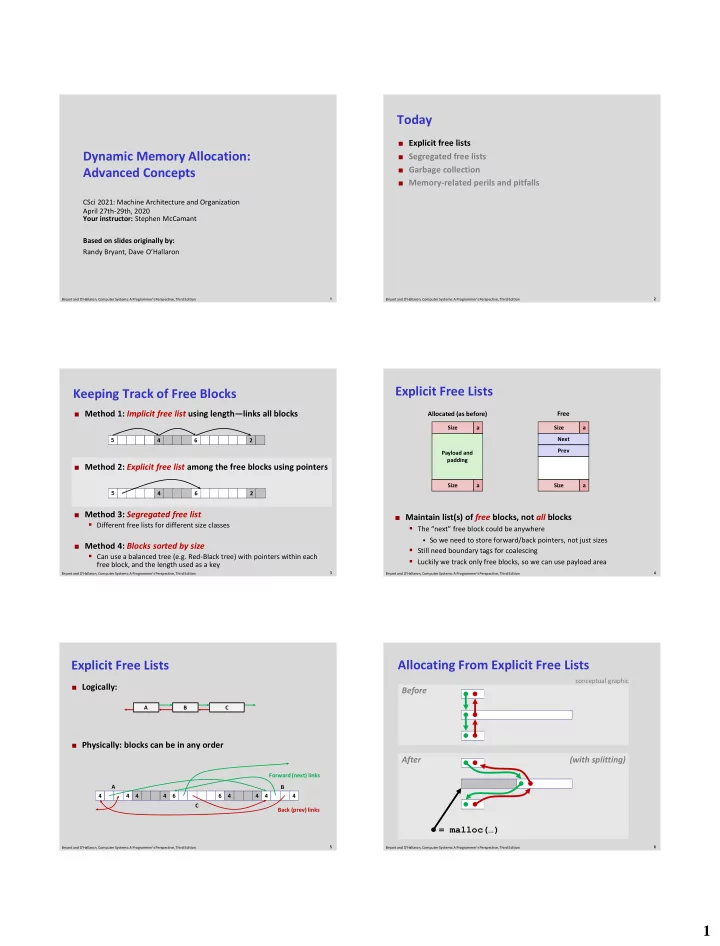
Keeping Track of Free Blocks
Method 1: Implicit free list using length—links all blocks Method 2: Explicit free list among the free blocks using pointers Method 3: Segregated free list
- Different free lists for different size classes
Method 4: Blocks sorted by size
- Can use a balanced tree (e.g. Red-Black tree) with pointers within each
free block, and the length used as a key
5 4 2 6 5 4 2 6
4 Bryant and O’Hallaron, Computer Systems: A Programmer’s Perspective, Third Edition
Explicit Free Lists
Maintain list(s) of free blocks, not all blocks
- The “next” free block could be anywhere
- So we need to store forward/back pointers, not just sizes
- Still need boundary tags for coalescing
- Luckily we track only free blocks, so we can use payload area
Size Payload and padding a Size a Size a Size a Next Prev
Allocated (as before) Free
5 Bryant and O’Hallaron, Computer Systems: A Programmer’s Perspective, Third Edition
Explicit Free Lists
Logically: Physically: blocks can be in any order A B C 4 4 4 4 6 6 4 4 4 4 Forward (next) links Back (prev) links A B C
6 Bryant and O’Hallaron, Computer Systems: A Programmer’s Perspective, Third Edition
Allocating From Explicit Free Lists
Before After = malloc(…) (with splitting)
conceptual graphic