1 Measuring quality Costs of quality assurance Is it possible to - - PDF document

1
SMART_READER_LITE
LIVE PREVIEW

1 Measuring quality Costs of quality assurance Is it possible to - - PDF document

Key Points Many different characteristics of quality Quality Assurance and Testing Importance of having independent quality assurance from development The deliverable of QA is information CSE 403 Write it down Lecture 22 QA


slide-1
SLIDE 1

1 Quality Assurance and Testing

CSE 403 Lecture 22

Slides derived from a talk by Ian King

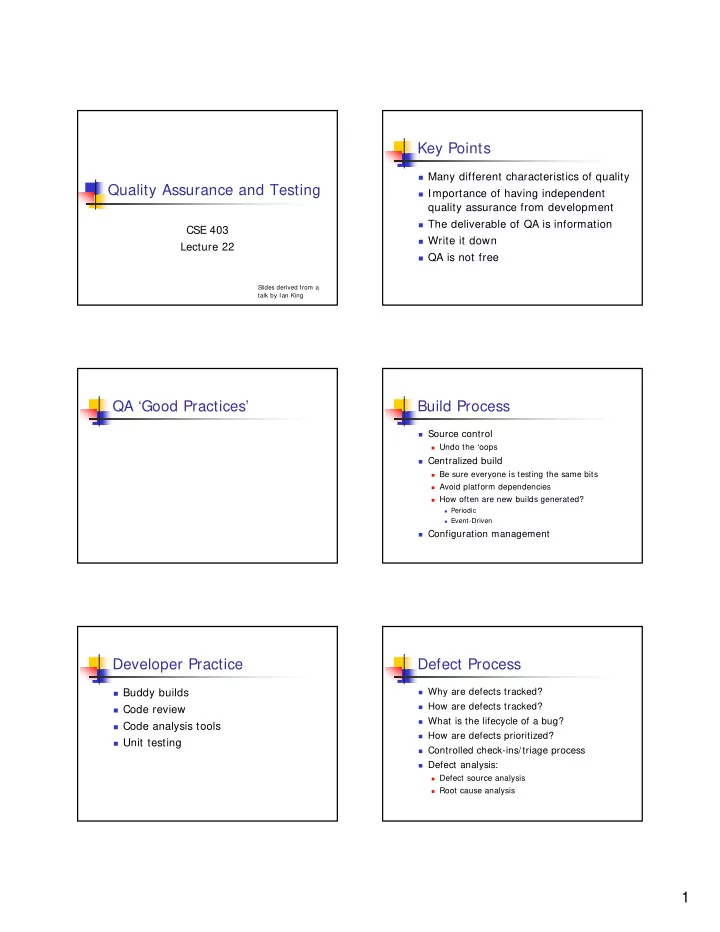
Key Points

Many different characteristics of quality Importance of having independent

quality assurance from development

The deliverable of QA is information Write it down QA is not free

QA ‘Good Practices’ Build Process

Source control

Undo the ‘oops

Centralized build

Be sure everyone is testing the same bits Avoid platform dependencies How often are new builds generated?

Periodic Event-Driven

Configuration management

Developer Practice

Buddy builds Code review Code analysis tools Unit testing

Defect Process

Why are defects tracked? How are defects tracked? What is the lifecycle of a bug? How are defects prioritized? Controlled check-ins/triage process Defect analysis:

Defect source analysis Root cause analysis

slide-2
SLIDE 2

2 Measuring quality

Is it possible to quantify software

quality?

Costs of quality assurance

Programmer Productivity

8-20 LOC / day

Building QA into the schedule

Quality Assurance: Test Development & Execution

Slides derived from a talk by Ian King

Developing Test Strategy

Elements of Test Strategy

Test specification Test plan Test harness/architecture Test case generation Test schedule

Where is your focus?

The customer The customer The customer The customer The customer The customer The customer Schedule and budget

Requirements feed into test design

What factors are important to the

customer?

Reliability vs. security Reliability vs. performance Features vs. reliability Cost vs. ?

What are the customer’s expectations? How will the customer use the

software?

slide-3
SLIDE 3

3 Test Specifications

What questions do I want to answer about

this code? Think of this as experiment design

In what dimensions will I ask these

questions?

Functionality Security Reliability Performance Scalability Manageability

Test specification: example

CreateFile method

Should return valid, unique handle for

initial ‘open’ for appropriate resource subsequent calls for shareable resource for files, should create file if it doesn’t exist

Should return NULL handle and set error indicator

if resource is

nonexistent device inappropriate for ‘open’ action in use and not shareable unavailable because of error condition (e.g. no disk

space)

Must recognize valid forms of resource name

Filename, device, ?

Test Plans

How will I ask my questions? Think of this as

the “Methods” section

Understand domain and range Establish equivalence classes Address domain classes

Valid cases Invalid cases Boundary conditions Error conditions Fault tolerance/stress/performance

Test plan: goals

Enables development of tests Proof of testability – if you can’t design

it, you can’t do it

Review: what did you miss?

Test plan: example

  • CreateFile method
  • Valid cases
  • execute for each resource supporting ‘open’ action
  • pening existing device
  • pening existing file
  • pening (creating) nonexistent file
  • execute for each such resource that supports sharing
  • multiple method calls in separate threads/processes
  • multiple method calls in single thread/process
  • Invalid cases
  • nonexistent device
  • file path does not exist
  • in use and not shareable
  • Error cases
  • insufficient disk space
  • invalid form of name
  • permissions violation
  • Boundary cases
  • e.g. execute to/past system limit on open device handles
  • device name at/past name length limit (MAXPATH)
  • Fault tolerance
  • execute on failed/corrupted filesystem
  • execute on failed but present device

Performance testing

Test for performance behavior

Does it meet requirements?

Customer requirements Definitional requirements (e.g. Ethernet)

Test for resource utilization

Understand resource requirements

Test performance early

Avoid costly redesign to meet performance

requirements
slide-4
SLIDE 4

4 Security Testing

Is data/access safe from those who should

not have it?

Is data/access available to those who should

have it?

How is privilege granted/revoked? Is the system safe from unauthorized control?

Example: denial of service

Collateral data that compromises security

Example: network topology

Stress testing

Working stress: sustained operation at

  • r near maximum capability

Goal: resource leak detection Breaking stress: operation beyond

expected maximum capability

Goal: understand failure scenario(s)

“Failing safe” vs. unrecoverable failure or

data loss

Globalization

Localization

UI in the customer’s language German overruns the buffers Japanese tests extended character sets

Globalization

Data in the customer’s language Non-US values ($ vs. Euro, ips vs. cgs) Mars Global Surveyor: mixed metric and

SAE

Test Cases

Actual “how to” for individual tests Expected results One level deeper than the Test Plan Automated or manual? Environmental/platform variables

Test case: example

CreateFile method

Valid cases

English

  • pen existing disk file with arbitrary name and full path,

file permissions allowing access

  • create directory ‘c:\foo’
  • copy file ‘bar’ to directory ‘c:\foo’ from test server;

permissions are ‘Everyone: full access’

  • execute CreateFile(‘c:foo\bar’, etc.)
  • expected: non-null handle returned

Test Harness/Architecture

Test automation is nearly always worth

the time and expense

How to automate?

Commercial harnesses Roll-your-own Record/replay tools Scripted harness

Logging/Evaluation

slide-5
SLIDE 5

5 Test Schedule

Phases of testing

  • Unit testing (may be done by developers)
  • Component testing
  • Integration testing
  • System testing

Dependencies – when are features ready?

  • Use of stubs and harnesses

When are tests ready?

  • Automation requires lead time

The long pole – how long does a test pass take?

Where The Wild Things Are: Challenges and Pitfalls

“Everyone knows” – hallway design “We won’t know until we get there” “I don’t have time to write docs” Feature creep/design “bugs” Dependency on external groups