1 FDA 101 FDA mission: Protecting the public health by assuring the - - PDF document

1
SMART_READER_LITE
LIVE PREVIEW

1 FDA 101 FDA mission: Protecting the public health by assuring the - - PDF document

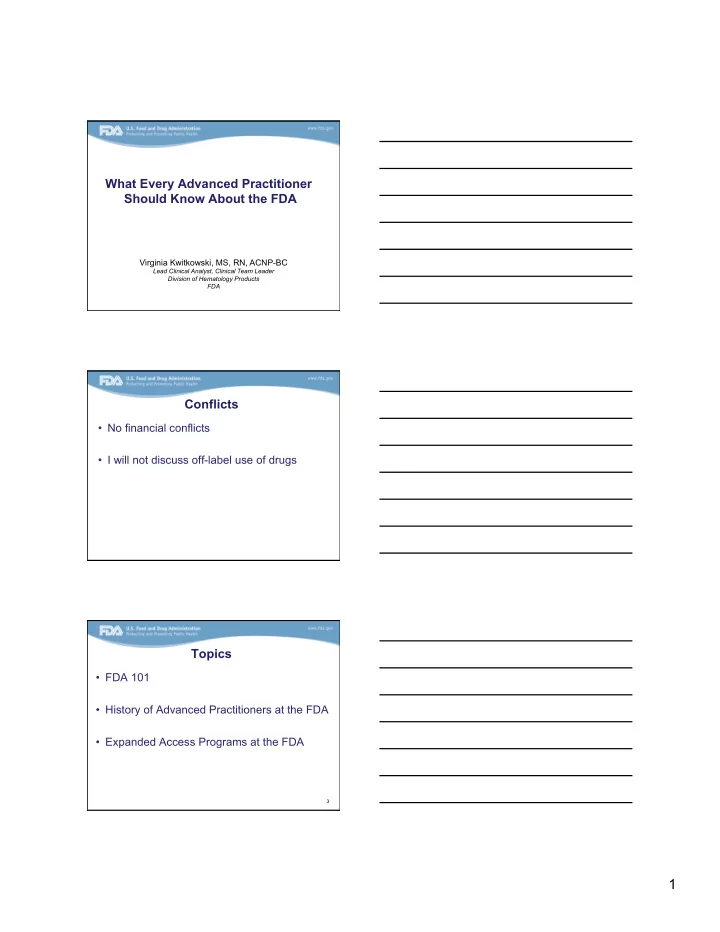
What Every Advanced Practitioner Should Know About the FDA Virginia Kwitkowski, MS, RN, ACNP-BC Lead Clinical Analyst, Clinical Team Leader Division of Hematology Products FDA Conflicts No financial conflicts I will not discuss


slide-1
SLIDE 1

1

What Every Advanced Practitioner Should Know About the FDA

Virginia Kwitkowski, MS, RN, ACNP-BC

Lead Clinical Analyst, Clinical Team Leader Division of Hematology Products FDA

Conflicts

  • No financial conflicts
  • I will not discuss off-label use of drugs

Topics

  • FDA 101
  • History of Advanced Practitioners at the FDA
  • Expanded Access Programs at the FDA

3

slide-2
SLIDE 2

2

FDA 101

  • FDA mission: Protecting the public health by assuring the

safety, efficacy and security of human and veterinary drugs, biological products, medical devices, our nation’s food supply, cosmetics, and products that emit radiation.

  • FDA is also responsible for advancing the public health by

helping to speed innovations that make medicines more effective, safer, and more affordable and by helping the public get the accurate, science-based information they need to use medicines and foods to maintain and improve their health.

4

What are APs Doing at FDA?

  • Clinical Reviewer
  • Clinical Team Leader
  • Deputy Director for Safety
  • Associate Director for Labeling
  • Regulatory Project Manager
  • Nurse Scientist
  • Safety Evaluator

5

Phases of Clinical Trials

Phase

  • f Trial

Purpose of Trial Typical Size Level of Evidence Provided Early Pharmacokinetic/ Pharmacodynamic Data 10-12 Should a new drug be tested? 1 Find a safe dose Pharmacokinetic data Pharmacodynamic Safety 15-30 What is the maximum tolerated dose or RP2D? 2 Assess Drug Activity Safety <100 Is the drug active enough to plan a Phase 3 trial OR Accelerated approval. 3 Compare new treatment to standard treatment In oncology; from 100-1000s Regular approval 4 Evaluate post-marketing safety or efficacy; possibly a new indication 100-1000s New indication, serve as a PMR

6

slide-3
SLIDE 3

3

Drug Development Timeline

8

Efficacy Endpoints and Approval Pathways

Endpoints of Direct Clinical Benefit: Surrogate Endpoints REGULAR APPROVAL ACCELERATED APPROVAL

  • All Regulatory Approvals requires Substantial Evidence from adequate and well-controlled

clinical trials

  • Regular approval

– Endpoint: based on prolongation of life, a better life or an established surrogate for either of the above

  • Accelerated approval for Severe or Life Threatening Diseases

– Provide meaningful therapeutic benefit… over existing therapies – Endpoint: “Surrogate endpoint… reasonably likely… to predict clinical benefit”

Higher Certainty Lower Certainty

Certainty of Clinical Benefit (Response Rate in Solid Tumors) (Overall Survival) (DFS – Adjuvant Breast)

IND Received by FDA Divisional Assignment Made Clinical Chemistry Pharmacology/ Toxicology Clinical Pharmacology Clinical Deficiencies Identified? YES NO IND May Proceed Deficiency Communicated to Sponsor Sponsor Response to FDA

Initial 30-Day IND Review Process

IND # Assigned

slide-4
SLIDE 4

4

How APs Accomplish the Mission

  • Review INDs from initial safety review to the New

Drug Application that may lead to a safe and effective new drug/biologic

  • Guide the pharmaceutical industry in trial design,

endpoint selection, trial implementation, and overall drug development strategies.

  • Communicate important new approvals and safety

information

  • Monitor post-marketing safety, ensure accurate

product labeling (Prescribing Information)

10

Advisory Committee Meetings

  • Convened by FDA review divisions to discuss

new applications, safety issues, etc.

  • Provide independent advice to FDA
  • Membership includes a chairperson, standing

members, invited clinical experts (in the area

  • f interest), statisticians, consumer

representatives, industry reps (all carefully screened for conflict of interest)

  • Hear presentations, discuss topics, and vote

11

How to Access Investigational Drugs

12

slide-5
SLIDE 5

5

Expanded Access Programs

(Compassionate Use) 21CFR312(I)

  • Use of investigational drug/biologic to treat a

patient

  • With a serious disease or condition
  • Who does NOT have comparable or

satisfactory alternative therapies (including a clinical trial for the product)

  • Where the potential benefit justifies potential

risks

13

Expanded Access Programs

  • Benefits
  • Autonomy for the patient
  • Bridges the gap between closure of the

pivotal clinical trial and approval of drug

  • Fosters development of additional uses of a drug
  • Risks
  • Unknown risks associated; little info
  • Unknown efficacy
  • May adversely effect clinical trial accrual

14

Ways to Mitigate Risk of EAPs

  • Ensure that pivotal trials are completed prior

to opening EAP

  • Risk of access to investigational drug for

patient is carefully weighed by treating physician and FDA reviewer

15

slide-6
SLIDE 6

6

Requirements for Individual Patient EAPs (21 CFR 312.310)

  • Treating physician determines probable risk

from drug not > than that from disease

  • FDA determines that patient can’t obtain

access to drug from another type of IND

  • FDA requires reporting
  • FDA may request consolidation of multiple

cases into a single, intermediate sized IND

16

Requirements for Treatment IND or Protocol (21 CFR 312.320)

  • Drug is being investigated in clinical trial

designed to support marketing OR trials are complete

  • Company is actively pursuing marketing

approval

  • Sufficient evidence of safety and

effectiveness

  • Additional safeguards

– Monitoring

17

Single Patient INDs Implementing the Process

Five Components

  • 1. Patient-urgent need, limited info, costs?
  • 2. Doctor-initiates process, contacts company,

monitoring and reporting

  • 3. Manufacturer-must be willing to provide drug
  • 4. FDA-Resource intensive, assesses data, confirms

patient protections in place

  • 5. IRB-May not be familiar with procedure, may
  • verestimate risk, requires full review

18

slide-7
SLIDE 7

7

What Information Do I Send to Get a Single Patient IND?

1. Statement that this is a request for Individual Patient IND for treatment use 2. Brief clinical history of the patient including: Diagnosis, disease status, prior therapy, response to prior therapy, rationale for requesting the proposed treatment

  • 3. Proposed Treatment Plan
  • 4. Chemistry/Manufacturing/Controls & Pharmacology/Toxicology Info

(requirement may be met by Letter of Authorization from Drug company. 5. Informed consent statement 6. Investigator qualification statement 7. FDA Form 1571 8. Contact Information for Requestor Send to FDA review division that handles disease/drug (DHP, DOP1, or DOP2). See contact #s on last slide.

19

Emergency INDs

  • Request via phone (see #s on last slide)
  • Shipment and treatment may occur after

verbal approval

  • Written information must follow

20

Abbreviations

  • FDA-Food and Drug Administration
  • IND-Investigational New Drug Application
  • NDA-New Drug Application
  • BLA-Biologic License Application
  • EAP-Expanded Access Programs
  • IRB-Institutional Review Board
  • PMR-Post Marketing Requirement

21

slide-8
SLIDE 8

8

Resources

  • Expanded Access:

http://www.fda.gov/forpatients/other/ expandedaccess/default.htm

22

Office of Hematology Oncology Products Contact #s

CDER Review Division Telephone Number FAX Number Division of Oncology Products 1 301-796-2330 301-796-9883 Division of Oncology Products 2 301-796-2320 301-796-9849 Division of Hematology Products 301-796-7550 301-796-9849

23