1 9/14/2019 Patient 2 Twitter poll 73 yo female 69 yo female - - PDF document

1
SMART_READER_LITE
LIVE PREVIEW

1 9/14/2019 Patient 2 Twitter poll 73 yo female 69 yo female - - PDF document

9/14/2019 Disclosures AF and CHF Should ablation be the first line therapy? Research grants NIH, Abbott, Sanofi, Biosense, BI, Biotronik, MARREK Inc., Medtronic, Boston Scientific, Catheter Robotics, Nassir F. Marrouche, MD VytronUs


slide-1
SLIDE 1

9/14/2019 1

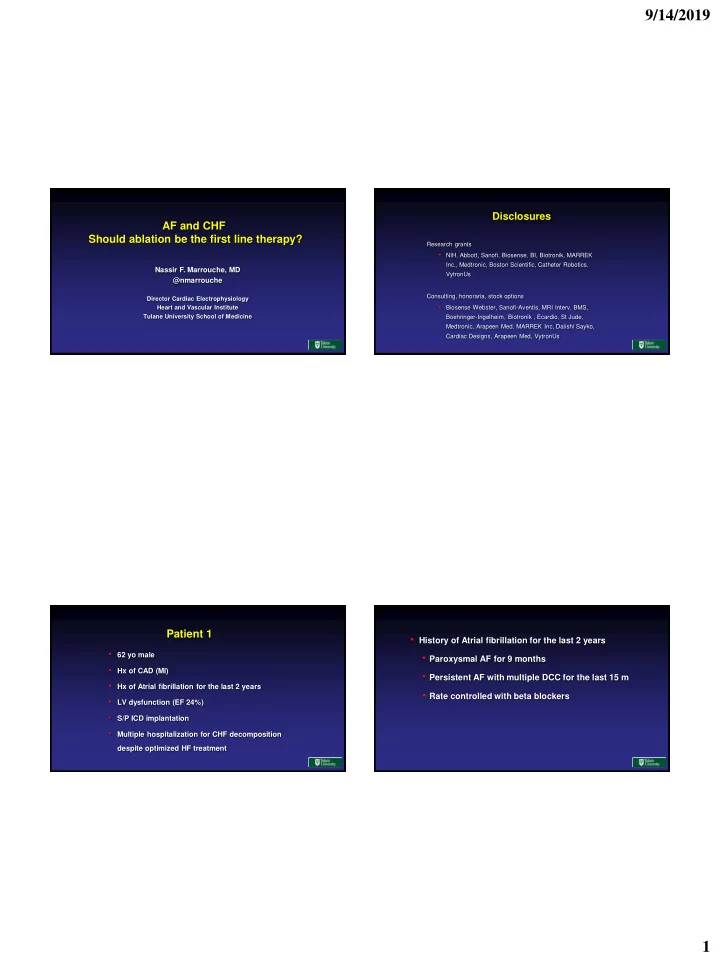
AF and CHF Should ablation be the first line therapy?

Nassir F. Marrouche, MD @nmarrouche

Director Cardiac Electrophysiology Heart and Vascular Institute Tulane University School of Medicine

Disclosures

Research grants

  • NIH, Abbott, Sanofi, Biosense, BI, Biotronik, MARREK

Inc., Medtronic, Boston Scientific, Catheter Robotics, VytronUs Consulting, honoraria, stock options

  • Biosense Webster, Sanofi-Aventis, MRI Interv, BMS,

Boehringer-Ingelheim, Biotronik , Ecardio, St Jude, Medtronic, Arapeen Med, MARREK Inc, Daiishi Sayko, Cardiac Designs, Arapeen Med, VytronUs

Patient 1

  • 62 yo male
  • Hx of CAD (MI)
  • Hx of Atrial fibrillation for the last 2 years
  • LV dysfunction (EF 24%)
  • S/P ICD implantation
  • Multiple hospitalization for CHF decomposition

despite optimized HF treatment

  • History of Atrial fibrillation for the last 2 years
  • Paroxysmal AF for 9 months
  • Persistent AF with multiple DCC for the last 15 m
  • Rate controlled with beta blockers
slide-2
SLIDE 2

9/14/2019 2

Patient 2

  • 73 yo female
  • LV dysfunction (EF 30%)
  • S/P ICD implantation
  • Dilated Cardiomyopathy
  • Persistent AF for
  • 3 monthsShortness of breath on exertion

Twitter poll

  • 69 yo female with symptomatic (NYHA II-III)

persistent #AFib and 29% ejection fraction, ischemic cardiomyopathy Never used #antiarrhythmics or had #DCCV. Left atrial size 5.5 cm. What is next assuming optimal heart failure tx!

Twitter Poll Results Recommendation for Catheter Ablation of AF in Heart Failure (IIa)

2017 HRS/EHRA/ECAS/APHRS/SOLAECE expert consensus statement on catheter and surgical ablation of atrial fibrillation

slide-3
SLIDE 3

9/14/2019 3

Recommendation for Catheter Ablation

  • f AF in Heart Failure

(2018 ACC/AHA updated recommendation)

Ablation of atrial fibrillation in patients with heart failure deserves more than a IIb guidelines recommendation

Chelu et al JCE 2019 Sep;30(9):1412-1415

Outline

  • Challenges of Antiarrhythmics in Heart Failure
  • Atrial Fibrillation Ablation in Heart Failure
  • Selecting the Right Patient for Ablation

The Challenges of the Antiarrhythmic Drugs in the Heart Failure Population

slide-4
SLIDE 4

9/14/2019 4

Dofetilide Has No Effect on Mortality in Patients with Atrial Fibrillation and Heart Failure

slide-5
SLIDE 5

9/14/2019 5

Outline

  • Challenges of Antiarrhythmics in Heart Failure
  • Atrial Fibrillation Ablation in Heart Failure
  • Selecting the Right Patient for Ablation

PVI vs. AV node Ablation and Biventricular ICD: PABA-CHF Trial

  • 41 Patients with symptomatic drug-resistant AF
  • Randomized control trial of patients EF <40%, NYH II, III
  • PVI vs. AV node ablation and Biventricular ICD
  • Primary end points: EF, 6-min walk, HF questionnaire

Khan M et al. N Engl J Med 2008;359:1778-1785

  • EF improved in 76% of pts with PVI vs. 25% in AVNA
  • Mean EF increase of 8.8% in PVI vs. 1.1% in AVNA
  • Increased distance in 6 min walk with PVI
  • improved Quality of Life with PVI

Khan M et al. N Engl J Med 2008;359:1778-1785

PVI vs. AV node Ablation and Biventricular ICD: PABA-CHF Trial

Di Biase et al. Circulation 2017

Ablation vs Amiodarone for Treatment of Atrial Fibrillation in Heart Failure (AATAC-Study)

slide-6
SLIDE 6

9/14/2019 6

8.1 22 11 6.2 10 6 LVEF 6MWD MLFHQ score reduction Ablation Amiodarone

Change in LVEF, 6MWD and MLHFQ AATAC-Trial

p-value = 0.02 p-value = 0.02 p-value = 0.04

8 31 18 57 Death Hospitalization Ablation Amiodarone

Unplanned Hospitalization and Death AATAC-Trial

Relative Risk Reduction = 45% p-value < 0.001 Relative Risk Reduction = 56% p-value = 0.037

Change in LVEF (MRI) at Baseline and 6 Months

Catheter ABlation vs ANtiarrhythmic Drug Therapy in Atrial Fibrillation (CABANA) Trial

Packer et al. JAMA 2019

slide-7
SLIDE 7

9/14/2019 7

CABANA-Trial Primary Endpoint (Death, Disabling Stroke, Serious Bleeding, or Cardiac Arrest) (ITT)

All-Cause mortality, stroke, serious bleeding

  • r cardiac arrest: Impact of Heart Failure

CABANA-Trial

Hazard ratio 0.64

Catheter Ablation versus Standard conventional Treatment in patients with LEft ventricular dysfunction and Atrial Fibrillation

The CASTLE-AF trial

Marrouche et al. N Engl J Med. 2018 Feb 1;378(5):417-427

CASTLE-AF

slide-8
SLIDE 8

9/14/2019 8

CASTLE AF Primary Composite Endpoint

0.2 0.4 0.6 0.8 1

12 24 36 48 60 Risk Reduction: 38%

Follow-Up Time (Months) Survival Probability

Patients at Risk Ablation 179 141 114 76 58 22 Conventional 184 145 111 70 48 12 Ablation Conventional HR, 0.62 (95% CI, 0.43-0.87); P=0.007 Log-rank test: P=0.006 N Engl J Med. 2018 Feb 1;378(5):417-427

CASTLE AF All-Cause Mortality

0.2 0.4 0.6 0.8 1

12 24 36 48 60

Patients at Risk Ablation 179 154 130 94 71 27 Conventional 184 168 138 97 63 19 HR, 0.53 (95% CI, 0.32-0.86); P=0.011 Log-rank test: P=0.009 Ablation Conventional

Survival Probability Follow-Up Time (Months)

Risk Reduction: 47%

CASTLE AF Worsening Heart Failure Admissions

0.2 0.4 0.6 0.8 1

12 24 36 48 60

Patients at Risk Ablation 179 141 114 76 58 22 Conventional 184 145 111 70 48 12 HR, 0.56 (95% CI, 0.37-0.83); P=0.004 Log-rank test: P=0.004 Ablation Conventional

Survival Probability Follow-Up Time (Months)

Risk Reduction: 44%

Intention-to-treat, per-protocol, as-treated

slide-9
SLIDE 9

9/14/2019 9

CASTLE-AF: Time to first 30 sec recurrence AF recurrence (30 sec) was not associated with outcome

HR 95% CI P-value Ablated patients 2.13 0.87 – 5.18 0.097 Non-ablated patients 0.96 0.44 – 2.09 0.914

HR, 2.52 (95% CI, 1.15-5.50); P=0.021

AF Burden <50% at follow up a strong predictor for Composite of Mortality + Hospitalization AF Burden <50% at follow up a strong predictor for mortality

slide-10
SLIDE 10

9/14/2019 10

AF recurrence No AF recurrence Yes 1.04 [0.68-1.61] 0.18 [0.05-0.63]

  • 0.5

0.5 1 1.5 2

CASTLE-AF

Ablation and incidence of VT

Ablation better Pharmacological treatment better AF recurrence No AF recurrence Yes 0.8 [0.54-1.18] 0.09 [0.03- 0.28]

  • 0.5

0.5 1 1.5

CASTLE-AF

Ablation and incidence of VF

Ablation better Pharmacological treatment better

CASTLE-AF Ablation led to better QoL

Sanders et al HRS 2019

CASTLE AF Absolute change in LVEF from baseline

7 4.5 8 2 1

  • 10
  • 5

5 10 15 20 12mo 36mo 60mo LVEF Change from Baseline Ablation Conventional

p*=0.001 p=0.055 p*=0.005

slide-11
SLIDE 11

9/14/2019 11

OR=2.17,p<0.001

CASTLE-AF improvement to >35%

CASTLE-AF Outcome in EF<20%

Marrouche et al HRS 2019

CASTLE-AF Outcome in EF>20%

Marrouche et al HRS 2019

Ablation of AF in Heart Failure Patient Selection

slide-12
SLIDE 12

9/14/2019 12

CASTLE-AF

Impact of NYHA functional class

Marrouche et al HRS 2019

Correlation between % of ventricular scar and ΔLVEF following catheter ablation

Prabhu et al J Am Coll Cardiol. 2017 Oct 17;70(16):1949-1961. Late gadolinium enhancement demonstrating regional mid-wall fibrosis in dilated cardiomyopathy

A. B. LGE Positive LGE Negative

Classification of AF based on degree

  • f atrial fibrosis/myopathy

Marrouche et al. JAMA. 2014 Feb 5;311(5):498-506

Left atrium fibrosis

Higher degree of left atrial fibrosis in patients with AF and left ventricular systolic dysfunction

  • Akkaya et al. JCE 2013
slide-13
SLIDE 13

9/14/2019 13

Degree of atrial disease affects LVEF improvement post AF ablation

  • Akkaya et al. JCE 2013

What we know today!

  • ABLATION CONTROLL of atrial fibrillation in heart failure
  • Improves AF Burden
  • Improves QoL
  • Improves incidence of Ventricular Arrhythmias
  • Improves LVEF
  • Improves Hospitalization
  • Improves Mortality
  • Patient selection is important

<15% ventricular LGE Scar

Personalized Management of Ablation of Atrial Fibrillation Heart Failure Patient

LGE-MRI NYHA I-II Medical management NYHA III-IV NYHA II

Fibrosis ≥30% Fibrosis <10% Fibrosis ≥10%-<20% Fibrosis ≥20%-<30%

Healthy Fibrotic tissue

Thank You!