1 Recap: Taking Differences Distribution of Integer Values 0.1 - - PDF document

1
SMART_READER_LITE
LIVE PREVIEW

1 Recap: Taking Differences Distribution of Integer Values 0.1 - - PDF document

Recap: Search Engine Query Processing Recap: Search Engine Query Processing Parallel query processing: divide docs between Basically, to process a query we need to traverse the many machines, broadcast results to all inverted lists of the


slide-1
SLIDE 1

1

  • Basically, to process a query we need to traverse the

inverted lists of the query terms

  • Lists are very long and are stored on disks
  • Challenge: traverse lists as quickly as possible
  • Tricks: compression, caching,

parallelism, early termination (“pruning”)

Recap: Search Engine Query Processing

  • Parallel query processing: divide docs between

many machines, broadcast results to all

  • Caching of results at query integrator
  • Caching of compressed lists at each node

Recap: Search Engine Query Processing Chunked Compression

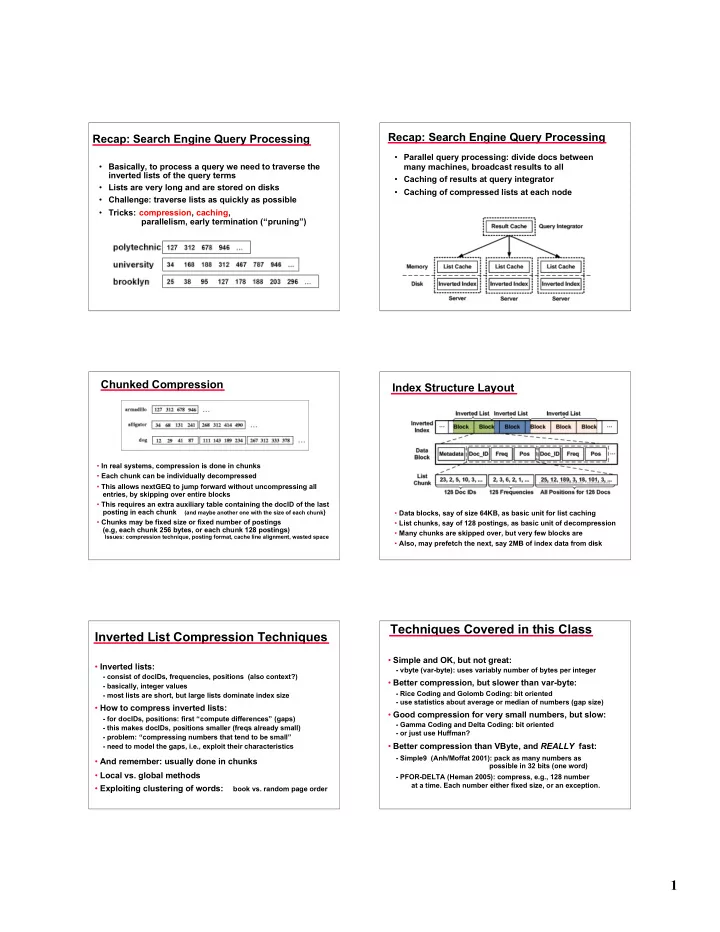
  • In real systems, compression is done in chunks
  • Each chunk can be individually decompressed
  • This allows nextGEQ to jump forward without uncompressing all

entries, by skipping over entire blocks

  • This requires an extra auxiliary table containing the docID of the last

posting in each chunk (and maybe another one with the size of each chunk)

  • Chunks may be fixed size or fixed number of postings

(e.g, each chunk 256 bytes, or each chunk 128 postings) Issues: compression technique, posting format, cache line alignment, wasted space

Index Structure Layout

  • Data blocks, say of size 64KB, as basic unit for list caching
  • List chunks, say of 128 postings, as basic unit of decompression
  • Many chunks are skipped over, but very few blocks are
  • Also, may prefetch the next, say 2MB of index data from disk
  • Inverted lists:
  • consist of docIDs, frequencies, positions (also context?)
  • basically, integer values
  • most lists are short, but large lists dominate index size
  • How to compress inverted lists:
  • for docIDs, positions: first “compute differences” (gaps)
  • this makes docIDs, positions smaller (freqs already small)
  • problem: “compressing numbers that tend to be small”
  • need to model the gaps, i.e., exploit their characteristics
  • And remember: usually done in chunks
  • Local vs. global methods
  • Exploiting clustering of words: book vs. random page order

Inverted List Compression Techniques

  • Simple and OK, but not great:
  • vbyte (var-byte): uses variably number of bytes per integer
  • Better compression, but slower than var-byte:
  • Rice Coding and Golomb Coding: bit oriented
  • use statistics about average or median of numbers (gap size)
  • Good compression for very small numbers, but slow:
  • Gamma Coding and Delta Coding: bit oriented
  • or just use Huffman?
  • Better compression than VByte, and REALLY fast:
  • Simple9 (Anh/Moffat 2001): pack as many numbers as

possible in 32 bits (one word)

  • PFOR-DELTA (Heman 2005): compress, e.g., 128 number

at a time. Each number either fixed size, or an exception.

Techniques Covered in this Class

slide-2
SLIDE 2

2

Distribution of Integer Values

1 2 3 4 5 6 7 8 9 10 11 probability 0.1

  • many small values means better compression

Recap: Taking Differences

  • idea: use efficient coding for docIDs, frequencies, and positions in index
  • first, take differences, then encode those smaller numbers:
  • example: encode alligator list, first produce differences:
  • if postings only contain docID:

(34) (68) (131) (241) … becomes (34) (34) (43) (110) …

  • if postings with docID and frequency:

(34,1) (68,3) (131,1) (241,2) … becomes (34,1) (34,3) (43,1) (110,2) …

  • if postings with docID, frequency, and positions:

(34,1,29) (68,3,9,46,98) (131,1,46) (241,2,45,131) …

becomes (34,1,29) (34,3,9,37,52) (43,1,46) (110,2,45,86) …

  • afterwards, do encoding with one of many possible methods

Recap: var-byte Compression

  • simple byte-oriented method for encoding data
  • encode number as follows:
  • if < 128, use one byte (highest bit set to 0)
  • if < 128*128 = 16384, use two bytes (first has highest bit 1, the other 0)
  • if < 128^3, then use three bytes, and so on …
  • examples: 14169 = 110*128 + 89 = 11101110 01011001

33549 = 2*128*128 + 6*128 + 13 = 10000010 10000110 00001101

  • example for a list of 4 docIDs: after taking differences

(34) (178) (291) (453) … becomes (34) (144) (113) (162)

  • this is then encoded using six bytes total:

34 = 00100010 144 = 10000001 00010000 113 = 01110001 162 = 10000001 00100010

  • not a great encoding, but fast and reasonably OK
  • implement using char array and char* pointers in C/C++

Rice Coding:

  • consider the average or median of the numbers (i.e., the gaps)
  • simplified example for a list of 4 docIDs: after taking differences

(34) (178) (291) (453) … becomes (34) (144) (113) (162)

  • so average is g = (34+144+113+162) / 4 = 113.33
  • Rice coding: round this to smaller power of two: b = 64 (6 bits)
  • then for each number x, encode x-1 as

(x-1)/b in unary followed by (x-1) mod b binary (6 bits)

33 = 0*64+33 = 0 100001 143 = 2*64+15 = 110 001111 112 = 1*64+48 = 10 110000 161 = 2*64+33 = 110 100001

  • note: there are no zeros to encode (might as well deduct 1 everywhere)
  • simple to implement (bitwise operations)
  • better compression than var-byte, but slightly slower

Golomb Coding:

  • example for a list of 4 docIDs: after taking differences

(34) (178) (291) (453) … becomes (34) (144) (113) (162)

  • so average is g = (34+144+113+162) / 4 = 113.33
  • Golomb coding: choose b ~ 0.69*g = 78 (usually not a power of 2)
  • then for each number x, encode x-1 as

(x-1)/b in unary followed by (x-1) mod b in binary (6 or 7 bits)

  • need fixed encoding of number 0 to 77 using 6 or 7 bits
  • if (x-1) mod b < 50: use 6 bits else: use 7 bits
  • e.g., 50 = 110010 0 and 64 = 110010 1

33 = 0*78+33 = 0 100001 143 = 1*78+65 = 10 1100111 112 = 1*78+34 = 10 100010 161 = 2*78+5 = 110 000101

  • optimal for random gaps (dart board, random page ordering)

Rice and Golomb Coding:

  • uses parameters b – either global or local
  • local (once for each inverted list) vs. global (entire index)
  • local more appropriate for large index structures
  • but does not exploit clustering within a list
  • compare: random docIDs vs. alpha-sorted vs. pages in book
  • random docIDs: no structure in gaps, global is as good as local
  • pages in book: local better since some words only in certain chapters
  • assigning docIDs alphabetically by URL is more like case of a book
  • instead of storing b, we could use N (# of docs) and f :

g = (N - f ) / (f + 1)

  • idea: e.g., 6 docIDs divide 0 to N-1 into 7 intervals

t t

N-1

t

slide-3
SLIDE 3

3

Gamma and Delta Coding:

  • no parameters such as b: each number coded by itself
  • simplified example for a list of 4 docIDs: after taking differences

(34) (178) (291) (453) … becomes (34) (144) (113) (162)

  • imagine each number as binary with leading 1: 34 = 100010
  • then for each number x, encode x-1 as

1 + floor(log(x)) in unary followed by floor(log(x)) bits

  • thus, 1 = 0 and 5 = 110 01

33 = 111110 00001 143 = 11111110 0001111 112 = 1111110 110000 161 = 11111110 0100001

  • note: good compression for small values, e.g., frequencies
  • bad for large numbers, and fairly slow
  • Delta coding: Gamma code; then gamma the unary part

Simple9 (S9) Coding: (Anh/Moffat 2004)

  • idea: produce a word-aligned code – basic unit 32 bits
  • try to pack several numbers into one word (32 bits)
  • each word is split into 4 control bits and 28 data bits
  • what can we store in 28 bits?
  • 1 28-bit number
  • 2 14-bit numbers
  • 3 9-bit numbers (1 bit wasted)
  • 4 7-bit numbers
  • 5 5-bit numbers (3 bits wasted)
  • 7 4-bit numbers
  • 9 3-bit numbers (1 bit wasted)
  • 14 2-bit numbers
  • 28 1-bit numbers
  • then use other 4 bits to store which of these 9 cases is used

(assumption for simplicity: all numbers that we encounter need at most 28 bits)

Simple9 (S9) Coding: (continued)

  • store and retrieve numbers using fixed bit masks
  • algorithm:
  • do the next 28 numbers fit into one bit each?
  • if yes: use that case
  • if no: do the next 14 numbers fit into 2 bits each?
  • if yes: use that case
  • if no: do the next 9 numbers fit into 3 bits each?

… and so on …

  • fast decoding: only one if-decision for every 32 bits
  • compare to varbyte: one or more decisions per number
  • decent compression: can use < 1 byte for small numbers
  • related techniques: relate10 and carryover12
  • Simple16 (S16): contains several optimizations over S9

PFOR-DELTA: (Heman 2005)

  • idea: compress/decompress many values at a time (e.g., 128)
  • how many bits per number?
  • different choice for each number? (decoding slow due to branches)
  • or one size fits all? (bad compression)
  • good compromise: choose size such that 90% fit, code the
  • ther 10% as exceptions
  • suppose in next 128 numbers, 90% are < 32 : choose b=5
  • allocate 128 x 5 bits, plus space for exceptions
  • exceptions stored at end as ints (using 4 bytes each)
  • example: b=5 and sequence 23, 41, 8, 12, 30, 68, 18, 45, 21, 9, ..
  • exceptions (grey) form linked list within the locations (e.g., 3 means “next except. 3 away”)
  • one extra slot at beginning points to location of first exception (or store in separate array)

23 8 3 12 30 1 18 2 21 9 41 68 45 1

space for 128 5-bit numbers space for exceptions (4 bytes each, back to front) stores location

  • f 1st exception

PFOR-DELTA: (ctd.)

  • there may sometimes be “forced exceptions”:

in example: if there are more than 2 consecutive numbers < 2 , then encode the 2 -th number as exception so we can keep a simple linked list structure

  • very simple and fast decoding
  • first, copy the 128 b-bit numbers into integer array (very fast per element)
  • then traverse linked list and patch the exceptions (slower per element)
  • if we keep exceptions < 10%, this will be extremely fast
  • first phase: unroll loops for best performance – hardcode for each b
  • note: always uncompress next 128 posts into temp array
  • do not uncompress entire list into one long array: slower since out of cache
  • simple effective improvement: do not use 32 bits / except
  • use maximum among next 128 numbers to choose number of bits
  • 10-20% better compression with basically same speed (if done properly)

23 8 3 12 30 1 18 2 21 9 41 68 45 1

space for 128 5-bit numbers space for exceptions (32 bits each) stores location

  • f 1st exception

b b b

Some Experimental Numbers

  • results from Witten/Moffat/Bell book
  • includes golomb, gamma, delta, but not others above
  • data with “locality”: books, or web pages sorted by URL
  • word occurrences not uniform within

a book, but often clustered in one part

  • in this case, interpolative better
  • see book for details
slide-4
SLIDE 4

4

Some Newer Experimental Numbers

  • by Xiaohui Long, 2006
  • includes golomb, rice, gamma, delta, S9 and its variants
  • lists weighted by frequency in queries
  • not total index size, but size of compressed data fetched per query
  • but also tracks index size reasonably well
  • bytes per compressed integer in list
  • var-byte bad for frequency
  • always at least one byte
  • S9 and variants much better
  • but not as good as others

Some Experimental Numbers (ctd.)

  • another perspective: index data access in GB / 1000 queries
  • note: position data much larger than docID and frequency

reason: several positions/posting, and larger numbers on average

  • relative differences in cost smaller if we have positions

Some Experimental Numbers (ctd.)

  • CPU cost for uncompression (Xiaohui Long, 2006)
  • cost per 1000 queries on 8 million pages (not fully optimized)
  • var-byte MUCH faster than the others
  • later: other newer techniques (S9, PFORDELTA, etc.) also fast

Hacking up Rice Coding:

  • can we implement Rice coding much faster than known?
  • note similarity to PFORDELTA: unary part == exception
  • more bits for binary part == fewer exceptions
  • idea: when compressing 128 integers:
  • store 128 binary parts followed by 128 unary parts
  • during decompression, first retrieve the 128 binary parts
  • use same bit-copy routines as in PFORDELTA
  • then apply unary parts to patch things up
  • of course, more exceptions as in PFORDELTA
  • second idea: process 8 bits of the unary data at once
  • switch statement with 256 cases and 2000 lines of code - but fast!

Experimental Setup:

  • set of 7.4 million web pages
  • Excite query trace from 1999
  • remove duplicate queries (to take result caching into account)
  • select 1000 consecutive queries, run in main memory
  • 3.2 Ghz Pentium 4, gcc compiler, …
  • used var-byte for very short lists

Compressed Size:

slide-5
SLIDE 5

5

Bytes per Integer:

docIDs frequencies

Decompression Times:

Decompression Speeds: (millions of integers / second) Index Caching - Algorithms

  • study of replacement policies for list caching
  • most common algorithm: LRU (Least Recently Used)
  • alternative: LFU (Least Frequently Used)
  • discussion: LRU vs. LFU
  • LRU good for changing hot items, LFU for more static
  • out of cache, out of mind ?
  • Landlord: generalization of weighted caching
  • analyzed for weighted caching (Cao/Irani/Young)
  • modification: give longer leases to repeat tenants
  • Multi-Queue (MQ) (Zhou/Philbin/Li 2001)
  • Adaptive Replacement Policy (Megiddo/Modha 2003)

Comparison of Caching Policies: Impact of Compression:

slide-6
SLIDE 6

6

Total Cost for Fixed Disk Speed:

10 MB/s disk 50 MB/s disk

Effect of Disk Speed:

Conclusions

  • Great differences in speed and compression
  • Old story: var-byte is not as good in compression, but

much faster and thus used in practice

  • New story (last 2-3 years): there are other techniques

that are faster and also compress much better

  • Decompression speeds: GBs per second !
  • Bit- versus byte-alignment is not the issue
  • But you need to be able to use fixed masks and

avoid branch mispredicts (simple ideas, long code)

  • LRU not a good caching policy
  • Compression has caching consequences …
  • Better compression gives higher cache hit ratio

Index Compression in Google (1998)

  • see paper for details
  • forward barrel: postings during sorting, before final index constructed
  • inverted barrels: inverted index structure: 27 bits / docID, 5 bits / freq
  • plus extra context data about each hit (each occurrence)
  • was replaced by newer technique …