1 s Markov Decision Processes Graphical View of MDP a s, a - - PDF document

1
SMART_READER_LITE
LIVE PREVIEW

1 s Markov Decision Processes Graphical View of MDP a s, a - - PDF document

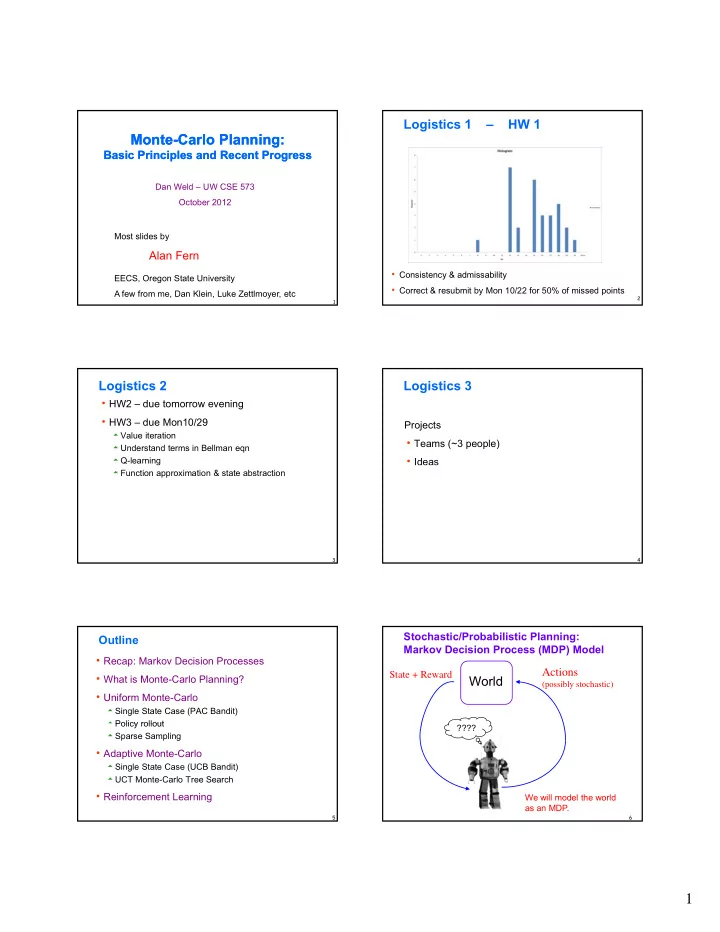
Logistics 1 HW 1 Monte Monte- -Carlo Planning: Carlo Planning: Basic Principles and Recent Progress Basic Principles and Recent Progress Dan Weld UW CSE 573 October 2012 Most slides by Alan Fern Consistency &


slide-1
SLIDE 1

1

Monte Monte-

  • Carlo Planning:

Carlo Planning:

Basic Principles and Recent Progress Basic Principles and Recent Progress

Dan Weld – UW CSE 573 October 2012

1

Most slides by

Alan Fern

EECS, Oregon State University A few from me, Dan Klein, Luke Zettlmoyer, etc

Logistics 1 – HW 1

2

 Consistency & admissability  Correct & resubmit by Mon 10/22 for 50% of missed points

Logistics 2

HW2 – due tomorrow evening HW3 – due Mon10/29

Value iteration Understand terms in Bellman eqn Q-learning Function approximation & state abstraction

3

Logistics 3

Projects

Teams (~3 people) Ideas

4

Outline

Recap: Markov Decision Processes What is Monte-Carlo Planning? Uniform Monte-Carlo

Single State Case (PAC Bandit) Policy rollout

5

Policy rollout

Sparse Sampling

Adaptive Monte-Carlo

Single State Case (UCB Bandit) UCT Monte-Carlo Tree Search

Reinforcement Learning

State + Reward

Actions

(possibly stochastic)

World

Stochastic/Probabilistic Planning: Markov Decision Process (MDP) Model

6

???? We will model the world as an MDP.

slide-2
SLIDE 2

2

Markov Decision Processes

An MDP has four components: S, A, PR, PT:

 finite state set S

a s s, a s,a,s’ s’

$R

7

 finite action set A  Transition distribution PT(s’ | s, a)

 Probability of going to state s’ after taking action a in state s  First-order Markov model

 Bounded reward distribution PR(r | s, a)

 Probability of receiving immediate reward r after exec a in s  First-order Markov model

Graphical View of MDP

St Rt St+1 At R

1

St+2 At+1 Rt 2 At+2

8

Rt Rt+1 Rt+2

 First-Order Markovian dynamics (history independence)  Next state only depends on current state and current action  First-Order Markovian reward process  Reward only depends on current state and action

Recap: Defining MDPs

Policy, 

Function that chooses an action for each state

Value function of policy

Aka Utility S

f di t d d f f ll i li

Sum of discounted rewards from following policy

Objective?

Find policy which maximizes expected utility, V(s)

Policies (“plans” for MDPs)

 Given an MDP we wish to compute a policy

 Could be computed offline or online.

 A policy is a possibly stochastic mapping from states to actions

 π:S → A  π(s) is action to do at state s

10

( )

 specifies a continuously reactive controller

π(s) How to measure goodness of a policy?

Value Function of a Policy

 We consider finite-horizon discounted reward,

discount factor 0 ≤ β < 1 Vπ(s,h) denotes expected h-horizon discounted total

reward of policy π at state s

 Each run of π for h steps produces a random reward

R R R R

11

sequence: R1 R2 R3 … Rh

 Vπ(s,h) is the expected discounted sum of this sequence

Optimal policy π* is policy that achieves maximum

value across all states

      

s R E h s V

h t t

t

, | ) , (  

Relation to Infinite Horizon Setting

Often value function Vπ(s) is defined over infinite

horizons for a discount factor 0 ≤ β < 1

It is easy to show that difference between V (s h) and

] , | [ ) ( s R E s V

t t t

 

 

12

It is easy to show that difference between Vπ(s,h) and

Vπ(s) shrinks exponentially fast as h grows

h-horizon results apply to infinite horizon setting

h

R h s V s V  

 

           1 ) , ( ) (

max

slide-3
SLIDE 3

3

Bellman Equations for MDPs

Q*(a, s)

(1920‐1984)

Computing the Best Policy

Optimal policy maximizes value at each state Optimal policies guaranteed to exist [Howard, 1960] When state and action spaces are small and MDP is

known we find optimal policy in poly-time

14

p p y p y

With value iteration Or policy Iteration

Both use…?

Bellman Backup

V0= 0 V1= 6.5 a1

s1

Vi+1 Vi V0= 1 V0= 2

max

5 a2 a3

s0 s2 s3

Computing the Best Policy

What if…

Space is exponentially large? MDP transition & reward models are unknown?

16

Large Worlds: Model-Based Approach

  • 1. Define a language for compactly describing MDP

model, for example:

 Dynamic Bayesian Networks  Probabilistic STRIPS/PDDL

D i l i l i h f h l

17

  • 2. Design a planning algorithm for that language

Problem: more often than not, the selected language is inadequate for a particular problem, e.g.

 Problem size blows up  Fundamental representational shortcoming

Large Worlds: Monte-Carlo Approach

Often a simulator of a planning domain is available

  • r can be learned from data

Even when domain can’t be expressed via MDP language

Fire & Emergency Response

18 18

Klondike Solitaire g y p

slide-4
SLIDE 4

4

Large Worlds: Monte-Carlo Approach

Monte-Carlo Planning: compute a good policy for an MDP by interacting with an MDP simulator

19 19

World Simulator

Real World

action State + reward

Example Domains with Simulators

 Traffic simulators  Robotics simulators  Military campaign simulators  Computer network simulators  Emergency planning simulators

20  large-scale disaster and municipal

 Sports domains (Madden Football)  Board games / Video games

 Go / RTS

In many cases Monte-Carlo techniques yield state-of-the-art

  • performance. Even in domains where model-based planner

is applicable.

MDP: Simulation-Based Representation

 A simulation-based representation gives: S, A, R, T:

 finite state set S (generally very large)  finite action set A  Stochastic, real-valued, bounded reward function R(s,a) = r

 Stochastically returns a reward r given input s and a  Can be implemented in arbitrary programming language

21

 Can be implemented in arbitrary programming language

 Stochastic transition function T(s,a) = s’ (i.e. a simulator)

 Stochastically returns a state s’ given input s and a  Probability of returning s’ is dictated by Pr(s’ | s,a) of MDP  T can be implemented in an arbitrary programming language

Slot Machines as MDP?

22

????

Outline

Preliminaries: Markov Decision Processes What is Monte-Carlo Planning? Uniform Monte-Carlo

Single State Case (Uniform Bandit) Policy rollout

23

Policy rollout

Sparse Sampling

Adaptive Monte-Carlo

Single State Case (UCB Bandit) UCT Monte-Carlo Tree Search

Single State Monte-Carlo Planning

Suppose MDP has a single state and k actions

Figure out which action has best expected reward Can sample rewards of actions using calls to simulator Sampling a is like pulling slot machine arm with random

payoff function R(s,a) s

24

a1 a2 ak R(s,a1) R(s,a2) R(s,ak) Multi-Armed Bandit Problem … …

slide-5
SLIDE 5

5

PAC Bandit Objective

Probably Approximately Correct (PAC)

 Select an arm that probably (w/ high probability, 1-) has

approximately (i.e., within ) the best expected reward

 Use as few simulator calls (or pulls) as possible

s

25

a1 a2 ak R(s,a1) R(s,a2) R(s,ak) Multi-Armed Bandit Problem … …

UniformBandit Algorithm

NaiveBandit from [Even-Dar et. al., 2002]

  • 1. Pull each arm w times (uniform pulling).
  • 2. Return arm with best average reward.

s a1 a2 ak

26

How large must w be to provide a PAC guarantee? … …

r11 r12 … r1w r21 r22 … r2w rk1 rk2 … rkw

Aside: Additive Chernoff Bound

  • Let R be a random variable with maximum absolute value Z.

An let ri (for i=1,…,w) be i.i.d. samples of R

  • The Chernoff bound gives a bound on the probability that the

average of the ri are far from E[R]

                       w r R E

w i 2 1

exp ] [ Pr  

Chernoff B d

27

 1 1 1 1

ln ] [

w w i i w

Z r R E   

With probability at least we have that,

  1

           

Z

i i w 1

p ] [

Bound Equivalently:

UniformBandit Algorithm

NaiveBandit from [Even-Dar et. al., 2002]

  • 1. Pull each arm w times (uniform pulling).
  • 2. Return arm with best average reward.

s a1 a2 ak

28

How large must w be to provide a PAC guarantee? … …

r11 r12 … r1w r21 r22 … r2w rk1 rk2 … rkw

UniformBandit PAC Bound

If for all arms simultaneously

k

R w ln

2 max 

     

With a bit of algebra and Chernoff bound we get:

   

 w j ij w i

r a s R E

1 1

)] , ( [

29

with probability at least

  1

That is, estimates of all actions are ε–accurate with

probability at least 1-

Thus selecting estimate with highest value is

approximately optimal with high probability, or PAC

 # Simulator Calls for UniformBandit

s a1 a2 ak …

30

R(s,a1) R(s,a2) R(s,ak) … Total simulator calls for PAC: Can get rid of ln(k) term with more complex

algorithm [Even-Dar et. al., 2002].        

k

k O w k ln

2

slide-6
SLIDE 6

6

Outline

Preliminaries: Markov Decision Processes What is Monte-Carlo Planning? Non-Adaptive Monte-Carlo

Single State Case (PAC Bandit) Policy rollout

31

Policy rollout

Sparse Sampling

Adaptive Monte-Carlo

Single State Case (UCB Bandit) UCT Monte-Carlo Tree Search

Policy Improvement via Monte-Carlo

 Now consider a multi-state MDP.  Suppose we have a simulator and a non-optimal policy

 E.g. policy could be a standard heuristic or based on intuition

 Can we somehow compute an improved policy?

32

World Simulator + Base Policy

Real World

action State + reward

Policy Improvement Theorem

 The h-horizon Q-function Qπ(s,a,h) is defined as:

expected total discounted reward of starting in state s, taking action a, and then following policy π for h-1 steps

 Define:

) , , ( max arg ) ( ' h a s Q s

a 

 

33

 Theorem [Howard, 1960]: For any non-optimal policy π the

policy π’ a strict improvement over π.

 Computing π’ amounts to finding the action that maximizes

the Q-function

 Can we use the bandit idea to solve this?

Policy Improvement via Bandits

s a1 a2 ak

SimQ(s,a1,π,h) SimQ(s,a2,π,h) SimQ(s,ak,π,h)

34

(

1

) (

2

) (

k

)  Idea: define a stochastic function SimQ(s,a,π,h) that we

can implement and whose expected value is Qπ(s,a,h)

 Use Bandit algorithm to PAC select improved action

How to implement SimQ?

Policy Improvement via Bandits

SimQ(s,a,π,h)

r = R(s,a) simulate a in s s = T(s,a) for i = 1 to h-1 r = r + βi R(s, π(s)) simulate h-1 steps s = T(s, π(s)) of policy R t

35

Return r  Simply simulate taking a in s and following policy for h-1

steps, returning discounted sum of rewards

 Expected value of SimQ(s,a,π,h) is Qπ(s,a,h)

Policy Improvement via Bandits

SimQ(s,a,π,h)

r = R(s,a) simulate a in s s = T(s,a) for i = 1 to h-1 r = r + βi R(s, π(s)) simulate h-1 steps s = T(s, π(s)) of policy R t

36

Return r

s

… … … …

a1 a2 Trajectory under  Sum of rewards = SimQ(s,a1,π,h)

ak

Sum of rewards = SimQ(s,a2,π,h) Sum of rewards = SimQ(s,ak,π,h)

slide-7
SLIDE 7

7

Policy Rollout Algorithm

  • 1. For each ai, run SimQ(s,ai,π,h) w times
  • 2. Return action with best average of SimQ results

s a1 a2 ak

37

q11 q12 … q1w q21 q22 … q2w qk1 qk2 … qkw … … … … … … … … …

SimQ(s,ai,π,h) trajectories Each simulates taking action ai then following π for h-1 steps.

Samples of SimQ(s,ai,π,h)

Policy Rollout: # of Simulator Calls

a1 a2 ak …

SimQ(s a h) trajectories

s

38

  • For each action, w calls to SimQ, each using h sim calls
  • Total of khw calls to the simulator

… … … … … … … … …

SimQ(s,ai,π,h) trajectories Each simulates taking action ai then following π for h-1 steps.

Multi-Stage Rollout

a1 a2 ak …

Each step requires khw simulator calls

s

39

… … … … … … … … …

Trajectories of SimQ(s,ai,Rollout(π),h)

  • Two stage: compute rollout policy of rollout policy of π
  • Requires (khw)2 calls to the simulator for 2 stages
  • In general exponential in the number of stages

Rollout Summary

We often are able to write simple, mediocre policies

Network routing policy Compiler instruction scheduling Policy for card game of Hearts Policy for game of Backgammon Solitaire playing policy Game of GO

40

Ga e o GO

Combinatorial optimization

Policy rollout is a general and easy way to improve

upon such policies

Often observe substantial improvement!

Example: Rollout for Thoughful Solitaire

[Yan et al. NIPS’04] Player Success Rate Time/Game Human Expert 36.6% 20 min (naïve) Base Policy 13.05% 0.021 sec 1 rollout 31.20% 0.67 sec

41

1 rollout 31.20% 0.67 sec 2 rollout 47.6% 7.13 sec 3 rollout 56.83% 1.5 min 4 rollout 60.51% 18 min 5 rollout 70.20% 1 hour 45 min

Example: Rollout for Thoughful Solitaire

[Yan et al. NIPS’04] Player Success Rate Time/Game Human Expert 36.6% 20 min (naïve) Base Policy 13.05% 0.021 sec 1 rollout 31.20% 0.67 sec

42

1 rollout 31.20% 0.67 sec 2 rollout 47.6% 7.13 sec 3 rollout 56.83% 1.5 min 4 rollout 60.51% 18 min 5 rollout 70.20% 1 hour 45 min

slide-8
SLIDE 8

8

Example: Rollout for Thoughful Solitaire

[Yan et al. NIPS’04] Player Success Rate Time/Game Human Expert 36.6% 20 min (naïve) Base Policy 13.05% 0.021 sec 1 rollout 31.20% 0.67 sec

43

1 rollout 31.20% 0.67 sec 2 rollout 47.6% 7.13 sec 3 rollout 56.83% 1.5 min 4 rollout 60.51% 18 min 5 rollout 70.20% 1 hour 45 min

Example: Rollout for Thoughful Solitaire

[Yan et al. NIPS’04] Player Success Rate Time/Game Human Expert 36.6% 20 min (naïve) Base Policy 13.05% 0.021 sec 1 rollout 31.20% 0.67 sec

44

Deeper rollout can pay off, but is expensive 1 rollout 31.20% 0.67 sec 2 rollout 47.6% 7.13 sec 3 rollout 56.83% 1.5 min 4 rollout 60.51% 18 min 5 rollout 70.20% 1 hour 45 min

Outline

Preliminaries: Markov Decision Processes What is Monte-Carlo Planning? Uniform Monte-Carlo

Single State Case (UniformBandit) Policy rollout

45

Policy rollout

Sparse Sampling

Adaptive Monte-Carlo

Single State Case (UCB Bandit) UCT Monte-Carlo Tree Search

Sparse Sampling

 Rollout does not guarantee optimality or near optimality  Can we develop simulation-based methods that give us

near optimal policies?

 Using computation that doesn’t depend on number of states!

46

 In deterministic games and problems it is common to build

a look-ahead tree at a state to determine best action

 Can we generalize this to general MDPs?

Sparse Sampling is one such algorithm

Strong theoretical guarantees of near optimality

MDP Basics

Let V*(s,h) be the optimal value function of MDP Define Q*(s,a,h) = E[R(s,a) + V*(T(s,a),h-1)]

Optimal h-horizon value of action a at state s. R(s,a) and T(s,a) return random reward and next state

Optimal Policy: *(x) = argmaxa Q*(x,a,h) What if we knew V*?

Can apply bandit algorithm to select action that

approximately maximizes Q*(s,a,h)

Bandit Approach Assuming V*

s a1 a2 ak

SimQ*(s,a1,h) SimQ*(s,a2,h) SimQ*(s,ak,h)

SimQ*(s,ai,h) = R(s, ai) + V*(T(s, ai),h-1)

48

( ,

1, )

( ,

2, )

( ,

k, )

SimQ*(s,a,h)

s’ = T(s,a) r = R(s,a) Return r + V*(s’,h-1)  Expected value of SimQ*(s,a,h) is Q*(s,a,h)

 Use UniformBandit to select approximately optimal action

slide-9
SLIDE 9

9

But we don’t know V*

To compute SimQ*(s,a,h) need V*(s’,h-1) for any s’ Use recursive identity (Bellman’s equation):

V*(s,h-1) = maxa Q*(s,a,h-1)

Idea: Can recursively estimate V*(s,h-1) by running

h-1 horizon bandit based on SimQ*

Base Case: V*(s,0) = 0, for all s

Recursive UniformBandit

s a1 a2 ak

SimQ*(s,a2,h) SimQ*(s,ak,h)

q11

SimQ(s,ai,h) Recursively generate samples of R(s, ai) + V*(T(s, ai),h-1)

… q1w q12

50

( ,

2, )

( ,

k, )

q11

a1 ak …

SimQ*(s11,a1,h-1) SimQ*(s11,ak,h-1)

… s11 a1 ak …

SimQ*(s12,a1,h-1) SimQ*(s12,ak,h-1)

… s12

q12

Sparse Sampling [Kearns et. al. 2002]

SparseSampleTree(s,h,w) For each action a in s Q*(s,a,h) = 0 For i = 1 to w

This recursive UniformBandit is called Sparse Sampling Return value estimate V*(s,h) of state s and estimated optimal action a*

Simulate taking a in s resulting in si and reward ri [V*(si,h),a*] = SparseSample(si,h-1,w) Q*(s,a,h) = Q*(s,a,h) + ri + V*(si,h) Q*(s,a,h) = Q*(s,a,h) / w ;; estimate of Q*(s,a,h) V*(s,h) = maxa Q*(s,a,h) ;; estimate of V*(s,h) a* = argmaxa Q*(s,a,h) Return [V*(s,h), a*]

# of Simulator Calls

s a1 a2 ak

SimQ*(s,a2,h) SimQ*(s,ak,h)

q11 … q1w q12

( ,

2, )

( ,

k, )

q11

a1 ak …

SimQ*(s11,a1,h-1) SimQ*(s11,ak,h-1)

… s11

q12

  • Can view as a tree with root s
  • Each state generates kw new states

(w states for each of k bandits)

  • Total # of states in tree (kw)h

How large must w be?

Sparse Sampling

For a given desired accuracy, how large

should sampling width and depth be?

Answered: [Kearns et. al., 2002]

Good news: can achieve near optimality for

value of w independent of state-space size!

First near optimal general MDP planning algorithm First near-optimal general MDP planning algorithm

whose runtime didn’t depend on size of state-space Bad news: the theoretical values are typically

still intractably large---also exponential in h

In practice: use small h and use heuristic at

leaves (similar to minimax game-tree search)

Outline

Preliminaries: Markov Decision Processes What is Monte-Carlo Planning? Uniform Monte-Carlo

Single State Case (UniformBandit) Policy rollout

54

Policy rollout

Sparse Sampling

Adaptive Monte-Carlo

Single State Case (UCB Bandit) UCT Monte-Carlo Tree Search

slide-10
SLIDE 10

10

Uniform vs. Adaptive Bandits

 Sparse sampling wastes time

  • n bad parts of tree

 Devotes equal resources to each

state encountered in the tree

 Would like to focus on most

promising parts of tree

55

 But how to control exploration

  • f new parts of tree??

Regret Minimization Bandit Objective

Problem: find arm-pulling strategy such that the

expected total reward at time n is close to the best possible (i.e. pulling the best arm always)

UniformBandit is poor choice --- waste time on bad arms Must balance exploring machines to find good payoffs

and exploiting current knowledge

56

s a1 a2 ak … and exploiting current knowledge

UCB Adaptive Bandit Algorithm

[Auer, Cesa-Bianchi, & Fischer, 2002]

Q(a) : average payoff for action a based on

current experience

n(a) : number of pulls of arm a Action choice by UCB after n pulls:

ln 2

*

n

Assumes payoffs in [0,1]

57

) ( ln 2 ) ( max arg

*

a n n a Q a

a

 

Value Term: favors actions that looked good historically Exploration Term: actions get an exploration bonus that grows with ln(n) Doesn’t waste much time on sub-optimal arms unlike uniform!

UCB Algorithm [Auer, Cesa-Bianchi, & Fischer, 2002]

) ( ln 2 ) ( max arg

*

a n n a Q a

a

 

Theorem: expected number of pulls of sub-optimal arm a is bounded by:

n ln 8

2

58

where is regret of arm a

a 2

a

 Hence, the expected regret after n arm pulls compared to

  • ptimal behavior is bounded by O(log n)

 No algorithm can achieve a better loss rate

UCB for Multi-State MDPs

UCB-Based Policy Rollout:

Use UCB to select actions instead of uniform

UCB-Based Sparse Sampling

59

Use UCB to make sampling decisions at internal

tree nodes

UCB-based Sparse Sampling [Chang et. al. 2005]

s a1 a2 ak …

q11 q32

  • Use UCB instead of Uniform

to direct sampling at each state

  • Non-uniform allocation

q21 q31 q22

a1 ak …

SimQ*(s11,a1,h-1) SimQ*(s11,ak,h-1)

… s11

q32 q21 q31

s11

q22

  • But each qij sample requires

waiting for an entire recursive h-1 level tree search

  • Better but still very expensive!
slide-11
SLIDE 11

11

Outline

Preliminaries: Markov Decision Processes What is Monte-Carlo Planning? Uniform Monte-Carlo

Single State Case (UniformBandit) Policy rollout

61

Policy rollout

Sparse Sampling

Adaptive Monte-Carlo

Single State Case (UCB Bandit) UCT Monte-Carlo Tree Search

Instance of Monte-Carlo Tree Search

Applies principle of UCB Some nice theoretical properties Much better anytime behavior than sparse sampling Major advance in computer Go

UCT Algorithm [Kocsis & Szepesvari, 2006]

Monte-Carlo Tree Search

Repeated Monte Carlo simulation of a rollout policy Each rollout adds one or more nodes to search tree

Rollout policy depends on nodes already in tree

Current World State

Rollout

1 1 1 At a leaf node perform a random rollout Initially tree is single leaf

Rollout Policy

Terminal (reward = 1) 1 1 1 Current World State 1 1 1 Must select each action at a node at least once

R ll t

1 1 1

Rollout Policy

Terminal (reward = 0) Current World State 1 1

1/2

Must select each action at a node at least once 1 1 1 Current World State 1 1

1/2

When all node actions tried once, select action according to tree policy

Tree Policy

1 1 1

slide-12
SLIDE 12

12

Current World State 1 1

1/2

When all node actions tried once, select action according to tree policy

Tree Policy

1 1 1

Rollout Policy

Current World State 1

1/2 1/3

When all node actions tried once, select action according to tree policy

Tree Policy

1 1 1

What is an appropriate tree policy? Rollout policy? Basic UCT uses random rollout policy Tree policy is based on UCB:

Q(s,a) : average reward received in current

trajectories after taking action a in state s

UCT Algorithm [Kocsis & Szepesvari, 2006]

69

n(s,a) : number of times action a taken in s n(s) : number of times state s encountered

) , ( ) ( ln ) , ( max arg ) ( a s n s n c a s Q s

a UCT

  

Theoretical constant that must be selected empirically in practice

Current World State 1

1/2 1/3

When all node actions tried once, select action according to tree policy

Tree Policy a1 a2

) , ( ) ( ln ) , ( max arg ) ( a s n s n c a s Q s

a UCT

   1 1 1 Current World State 1

1/2 1/3

When all node actions tried once, select action according to tree policy

Tree Policy

) , ( ) ( ln ) , ( max arg ) ( a s n s n c a s Q s

a UCT

   1 1 1

UCT Recap

To select an action at a state s

Build a tree using N iterations of monte-carlo tree

search

 Default policy is uniform random  Tree policy is based on UCB rule

72

 Tree policy is based on UCB rule

Select action that maximizes Q(s,a)

(note that this final action selection does not take the exploration term into account, just the Q-value estimate) The more simulations the more accurate

slide-13
SLIDE 13

13

Computer Go

“Task Par Excellence for AI” (Hans Berliner) “New Drosophila of AI” (John McCarthy) “Grand Challenge Task” (David Mechner)

9x9 (smallest board) 19x19 (largest board)

A Brief History of Computer Go

2005: Computer Go is impossible! 2006: UCT invented and applied to 9x9 Go (Kocsis, Szepesvari; Gelly et al.) 2007: Human master level achieved at 9x9 Go (Gelly, Silver; Coulom) 2008: Human grandmaster level achieved at 9x9 Go (Teytaud et al ) 2008: Human grandmaster level achieved at 9x9 Go (Teytaud et al.)

Computer GO Server: 1800 ELO  2600 ELO

Other Successes

Klondike Solitaire (wins 40% of games) General Game Playing Competition Real-Time Strategy Games Combinatorial Optimization Combinatorial Optimization List is growing Usually extend UCT is some ways

Some Improvements

Use domain knowledge to handcraft a more intelligent default policy than random

E.g. don’t choose obviously stupid actions

Learn a heuristic function to evaluate positions

Use the heuristic function to initialize leaf nodes (otherwise initialized to zero)

Summary

When you have a tough planning problem

and a simulator

Try Monte-Carlo planning

Basic principles derive from the multi-arm

bandit

77

Policy Rollout is a great way to exploit

existing policies and make them better

If a good heuristic exists, then shallow sparse

sampling can give good gains

UCT is often quite effective especially when

combined with domain knowledge