1 What are the problems? Direction and Principles Message may be - - PDF document

1
SMART_READER_LITE
LIVE PREVIEW

1 What are the problems? Direction and Principles Message may be - - PDF document

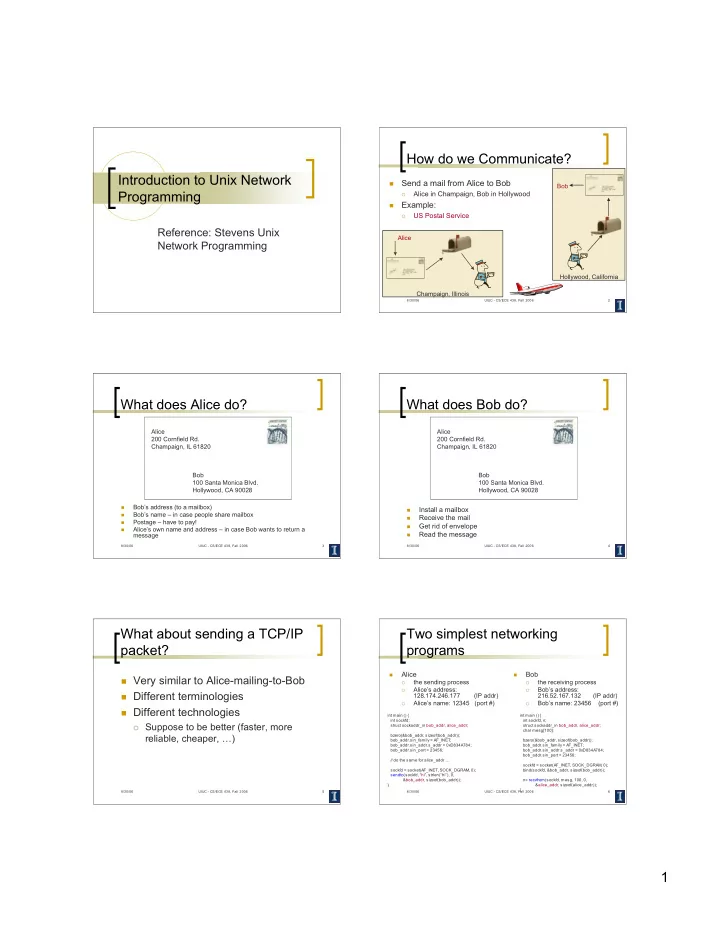
How do we Communicate? Introduction to Unix Network Send a mail from Alice to Bob Bob Programming Alice in Champaign, Bob in Hollywood Example: US Postal Service Reference: Stevens Unix Alice Network Programming


slide-1
SLIDE 1

1 Introduction to Unix Network Programming

Reference: Stevens Unix Network Programming

8/30/06 UIUC - CS/ECE 438, Fall 2006 2

How do we Communicate?

Send a mail from Alice to Bob

Alice in Champaign, Bob in Hollywood

Example:

US Postal Service

Bob Champaign, Illinois Hollywood, California Alice

8/30/06 UIUC - CS/ECE 438, Fall 2006 3

What does Alice do?

Bob’s address (to a mailbox)

Bob’s name – in case people share mailbox

Postage – have to pay!

Alice’s own name and address – in case Bob wants to return a message Bob 100 Santa Monica Blvd. Hollywood, CA 90028 Alice 200 Cornfield Rd. Champaign, IL 61820

8/30/06 UIUC - CS/ECE 438, Fall 2006 4

What does Bob do?

Install a mailbox

Receive the mail

Get rid of envelope

Read the message

Bob 100 Santa Monica Blvd. Hollywood, CA 90028 Alice 200 Cornfield Rd. Champaign, IL 61820

8/30/06 UIUC - CS/ECE 438, Fall 2006 5

What about sending a TCP/IP packet?

 Very similar to Alice-mailing-to-Bob  Different terminologies  Different technologies

 Suppose to be better (faster, more

reliable, cheaper, …)

8/30/06 UIUC - CS/ECE 438, Fall 2006 6

Two simplest networking programs

Alice

the sending process

Alice’s address: 128.174.246.177 (IP addr)

Alice’s name: 12345 (port #)

Bob

the receiving process

Bob’s address: 216.52.167.132 (IP addr)

Bob’s name: 23456 (port #)

int main () { int sockfd; struct sockaddr_in bob_addr, alice_addr; bzero(&bob_addr, sizeof(bob_addr)); bob_addr.sin_family = AF_INET; bob_addr.sin_addr.s_addr = 0xD834A784; bob_addr.sin_port = 23456; // do the same for alice_addr … sockfd = socket(AF_INET, SOCK_DGRAM, 0); sendto(sockfd, “hi”, strlen(“hi”), 0, &bob_addr, sizeof(bob_addr)); } int main () { int sockfd, n; struct sockaddr_in bob_addr, alice_addr; char mesg[100]; bzero(&bob_addr, sizeof(bob_addr)); bob_addr.sin_family = AF_INET; bob_addr.sin_addr.s_addr = 0xD834A784; bob_addr.sin_port = 23456; sockfd = socket(AF_INET, SOCK_DGRAM, 0); bind(sockfd, &bob_addr, sizeof(bob_addr)); n= recvfrom(sockfd, mesg, 100, 0, &alice_addr, sizeof(alice_addr)); }

slide-2
SLIDE 2

2

8/30/06 UIUC - CS/ECE 438, Fall 2006 7

What are the problems?

 Message may be lost

 Network is congested  Receiver is congested

 Message may be duplicated, corrupted  Multiple messages: re-ordered  Concurrent connections  …

8/30/06 UIUC - CS/ECE 438, Fall 2006 8

Direction and Principles

Physical Transport Data Link Network Programming

learn to use Internet for communication (with focus on implementation of networking concepts)

Principles and Concepts

learn to build network from ground up

8/30/06 UIUC - CS/ECE 438, Fall 2006 9

Sockets

process TCP with buffers, variables socket host or server process TCP with buffers, variables socket host or server Internet controlled by app developer 

process sends/receives messages to/from its socket

socket analogous to mailbox

sending process relies

  • n transport

infrastructure which brings message to socket at receiving process

8/30/06 UIUC - CS/ECE 438, Fall 2006 10

Network Programming with Sockets

 Reading:

Stevens 2nd ed., Ch. 1-6 or 1st ed., Ch. 1-3, 6

 Sockets API:

A transport layer service interface

Introduced in 1981 by BSD 4.1

Implemented as library and/or system calls

Similar interfaces to TCP and UDP

Can also serve as interface to IP (for super-user); known as “raw sockets”

8/30/06 UIUC - CS/ECE 438, Fall 2006 11

Outline

 Client-Sever Model  TCP/UDP Overview  Addresses and Data  Sockets API  Example

8/30/06 UIUC - CS/ECE 438, Fall 2006 12

Client-Server Model

Asymmetric Communication

Client sends requests

Server sends replies 

Server/Daemon

Well-known name (e.g., IP address + port)

Waits for contact

Processes requests, sends replies 

Client

Initiates contact

Waits for response

Client Server Client Client Client

slide-3
SLIDE 3

3

8/30/06 UIUC - CS/ECE 438, Fall 2006 13

Socket Communication

Client process Server process Client socket

3-way handshaking

Listening socket Connection socket

8/30/06 UIUC - CS/ECE 438, Fall 2006 14

Client-Server Communication Model

 Service Model

Concurrent:

Server processes multiple clients’ requests simultaneously

Sequential:

Server processes only one client’s requests at a time

Hybrid:

Server maintains multiple connections, but processes responses sequentially  Client and server categories are not disjoint

A server can be a client of another server

A server can be a client of its own client

8/30/06 UIUC - CS/ECE 438, Fall 2006 15

TCP Connections

 Transmission Control Protocol (TCP)

Service

OSI Transport Layer

Service Model

Reliable byte stream (interpreted by application)

16-bit port space allows multiple connections on a single host

Connection-oriented

Set up connection before communicating

Tear down connection when done

8/30/06 UIUC - CS/ECE 438, Fall 2006 16

TCP Service

 Reliable Data Transfer

 Guarantees delivery of all data  Exactly once if no catastrophic failures

 Sequenced Data Transfer

 Guarantees in-order delivery of data  If A sends M1 followed by M2 to B, B never receives M2

before M1

 Regulated Data Flow

 Monitors network and adjusts transmission appropriately  Prevents senders from wasting bandwidth  Reduces global congestion problems

 Data Transmission

 Full-Duplex byte stream

8/30/06 UIUC - CS/ECE 438, Fall 2006 17

UDP Services

 User Datagram Protocol Service

 OSI Transport Layer  Provides a thin layer over IP  16-bit port space (distinct from TCP

ports) allows multiple recipients on a single host

8/30/06 UIUC - CS/ECE 438, Fall 2006 18

UDP Services

 Unit of Transfer

 Datagram (variable length packet)

 Unreliable

 No guaranteed delivery  Drops packets silently

 Unordered

 No guarantee of maintained order of delivery

 Unlimited Transmission

 No flow control

slide-4
SLIDE 4

4

8/30/06 UIUC - CS/ECE 438, Fall 2006 19

Addresses and Data

 Internet domain names

Human readable

Variable length

Ex: sal.cs.uiuc.edu

 IP addresses

Easily handled by routers/computers

Fixed length

Somewhat geographical

Ex: 128.174.252.217

8/30/06 UIUC - CS/ECE 438, Fall 2006 20

Byte Ordering

 Big Endian vs. Little Endian

Little Endian (Intel, DEC):

Least significant byte of word is stored in the lowest memory address

Big Endian (Sun, SGI, HP):

Most significant byte of word is stored in the lowest memory address

Network Byte Order = Big Endian

Allows both sides to communicate

Must be used for some data (i.e. IP Addresses)

Good form for all binary data

8/30/06 UIUC - CS/ECE 438, Fall 2006 21

Byte Ordering Functions

16- and 32-bit conversion functions (for platform independence)

Examples:

int m, n; short int s,t; m = ntohl (n) net-to-host long (32-bit) translation s = ntohs (t) net-to-host short (16-bit) translation n = htonl (m) host-to-net long (32-bit) translation t = htons (s) host-to-net short (16-bit) translation

8/30/06 UIUC - CS/ECE 438, Fall 2006 22

Socket Address Structure

IP address:

struct in_addr { in_addr_t s_addr; /* 32-bit IP address */ }; 

TCP or UDP address:

struct sockaddr_in { short sin_family; /* e.g., AF_INET */ ushort sin_port; /* TCP/UDP port */ struct in_addr; /* IP address */ };

all but sin_family in network byte order

8/30/06 UIUC - CS/ECE 438, Fall 2006 23

Address Access/Conversion Functions

All binary values are network byte ordered struct hostent* gethostbyname (const char* hostname);

Translate English host name to IP address (uses DNS)

struct hostent* gethostbyaddr (const char* addr, size_t len, int family);

Translate IP address to English host name (not secure)

char* inet_ntoa (struct in_addr inaddr);

Translate IP address to ASCII dotted-decimal notation (e.g., “128.32.36.37”)

8/30/06 UIUC - CS/ECE 438, Fall 2006 24

Structure: hostent

The hostent data structure (from /usr/include/netdb.h)

canonical domain name and aliases

list of addresses associated with machine

also address type and length information

struct hostent { char* h_name; /* official name of host */ char** h_aliases; /* NULL-terminated alias list */ int h_addrtype /* address type (AF_INET) */ int h_length; /* length of addresses (4B) */ char** h_addr_list; /* NULL-terminated address list */ #define h_addr h_addr_list[0];/* backward-compatibility */ };

slide-5
SLIDE 5

5

8/30/06 UIUC - CS/ECE 438, Fall 2006 25

Address Access/Conversion Functions

in_addr_t inet_addr (const char* strptr);

Translate dotted-decimal notation to IP address; returns -1 on failure, thus cannot handle broadcast value “255.255.255.255”

int inet_aton (const char *strptr, struct in_addr *inaddr);

Translate dotted-decimal notation to IP address; returns 1 on success, 0 on failure

int gethostname (char* name, size_t namelen);

Read host’s name (use with gethostbyname to find local IP)

8/30/06 UIUC - CS/ECE 438, Fall 2006 26

Sockets API

 Basic Unix Concepts  Creation and Setup  Establishing a Connection (TCP)  Sending and Receiving Data  Tearing Down a Connection (TCP)  Advanced Sockets

8/30/06 UIUC - CS/ECE 438, Fall 2006 27

UDP Connection Example

client server socket socket sendto bind recvfrom sendto recvfrom close

8/30/06 UIUC - CS/ECE 438, Fall 2006 28

Functions: sendto

int sendto (int sockfd, char* buf, size_t nbytes, int flags, struct sockaddr* destaddr, int addrlen);

Send a datagram to another UDP socket.

Returns number of bytes written or -1. Also sets errno on failure.

sockfd: socket file descriptor (returned from socket)

buf: data buffer

nbytes: number of bytes to try to read

flags: see man page for details; typically use 0

destaddr: IP address and port number of destination socket

addrlen: length of address structure

= sizeof (struct sockaddr_in)

8/30/06 UIUC - CS/ECE 438, Fall 2006 29

Functions: recvfrom

int recvfrom (int sockfd, char* buf, size_t nbytes, int flags, struct sockaddr* srcaddr, int* addrlen);

Read a datagram from a UDP socket.

Returns number of bytes read (0 is valid) or -1. Also sets errno

  • n failure.

sockfd: socket file descriptor (returned from socket)

buf: data buffer

nbytes: number of bytes to try to read

flags: see man page for details; typically use 0

srcaddr: IP address and port number of sending socket (returned from call)

addrlen: length of address structure = pointer to int set to sizeof (struct sockaddr_in)

8/30/06 UIUC - CS/ECE 438, Fall 2006 30

Socket Functions

socket() listen() accept() socket() bind() Well-known port blocks until connection from client connect() write() TCP three-way handshaking data (request) read() process request

TCP Client TCP Server

slide-6
SLIDE 6

6

8/30/06 UIUC - CS/ECE 438, Fall 2006 31

Socket Functions

socket() blocks until connection from client connect() write() TCP three-way handshaking data (request) read() process request

TCP Server TCP Client

write() read() data (reply) close() read() close()

8/30/06 UIUC - CS/ECE 438, Fall 2006 32

TCP Connection Example

client server socket socket connect bind listen accept write read write read close close read

8/30/06 UIUC - CS/ECE 438, Fall 2006 33

Socket Creation and Setup

Include file <sys/socket.h>

Create a socket

int socket (int family, int type, int protocol);

Returns file descriptor or -1.

Bind a socket to a local IP address and port number

int bind (int sockfd, struct sockaddr* myaddr, int addrlen);

Put socket into passive state (wait for connections rather than initiate a connection).

int listen (int sockfd, int backlog);

Accept connections

int accept (int sockfd, struct sockaddr* cliaddr, int* addrlen);

Returns file descriptor or -1.

8/30/06 UIUC - CS/ECE 438, Fall 2006 34

Functions: socket

int socket (int family, int type, int protocol);

Create a socket.

Returns file descriptor or -1. Also sets errno on failure.

family: address family (namespace)

AF_INET for IPv4

  • ther possibilities: AF_INET6 (IPv6), AF_UNIX or

AF_LOCAL (Unix socket), AF_ROUTE (routing)

type: style of communication

SOCK_STREAM for TCP (with AF_INET)

SOCK_DGRAM for UDP (with AF_INET)

protocol: protocol within family

typically 0

8/30/06 UIUC - CS/ECE 438, Fall 2006 35

Function: bind

int bind (int sockfd, struct sockaddr* myaddr, int addrlen);

Bind a socket to a local IP address and port number.

Returns 0 on success, -1 and sets errno on failure.

sockfd: socket file descriptor (returned from socket)

myaddr: includes IP address and port number

IP address: set by kernel if value passed is INADDR_ANY, else set by caller

port number: set by kernel if value passed is 0, else set by caller

addrlen: length of address structure

= sizeof (struct sockaddr_in)

8/30/06 UIUC - CS/ECE 438, Fall 2006 36

TCP and UDP Ports

Allocated and assigned by the Internet Assigned Numbers Authority

see RFC 1700 or

ftp://ftp.isi.edu/in-notes/iana/assignments/port-numbers

 private/ephemeral ports

49152-65535

 registered services/ephemeral ports

1024-49151

 registered and controlled, also used for identity

verification

 super-user only

513-1023

 standard services (see /etc/services)  super-user only

1-512

slide-7
SLIDE 7

7

8/30/06 UIUC - CS/ECE 438, Fall 2006 37

Functions: listen

int listen (int sockfd, int backlog);

Put socket into passive state (wait for connections rather than initiate a connection).

Returns 0 on success, -1 and sets errno on failure.

sockfd: socket file descriptor (returned from socket)

backlog: bound on length of unaccepted connection queue (connection backlog); kernel will cap, thus better to set high

8/30/06 UIUC - CS/ECE 438, Fall 2006 38

Functions: accept

int accept (int sockfd, struct sockaddr* cliaddr, int* addrlen);

Accept a new connection.

Returns file descriptor or -1. Also sets errno on failure.

sockfd: socket file descriptor (returned from socket)

cliaddr: IP address and port number of client (returned from call)

addrlen: length of address structure = pointer to int set to sizeof (struct sockaddr_in)

addrlen is a value-result argument:

the caller passes the size of the address structure, the kernel returns the size of the client’s address (the number of bytes written)

8/30/06 UIUC - CS/ECE 438, Fall 2006 39

server

#include <stdio.h> #include <stdlib.h> #include <errno.h> #include <string.h> #include <sys/types.h> #include <netinet/in.h> #include <sys/socket.h> #include <sys/wait.h> #define PORT 3490 /* well-known port */ #define BACKLOG 10 /* how many pending connections queue will hold */

8/30/06 UIUC - CS/ECE 438, Fall 2006 40

server

main() { int sockfd, new_fd; /* listen on sock_fd, new connection on new_fd */ struct sockaddr_in my_addr; /* my address */ struct sockaddr_in their_addr; /* connector addr */ int sin_size; if ((sockfd = socket(AF_INET, SOCK_STREAM, 0))==- 1){ perror("socket"); exit(1); }

8/30/06 UIUC - CS/ECE 438, Fall 2006 41

server

bzero(&my_addr, sizeof(struct sockaddr)); /* zero the struct */ my_addr.sin_family = AF_INET; /* host byte order */ my_addr.sin_port = htons(MYPORT); /* short, network byte order */ my_addr.sin_addr.s_addr = htonl(INADDR_ANY); if (bind(sockfd, (struct sockaddr *)&my_addr, sizeof(struct sockaddr)) == -1) { perror("bind"); exit(1); }

8/30/06 UIUC - CS/ECE 438, Fall 2006 42

server

if (listen(sockfd, BACKLOG) == -1) { perror("listen"); exit(1); } while(1) { /* main accept() loop */ sin_size = sizeof(struct sockaddr_in); if ((new_fd = accept(sockfd, (struct sockaddr*) &their_addr,&sin_size)) == -1) { perror("accept"); continue; } printf("server: got connection from %s\n", inet_ntoa(their_addr.sin_addr));

slide-8
SLIDE 8

8

8/30/06 UIUC - CS/ECE 438, Fall 2006 43

Establishing a Connection

Include file <sys/socket.h> int connect (int sockfd, struct sockaddr* servaddr, int addrlen);

Connect to another socket.

8/30/06 UIUC - CS/ECE 438, Fall 2006 44

Functions: connect

int connect (int sockfd, struct sockaddr* servaddr, int addrlen);

Connect to another socket.

Returns 0 on success, -1 and sets errno on failure.

sockfd: socket file descriptor (returned from socket)

servaddr: IP address and port number of server

addrlen: length of address structure

= sizeof (struct sockaddr_in)

8/30/06 UIUC - CS/ECE 438, Fall 2006 45

client

if ((sockfd = socket (AF_INET, SOCK_STREAM, 0)) == -1) { perror (“socket”); exit (1); } their_addr.sin_family = AF_INET; /* interp’d by host */ their_addr.sin_port = htons (PORT); their_addr.sin_addr = *((struct in_addr*)he->h_addr); bzero (&(their_addr.sin_zero), 8); /* zero rest of struct */ if (connect (sockfd, (struct sockaddr*)&their_addr, sizeof (struct sockaddr)) == -1) { perror (“connect”); exit (1); }

8/30/06 UIUC - CS/ECE 438, Fall 2006 46

Sending and Receiving Data

int write (int sockfd, char* buf, size_t nbytes);

Write data to a stream (TCP) or “connected” datagram (UDP) socket.

Returns number of bytes written or -1.

int read (int sockfd, char* buf, size_t nbytes);

Read data from a stream (TCP) or “connected” datagram (UDP) socket.

Returns number of bytes read or -1.

8/30/06 UIUC - CS/ECE 438, Fall 2006 47

Sending and Receiving Data

int sendto (int sockfd, char* buf, size_t nbytes, int flags, struct sockaddr* destaddr, int addrlen);

Send a datagram to another UDP socket.

Returns number of bytes written or -1.

int recvfrom (int sockfd, char* buf, size_t nbytes, int flags, struct sockaddr* srcaddr, int* addrlen);

Read a datagram from a UDP socket.

Returns number of bytes read or -1.

8/30/06 UIUC - CS/ECE 438, Fall 2006 48

Functions: write

int write (int sockfd, char* buf, size_t nbytes);

Write data to a stream (TCP) or “connected” datagram (UDP) socket.

Returns number of bytes written or -1. Also sets errno

  • n failure.

sockfd: socket file descriptor (returned from socket)

buf: data buffer

nbytes: number of bytes to try to write

Some reasons for failure or partial writes:

process received interrupt or signal

kernel resources unavailable (e.g., buffers)

slide-9
SLIDE 9

9

8/30/06 UIUC - CS/ECE 438, Fall 2006 49

Functions: read

int read (int sockfd, char* buf, size_t nbytes);

Read data from a stream (TCP) or “connected” datagram (UDP) socket.

Returns number of bytes read or -1. Also sets errno on failure.

Returns 0 if socket closed.

sockfd: socket file descriptor (returned from socket)

buf: data buffer

nbytes: number of bytes to try to read

8/30/06 UIUC - CS/ECE 438, Fall 2006 50

Tearing Down a Connection

int close (int sockfd);

Close a socket.

Returns 0 on success, -1 and sets errno on failure.

int shutdown (int sockfd, int howto);

Force termination of communication across a socket in

  • ne or both directions.

Returns 0 on success, -1 and sets errno on failure.

8/30/06 UIUC - CS/ECE 438, Fall 2006 51

Functions: close

int close (int sockfd);

Close a socket.

Returns 0 on success, -1 and sets errno on failure.

sockfd: socket file descriptor (returned from socket)

Closes communication on socket in both directions.

All data sent before close are delivered to other side (although this aspect can be overridden).

After close, sockfd is not valid for reading or writing.

8/30/06 UIUC - CS/ECE 438, Fall 2006 52

Functions: shutdown

int shutdown (int sockfd, int howto);

Force termination of communication across a socket in one or both directions.

Returns 0 on success, -1 and sets errno on failure.

sockfd: socket file descriptor (returned from socket)

howto:

SHUT_RD to stop reading

SHUT_WR to stop writing

SHUT_RDWR to stop both

shutdown overrides the usual rules regarding duplicated sockets, in which TCP teardown does not occur until all copies have closed the socket.

8/30/06 UIUC - CS/ECE 438, Fall 2006 53

Advanced Sockets

 Managing Multiple Connections

fork/exec: multiple server processes

pthread_create: multi-threaded server process

(no calls): event-based server process

 Detecting Data Arrival

select and poll functions

 Synchronous vs. Asynchronous

Connections

 Other Socket Options

8/30/06 UIUC - CS/ECE 438, Fall 2006 54

Examples

 Taken from Beej’s Guide to Network

Programming:

http://beej.us/guide/bgnet/

 Client-Server example using TCP  For each client  server forks new process to handle

connection

 sends “Hello, world”

slide-10
SLIDE 10

10

8/30/06 UIUC - CS/ECE 438, Fall 2006 55

server

#include <stdio.h> #include <stdlib.h> #include <errno.h> #include <string.h> #include <sys/types.h> #include <netinet/in.h> #include <sys/socket.h> #include <sys/wait.h> #define PORT 3490 /* well-known port */ #define BACKLOG 10 /* how many pending connections queue will hold */

8/30/06 UIUC - CS/ECE 438, Fall 2006 56

server

main() { int sockfd, new_fd; /* listen on sock_fd, new connection on new_fd */ struct sockaddr_in my_addr; /* my address */ struct sockaddr_in their_addr; /* connector addr */ int sin_size; if ((sockfd = socket(AF_INET, SOCK_STREAM, 0))==- 1){ perror("socket"); exit(1); }

8/30/06 UIUC - CS/ECE 438, Fall 2006 57

server

my_addr.sin_family = AF_INET; /* host byte order */ my_addr.sin_port = htons(MYPORT); /* short, network byte order */ my_addr.sin_addr.s_addr = htonl(INADDR_ANY); /* automatically fill with my IP (w/o Beej’s bug) */ bzero(&(my_addr.sin_zero), 8); /* zero the struct */ if (bind(sockfd, (struct sockaddr *)&my_addr, sizeof(struct sockaddr)) == -1) { perror("bind"); exit(1); }

8/30/06 UIUC - CS/ECE 438, Fall 2006 58

server

if (listen(sockfd, BACKLOG) == -1) { perror("listen"); exit(1); } while(1) { /* main accept() loop */ sin_size = sizeof(struct sockaddr_in); if ((new_fd = accept(sockfd, (struct sockaddr*) &their_addr,&sin_size)) == -1) { perror("accept"); continue; } printf("server: got connection from %s\n", inet_ntoa(their_addr.sin_addr));

8/30/06 UIUC - CS/ECE 438, Fall 2006 59

server

if (!fork()) { /* this is the child process */ if (send(new_fd,"Hello, world!\n", 14, 0) == -1) perror("send"); close(new_fd); exit(0); } close(new_fd); /* parent doesn't need this */ /* clean up all child processes */ while(waitpid(-1,NULL,WNOHANG) > 0); } }

8/30/06 UIUC - CS/ECE 438, Fall 2006 60

client

#include <stdlib.h> #include <errno.h> #include <string.h> #include <netdb.h> #include <sys/types.h> #include <netinet/in.h> #include <sys/socket.h> #define PORT 3490 /* well-known port */ #define MAXDATASIZE 100 /* max number of bytes we can get at once */

slide-11
SLIDE 11

11

8/30/06 UIUC - CS/ECE 438, Fall 2006 61

client

int main (int argc, char* argv[]){ int sockfd, numbytes; char buf[MAXDATASIZE + 1]; struct hostent* he; struct sockaddr_in their_addr; /* connector’s address information */ if (argc != 2) { fprintf (stderr, “usage: client hostname\n”); exit (1); } if ((he = gethostbyname (argv[1])) == NULL) { /* get the host info */ perror (“gethostbyname”); exit (1); }

8/30/06 UIUC - CS/ECE 438, Fall 2006 62

client

if ((sockfd = socket (AF_INET, SOCK_STREAM, 0)) == -1) { perror (“socket”); exit (1); } their_addr.sin_family = AF_INET; /* interp’d by host */ their_addr.sin_port = htons (PORT); their_addr.sin_addr = *((struct in_addr*)he->h_addr); bzero (&(their_addr.sin_zero), 8); /* zero rest of struct */ if (connect (sockfd, (struct sockaddr*)&their_addr, sizeof (struct sockaddr)) == -1) { perror (“connect”); exit (1); }

8/30/06 UIUC - CS/ECE 438, Fall 2006 63

client

if ((numbytes = recv (sockfd, buf, MAXDATASIZE, 0)) == -1) { perror (“recv”); exit (1); } buf[numbytes] = ‘\0’; printf (“Received: %s”, buf); close (sockfd); return 0; }