1 Prof. S. Ben-Yaakov , DC-DC Converters [1-4] Example (Cont.) % - - PDF document

1
SMART_READER_LITE
LIVE PREVIEW

1 Prof. S. Ben-Yaakov , DC-DC Converters [1-4] Example (Cont.) % - - PDF document

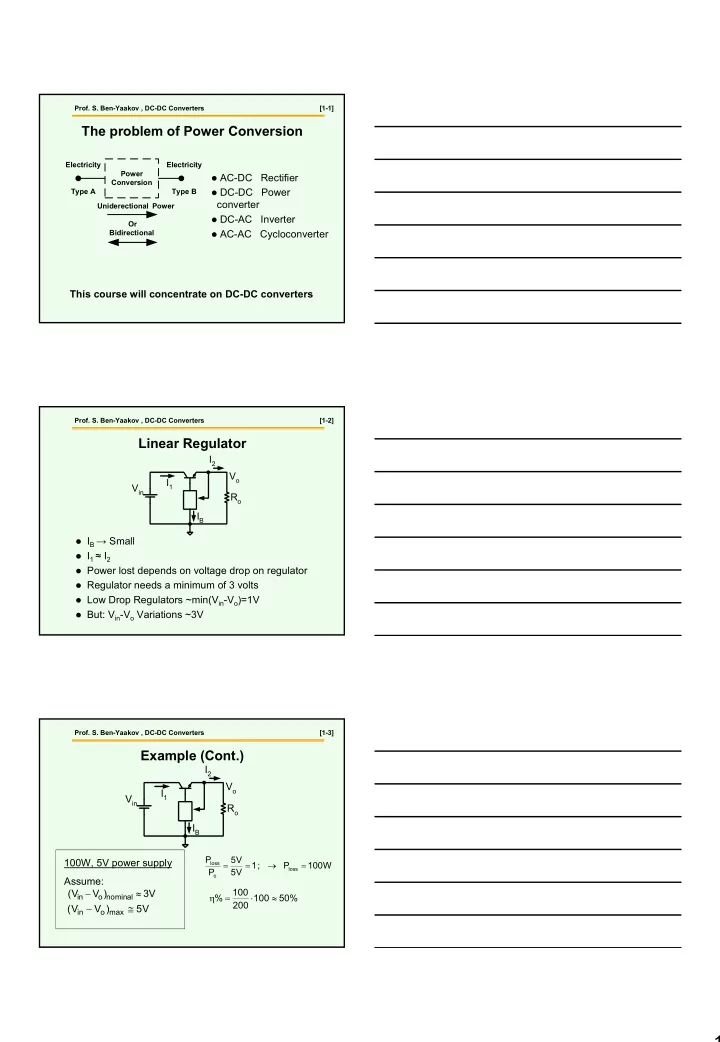
Prof. S. Ben-Yaakov , DC-DC Converters [1-1] The problem of Power Conversion Electricity Electricity Power AC-DC Rectifier Conversion DC-DC Power Type A Type B converter Uniderectional Power DC-AC Inverter Or AC-AC


slide-1
SLIDE 1

1

  • Prof. S. Ben-Yaakov , DC-DC Converters

[1-1]

The problem of Power Conversion

Power Conversion Electricity Type A Electricity Type B Uniderectional Power Or Bidirectional

This course will concentrate on DC-DC converters

AC-DC Rectifier DC-DC Power

converter

DC-AC Inverter AC-AC Cycloconverter

  • Prof. S. Ben-Yaakov , DC-DC Converters

[1-2]

Linear Regulator

Vin Ro IB Vo I1 I2

IB → Small I1 ≈ I2 Power lost depends on voltage drop on regulator Regulator needs a minimum of 3 volts Low Drop Regulators ~min(Vin-Vo)=1V But: Vin-Vo Variations ~3V

  • Prof. S. Ben-Yaakov , DC-DC Converters

[1-3]

Example (Cont.)

W 100 P ; 1 V 5 V 5 P P

loss

  • loss

= → = =

100W, 5V power supply Assume: V 3 ) V V (

al min no

  • in

≈ − V 5 ) V V (

max

  • in

≅ −

% 50 100 200 100 % ≈ ⋅ = η

Vin Ro IB Vo I1 I2

slide-2
SLIDE 2

2

  • Prof. S. Ben-Yaakov , DC-DC Converters

[1-4]

Example (Cont.)

% 50 % = η The problem is not It is 100W !

  • Battery -> efficiency
  • Line operation -> heat dissipation
  • Cooling -> size, expense
  • Prof. S. Ben-Yaakov , DC-DC Converters

[1-5]

Modern Power Conversion Systems Requirements

High efficiency Small size Cost

Source Load L C S Low Losses L, C: Reactive elements S: “On” Resistance →0 “Off” Resistance → ∞

  • Prof. S. Ben-Yaakov , DC-DC Converters

[1-6]

Disadvantages

More Expensive (in general) Noisy Less Reliable Switching Losses

500kHz Switching frequency Power level 102W 104W 106W 100kHz 1kHz Size Switching frequency 200 kHz

slide-3
SLIDE 3

3

  • Prof. S. Ben-Yaakov , DC-DC Converters

[1-7]

PWM

  • Prof. S. Ben-Yaakov , DC-DC Converters

[1-8]

Inductor_1

L V dt dI =

L I V

In most Power Electronics cases V=constant over time period

  • f interest

; L V t I = ∆ ∆ ; t L V I ∆ = ∆

L Vin +

  • I

I t Slope=V/L

  • Prof. S. Ben-Yaakov , DC-DC Converters

[1-9]

VL IL V1 V2 VL V1 V2 IL L V1 L V2 ts VL IL V1 V2 VL V1 V2 t IL L V1 L V2 ts t

Inductor _2

slide-4
SLIDE 4

4

  • Prof. S. Ben-Yaakov , DC-DC Converters

[1-10]

VL V1 t IL L V1 ts t VL V1 t IL

L V1

ts V2 VL IL V1 VL IL V1

real case

Inductor_3

  • Prof. S. Ben-Yaakov , DC-DC Converters

[1-11]

Most important equation in Power Electronics: Correct for average too: L V dt I d = _ V t V Vm Ts ton

=

T

Xdt T 1 X X - average

  • n

m s

  • n

m

D V T t V V = ⋅ = t ts t ts IL

1

V

L

V

2

V dt I d

2

dt I d

1

L V dt dI =

Average Signals

  • Prof. S. Ben-Yaakov , DC-DC Converters

[1-12]

Implication

VL =

If

VL ≠

then

∞ →

L

I

That is:

System must be designed such that:

For any practical system in steady state: Average voltage on inductor VL =

Proof:

slide-5
SLIDE 5

5

  • Prof. S. Ben-Yaakov , DC-DC Converters

[1-13]

Inductor current interruption

tS t IL

∞ = dt dI

∞ = → ∞ =

L

V dt dI spark

tS t VL V1

∞ −

IL Vin S L

  • Prof. S. Ben-Yaakov , DC-DC Converters

[1-14]

Inductor current interruption

What is the polarity?

The imaginary resistor method

tS t VL V1

∞ − Current continuity

IL

Vin S L R