
SLIDE 1
1
1
Lecture 9: Branch Prediction
Basic idea, saturating counter, BHT, BTB, return address prediction, correlating prediction
2
Reducing Branch Penalty
Branch penalty in dynamically scheduled processors: wasted cycles due to pipeline flushing on mis- predicted branches Reduce branch penalty:
1.
Predict branch/jump instructions AND branch direction (taken or not taken)
2.
Predict branch/jump target address (for taken branches)
3.
Speculatively execute instructions along the predicted path
3
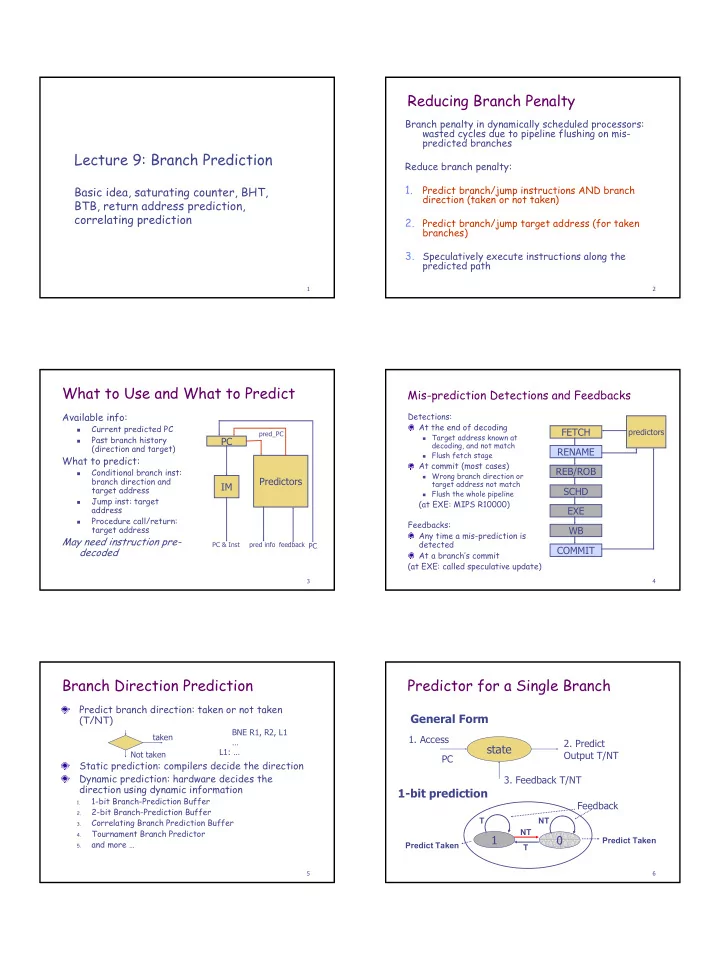
What to Use and What to Predict
Available info:
- Current predicted PC
- Past branch history
(direction and target)
What to predict:
- Conditional branch inst:
branch direction and target address
- Jump inst: target
address
- Procedure call/return:
target address
May need instruction pre- decoded IM PC Predictors
PC
pred_PC pred info feedback PC & Inst
4
Mis-prediction Detections and Feedbacks
Detections: At the end of decoding
- Target address known at
decoding, and not match
- Flush fetch stage
At commit (most cases)
- Wrong branch direction or
target address not match
- Flush the whole pipeline
(at EXE: MIPS R10000) Feedbacks: Any time a mis-prediction is detected At a branch’s commit (at EXE: called speculative update)
FETCH RENAME SCHD REB/ROB COMMIT WB EXE
predictors
5
Branch Direction Prediction
Predict branch direction: taken or not taken (T/NT) Static prediction: compilers decide the direction Dynamic prediction: hardware decides the direction using dynamic information
1.
1-bit Branch-Prediction Buffer
2.
2-bit Branch-Prediction Buffer
3.
Correlating Branch Prediction Buffer
4.
Tournament Branch Predictor
5.
and more … Not taken taken BNE R1, R2, L1 … L1: …
6
Predictor for a Single Branch
state
- 2. Predict
Output T/NT
- 1. Access
- 3. Feedback T/NT