
SLIDE 1
1
1
Lecture 10: Memory Dependence Detection and Speculation
Memory correctness, dynamic memory disambiguation, speculative disambiguation, Alpha 21264 Example
2
Register and Memory Dependences
Store: SW Rt, A(Rs)
1.
Calculate effective memory address ⇒ dependent on Rs
2.
Write to D-Cache ⇒ dependent on Rt, and cannot be speculative Compare “ADD Rd, Rs, Rt” What is the difference? LW Rt, A(Rs)
1.
Calculate effective memory address ⇒ dependent on Rs
2.
Read D-Cache ⇒ could be memory-dependent
- n pending writes!
When is the memory dependence known?
3
Memory Correctness and Performance
Correctness conditions:
- Only committed store instructions can
write to memory
- Any load instruction receives its memory
- perand from its parent (a store
instruction)
- At the end of execution, any memory word
receives the value of the last write Performance: Exploit memory level parallelism
4
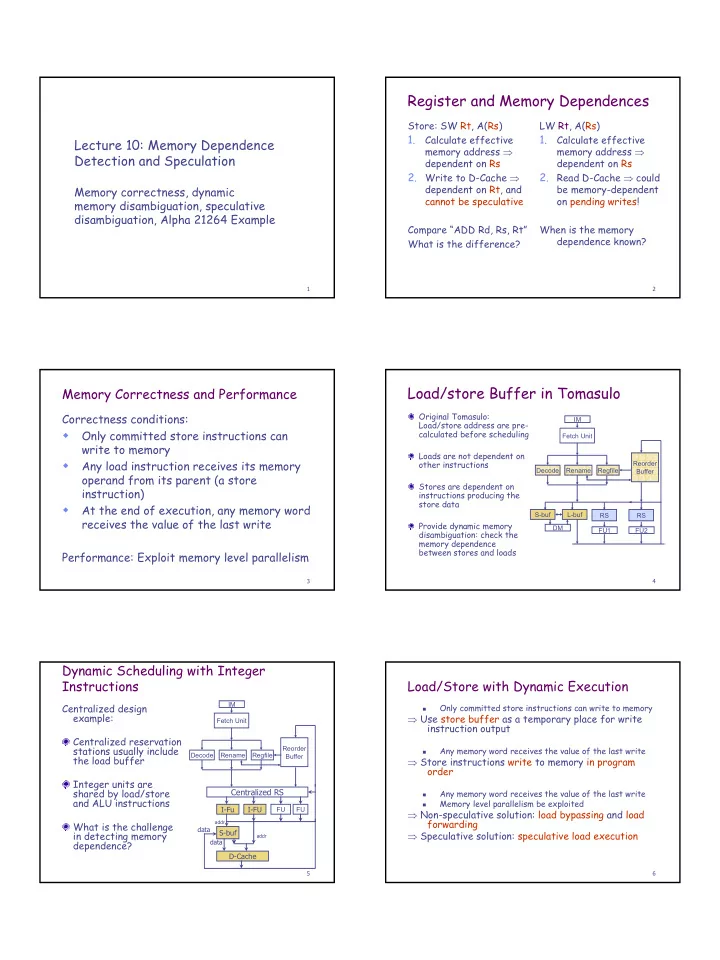
Load/store Buffer in Tomasulo
Original Tomasulo: Load/store address are pre- calculated before scheduling Loads are not dependent on
- ther instructions
Stores are dependent on instructions producing the store data Provide dynamic memory disambiguation: check the memory dependence between stores and loads
Reorder Buffer Decode FU1 FU2 RS RS Fetch Unit Rename L-buf S-buf DM Regfile IM
5
Dynamic Scheduling with Integer Instructions
Centralized design example: Centralized reservation stations usually include the load buffer Integer units are shared by load/store and ALU instructions What is the challenge in detecting memory dependence?
Reorder Buffer Decode FU FU Fetch Unit Rename
I-Fu
Regfile IM
Centralized RS
D-Cache I-FU
addr
S-buf
data data
addr
6
Load/Store with Dynamic Execution
- Only committed store instructions can write to memory
⇒ Use store buffer as a temporary place for write instruction output
- Any memory word receives the value of the last write
⇒ Store instructions write to memory in program
- rder
- Any memory word receives the value of the last write
- Memory level parallelism be exploited