
SLIDE 1
Unités de recherche Vague D : campagne d’évaluation 2012-2013 Février 2012
1
- 1. Scientific report: auto-evaluation of the ADAMIS team
- a. Activities and results
ADAMIS is an interdisciplinary research group aiming at more effective, advanced, and robust scientific exploitation and interpretation of existing and anticipated astrophysical and cosmological data sets in particular in the view of their rapidly growing sizes and complexity. ADAMIS approach to reaching such goals is to perform research at the interface of physics, statistics, computer science, signal processing, and applied mathematics with an aim of not only capitalizing on the most recent developments in those areas but of engaging directly in interdisciplinary research to find novel, more comprehensive and robust solutions. This often requires simultaneous advances in multiple science areas and consequently interdisciplinary collaborations involving researchers from diverse fields and which the group members strive to instigate and coordinate. Two main themes of the group research are a development of novel data analysis techniques as driven by needs of actual experiments and their application to some of the most exciting current and forthcoming data, and advanced numerical simulations of complex astrophysical phenomena, e.g. compact sources. These two themes are closely intertwined, as simulated, high-quality mock data sets are necessary to validate and tests data analysis algorithms. They also share a similar technical background. The group’s focus is on 3 science areas: CMB data analysis, GW data analysis, and simulations. CMB data analysis PLANCK ADAMIS has played and continues on playing an important role within the Planck HFI collaboration. Permanent members of ADAMIS (Cardoso, Delabrouille, LeJeune, Stompor) together with students and postdocs have worked over the years on a number of aspects of the mission often in leading and coordinating roles as outlined below. They are HFI Core Team members and have Planck Scientists status within the collaboration. ADAMIS has been a major player on French and international arena in the foreground component separation effort. Two of the ADAMIS conceived and developed numerical codes, SMICA and NILC (Cardoso, Delabrouille, LeJeune), have been retained in a final selection of 4 codes (out of more than dozen in the running) to be used for final Planck
- analysis. Cardoso and LeJeune lead the effort of applying these codes to the actual Planck data.
The group researchers (Stompor) have also contributed in a major way to the development of the Planck HFI map- making codes, developing, together with the group at LAL, a polarized destriper code, polkaPIX, (Tristram et al, 2011, [in2p3-00604975]), which is principal map-making work horse software of the HFI Data Processing Center used to produce official Planck products as well as internal releases. Complementary, Stompor has been one of the co-authors
- f the maximum likelihood map-making code, MADmap, (Cantalupo et al, 2011, [in2p3-00517907]), which is the
leading code of this type used for Planck at the US Data Center. (Incidentally, and notably, the code has also become the backbone of the on-board map-maker of the Hershel SPIRES instrument.)
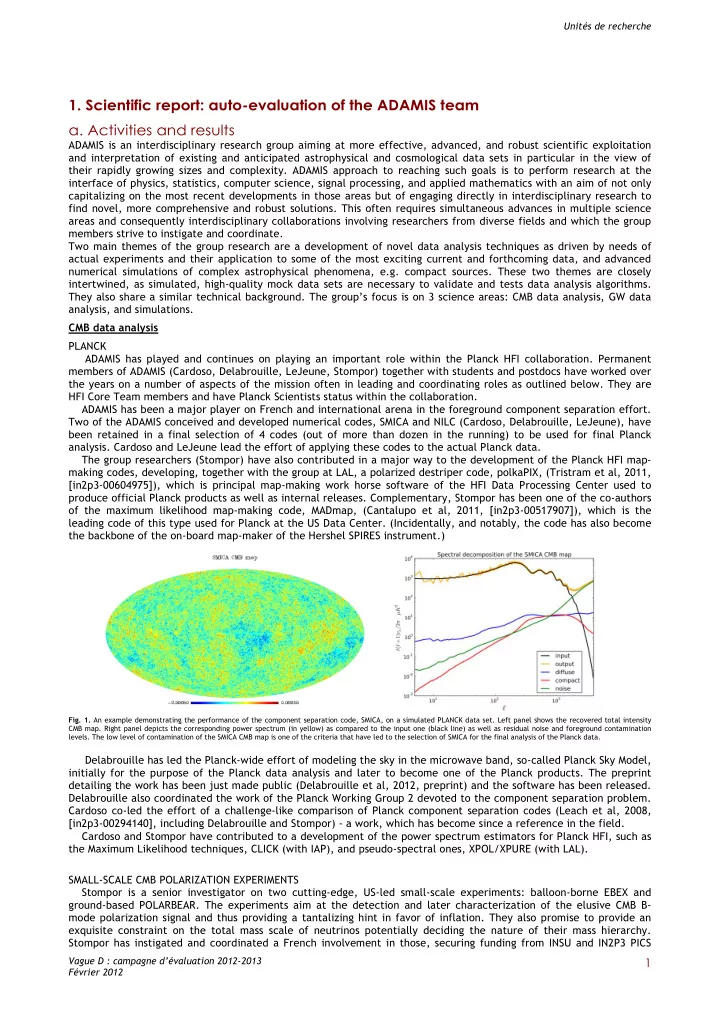
- Fig. 1. An example demonstrating the performance of the component separation code, SMICA, on a simulated PLANCK data set. Left panel shows the recovered total intensity
CMB map. Right panel depicts the corresponding power spectrum (in yellow) as compared to the input one (black line) as well as residual noise and foreground contamination
- levels. The low level of contamination of the SMICA CMB map is one of the criteria that have led to the selection of SMICA for the final analysis of the Planck data.