SLIDE 1
1
Panel: “Working with power and politics” TALEARN, March 12, 2014 Jakarta
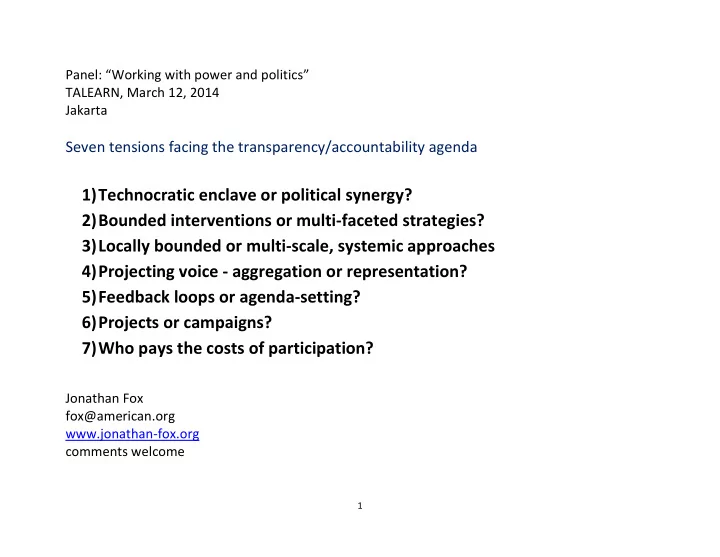
Seven tensions facing the transparency/accountability agenda
1) Technocratic enclave or political synergy? 2) Bounded interventions or multi-faceted strategies? 3) Locally bounded or multi-scale, systemic approaches 4) Projecting voice - aggregation or representation? 5) Feedback loops or agenda-setting? 6) Projects or campaigns? 7) Who pays the costs of participation?
Jonathan Fox fox@american.org www.jonathan-fox.org comments welcome
SLIDE 2
2
In the spirit of the banner outside this hall, “empowering citizens,” I will try to take a citizens’ eye view by applying a power analysis to many of the seemingly common-sense, everyday terms that we use in our work… 8) Enclave or synergy? This is the overarching issue that frames the others. The challenge here is do we frame the T/A agenda in terms of a self-contained enclave, or do we see this agenda as the T/A wing of a broader civic movement to deepen accountable governance more generally? This big question is closely related to the next tension: 9) Interventions or strategies? The concept of “intervention” is closely associated with what I will only slightly caricature as the enclave approach. The idea of an intervention is also closely associated with an adjective – external, that one could contrast with a more embedded partnership approach. Interventions are time-bounded, one-off actions that are often intentionally not combined with change initiatives involving many other actors, mainly because from an impact evaluation point of view, if you bundle intervention X together with actions A, B and C, you can’t adequately isolate its impact. In our field, interventions are closely associated with strictly demand-side approaches that tend to be based on the assumption that information delivery or data access will, by itself, first overcome collective action problems, and second - also by itself - will also generate sufficient leverage over the public sector to change its
SLIDE 3 3
- behavior. Some RCTs avoid these assumptions, most notably Bjorkman and Svensson’s
“power to the people” study in Uganda, but it stands out as an exception. In shorthand, this tool-led approach to interventions can be called tactical, in contrast with what I would call strategic approaches that combine multiple, hopefully mutually-reinforcing change initiatives, which include the active promotion of enabling environments to reduce the costs and risks of collective action, and which also try to influence the so-called supply side by bolstering state capacity to respond to voice. 10) Locally bounded or multi-scale, systemic approaches? Going back to the influential conceptual framework of the 2004 WDR, many tactical approaches to using information for accountability are based on the implicit assumption that service delivery failures are fundamentally local, at the micro interface between the state and the citizenry. This approach ignores the potential capacity of voice to address public sector failures further up the so-called “supply chain” of governance. This approach basically blames frontline service providers for what are often systemic problems that reach all the way to the top, and does not recognize the accountability potential of scaling up citizen capacity to oversee multiple levels of the public sector at the same time – a process that I call the vertical integration of civil society oversight.
SLIDE 4
4
Limiting the role assigned to citizen voice to the local arena is related to a 4th political tension facing the T/A agenda 11) How does voice gain clout? Through aggregation or representation? If collective action plays a key role in our theory of change, and if governance failures occur at levels above the neighborhood or village, then the next question is: how can collective action scale up? There is a lot that could be said here, but that main distinction that I want to flag here is between the aggregation of voice (when many people speak, presumably to the same issue – and voice as representation. Aside from rare political turning points, most of the time, the collective action pathways to scale that involve representation usually involve mass membership organizations, those whose leaders can credibly speak for their members, often involving some kind of accountability relationship between leaders and membership. So what’s the real difference here? Voice can be aggregated through social media, which of course can spotlight problems or demonstrate the existence of a broad base of concern. This is very helpful for influencing public agendas - but then what? What if powerholders ignore aggregated voice? Where is the leverage to encourage a response? Even when powerholders are willing to respond to some degree, who is going to negotiate the terms on behalf of large numbers of basically individual voices? The political point here is that aggregation of voices is not enough – representation is also key to be able to actually influence the response, whether through pressure, negotiation or some combination.
SLIDE 5
5
12) Feedback loops or agenda-setting? Note that the emphasis here on what gives voice clout is quite different from the feedback loop metaphor, whose language implies that projecting voice upwards to flag problems is enough to generate institutional responses, as though all power-holders need to know is what doesn’t work and then they will somehow swing into action. The term feedback implicitly leaves out two key questions - whether and how voice can influence institutional behavior by changing the balance of power, and who sets the agenda that the feedback responds to. This is what the recent emphasis on closing the feedback loop tries to do, but at least some of the work under this heading still sidesteps the question of what motivates powerholders to listen to the feedback. The main point I want to make here it that the conventional idea of providing or inducing feedback involves public comment on an agenda that is still basically set from above, in contrast to those citizens who want to strategically influence the agenda. Trying to close feedback loops is somewhere in between client satisfaction surveys and participatory democracy, but it’s usually much closer to the first than the second. For example, in one of the recent TAI think pieces on natural resource governance, the focus was exclusively on how citizens can monitor the use of the public funds that come from natural resource exploitation. But there was no questioning of assumptions about whether natural resources should be exploited, and who would pay the social and environmental costs? Time after time, supposed institutional safeguards have been promised by powerholders to encourage better
SLIDE 6 6
investment and oversight of resource flows, but sometimes this ends up just providing political cover to what turns out to be yet another resource curse. In the T/A field involving extractive industries, it’s now widely recognized that it’s hard to find evidence of civil society impact, but it’s a reality check that the most clear-cut case of such impact is in El Salvador. There it was national social movements, an enlightened church hierarchy, the electoral clout
- f their allies and divided national elites that led to a sustained moratorium on gold mining.
The main accountability mechanisms were electoral competition and stakeholders’ capacity to protest. This was agenda-setting, not feedback. 13) Projects or campaigns? In the arena of learning from failure, one hears a lot of frustration when modest initiatives that basically cover a few good peoples’ salaries for a couple of years fall short of overturning centuries of social exclusion and institutional impunity – especially when those projects are intended to activate the unorganized rather than partner with already-organized social constituencies. This project/campaign distinction came up in a very productive meeting the IBP held a couple of years ago, in the process of reflecting on many useful cases studies – some with more impact than others. My
- bservation at the time was that the initiatives covered in the case studies included apples
and oranges – some were modest, bounded projects, while others were more strategic, power-oriented campaigns involving multiple actors on the other.
SLIDE 7
7
My point here is that we need to have realistic expectations – what kind of modest project, even with the most careful design and the best of intentions, can manage to leverage profound changes in power relations on a large scale? Thinking about the implications of the terminology we use, my point here is that the very concept of a project is closely related to the bounded, one-off intervention I was referring to… it may well involve building something, and that something could be a bridge as much as it could be capacity to project voice, but the implication of the term is more closely associated with the goal of deliverables than with changing the balance of power. In contrast, the idea of a campaign inherently involves trying to engineer change, usually with some kind of contestation. Think about the different uses of the term – a military campaign involves contesting power with force, a political campaign involves contesting votes with ideas and mass organizing, a media campaign involves changing opinions and practices with bold messages and images… To sum this up, projects may or may not contribute to creating the conditions for change, whereas campaigns are by definition about seeking change strategically. 14) Challenging impunity is most risky for those with the least clout. Tactical information interventions are often based on the implicit assumption that participation has more benefits than costs, if the costs are recognized at all – and that the targets for encouraging
SLIDE 8 8
participation perceive the benefits as being greater than the costs. That’s one reason that the role of external allies is so important, insofar as they might be able to reduce the risks inherent in challenging impunity from below. That’s the real meaning behind the technocratic-sounding term “enabling environment.” To illustrate what taking a citizens-eye views means in the contexts of two large-scale democracies that have world-class information rights laws, I’ll close with a brief story from Mexico and a factoid from India. This story is about a recent incident involving a Mexican NGO partner working in the indigenous highlands of Chiapas, where they trained community members to become local accountability promoters. Local citizens learned how to exercise their legal rights to call on their mayors to disclose how public funds were spent, in socially sensitive workshops in their
- wn language. Everyone knew that most of those mayors are local bosses who play rough.
The local NGO assured me, yes, we know it’s risky, but we think we have enough momentum and community support to pull this off. So they drew on their long-standing social networks, trained dozens of local activists and launched their bottom-up, public campaign for accountable local government. The backlash came hard and fast. The NGO was banned from the district, and they headed back to their headquarters in a regional city. But the consequences were not so simple for the local organizers, at least one of whom was expelled
SLIDE 9 9
from his own village, under threat of violence. Local radio media coverage was good and national news coverage was nice, but the local mayors didn’t care. A flagship national NGO blogged about it, but their coverage stressed how great it was that the grassroots campaign was launched, mentioning only in passing that the local community watchdogs got screwed – a reflection of our community’s persistent tendency to find the glass at least half-full, even when it’s empty. The very worried NGO then met with state government, which promised to do “trainings” for local mayors on the right to information, but they didn’t show up to their
- wn workshops. The institutional reforms of the national information access regime then
being debated in Mexico City might as well have been happening on another planet. The mayors retained their impunity. This is hardly an isolated incident in the grassroots wing of the right-to-know movement. I’d like to cite a colleague Suchi Pande, who just finished her dissertation at Sussex under the supervision of our colleague here, Dr. Anuradha Joshi. Suchi recently shared some data on the human rights costs of using India’s widely-hailed right to know law. According to a still- incomplete collection of newspaper reports, at least 3 dozen Indian information requesters have been assassinated for trying to exercise their rights, with many more injured or
- threatened. Meanwhile, globally, our community often hails India’s law as an unqualified
success story. This last point reminds us of the persistent question of who decides what counts as a success, and based on what criteria?
SLIDE 10
10
Sorry to end with this unsettling reminder of the many missing links in the causal chain between transparency and accountability…. But we have two more whole days to rediscover the good news…