1. The International Futures forecasting system (IFs) 2. Four - - PDF document

1 the international futures forecasting system ifs 2 four
SMART_READER_LITE
LIVE PREVIEW

1. The International Futures forecasting system (IFs) 2. Four - - PDF document

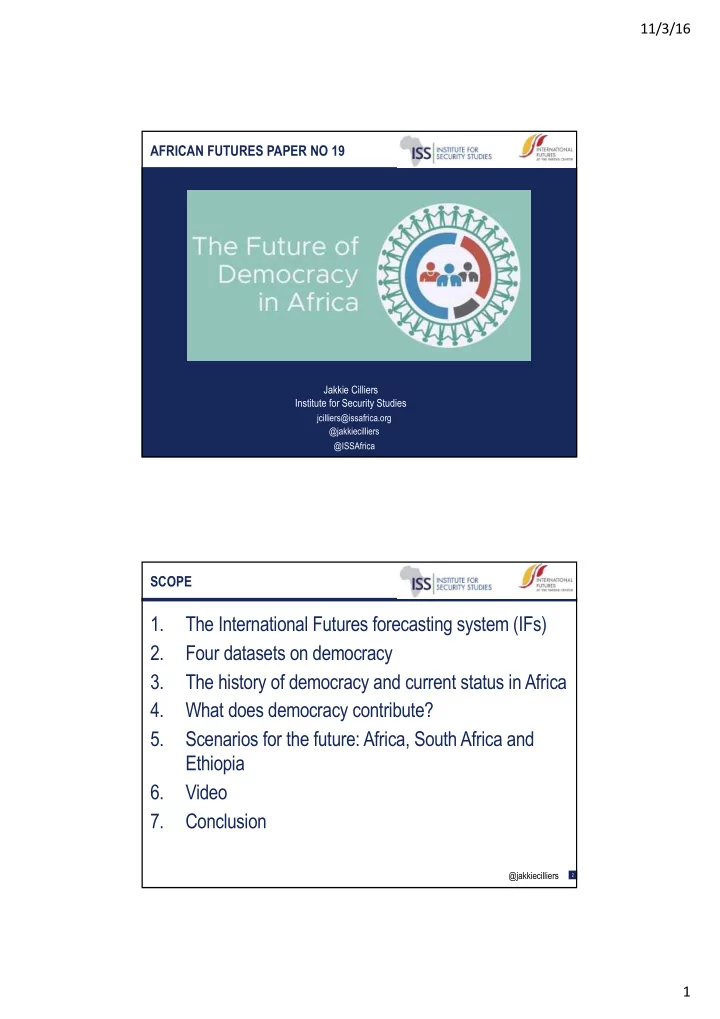
11/3/16 AFRICAN FUTURES PAPER NO 19 Jakkie Cilliers Institute for Security Studies jcilliers@issafrica.org @jakkiecilliers @ISSAfrica SCOPE 1. The International Futures forecasting system (IFs) 2. Four datasets on democracy 3. The


slide-1
SLIDE 1

11/3/16 1

Jakkie Cilliers Institute for Security Studies

jcilliers@issafrica.org @jakkiecilliers @ISSAfrica

AFRICAN FUTURES PAPER NO 19

2

SCOPE

1. The International Futures forecasting system (IFs) 2. Four datasets on democracy 3. The history of democracy and current status in Africa 4. What does democracy contribute? 5. Scenarios for the future: Africa, South Africa and Ethiopia 6. Video 7. Conclusion

@jakkiecilliers

slide-2
SLIDE 2

11/3/16 2

3

THE INTERNATIONAL FUTURES FORECASTING SYSTEM (IFS) IS …

  • A dynamic, global model that integrates data and
  • utcomes across development systems.
  • Historical data for over 3 500 data series for 186

countries

  • Allows:
  • 1. Historical trends
  • 2. Current path/base case forecasts
  • 3. Alternative future scenarios

3

4

IFS MAJOR SUB-MODULES

slide-3
SLIDE 3

11/3/16 3

5

EXPANDING RELATIONSHIPS

6

CONNECTIONS FOR ONE COUNTRY

slide-4
SLIDE 4

11/3/16 4

7

SCOPE

1. The International Futures forecasting system (IFs) 2. Four datasets on democracy 3. The history of democracy and current status in Africa 4. What does democracy contribute? 5. Scenarios for the future: Africa, South Africa and Ethiopia 6. Video 7. Conclusion

@jakkiecilliers

8

USED FOUR DATASETS

@jakkiecilliers

slide-5
SLIDE 5

11/3/16 5

9

SCOPE

1. The International Futures forecasting system (IFs) 2. Four datasets on democracy 3. The history of democracy and current status in Africa 4. What does democracy contribute? 5. Scenarios for the future: Africa, South Africa and Ethiopia 6. Video 7. Conclusion

@jakkiecilliers

10

WORLD: HISTORY OF DEMOCRACY

0.1 0.2 0.3 0.4 0.5 0.6

  • 10
  • 8
  • 6
  • 4
  • 2

2 4 6 1900 1910 1920 1930 1940 1950 1960 1970 1980 1990 2000 2010 V-Dem Polity World Polity World V-Dem

slide-6
SLIDE 6

11/3/16 6

12

FREEDOM HOUSE: AFRICA

14

ECONOMIST INTELLIGENCE UNIT

slide-7
SLIDE 7

11/3/16 7

15

POLITY IV

16

DEMOCRACY IN AFRICA OCCURING AT EVER LOWER LEVELS OF INCOME

2 4 6 8 10 12 14 16 2 4 6 8 10 12 14 16 1990 1995 2000 2005 2010 2015 Polity score Thousand of 2015 US$ GDPPC Africa GDPPC world Polity Africa Polity world

slide-8
SLIDE 8

11/3/16 8

17

THE AFRICAN EXPERIENCE WITH DEMOCRACY

An intrinsic ‘good’ but democracy has been undermined by:

  • Association with neo-liberal economic policies
  • Western support to dictators and authoritarian states
  • Weakness of the African state - process of delayed state formation -

African states simultaneously have to provide security, develop capacity and become more inclusive Neopatrimonialism has adapted to democracy – African elites go through motions of elections but frustrate the essence Rise of China vs relative decline in influence of Africa’s traditional development partners – African elites (again) have alternatives But hugely popular (Afrobarometer)

18

SCOPE

1. The International Futures forecasting system (IFs) 2. Four datasets on democracy 3. The history of democracy and current status in Africa 4. What does democracy contribute? 5. Scenarios for the future: Africa, South Africa and Ethiopia 6. Video 7. Conclusion

@jakkiecilliers

slide-9
SLIDE 9

11/3/16 9

20

TWO KEY QUESTIONS

  • 1. The sequencing debate: what comes first,

democracy or development?

  • 2. Statistically, what elements of democracy matter

for human and economic development?

21

TWO KEY QUESTIONS

  • 1. The sequencing debate: what comes first, democracy
  • r development?
  • Democracy and good governance accompany development,

not prerequisites.

  • Democracy is not a necessary byproduct of growth, but

higher GDP per capita prevents democratic backsliding

  • Nature of governing elites important – need for a

developmental state at low levels of development

  • Development often chaotic, corrupt and violent – easier to

manage without democracy

  • As countries develop, democracy becomes more important

to sustain productivity improvements and hence growth

slide-10
SLIDE 10

11/3/16 10

23

TWO KEY QUESTIONS

  • 1. The sequencing debate: what comes first,

democracy or development?

  • 2. Statistically, what elements of democracy

matter for human and economic development?

24

TWO KEY QUESTIONS

  • 2. Statistically, what elements of democracy impact

upon human and economic development?

Electoral aspects of democracy Citizen empowerment aspects of democracy

Clean, competitive elections Participation, deliberation and egalitarianism Chief executive that is selected through elections Female empowerment Suffrage that is extensive Strong and diversified civil society Political and civil society

  • rganizations able to operate freely

Equality before the law and individual liberty Freedom of expression including access to alternative information Thus a state-centred vs a society-centred view of development

slide-11
SLIDE 11

11/3/16 11

25

SCOPE

1. The International Futures forecasting system (IFs) 2. Four datasets on democracy 3. The history of democracy and current status in Africa 4. What does democracy contribute? 5. Scenarios for the future: Africa, South Africa and Ethiopia 6. Video 7. Conclusion

@jakkiecilliers

26

WORLD: HISTORY OF DEMOCRACY

0.1 0.2 0.3 0.4 0.5 0.6

  • 10
  • 8
  • 6
  • 4
  • 2

2 4 6 1900 1910 1920 1930 1940 1950 1960 1970 1980 1990 2000 2010 V-Dem Polity World Polity World V-Dem

slide-12
SLIDE 12

11/3/16 12

27

THE FUTURE

  • Two scenarios:
  • Fourth Wave
  • Authoritarian Regression
  • Short/medium-term democratic regression likely due to: failure of

Arab Spring; impact of US invasion of Iraq; continued impact of 2008 global recession; rise of populism; and global rebalancing

  • But waves have crests and troughs - long-term global trend is

towards more democracy

  • Africa?
  • Huge popular demand, but traditional development partners have lost

leverage while authoritarian development model popular amongst leaders

28

POLITY IV: HISTORY AND FORECAST

2 4 6 8 10 12 14 16 18 1990 2000 2010 2020 2030 2040 2050 2060 2070 Polity scale 0-20 Africa Regress Africa 4th Wave World Regress World - 4th Wave

slide-13
SLIDE 13

11/3/16 13

29

IMPACT OF DEMOCRACY IN AFRICA

30

AFRICA GDP IN MER

11/2/16 30

2 681 8 285 2 681 9 551 2 000 4 000 6 000 8 000 10 000 12 000 2016 2043 Bn 2015 US$ Regression 4th Wave

slide-14
SLIDE 14

11/3/16 14

31

AFRICA GDP PER CAPITA IN PPP

11/2/16 31

4 822 6 952 4 822 7 666 1 000 2 000 3 000 4 000 5 000 6 000 7 000 8 000 9 000 2016 2043 2015 US$ Regression 4th Wave

33

AFRICA EXTREME POVERTY NUMBERS

11/2/16 33

1 212 2 127 467 598 467 530 500 1 000 1 500 2 000 2 500 2016 2043 Millions of people Pop Regression 4th Wave

slide-15
SLIDE 15

11/3/16 15

37

ETHIOPIA AND THE POTENTIAL GAINS FROM DEMOCRACY

38

SA AND ETHIOPIA ON POLITY

11/3/16 38

  • 8
  • 6
  • 4
  • 2

2 4 6 8 2015 2020 2025 2030 2035 2040 2045 2050 2055 2060 2065 2070 Polity score (-10 to +10) SA 4th Wave SA Regression Ethiopia 4th Wave Ethiopia Regression

slide-16
SLIDE 16

11/3/16 16

39

GDP IN MER

11/3/16 39

474 1 049 474 885 50 362 50 317 200 400 600 800 1000 1200 2016 2043 Bn 2015 US$ SA 4th Wave SA Regression Eth 4th Wave Eth Regression

40

GDP PER CAPITA IN PPP

11/3/16 40

13 038 20 859 13 038 18 614 1 612 4 423 1 612 4 049 5000 10000 15000 20000 25000 2016 2043 2015 US$ SA 4th Wave SA Regression Eth 4th Wave Eth Regression

slide-17
SLIDE 17

11/3/16 17

41

POVERTY RATE

11/3/16 41

16 15 16 17 24 10 24 12 5 10 15 20 25 2016 2043 Percent SA 4th Wave SA Regression Eth 4th Wave Eth Regression

47

SCOPE

1. The International Futures forecasting system (IFs) 2. Four datasets on democracy 3. The history of democracy and current status in Africa 4. What does democracy contribute? 5. Scenarios for the future: Africa, South Africa and Ethiopia 6. Video 7. Conclusion

@jakkiecilliers

slide-18
SLIDE 18

11/3/16 18

49

SCOPE

1. The International Futures forecasting system (IFs) 2. Four datasets on democracy 3. The history of democracy and current status in Africa 4. What does democracy contribute? 5. Scenarios for the future: South Africa and Ethiopia 6. Video 7. Conclusion

@jakkiecilliers

slide-19
SLIDE 19

11/3/16 19

50

CONCLUSION 1

Over the long term democracy provides

  • A mechanism to check power of elite
  • A separation of powers
  • Protection of human rights and the rule of law

Sustained growth at higher levels of income likely require democracy to continue to grow. But Substantive democracies emerge over time and require significant resources (and growth) to mature

51

CONCLUSION 2

  • Democracy is not the dominant form of governance in

Africa but positive trend - demand is high

  • Likely a global democratic regression – what will happen

in Africa?

  • It is possible to quantify the impact of democracy on

growth and human development, BUT

  • Statistically the “electoral” aspect of democracy improves

human development and growth while those related to citizen empowerment do not

slide-20
SLIDE 20

11/3/16 20

52

STAY INFORMED

www.issafrica.org @ISSAfrica