
SLIDE 1
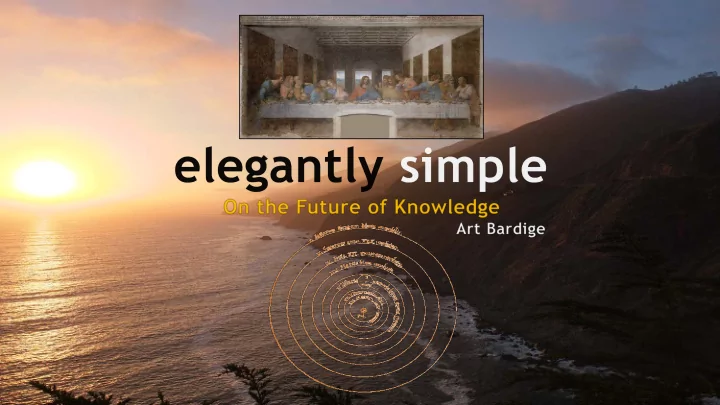
1. Unifying Art and Science Charles Darwin Subtitled his great work - - PowerPoint PPT Presentation
1. Unifying Art and Science Charles Darwin Subtitled his great work Preservation of Favored Races in the Struggle for Life So why are we artists? I found an answer in an accidental discovery James Clerk Maxwell A Dynamical Theory of the
Charles Darwin
I found an answer in an accidental discovery
James Clerk Maxwell “A Dynamical Theory of the Electromagnetic Field” 1864
1864
“The theory I propose may therefore be called a theory of the Electromagnetic Field because it has to do with the space in the neighborhood of the electric or magnetic bodies…”
James Clerk Maxwell “A Dynamical Theory of the Electromagnetic Field”
”…I am induced by many reasons to suspect that they may all depend upon certain forces by which the particles
unknown, are either mutually impelled towards each other, and cohere in regular figures, or are repelled and recede from each other…” Isaac Newton 1686
Maxwell’s Equations Manet’s Luncheon on the Grass 1864 1863
Arthur Cayley Matrices
Arthur Cayley Matrices Charles Darwin On the Origin of Species
Arthur Cayley Matrices Charles Darwin On the Origin of Species Lewis Carroll Alice in Wonderland
Arthur Cayley Matrices Charles Darwin On the Origin of Species Lewis Carroll Alice in Wonderland Edouard Manet "Luncheon on the Grass"
Arthur Cayley Matrices Charles Darwin On the Origin of Species Lewis Carroll Alice in Wonderland Auguste Rodin “Man with a Broken Nose” Edouard Manet "Luncheon on the Grass"
Arthur Cayley Matrices Charles Darwin On the Origin of Species Lewis Carroll Alice in Wonderland James Clerk Maxwell “A Dynamical Theory of the Electromagnetic Field” Auguste Rodin “Man with a Broken Nose” Edouard Manet "Luncheon on the Grass"
Arthur Cayley Matrices Charles Darwin On the Origin of Species Lewis Carroll Alice in Wonderland Louis Pasteur "Corpuscles in the Atmosphere" James Clerk Maxwell “A Dynamical Theory of the Electromagnetic Field” Auguste Rodin “Man with a Broken Nose” Edouard Manet "Luncheon on the Grass"
Arthur Cayley Matrices Charles Darwin On the Origin of Species Lewis Carroll Alice in Wonderland Louis Pasteur "Corpuscles in the Atmosphere" Leo Tolstoy War and Peace James Clerk Maxwell “A Dynamical Theory of the Electromagnetic Field” Auguste Rodin “Man with a Broken Nose” Edouard Manet "Luncheon on the Grass"
Arthur Cayley Matrices Charles Darwin On the Origin of Species Lewis Carroll Alice in Wonderland Louis Pasteur "Corpuscles in the Atmosphere" Leo Tolstoy War and Peace James Clerk Maxwell “A Dynamical Theory of the Electromagnetic Field” Karl Marx Das Kapital Auguste Rodin “Man with a Broken Nose” Edouard Manet "Luncheon on the Grass"
Arthur Cayley Matrices Charles Darwin On the Origin of Species Lewis Carroll Alice in Wonderland Louis Pasteur "Corpuscles in the Atmosphere" Leo Tolstoy War and Peace James Clerk Maxwell “A Dynamical Theory of the Electromagnetic Field” Karl Marx Das Kapital Auguste Rodin “Man with a Broken Nose” Gregor Mendel “Experiments on Plant Hybridization” Edouard Manet "Luncheon on the Grass"
Arthur Cayley Matrices Charles Darwin On the Origin of Species Lewis Carroll Alice in Wonderland Louis Pasteur "Corpuscles in the Atmosphere" Leo Tolstoy War and Peace James Clerk Maxwell “A Dynamical Theory of the Electromagnetic Field” Karl Marx Das Kapital Auguste Rodin “Man with a Broken Nose” Gregor Mendel “Experiments on Plant Hybridization” Edouard Manet "Luncheon on the Grass"
Arthur Cayley Matrices Charles Darwin On the Origin of Species Lewis Carroll Alice in Wonderland Louis Pasteur "Corpuscles in the Atmosphere" Leo Tolstoy War and Peace James Clerk Maxwell “A Dynamical Theory of the Electromagnetic Field” Karl Marx Das Kapital Auguste Rodin “Man with a Broken Nose” Gregor Mendel “Experiments on Plant Hybridization” Edouard Manet "Luncheon on the Grass"
James Clerk Maxwell “A Dynamical Theory of the Electromagnetic Field”
Leonardo da Vinci The Last Supper
Leonardo da Vinci The Last Supper Bramante
Cathedral
Leonardo da Vinci The Last Supper Bramante
Cathedral Copernicus Heliocentric System
Leonardo da Vinci The Last Supper Bramante
Cathedral Copernicus Heliocentric System Michelangelo Pieta
Leonardo da Vinci The Last Supper Bramante
Cathedral Copernicus Heliocentric System Martin Luther “95 Theses” Michelangelo Pieta
Machiavelli The Prince Martin Luther “95 Theses”
Leonardo da Vinci The Last Supper Bramante
Cathedral Copernicus Heliocentric System Michelangelo Pieta
Machiavelli The Prince Moore Utopia
Leonardo da Vinci The Last Supper Bramante
Cathedral Copernicus Heliocentric System Martin Luther “95 Theses” Michelangelo Pieta
Machiavelli The Prince Moore Utopia Erasmus In Praise of Folly
Leonardo da Vinci The Last Supper Bramante
Cathedral Copernicus Heliocentric System Martin Luther “95 Theses” Michelangelo Pieta
Machiavelli The Prince Moore Utopia
Albrecht Durer “Adam and Eve” Erasmus In Praise of Folly Leonardo da Vinci The Last Supper Bramante
Cathedral Copernicus Heliocentric System Martin Luther “95 Theses” Michelangelo Pieta
Leonardo da Vinci The Last Supper Bramante
Cathedral Copernicus Heliocentric System Machiavelli The Prince Moore Utopia Martin Luther “95 Theses” Michelangelo ”Sistine Chapel"
Albrecht Durer “Adam and Eve” Erasmus In Praise of Folly
Thales of Miletus Logos
Thales of Miletus Geometric Proof
Thales of Miletus Logos
Thales of Miletus Geometric Proof Kouros Archaic Art
Thales of Miletus Logos
Thales of Miletus Geometric Proof Kouros Archaic Art Solon Constitution of Athens
Thales of Miletus Logos
Thales of Miletus Geometric Proof Kouros Archaic Art Kouros Free Standing Sculpture Solon Constitution of Athens
Thales of Miletus Logos
Thales of Miletus Geometric Proof Kouros Archaic Art Kouros Free Standing Sculpture Solon Constitution of Athens
Theater Thales of Miletus Logos
Thales of Miletus Geometric Proof Kouros Archaic Art Free Standing Buildings Doric Order Kouros Free Standing Sculpture Solon Constitution of Athens
Theater Thales of Miletus Logos
Thales of Miletus Geometric Proof Kouros Archaic Art Free Standing Buildings Doric Order Aesop’s Fables Kouros Free Standing Sculpture Solon Constitution of Athens
Theater Thales of Miletus Logos
Thales of Miletus Geometric Proof Kouros Archaic Art Free Standing Buildings Doric Order Aesop’s Fables Kouros Free Standing Sculpture Black Figure Vases Solon Constitution of Athens
Theater Thales of Miletus Logos
Thales of Miletus Geometric Proof Kouros Archaic Art Free Standing Buildings Doric Order Aesop’s Fables Kouros Free Standing Sculpture Black Figure Vases Polis Solon Constitution of Athens
Theater Thales of Miletus Logos
Cave Art
Cave Art Venus Figures
Cave Art Venus Figures
Language and Storytelling
Cave Art Venus Figures
Language and Storytelling Fashioned tools
Cave Art Venus Figures Decorated bodies
Language and Storytelling Fashioned tools
Cave Art Venus Figures Decorated bodies
Music Language and Storytelling Fashioned tools
Cave Art Venus Figures Dance Decorated bodies
Music Language and Storytelling Fashioned tools
Cave Art Venus Figures Dance Decorated bodies Tribal Life
Music Language and Storytelling Fashioned tools
Cave Art Venus Figures Language and Storytelling Dance Decorated bodies Tribal Life “Magic”
Music Fashioned tools
Based on that singular idea
The Pattern of Knowledge
Periods Sites Fasteners
Symbols Universals Objects Environments
Singular Parts Connections Relations Transformations Wholes Connections Relations Transformations Plural Parts Connections Relations Transformations Wholes Connections Relations Transformations
12 Phases
I could divide each in two distinct halves
The Pattern of Knowledge
Periods Semi-Periods Fasteners
Symbols Universals Objects Environments
Singular
Parts Connections Relations Transformations Wholes Connections Relations Transformations
Plural
Parts Connections Relations Transformations Wholes Connections Relations Transformations
12 Phases
And each half again in half into
The Pattern of Knowledge
Periods
Symbols Universals Objects Environments
Singular Parts
Connections Relations Transformations
Wholes
Connections Relations Transformations
Plural Parts
Connections Relations Transformations
Wholes
Connections Relations Transformations
12 Phases
And each of those into three parts
The Pattern of Knowledge
Entities Sites Fasteners
Symbols Universals Objects Environments
Singular Parts
Connections Relations Transformations
Wholes
Connections Relations Transformations
Plural Parts
Connections Relations Transformations
Wholes
Connections Relations Transformations
12 Phases
12 “phases” in Symbols
Universals
Objects
Environments
Symbols went through these phases many times.
Universals phases repeated in Medieval Europe
I call this the “Pattern of Knowledge”
While I focused on “Western knowledge,” I believe this pattern of the evolution of knowledge is independent of culture.
Einstein, “On the Electrodynamics of Moving Bodies
Picasso, Les Demoiselles d’Avignon
1905 1907
Democritus, Atomic Theory Parthenon
437
Delacroix, The Fanatics of Tangier Faraday, Lines of Force
1838
Feynman, Feynman Diagrams Jackson Pollack, No. 5, 1948
1948 1948
Kepler, The New Astronomy Caravaggio, The Calling of St. Matthew
1609 1600
Plato
Plato Dante
Plato Dante Kant
Plato Dante Kant Einstein
Since we seem to have ended the environments periods…
Symbols as the simplest building block Universals Objects Environments ?
Symbols as the simplest Universals as collections of symbols Objects Environments ?
Symbols as the simplest Universals as collections of symbols Objects as collections of universals Environments ?
Symbols as the simplest Universals as collections of symbols Objects as collections of universals Environments as collections of objects ?
Newton’s Universal Law of Gravitation
Newton’s Universal Law of Gravitation Maxwell’s Electrodynamics
Newton’s Universal Law of Gravitation Maxwell’s Electrodynamics
Symbols as the simplest Universals as collections of symbols Objects as collections of universals Environments as collections of objects A collection of environments is an artifact
Symbols as the simplest Universals as collections of symbols Objects as collections of universals Environments as collections of objects A collection of environments is an artifact
Gehry, Stata Center MIT 2004
What is an artifact?
A human construction
A pattern
For thought as well as for things
Library of Alexandria, Von Corven, c. 19th century
This is an artifact
And this…
Frederic Church, The Heart of the Andes, 1859
Or this
Monet, Impression, Sunrise, 1872
Or this
Kandinsky, Landscape with Two Poplars, 1912
They are all human constructions.
LEGOLAND Billund, Denmark
They are all patterns.
We make patterns constantly…
Feynman doodles
Move our furniture
Cover our walls…
Mold our ceilings
In everything we do. Carve our columns
Inside and Outside Plant our Gardens
“Mathematics has become the science of patterns”
Lynn Steen 1988
Do mathematics
Play sports
Study science
Tell stories
Create art
Describe history
Compte, Theory of Science c. 1848
Plan cities
L’Enfant Map of Washington, DC
Play music
Bach, Fugue
Everywhere
All the time
So how do we decide which ones we should keep…
Leonardo’s Sketchbook
And share?
I would argue that those are…
Cassiopeia
M31, the Galaxy beyond Andromeda
We know uniqueness
The Standard Model
Because it is beautiful
Garrett Lisi, A Theory of Everything
…I seem to have been only like a boy playing on the sea-shore, and diverting myself in now and then finding a smoother pebble or a prettier shell than
Isaac Newton
When I am working
think about beauty. I
to solve the problem. But when I have finished, if the solution is not beautiful, I know it is wrong.
Buckminster Fuller (1895-1983) Fuller dome
It seems that if one is working from the point of view of getting beauty in
if one has really a sound insight, one is
progress. Paul Dirac 1963
Paul Dirac 1963
Thus, from the war of nature, from famine and death, the most exalted object of which we are capable of conceiving, namely, the production of the higher animals, directly follows. There is grandeur in this view of life, with its several powers, having been originally breathed into a few forms or into one; and that, whilst this planet has gone cycling on according to the fixed law
beautiful and most wonderful have been, and are being, evolved.
Charles Darwin 1859