10/11/2013 Income Security & Aging Christopher M. Kelly, Ph.D. - - PDF document

10 11 2013
SMART_READER_LITE
LIVE PREVIEW

10/11/2013 Income Security & Aging Christopher M. Kelly, Ph.D. - - PDF document

10/11/2013 Income Security & Aging Christopher M. Kelly, Ph.D. UNO Department of Gerontology October 16, 2013 Financial Status of Older Adults Since Great Depression, financial status of older Americans has improved Median incomes


slide-1
SLIDE 1

10/11/2013 1

Income Security & Aging

Christopher M. Kelly, Ph.D. UNO Department of Gerontology October 16, 2013

Financial Status of Older Adults

  • Since Great Depression, financial status of
  • lder Americans has improved
  • Median incomes for 65+ has risen; poverty

rates for 65+ have dropped

  • Financial status within 65+ population

varies significantly

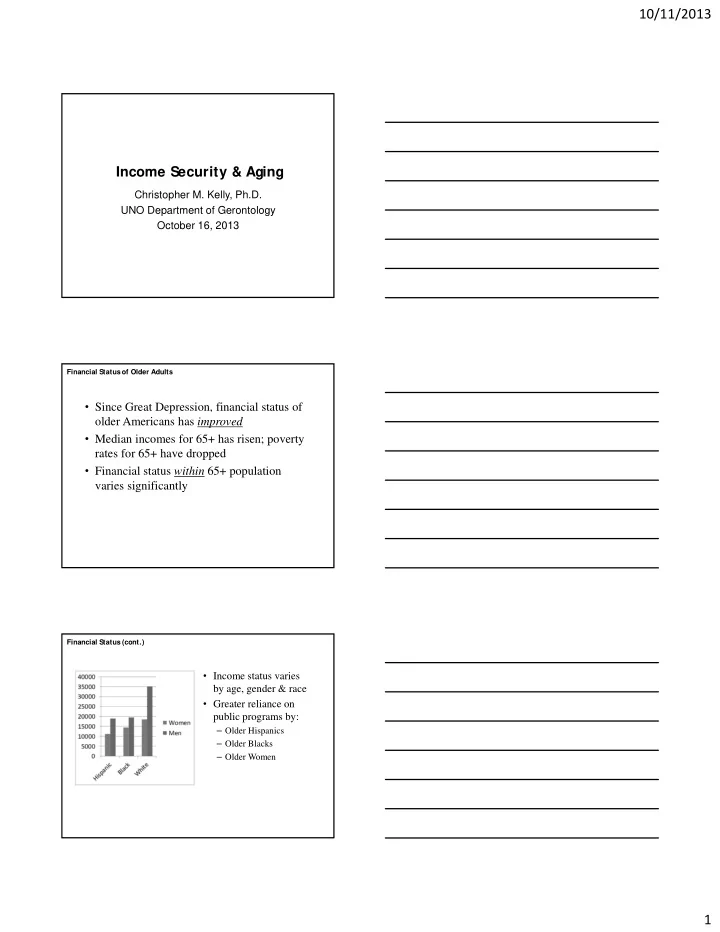
Financial Status (cont.)

  • Income status varies

by age, gender & race

  • Greater reliance on

public programs by:

– Older Hispanics – Older Blacks – Older Women

slide-2
SLIDE 2

10/11/2013 2

3-Legged Stool

  • Primary sources of

financial security in retirement in U.S.

  • Consists of:

– Social Security – Private Pensions – Savings & Assets

  • Social Security not

meant to be sole source

  • f income

S

  • cial S

ecurity in U.S .

  • U.S. old age pension,

created in 1935

  • An “earned benefit”

(unlike programs in other countries)

  • Today, 3 types of benefits:

– Retirement – Survivors – Disability

Retirement Benefits (1935)

  • Coverage is nearly universal for work done in U.S.

(95% of all jobs)

  • 40 quarters (10 years) of paid work are required in
  • rder to qualify for benefits
  • Covered employment: all work as a paid employee

(includes self-employment)

  • Earnings limit eliminated in 2000 (persons age 65+

can work & receive Social Security benefits)

slide-3
SLIDE 3

10/11/2013 3

Retirement Benefits (cont.)

  • Benefit based on

previous income

  • Automatic cost-of-

living adjustments (COLAs) since 1973

  • Redistributive: lower

wage workers receive higher rate of return

Eligibility for Full Benefits

Worked 10 years in covered employment

  • Born before 1940?

– Age 65

  • Born 1940-1960?

– Eligibility age gradually increases from 65-67

  • Born after 1960?

– Age 67

S

  • cial S

ecurity Early Retirement (1961)

  • Partial benefits are available at age 62 if

you have worked for 10 years

  • If you take early retirement, your benefits

will be permanently reduced

  • Amount about 85% of full retirement

benefits (i.e., if you had waited until 65)

slide-4
SLIDE 4

10/11/2013 4

S urvivors Benefits (1939)

  • Continued benefits for

dependents of deceased workers

  • Who’s eligible?

– Widowed spouses + children (including divorced spouses) – Who have not worked for 10 years

Disability Benefits (1956)

  • For workers of any age

who are:

– Permanently disabled – Unable to work

  • Problem: difficult to

qualify today

Social Security Financing

  • Benefits financed by payroll

taxes on current workers

  • Payroll tax (FICA):

employee pays:

– 7.65% of first $110,100 of annual income

  • 6.20% for Social Security
  • 1.45% for Medicare

– Employer matches this amount

  • Today: SS Trust Fund has a

surplus

– $461 billion going out – $642 billion coming in

slide-5
SLIDE 5

10/11/2013 5

Future of Social Security

  • Today under law, SS benefits are insured

for 75 years (Social Security Act of 1935)

  • Problems:

– Between 2011-2029, an increasing strain on SS trust fund (benefits for baby boomers) – U.S. Government has borrowed from SS trust fund to pay other expenses – To maintain benefits at current levels, payroll taxes will have to be increased

Proposals to Fix S

  • cial S

ecurity

  • Current debate on

entitlement reform began in 1990s

  • Two types of changes

discussed today

– Radical (privatization) – Incremental

Privatization

  • 2005: President Bush proposed creating

Personal Retirement Accounts (was not passed by Congress)

  • Would have allowed workers to shift payroll

taxes: from Social Security trust fund to private account

  • Would have changed the goal of Social

Security: from economic security to maximization of return

slide-6
SLIDE 6

10/11/2013 6

Incremental Changes

Possibilities include: 1. Raise eligibility age for full benefits 2. Increase payroll tax

  • n all workers

3. Raise taxable earnings ceiling 4. Decrease benefits

Why should we fix Social Security?

Popularity due to:

  • Security

– Protects seniors from economic uncertainty – Is reliable

  • Dignity

– Protects self-reliance & independence – Is not “welfare”

Supplemental Security Income (1972)

  • Federal income

program funded by general tax revenues

  • States can issue

additional benefits; but cannot change federal eligibility rules

  • Means-tested: must

have income below federal eligibility level

– $2000/year (individual) – $3000/year (couple)

slide-7
SLIDE 7

10/11/2013 7

Pensions

  • Provide an additional source of income for

people no longer in employment

  • May be set up by employers, employees,

insurance companies, or government (example: public pensions)

  • Today: 2 major types of private pension

plans:

– Defined Benefit – Defined Contribution

Defined Benefit

  • Majority of pension

plans before 1980

  • Set amount paid by

employer each month (based on earnings, years of service)

  • Employer’s

responsibility to set aside funds & invest wisely

Defined Contribution

  • Majority of pension

plans today (i.e., 401(k); IRAs)

  • Stock dividend; pension

is based on the employee’s investments

  • Employee’s

responsibility to make regular payments into his/her own account

slide-8
SLIDE 8

10/11/2013 8

S avings & Assets

  • Higher-income older adults rely more on

savings & assets for income

  • Assets include: stocks & bonds, checking &

savings accounts, business income (including rental income)

  • For most older adults, the most valuable

asset is their home (a source of income through reverse mortgage)

Financial Counseling

  • Available to age 50+ at

Area Agencies on Aging (AAAs)

  • Free counseling

includes:

  • 1. Investments
  • 2. Housing (including

reverse mortgages)

  • 3. Banking & credit card

(including fraud)

  • 4. Health care (including

power of attorney)

Questions

Christopher M. Kelly, Ph.D. Associate Professor Department of Gerontology UNO, CB 210H UNL, NH 338 402-554-4124 (UNO) 402-472-4317 (UNL) cmkelly@unomaha.edu