10/15/2019 Dr. M Megan an Smith, C h, C. P Psych. ych. 1 What - - PDF document

10 15 2019
SMART_READER_LITE
LIVE PREVIEW

10/15/2019 Dr. M Megan an Smith, C h, C. P Psych. ych. 1 What - - PDF document

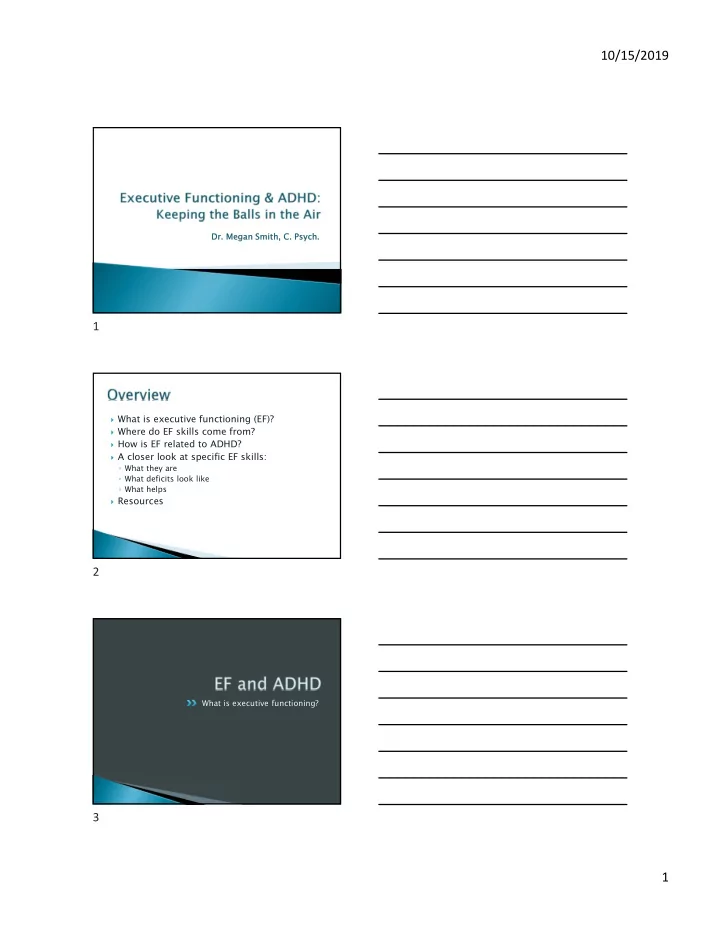
10/15/2019 Dr. M Megan an Smith, C h, C. P Psych. ych. 1 What is executive functioning (EF)? Where do EF skills come from? How is EF related to ADHD? A closer look at specific EF skills: What they are What deficits


slide-1
SLIDE 1

10/15/2019 1

  • Dr. M

Megan an Smith, C h, C. P Psych. ych.

 What is executive functioning (EF)?  Where do EF skills come from?  How is EF related to ADHD?  A closer look at specific EF skills:

  • What they are
  • What deficits look like
  • What helps

 Resources

What is executive functioning?

1 2 3

slide-2
SLIDE 2

10/15/2019 2

Executive Functioning

Self- Regulation

Inhibition Emotion Regulation Motivation Attention Shifting Working Memory

Cognitive Meta- cognitive

Planning Organization Self- Monitoring

Grou Group of

  • f n

neurolog

  • gical proc

processes th that allo allow u us to en to enga gage in in goal goal-directed beh behaviour In Initi itiate ( (star tart res resear arch) Plan ( (topic ic, p points, c conclu lusion

  • n)

Monito tor ( r (time, p e, progres ress) Mai Maintain arou arousal Sh Shift ift Ignore d re distrac ractors

  • rs

Consider t the E EF skills requi kills required by by a stud udent writ iting a g an es essay say…

4 5 6

slide-3
SLIDE 3

10/15/2019 3

Air-traffi affic c con contr troller Con Conductor

Where does executive functioning come from?

 Highly genetic – 99% heritability  Develop slowly, over time, through our early-

to-mid twenties

 Directly related to the structure and

functioning of specific parts of the brain, including specific pathways, networks, neurotransmitters, etc.

7 8 9

slide-4
SLIDE 4

10/15/2019 4

FR FRON ONTAL LOB LOBE TEM TEMPORAL LO LOBE PAR PARIETAL LO LOBE BE OCCI CCIPITAL LOB LOBE CER CEREBELL LLUM BRA BRAIN N STEM STEM LIMB LIMBIC IC SYSTEM FR FRON ONTAL LOB LOBE: Self- Self-regul ulat atio ion, a n, attentio ion, w n, work rking g memor memory, s , self lf-monit itor

  • ring ,

g , in inhibi hibition, , pla planni nning… ng… LIMBIC IC SY SYST STEM: EM: Emotions, m ns, motivati vation, r

  • n, reacti

tivi vity ( ty (e.g. f . fight/ t/fl flight)… )… PAR PARIETAL LO LOBE BE: Att Attention BRA BRAIN S STEM EM: Aro Arousal, al aler ertness

These parts of the brain have all been associated with ADHD! How is EF related to ADHD?

 Both associated with a number of specific

brain structures, neuropathways, etc.

 Many of these structures develop more

slowly in people with ADHD

  • Not coincidentally, development of EF skills is also

delayed

 Each ADHD symptom is related to one or

more executive functions!

10 11 12

slide-5
SLIDE 5

10/15/2019 5

1.

Fidgets with or taps hands or squirms in seat

2.

Leaves seat in situations when remaining seated is expected

3.

Runs about or climbs in situations where it is inappropriate feeling restless

4.

Unable to play or engage in leisure activities quietly

5.

“On the go" acting as if "driven by a motor“

6.

Talks excessively

7.

Blurts out answers before questions have been completed

8.

Has difficulty awaiting turn (e.g., while waiting in line)

9.

Interrupts or intrudes on others

Motor Activity Speech (Other) Impulses

Regulation of…

  • 1. Fails to give close attention to

details/makes careless mistakes

  • 2. Has difficulty sustaining

attention

  • 3. Does not seem to listen when

spoken to directly

  • 4. Does not follow through on

instructions and fails to finish school work, chores, or duties

  • 5. Has difficulty organizing tasks

and activities

  • 6. Avoids or is reluctant to engage

in tasks that require sustained mental effort

  • 7. Loses things necessary for tasks
  • r activities
  • 8. Easily distracted by extraneous

stimuli

  • 9. Forgetful in daily activities

Self-monitoring/ attention to detail Sustained attention/ selective attention Sustained attention/ motivation/ self- monitoring Organization/ planning Emotion regulation/ motivation Organization/ attention… Selective attention Attention/ self- monitoring/WM/planning  Like ADHD itself, EF deficits will likely be

life-long

  • Long-term scaffolding is critical for children and

adolescents with ADHD

  • With support, practice, and lots of strategies in

place, people can be highly successful and independent, as adults

 Some adults will continue to need support Ple Please se use e e extr trem eme e cauti caution if if you you find nd you yoursel elf t f thinking ng: “ : “but t ut they’r ey’re goi e going t g to have ve to le lear arn…sooner or

  • r later

later.”

13 14 15

slide-6
SLIDE 6

10/15/2019 6

Pro Problem Are Area o

  • f EF

EF:

  • Inhibitory control
  • Emotional

regulation

  • Shifting
  • Working Memory

Possible O ssible Outcom tcomes: es:

  • Behavioral dysregulation
  • Emotional dysregulation
  • Rigidity; “stubbornness”
  • Problems following rules,

routines independently Environm vironmenta ental R Responses: sponses:

  • Punishment
  • Punishment and coercion
  • Failure
  • Punishment and constant

reminders (aka nagging) Long-Term O ng-Term Outcomes: tcomes:

  • Anxiety
  • Depression
  • Anger
  • Poor relationships

A closer look at specific EF skills

We will look at each EF skill, and consider:

What the skill is What deficits in the skill might look like Strategies to support deficits in that skill

16 17 18

slide-7
SLIDE 7

10/15/2019 7

I.SELF-REGULATION

  • Mental functions required to regulation actions,

emotions, and drive

  • Gateway EF skills

 Without these skills, difficult or impossible to access other EF skills.

Inhibition

 What is it?

  • Ability to not act on impulse

 Ability to think before acting  Ability to resist a conscious (i.e. recognized) impulse

  • Test
  • Essentially, inhibition is like having good brakes
  • n your car!

 Allow you to stop or slow down, as needed

Inhibition…

 What do problems look like?

  • Think: car with malfunctioning brakes!

 No matter how hard you slam on them, you can’t stop in time

  • Inconsistent control over actions
  • Acting without awareness/conscious intent
  • Saying and doing the wrong thing at the wrong time
  • Difficulty resisting impulses; associated with compulsions
  • Difficulty following rules and social norms
  • Difficulty adapting behaviour to context
  • Often seen as annoying, inconsiderate, unempathetic, out-
  • f-control, attention-seeking…

19 20 21

slide-8
SLIDE 8

10/15/2019 8

Inhibition…

 What helps?

  • Very challenging to address
  • Imagine what would help if your brakes weren’t working
  • Predict and prevent (collaboratively)
  • Use priming: review context-specific expectations

immediately prior to entering specific situations (e.g. recess)

  • Reduce stressors
  • Teach strategies for addressing problems that arise from

impulsive actions

  • Over-practice rules, routines, strategies

 Remember that many skills are non-transferrable

  • Do not punish impulsive actions; increase supports

Emotion Regulation

 What is it?

  • Ability to influence the intensity of emotions
  • Prevent limbic system from hijacking EF processes

 Flip Your Lid by Dan Siegel

 What might problems look like?

  • Quick, strong emotional reactions
  • Difficulty using effective strategies to manage emotions
  • Poor response to attempts to help (esp. logic)
  • May escalate in response to attempts to control them
  • Difficulty coping with environmental demands (e.g.

transitions, requests, frustrations, challenges)

  • Tendency to go into “freeze, flight, or fight” mode
  • Often viewed as: sensitive, dramatic, aggressive,

immature, manipulative, moody, spoiled, etc.

Emotion Regulation…

 What helps?

  • Work with the person to identify situations that

are most likely to trigger intense emotions, and generate potential ways to cope with or avoid those triggers (collaboratively)

  • Help them practice strategies in 3 key areas:
  • 1. Self-care
  • 2. Distress tolerance (e.g. self-soothing)
  • 3. Effective communication/relationships
  • Provide co-regulation

 Recognize stress  Provide required regulation support

22 23 24

slide-9
SLIDE 9

10/15/2019 9

Motivation

 What is it?

  • Our sense of drive
  • Strongly mediated by reward pathways and

neurotransmitters; can only manipulate for so long

 What do problems look like?

  • Difficulty getting started and maintaining effort
  • Difficulty attempting challenges
  • Reduced sense of reward when goals are met
  • Easily side-tracked by short-term desires
  • Lack of ambition
  • Often viewed as lazy, apathetic, unconcerned, etc.

Motivation…

 What helps?

  • Make use of areas of interest*
  • Make things into games, wherever possible
  • Alter the environment to get dopamine pumping

 Motivating music  Frequent breaks, especially for exercise (also needs to be fun)  Build in physical releases (e.g. exercise bike-desk)

  • Alter environment to reduce other stressors

 Think of the 5 senses (unpleasant sounds, sights, smells, etc.)

  • Build self-awareness and goal-focussed thinking:

 Have person rate stress (i) thinking about task; (ii) doing task; (iii) after task is complete

  • Make use of collaborative problem-solving to address
  • ngoing areas of difficulty

 May include incentives to develop habits II.COGNITIVE SKILLS

  • Mental functions required for thinking, learning,

remembering, reasoning, etc.

25 26 27

slide-10
SLIDE 10

10/15/2019 10

Attention

 What is it?

  • Different types
  • Selective: focussing on something, to exclusion of
  • ther things
  • Sustained: maintaining selective attention over time
  • Divided: focussing on more than one thing (e.g.

listening and taking notes)

  • Alternating: will be covered separately, as shifting
  • Gateway to learning

 Test your attention skills:

  • Test

Attention …

 What do problems look like?

  • Easily distracted by: irrelevant stimuli , irrelevant details,

thoughts, sensations, emotions…almost anything

  • Difficulty focussing on unengaging tasks*
  • Increased effort leads to decreased focus
  • Difficulty maintaining focus over time
  • Miss important details; can interfere with understanding
  • Frequent oversight errors
  • May miss non-verbal cues
  • May forget important rules/customs
  • May be slow to learn new concepts
  • May frequently lose or misplace things
  • May appear unmotivated, unfocussed, inconsiderate,

careless

 Attention task

Attention…

 What helps?

  • Post clear, visible reminders of expectations,

strategies, steps, etc.

  • Make sure person is attending to you when you

speak

 Learn to recognize the “blank stare”  Ask them to tell you what you said in their own words  Check on them to make sure they are following instructions

  • Foster independence

 E.g. have person choose an app for reminders  Provide checklists for transitions and routines

  • Manage your frustration when problems re-occur

28 29 30

slide-11
SLIDE 11

10/15/2019 11

Shifting

 What is it?

  • Ability to shift focus or change course of

action

  • Allows us to adapt, be flexible, multi-task

 Verbal set-shifting task:

  • Starting with A-1, recite letters and numbers

sequentially, alternating between letters and numbers

  • But…when I say “backwards,” keep going,

but go in reverse order (e.g. B-2 A-1), and when I say “forwards,” return to doing it in forward sequence

  • Also, try not to cheat by just going along

with the crowd – I’ve seen that backfire!

Shifting

 What do problems look like?

  • Difficulty tolerating change and adapting to new

routines

  • Difficulty with transitions
  • Resistant to trying new things
  • Gets stuck on details; may be obsessive
  • Tendency to hyper-focus on engaging tasks; difficulty

stopping

  • Tendency towards “black and white” or literal thinking
  • Argumentative and/or tenacious (for better or worse)
  • Difficulty coming up with alternatives
  • Difficulty managing multiple demands
  • Distressed when expectations aren’t met
  • Difficulty seeing others’ perspectives
  • May appear stubborn, controlling, manipulative,

cheeky…

Shifting…

 What helps?

  • Warn person of changes to routine

 Not too far in advance, but with enough warning to adapt

  • Use visual schedules, discuss week/day in advance
  • Use visual timers and provide ample warning before

transitions (e.g. 10 more minutes; 5 more minutes…)

  • Teach strategies to improve shifting and flexibility
  • Pressing pause
  • Do-the-opposite
  • Brainstorm alternatives
  • Play games that require frequent shifting
  • Start small! Increase challenge slowly; track &

celebrate success

31 32 33

slide-12
SLIDE 12

10/15/2019 12

Working Memory

 What is it?

  • Ability to hold and manipulate multiple pieces
  • f information in short-term memory
  • Critical to learning, problem-solving, social

skills & decision-making

 Working memory task:

REMEMBER THESE NUMBERS:

051475

Count to 3 What were the six numbers you saw before? Now say the numbers in reverse

  • rder (i.e. backwards)

Working Memory…

 What do problems look like?

  • Difficulty following multiple directions
  • Difficulty performing tasks with multiple steps

 E.g. writing; multi-step math problems; tidying  Frequently gets lost/confused  Performs tasks more slowly, because constantly having to stop and figure out where they are in a problem/tasks

  • Can’t hold multiple ideas in mind simultaneously

 Their own thoughts/feelings, and those of someone else  Multiple possible solutions to a problem

  • Difficulty prioritizing, sequencing and organizing ideas
  • Difficulty comparing and contrasting ideas
  • Forgets important details (vs. never having noticed

them)

Working Memory…

 What helps?

  • Reduce working memory load by using

checklists (audio or pictorial for younger kids)

  • Watch for signs of WM overload

 Increased hyperactivity, restlessness, frustration

  • Decrease demands

 Base expectations on developmental age and actual outcomes, rather than chronological age  Scaffold independence for component skills!

  • Work with person to identify parts of tasks

that are most challenging and identify helpful strategies

34 35 36

slide-13
SLIDE 13

10/15/2019 13

III.Meta-Cognitive Skills

  • Essentially thinking about thinking, knowing

about knowing, and being aware of awareness

  • Cognitive skills that service an overall plan (vs.

each, individual step)

Planning

 What is it?

  • Figuring out the steps you need to take to reach

a goal (e.g. complete a task)

 What do problems look like?

  • Difficulty deciding on/prioritizing goals
  • Difficulty breaking tasks down into steps
  • Difficulty knowing what to do, and in what order
  • Difficulty getting started (procrastination)
  • Difficulty getting things done on time
  • Frequently asking for help
  • Needing frequent prompting
  • May appear helpless/dependent, irresponsible,

lazy, etc.

Planning…

 What helps?

  • Teach/scaffold component skills

 Breaking task into small parts; sequencing steps; scheduling steps  Start by doing all steps; slowly reduce support one step at a time

  • Provide tools

 Checklists, reminders (e.g. phone alarms)

  • Do not penalize for poor planning

 Engage in collaborative problem-solving, if problem is reoccurring

  • Teach/scaffold time management

 Predicting time required; creating and managing schedules; remembering to use a schedule

37 38 39

slide-14
SLIDE 14

10/15/2019 14

Organization

 What is it?

  • Two types:

 Organizing materials (e.g. knowing where to put specific things)  Organizing thoughts/ideas (e.g. having a running list of things you need to bring home after school)

 What do problems look like?

  • Don’t know where to put things or find them
  • Misplace or loses things
  • Messy personal space (including binder, locker, bedroom,

etc.)

  • Thoughts are often jumbled
  • Frequently confused and overwhelmed
  • Difficulty organizing written work
  • Class notes are difficult to follow
  • May appear irresponsible, dependent, immature, lazy,

unmotivated

Organization…

 What helps?

  • Provide organizational tools (e.g. boxes, folders,

bins, labels)

  • Help person create a system that works for

them; experiment with different approaches

  • Use checklists to help person know where to put

things

  • Label drawers, shelves, bins
  • Use colour to help aid organization
  • Teach organizational strategies for note-taking
  • Provide direct support for tasks that require
  • rganization (e.g. tidying room, cleaning out

binders/desks) Self-Monitoring

 What is it?

  • Essentially: self-directed attention

 Awareness of where you are in relation to a goal  Awareness of impact of actions on others

 What do problems look like?

  • May not realize when they’re upsetting people
  • Problems adapting to demands of specific

situations

  • Poor awareness of accuracy, speed, progress
  • Tendency to over or under-estimate

understanding, ability to remember things later, etc.

  • May appear disorganized, inconsiderate,

unempathetic, careless, slow, etc.

40 41 42

slide-15
SLIDE 15

10/15/2019 15

Self-Monitoring…

 What helps?

  • Gentle communication of information they are unaware
  • f (e.g. after trusting relationship has been established

and person doesn’t feel defensive)

  • Direct support

 Daily self-reflections; first by person themselves, and then reviewed with support of caring adult  Reminders of target skills prior to entering specific situations (e.g. remember to match the volume of your voice to that of those around you)  Tracking/recording with support (e.g. graphing)

  • Tools such as visual timers, checklists, non-verbal

prompts (e.g. vibrating bracelets, touch on shoulder)

Observ rved ed Behav haviours

  • urs

Reckless, aggressive behaviour Frequently annoying others Frequently breaking rules Stubborn/inflexible Black-and-white thinker Obsessive Day-dreamy Slow to learn Clumsy Backpack, locker and desk messy Always late Doesn’t hand in homework Forgets important dates, forms, etc. EF EF Def Deficits Area Areas Emotion regulation Inhibition Attention/self-monitoring Shifting Working memory Emotion regulation Attention Self-monitoring Organization Planning Attention Self-monitoring Observ rved ed Behav haviours

  • urs

EF Defici cits ts A Areas Lies frequently Doesn’t do as asked Doesn’t stop preferred activities when necessary Frequent arguments with peers Bossy Acts without considering others Over-reactive Sensitive Moody Avoids challenges Rarely finishes assignments Procrastinates Inhibition Emotion regulation Shifting Attention Self-monitoring Working memory Shifting Emotion regulation Shifting Inhibition Emotion regulation Motivation (i.e. drive) Attention Planning/Organization

43 44 45

slide-16
SLIDE 16

10/15/2019 16

Other Resources

  • Stuart Shanker’s books (Self-Reg and Calm, Alert and

Learning)

  • Demos to illustrate experiences of children with various

learning-related difficulties, including attention and

  • rganization: http://www.understood.org/en/tools/through-

your-childs-eyes

  • Tips on addressing EF in secondary classrooms (all areas

covered: http://www.ecragroup.com/sites/default/files/images/White %20paper%20- %20Addressing%20executive%20education%20at%20the%20Se condary%20Level%2008.11_1.pdf

  • Lost at School website – tons of resources on helping children

with skills deficits that are causing problems. Although it is geared towards kids whose deficits are impacting behaviour, it is a collaborative problem-solving strategy, therefore it will work well for any struggling child, including those with underlying EF problems – http://www.livesinthebalance.org/

46