10/26/2011 Reading 1. Craspe, T. B. and Sommer, M. A. (2008). - - PDF document

10 26 2011
SMART_READER_LITE
LIVE PREVIEW

10/26/2011 Reading 1. Craspe, T. B. and Sommer, M. A. (2008). - - PDF document

10/26/2011 Reading 1. Craspe, T. B. and Sommer, M. A. (2008). Corollary discharge across the animal kingdom. Nature Reviews Neuroscience 9, 587 600. L35. Sensory Motor Integration The Corollary Discharge in the Animal 2. Poulet, J. F. A.


slide-1
SLIDE 1

10/26/2011 1

  • L35. Sensory‐Motor Integration

The Corollary Discharge in the Animal Kingdom Kingdom

October 26, 2011

  • C. D. Hopkins

Reading

  • 1. Craspe, T. B. and Sommer, M. A. (2008). Corollary

discharge across the animal kingdom. Nature Reviews Neuroscience 9, 587‐600.

  • 2. Poulet, J. F. A. (2005). Corollary discharge inhibition

and audition in the stridulating cricket. J. Comp. g p

  • Physiol. A. 191, 979‐986.
  • 3. Poulet, J. F. and Hedwig, B. (2006). The cellular basis
  • f a corollary discharge. Science 311, 518‐22.

Sensory‐Motor Integration

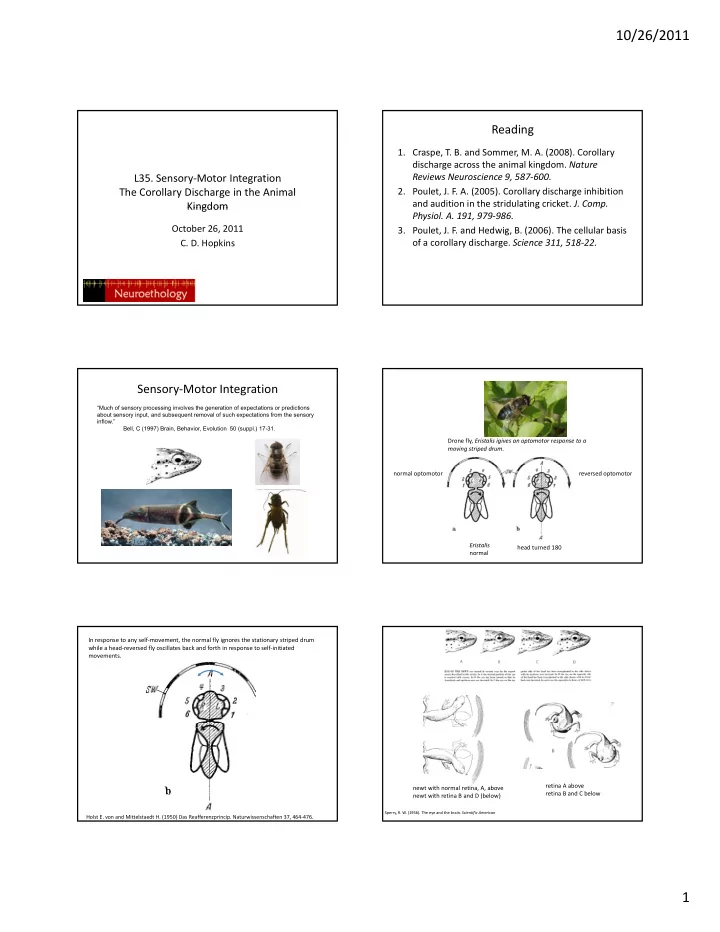
“Much of sensory processing involves the generation of expectations or predictions about sensory input, and subsequent removal of such expectations from the sensory inflow.” Bell, C (1997) Brain, Behavior, Evolution 50 (suppl.) 17-31.

Drone fly, Eristalis igives an optomotor response to a moving striped drum. Eristalis normal head turned 180 normal optomotor reversed optomotor In response to any self‐movement, the normal fly ignores the stationary striped drum while a head‐reversed fly oscillates back and forth in response to self‐initiated movements.

Holst E. von and Mittelstaedt H. (1950) Das Reafferenzprincip. Naturwissenschaften 37, 464‐476.

newt with normal retina, A, above newt with retina B and D (below) retina A above retina B and C below

Sperry, R. W. (1956). The eye and the brain. Scientific American

slide-2
SLIDE 2

10/26/2011 2

Corollary Discharge and Efference Copy

  • Erich von Holst and Horst Mittlesteadt (1950)
  • Roger Sperry (1950)

Sperry, R. W. (1950). Neural basis of the spontaneous optokinetic response produced by visual inversion. Journal of Comparative and Physiological Psychology 43:483‐489. Holst E. von and Mittelstaedt H. (1950) Das Reafferenzprincip. Naturwissenschaften 37, 464‐476.

Konrad Lorenz Erich von Holst Erich von Holst , 1908-1962

Expected Sensory Input and the Reafference Principle

  • Principle: every motor act causes

some sort of sensory response that can be used by animal to control subsequent actions.

  • Sensory feedback from motor act

can be useful ‐‐ even vital‐‐ to

  • Move eyes or head.
  • Retinal image shifts
  • Expected shift: things are

normal.

9

can be useful even vital to animal’s performance.

  • Sensory feedback that differs

from expected can be used to control subsequent action.

  • Unexpected intput: the visual

world is shifting, take action.

  • E. von Holst and H. Mittelstaedt

“The Reafference Principle: interaction between the central nervous system and periphery” (1950).

Higher brain center, Z has connections ( )

10

for both motor output (efference) and sensory responses (afferences). When a ‘motor command’ arises from a higher center, the afferent feedback is called ‘reafference’. Simultaneous with the efference, there is a second, internal, efference copy (EK). Compared to reafference, and appropriately delayed, it serves to tell whether sensory feedback is as expected. Holst E. von and Mittelstaedt H. (1950) Da;. Reafferenzprincip. Naturwissenschaften 37, 464‐476.

Reafference

11

Illustration of the Reafference Principle:

a) Reafference circuit for the control of eye movements. Zn = higher visual center Z1 = lower visual center E = efference (output to muscles) A = reafference (visual motion) a) The immobilized eye receives a command to turn the eye to the right. The eye muscles are immobilized by curare: the efference copy is present in the lower center, Z1 (a negative image of the expected reafference). The visual world appears to move to the

12

left. b) The object moves to the right; the image on the retina moves from 1 to 2 causing afference. c) The eye is passively moved to the right by exerting pressure on the eyeball. The image of object moves across retina. d) The command to move the eye to the right, causes the image to shift from 1 to 2, also causing afference, but now, it is expected. It is removed from the sensory stream in Z1.

slide-3
SLIDE 3

10/26/2011 3

this one is incorrect http://www.urllabs.com/wad/ia/corollar/corollar.htm Using von Holst and Mittelstaedt’s terminology: Efference: output (motor) Afference: input (sensory) Exafference: sensory response to events in the environment. Reafference: sensory response resulting from animal’s own movements. Efference copy: a copy of the motor efference, sent to the sensory system. When efference copy is added to reafference, the result is zero. Any left over sensation must be exafference.

Craspe, T. B. and Sommer, M. A. (2008). Corollary discharge across the animal kingdom. Nature Reviews Neuroscience 9, 587‐600. Craspe, T. B. and Sommer, M. A. (2008). Corollary discharge across the animal kingdom. Nature Reviews Neuroscience 9, 587‐600.

Classification scheme for Corollary Discharges

invertebrate examples only in vertebrates

Crayfish Escape Response

slide-4
SLIDE 4

10/26/2011 4

Cricket Stridulation

James Poulet and Berthold Hedwig: Corollary discharge maintains auditory sensitivity during sound production in crickets.

Cricket Gryllus bimaculatus

Omega Neuron 1 (ON1) responds to continuous sounds except when stridulating silent singing; no sound production stimulus sounds during fictive singing (nerve roots between ganglia and sense organs and muscles are cut) mesothoracic ganglia stimulus sounds

inhibition is from motor program, not from some

  • ther sensory feedback

during fictive singing ON1 receives inhibition Mesothoracic ganglion motor behavior

What about the primary afferent neuron? Is the afferent nerve silent during singing?

Record from auditory afferents near the terminals

  • n ON1.

Afferents respond in phase with sound. Soft sounds give primary afferent depolarizations (PAD) (arrow). In response the silent singing (one wing), there are Primary Afferent Depolarizations in synchrony with the moving wing (no sound). For silent singing afferent does not generate spikes as before. N t th i Note the primary afferent depolarizations (PAD). Timing of PADs is similar to timing of IPSPs in ON1.

slide-5
SLIDE 5

10/26/2011 5

No inhibition or excitation from PADs. Response to sound is normal during silent

The primary afferent from the ear is not silenced by these PADs, nor is it excited.

wing movements. PAD during fictive singing

Even after removal of the ears, the PAD is present in the auditory afferent.

even get PAD if ears are removed. Conclusion: primary afferent depolarizations are a type of pre- synaptic inhibition

How effective is the inhibition of ON1 (post synaptic and pre-synaptic)

During silent singing, chirps presented to cricket at typical volume. Note decrement during motor action. soft sounds evoke spikes loud, then soft, shows that loud sounds cause ON1 to adapt, not respond to soft sounds. hyperpolarize during loud prevents spiking, and prevents adaptation.

Conclusion:

In cricket, motor output is accompanied by a corollary discharge which interacts with primary acoustic afferents, and with Omega neuron 1. Both inputs inhibit the response to sound, reducing the response t th l d d to the loud sound. The overall effect is to prevent over-stimulation, thereby maintaining sensitivity.

Corollary Discharge Interneuron CDI Record from auditory neurons in prothoracic ganglion and from interneurons in mesothoracic (CPG for song). CDI: extensive projection throughout CNS

  • - cell body and dendrites in Meso., can

get input from CPG

  • - prothroracic dendrites overlap auditory

inputs

  • - other terminals – interaction with other

sensory inputs consequent on singing.

Poulet, J. F . and Hedwig, B. (2006). The cellular basis of a corollary discharge. Science 311, 518-22.

slide-6
SLIDE 6

10/26/2011 6

CDI during motor output

CDI fires during singing PSTH corresponds to wing closure (sound phase)

CDI is not part of CPG

phase response, Q = duration of

  • ngoing chirp period N/dur

. chirp period N+1

CDI is inhibited during flight stimulated by song production CDI is unresponsive to sounds

slide-7
SLIDE 7

10/26/2011 7

Conclusions

In the cricket, an efferent signal works at two levels in the auditory system Pre-synaptic inhibition by PAD's in the afferent auditory terminal Post-synaptic inhibition by IPSP's in ON1 The efferent signal is a corollary discharge because it is generated in the nervous system and it's strength is independent of sound production The corollary discharge corresponds closely in timing to sound production Corollary discharges effectively reduce desensitization

Mormyrid electric fish produce an ‘electro-motor’ command, and receive a electrosensory response as a consequence.

40

EODc

41

XU-FRIEDMAN, M. A. & HOPKINS, C. D., 1999.- J. Exp. Biol., 202:1311-1318. FRIEDMAN, M.A. & HOPKINS, C.D. 1998 – J. Neurosci.18:1171-1185.

EODc

Knollenorgans blank inputs by inhibition

  • -Primary afferent (blue)

terminates on nELL cell (yellow) with

  • -large calyx-like

synapses (electrotonic).

  • -fibers from EOD

command (eocd)

EOD command ipsp in nELL cell afferent 42

command (eocd) produce spikes that arrive at same time that EOD would be fired.

  • -sharp inhibition

IPSP blocks spike at the time when EOD is expected

  • - removes expected

EOD

EOD

command

slide-8
SLIDE 8

10/26/2011 8

x

43

Bell, CC (1982) EOD command

44

EOD command

45

Summary

  • 1. Sensory systems work to maintain

homeostasis, through reflex arcs.

  • 2. To overcome homeostasis, sensory response

must be inhibited during movement.

46

  • 3. Sensory systems respond to movement, but

the responses are “expected”.

  • 4. If brief (saccades) expected responses may be

inhibited (blanked). If longer lasting, expected response may be subtracted using “efference copy”.

References

Bell, C. C. (1981). An efference copy which is modified by reafferent input. Science 214, 450‐ 53. Bell, C. C. (1982). Properties of a modifiable efference copy in an electric fish. J Neurophysiol 47, 1043‐56. Bell, C. C. (1986). Duration of plastic change in a modifiable efference copy. Brain Res 369, 29‐ 36. Craspe, T. B. and Sommer, M. A. (2008). Corollary discharge across the animal kingdom. Nature Reviews Neuroscience 9, 587‐600. Holst, E. v. and Mittelstaedt, H. (1950). Das Reafferenzprincip. Naturvissenschaften 37, 464‐ 476. Poulet, J. F. A. and Hedwig, B. (2003). Corollary discharge inhibition of ascending auditory neurons in the stridulating cricket. Journal of Neuroscience 23, 4717‐4725. Poulet, J. F. & Hedwig, B. New insights into corollary discharges mediated by identified neural

  • pathways. Trends Neurosci. 30, 14–21 (2007).

Solis, M. M., Brainard, M. S., Hessler, N. A. and Doupe, A. J. (2000). Song selectivity and sensorimotor signals in vocal learning and production. Proc Natl Acad Sci U S A 97, 11836‐42. Sperry, R. W. (1950). Neural basis of the spontaneous optokinetic response produced by visual

  • inversion. . Journal of Comparative and Physiological Psychology 42, 483‐489.

Sperry, R. W. (1956). The eye and the brain. . Scientific American.