10/8/20 Armor Up, Armor Down: What this about and who we are The - - PDF document

10 8 20
SMART_READER_LITE
LIVE PREVIEW

10/8/20 Armor Up, Armor Down: What this about and who we are The - - PDF document

10/8/20 Armor Up, Armor Down: What this about and who we are The Inner Life of Cops, Firefighters and Medics Se Sessi ssion I: : Much Mo More Than a Job or Career Offer a different perspective Connect people who care about first


slide-1
SLIDE 1

10/8/20 1

Armor Up, Armor Down: The Inner Life of Cops, Firefighters and Medics

Se Sessi ssion I: : Much Mo More Than a Job or Career

When we are no longer able to change a situation – we are challenged to change ourselves.

  • Viktor E. Frankl

Matthew Domyancic, M.A. John Becknell, Ph.D., Jim Clarke, M.A., M.Div., Ph.D.

What this about and who we are

  • Offer a different perspective
  • Connect people who care about first responders and their lives
  • Reframe first responder work as a life path
  • Offer practical suggestions

Setting and approach

  • Difficult times for first responder
  • Our approach this
  • Experience
  • Study and research
  • Lived experience

Current framing of the experience

Incomplete

  • Society –heroes and villains
  • Psychology – risk of psychopathology
  • First responder – just a job and career

The actual experience

  • Most will not break down
  • The greatest stressors are not big events
  • Many start the work with high hopes but settle for a job or career
  • Rather than adding to their lives, first responder work subtracts from

their lives

  • First responders that thrive
  • A balanced, positive, grounded land vibrant inner life

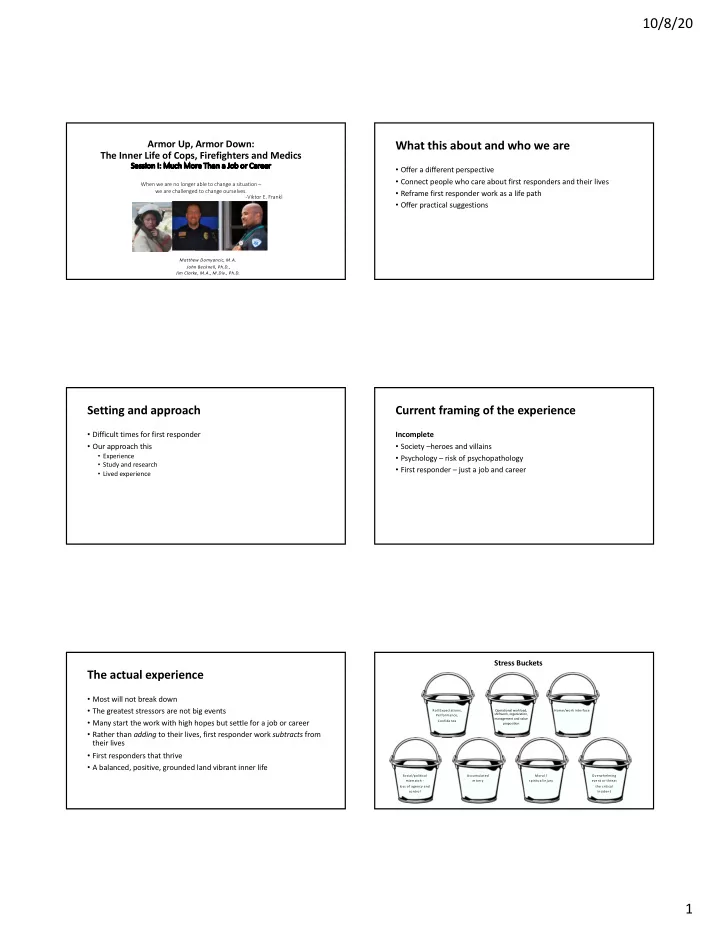
Roll Expectations, Performance, Confidence Operational workload, shiftwork, organization, management and value proposition Home/work interface Social/political mismatch - loss of agency and control Accumulated misery Moral / spiritual injury Overwhelming event or threat the critical Incident

Stress Buckets

slide-2
SLIDE 2

10/8/20 2

Some terms

  • Living well, wellbeing
  • Inner life
  • Life path
  • Spiritual life.

Those that thrive over time

  • Come from all environments, departments, age groups, lifestyles,

faiths

  • Described their experiences in a variety of ways but share

commonalities:

  • Deep respect for the role and work
  • Recognize the emotional, psychological and spiritual demands
  • Have an proactive relationship with adversity
  • Prioritize wellbeing and have a vibrant inner life path

Six areas of focus, work, learning

  • 1. Armor up and armor down
  • 2. Prioritize equanimity and calm
  • 3. Create a deep friendship with the self
  • 4. Cultivate and tend nutritious relationships with
  • thers
  • 5. Hold, carry and transform heartbreak
  • 6. Claim a personal and collective life narrative

Questions

  • October 15: "Working on the Friendship with

Yourself"

  • October 22: "Rocking with Adversity"
  • October 29: "Rediscovering and Cultivating Calm"

Matthew Domyancic matt.domyancic@globalassociates.org John Becknell. jmbecknell@gmail.com Jim Clarke. jimclarke@la-archdiocese.org

Emotional, psychological, spiritual demands

  • Willingly enter an occupation of high risk, high stress and high

responsibility;

  • Accept responsibility for others life, safety and health (including strangers);
  • Imagine, plan and prepare for the worst;
  • Suspend the natural priority of self-preservation;
  • Operate calmly amid extreme stress;
  • Cultivate psychological toughness;
  • Override strong emotions;
  • Normalize high levels of stress;
  • Cultivate high levels of vigilance;
slide-3
SLIDE 3

10/8/20 3

Emotional, psychological, spiritual demands

  • Develop finely tuned bullshit detector and always leave it on;
  • Display tolerance, kindness, concern, understanding, compassion and competence while

psychologically armored up;

  • Preference cognitive empathy over affective empathy;
  • Accept the necessity of violence and be willing to use violence;
  • Absorb and carry potentially distressing images, experiences and memories;
  • Regularly confront mortality;
  • Bear witness to society’s ills;
  • Observe, experience and participate in events that result in a sense of guilt and shame (even if

there is no logical connection between the event and feeling);

  • Wrestle with moral paradox;
  • Be self-reliant in extreme circumstances; and
  • Be subject to a society that sees the role of warrior rescuer as either heroic or the fodder for

breakdown or chooses not to see at all.