10. Repetition Binary Search Trees and Disadvantages of hashing: - - PowerPoint PPT Presentation

10 repetition binary search trees and
SMART_READER_LITE
LIVE PREVIEW

10. Repetition Binary Search Trees and Disadvantages of hashing: - - PowerPoint PPT Presentation

Dictionary implementation Hashing: implementation of dictionaries with expected very fast access times. 10. Repetition Binary Search Trees and Disadvantages of hashing: linear access time in worst case. Some Heaps operations not supported at


slide-1
SLIDE 1
  • 10. Repetition Binary Search Trees and

Heaps

[Ottman/Widmayer, Kap. 2.3, 5.1, Cormen et al, Kap. 6, 12.1 - 12.3]

199

Dictionary implementation

Hashing: implementation of dictionaries with expected very fast access times. Disadvantages of hashing: linear access time in worst case. Some

  • perations not supported at all:

enumerate keys in increasing order next smallest key to given key

200

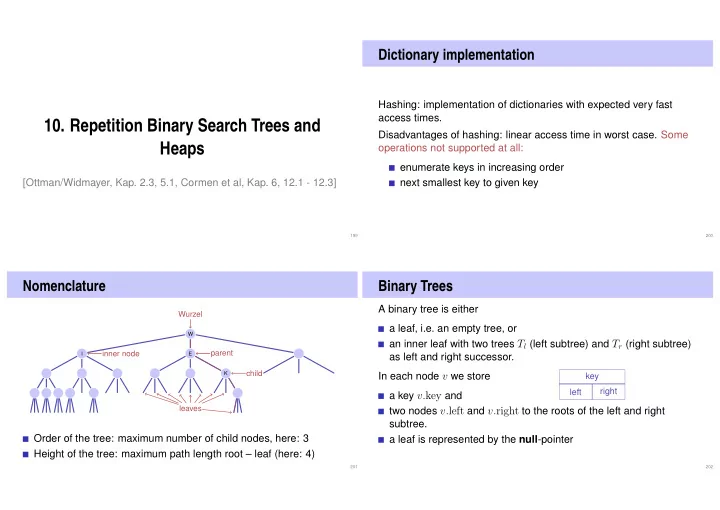
Nomenclature

Wurzel

W I E K

parent child inner node leaves

Order of the tree: maximum number of child nodes, here: 3 Height of the tree: maximum path length root – leaf (here: 4)

201

Binary Trees

A binary tree is either a leaf, i.e. an empty tree, or an inner leaf with two trees Tl (left subtree) and Tr (right subtree) as left and right successor. In each node v we store a key v.key and two nodes v.left and v.right to the roots of the left and right subtree. a leaf is represented by the null-pointer

key left right

202

slide-2
SLIDE 2

Baumknoten in Java

public class SearchNode { int key; SearchNode left; SearchNode right; SearchNode(int k){ key = k; left = right = null; } } 5 3 8 2 null null null null null

SearchNode key (type int) left (type SearchNode) right (type SearchNode)

203

Baumknoten in Python

class SearchNode: def __init__(self, k, l=None, r=None): self.key = k self.left, self.right = l, r self.flagged = False 5 3 8 2 None None None None None

SearchNode key left right

204

Binary search tree

A binary search tree is a binary tree that fulfils the search tree property: Every node v stores a key Keys in left subtree v.left are smaller than v.key Keys in right subtree v.right are greater than v.key

16 7 5 2 10 9 15 18 17 30 99

205

Searching

Input: Binary search tree with root r, key k Output: Node v with v.key = k or null v ← r while v = null do if k = v.key then return v else if k < v.key then v ← v.left else v ← v.right return null

8 4 13 10 9 19

Search (12) → null

206

slide-3
SLIDE 3

Insertion of a key

Insertion of the key k Search for k If successful search: output error No success: replace the reached leaf by a new node with key

8 4 5 13 10 9 19

Insert (5)

207

Remove node

Three cases possible: Node has no children Node has one child Node has two children

[Leaves do not count here] 8 3 5 4 13 10 9 19

208

Remove node

Node has no children Simple case: replace node by leaf.

8 3 5 4 13 10 9 19

remove(4)

− →

8 3 5 13 10 9 19

209

Remove node

Node has one child Also simple: replace node by single child.

8 3 5 4 13 10 9 19

remove(3)

− →

8 5 4 13 10 9 19

210

slide-4
SLIDE 4

Remove node

Node has two children The following observation helps: the smallest key in the right subtree v.right (the symmetric successor of v) is smaller than all keys in v.right is greater than all keys in v.left and cannot have a left child. Solution: replace v by its symmetric suc- cessor.

8 3 5 4 13 10 9 19

211

By symmetry...

Node has two children Also possible: replace v by its symmetric predecessor.

8 3 5 4 13 10 9 19

212

Algorithm SymmetricSuccessor(v)

Input: Node v of a binary search tree. Output: Symmetric successor of v w ← v.right x ← w.left while x = null do w ← x x ← x.left return w

213

Traversal possibilities

preorder: v, then Tleft(v), then

Tright(v).

8, 3, 5, 4, 13, 10, 9, 19 postorder: Tleft(v), then Tright(v), then

v.

4, 5, 3, 9, 10, 19, 13, 8 inorder: Tleft(v), then v, then Tright(v). 3, 4, 5, 8, 9, 10, 13, 19

8 3 5 4 13 10 9 19

214

slide-5
SLIDE 5

Height of a tree

The height h(T) of a tree T with root r is given by

h(r) =

  • if r = null

1 + max{h(r.left), h(r.right)}

  • therwise.

The worst case run time of the search is thus O(h(T))

215

Analysis

Search, Insertion and Deletion of an element v from a tree T requires O(h(T)) fundamental steps in the worst case.

216

Possible Heights

1 The maximal height hn of a tree with n inner nodes is given with

h1 = 1 and hn+1 ≤ 1 + hn by hn ≥ n.

2 The minimal height hn of an (ideally balanced) tree with n inner

nodes fulfils n ≤ h−1

i=0 2i = 2h − 1.

Thus

⌈log2(n + 1)⌉ ≤ h ≤ n

217

Further supported operations

Min(T): Read-out minimal value in

O(h)

ExtractMin(T): Read-out and remove minimal value in O(h) List(T): Output the sorted list of elements Join(T1, T2): Merge two trees with

max(T1) < min(T2) in O(n).

8 3 5 4 13 10 9 19

218

slide-6
SLIDE 6

Degenerated search trees

9 5 4 8 13 10 19

Insert 9,5,13,4,8,10,19

ideally balanced

4 5 8 9 10 13 19

Insert 4,5,8,9,10,13,19

linear list

19 13 10 9 8 5 4

Insert 19,13,10,9,8,5,4

linear list

219

[Probabilistically]

A search tree constructed from a random sequence of numbers provides an an expected path length of O(log n). Attention: this only holds for insertions. If the tree is constructed by random insertions and deletions, the expected path length is O(√n). Balanced trees make sure (e.g. with rotations) during insertion or deletion that the tree stays balanced and provide a O(log n) Worst-case guarantee.

(not shown in class) 220

[Max-]Heap8

Binary tree with the following prop- erties

1 complete up to the lowest

level

2 Gaps (if any) of the tree in

the last level to the right

3 Heap-Condition:

Max-(Min-)Heap: key of a child smaller (greater) that that of the parent node

root

22 20 16 3 2 12 8 11 18 15 14 17

parent child

8Heap(data structure), not: as in “heap and stack” (memory allocation) 221

Heap and Array

Tree → Array: children(i) = {2i, 2i + 1} parent(i) = ⌊i/2⌋

22 1 20 2 18 3 16 4 12 5 15 6 17 7 3 8 2 9 8 10 11 11 14 12

parent Children

22 20 16 3 2 12 8 11 18 15 14 17 [1] [2] [3] [4] [5] [6] [7] [8] [9] [10] [11] [12]

Depends on the starting index9

9For array that start at 0: {2i, 2i + 1} → {2i + 1, 2i + 2}, ⌊i/2⌋ → ⌊(i − 1)/2⌋ 222

slide-7
SLIDE 7

Height of a Heap

A complete binary tree with height10 h provides

1 + 2 + 4 + 8 + ... + 2h−1 =

h−1

  • i=0

2i = 2h − 1

  • nodes. Thus for a heap with height h:

2h−1 − 1 < n ≤ 2h − 1 ⇔ 2h−1 < n + 1 ≤ 2h

Particularly h(n) = ⌈log2(n + 1)⌉ and h(n) ∈ Θ(log n).

10here: number of edges from the root to a leaf 223

Insert

Insert new element at the first free

  • position. Potentially violates the heap

property. Reestablish heap property: climb successively Worst case number of operations:

O(log n)

22 20 16 3 2 12 8 11 18 15 14 17 22 20 16 3 2 12 8 11 21 18 14 15 17

224

Remove the maximum

Replace the maximum by the lower right element Reestablish heap property: sift down successively (in the direction of the greater child) Worst case number of operations:

O(log n)

21 20 16 3 2 12 8 11 18 15 14 17 20 16 14 3 2 12 8 11 18 15 17

225

Algorithm SiftDown(A, i, m)

Input: Array A with heap structure for the children of i. Last element m. Output: Array A with heap structure for i with last element m. while 2i ≤ m do j ← 2i; // j left child if j < m and A[j] < A[j + 1] then j ← j + 1; // j right child with greater key if A[i] < A[j] then swap(A[i], A[j]) i ← j; // keep sinking down else i ← m; // sift down finished

226

slide-8
SLIDE 8

Sort heap

A[1, ..., n] is a Heap.

While n > 1 swap(A[1], A[n]) SiftDown(A, 1, n − 1);

n ← n − 1

7 6 4 5 1 2

swap

2 6 4 5 1 7

siftDown

6 5 4 2 1 7

swap

1 5 4 2 6 7

siftDown

5 4 2 1 6 7

swap

1 4 2 5 6 7

siftDown

4 1 2 5 6 7

swap

2 1 4 5 6 7

siftDown

2 1 4 5 6 7

swap

1 2 4 5 6 7

227

Heap creation

Observation: Every leaf of a heap is trivially a correct heap. Consequence: Induction from below!

228

Algorithm HeapSort(A, n)

Input: Array A with length n. Output: A sorted. // Build the heap. for i ← n/2 downto 1 do SiftDown(A, i, n); // Now A is a heap. for i ← n downto 2 do swap(A[1], A[i]) SiftDown(A, 1, i − 1) // Now A is sorted.

229

Analysis: sorting a heap

SiftDown traverses at most log n nodes. For each node 2 key

  • comparisons. ⇒ sorting a heap costs in the worst case 2 log n

comparisons. Number of memory movements of sorting a heap also O(n log n).

230

slide-9
SLIDE 9

[Analysis: creating a heap]

Calls to siftDown: n/2. Thus number of comparisons and movements: v(n) ∈ O(n log n). But mean length of the sift-down paths is much smaller:

v(n) =

⌊log n⌋

  • l=0

2l

  • number heaps on level l

· (⌊log n⌋ − l)

  • height heaps on level l

=

⌊log n⌋

  • k=0

2⌊log n⌋−k · k ≤

⌊log n⌋

  • k=0

n 2k · k = n ·

⌊log n⌋

  • k=0

k 2k ∈ O(n)

with s(x) := ∞

k=0 kxk = x (1−x)2

(0 < x < 1) 11 and s( 1

2) = 2

11f(x) = 1 1−x = 1 + x + x2... ⇒ f′(x) = 1 (1−x)2 = 1 + 2x + ... (not shown in class) 231

  • 11. AVL Trees

Balanced Trees [Ottman/Widmayer, Kap. 5.2-5.2.1, Cormen et al,

  • Kap. Problem 13-3]

232

Objective

Searching, insertion and removal of a key in a tree generated from n keys inserted in random order takes expected number of steps

O(log2 n).

But worst case Θ(n) (degenerated tree). Goal: avoidance of degeneration. Artificial balancing of the tree for each update-operation of a tree. Balancing: guarantee that a tree with n nodes always has a height of

O(log n).

Adelson-Venskii and Landis (1962): AVL-Trees

233

Balance of a node

The height balance of a node v is de- fined as the height difference of its sub-trees Tl(v) and Tr(v)

bal(v) := h(Tr(v)) − h(Tl(v)) v Tl(v) Tr(v) hl hr

bal(v)

234

slide-10
SLIDE 10

AVL Condition

AVL Condition: for eacn node v of a tree bal(v) ∈ {−1, 0, 1}

v Tl(v) Tr(v)

h h + 1 h + 2

235

(Counter-)Examples

AVL tree with height 2 AVL tree with height 3 No AVL tree

236

Number of Leaves

  • 1. observation: a binary search tree with n keys provides exactly

n + 1 leaves. Simple induction argument.

The binary search tree with n = 0 keys has m = 1 leaves When a key is added (n → n + 1), then it replaces a leaf and adds two new leafs (m → m − 1 + 2 = m + 1).

  • 2. observation: a lower bound of the number of leaves in a search

tree with given height implies an upper bound of the height of a search tree with given number of keys.

237

Lower bound of the leaves

AVL tree with height 1 has

N(1) := 2 leaves.

AVL tree with height 2 has at least N(2) := 3 leaves.

238

slide-11
SLIDE 11

Lower bound of the leaves for h > 2

Height of one subtree ≥ h − 1. Height of the other subtree ≥ h − 2. Minimal number of leaves N(h) is

N(h) = N(h − 1) + N(h − 2) v Tl(v) Tr(v)

h − 2 h − 1 h

Overal we have N(h) = Fh+2 with Fibonacci-numbers F0 := 0,

F1 := 1, Fn := Fn−1 + Fn−2 for n > 1.

239

Fibonacci Numbers, closed Form

It holds that

Fi = 1 √ 5(φi − ˆ φi)

with the roots φ, ˆ

φ of the golden ratio equation x2 − x − 1 = 0: φ = 1 + √ 5 2 ≈ 1.618 ˆ φ = 1 − √ 5 2 ≈ −0.618

240

[Fibonacci Numbers, Inductive Proof]

Fi

!

=

1 √ 5(φi − ˆ

φi) [∗]

  • φ = 1+

√ 5 2

, ˆ φ = 1−

√ 5 2

  • .

1

Immediate for i = 0, i = 1.

2

Let i > 2 and claim [∗] true for all Fj, j < i.

Fi

def

= Fi−1 + Fi−2

[∗]

= 1 √ 5(φi−1 − ˆ φi−1) + 1 √ 5(φi−2 − ˆ φi−2) = 1 √ 5(φi−1 + φi−2) − 1 √ 5(ˆ φi−1 + ˆ φi−2) = 1 √ 5φi−2(φ + 1) − 1 √ 5 ˆ φi−2(ˆ φ + 1)

(φ, ˆ

φ fulfil x + 1 = x2) = 1 √ 5φi−2(φ2) − 1 √ 5 ˆ φi−2(ˆ φ2) = 1 √ 5(φi − ˆ φi).

(not shown in class) 241

Tree Height

Because |ˆ

φ| < 1, overal we have

N(h) ∈ Θ  

  • 1 +

√ 5 2 h  ⊆ Ω(1.618h)

and thus

N(h) ≥ c · 1.618h ⇒ h ≤ 1.44 log2 n + c′.

An AVL tree is asymptotically not more than 44% higher than a perfectly balanced tree.12

12The perfectly balanced tree has a height of ⌈log2 n + 1⌉ 242

slide-12
SLIDE 12

Insertion

Balance Keep the balance stored in each node Re-balance the tree in each update-operation New node n is inserted: Insert the node as for a search tree. Check the balance condition increasing from n to the root.

243

Balance at Insertion Point

= ⇒

+1 p p n

case 1: bal(p) = +1

= ⇒

−1 p p n

case 2: bal(p) = −1 Finished in both cases because the subtree height did not change

244

Balance at Insertion Point

= ⇒

+1 p p n

case 3.1: bal(p) = 0 right

= ⇒

−1 p p n

case 3.2: bal(p) = 0, left Not finished in both case. Call of upin(p)

245

upin(p) - invariant

When upin(p) is called it holds that the subtree from p is grown and

bal(p) ∈ {−1, +1}

246

slide-13
SLIDE 13

upin(p)

Assumption: p is left son of pp13

= ⇒

pp +1 pp p p

case 1: bal(pp) = +1, done.

= ⇒

pp pp −1 p p

case 2: bal(pp) = 0, upin(pp) In both cases the AVL-Condition holds for the subtree from pp

13If p is a right son: symmetric cases with exchange of +1 and −1 247

upin(p)

Assumption: p is left son of pp

pp −1 p

case 3: bal(pp) = −1, This case is problematic: adding n to the subtree from pp has violated the AVL-condition. Re-balance! Two cases bal(p) = −1, bal(p) = +1

248

Rotations

case 1.1 bal(p) = −1. 14

y x

t1 t2 t3

pp −2 p −1 h h − 1 h − 1 h + 2 h

= ⇒

rotation right

x y

t1 t2 t3

pp p h h − 1 h − 1 h + 1 h + 1

14p right son: ⇒ bal(pp) = bal(p) = +1, left rotation 249

Rotations

case 1.1 bal(p) = −1. 15

z x y

t1 t2 t3 t4

pp −2 p +1 h −1/ + 1 h − 1 h − 1 h − 2 h − 2 h − 1 h − 1 h + 2 h

= ⇒

double rotation left-right

y x z

t1 t2 t3 t4

pp 0/ − 1 +1/0 h − 1 h − 1 h − 2 h − 2 h − 1 h − 1 h + 1

15p right son ⇒ bal(pp) = +1, bal(p) = −1, double rotation right left 250

slide-14
SLIDE 14

Analysis

Tree height: O(log n). Insertion like in binary search tree. Balancing via recursion from node to the root. Maximal path lenght O(log n). Insertion in an AVL-tree provides run time costs of O(log n).

251

Deletion

Case 1: Children of node n are both leaves Let p be parent node of

  • n. ⇒ Other subtree has height h′ = 0, 1 or 2.

h′ = 1: Adapt bal(p). h′ = 0: Adapt bal(p). Call upout(p). h′ = 2: Rebalanciere des Teilbaumes. Call upout(p).

p n h = 0, 1, 2

− →

p h = 0, 1, 2

252

Deletion

Case 2: one child k of node n is an inner node Replace n by k. upout(k)

p n k

− →

p k

253

Deletion

Case 3: both children of node n are inner nodes Replace n by symmetric successor. upout(k) Deletion of the symmetric successor is as in case 1 or 2.

254

slide-15
SLIDE 15

upout(p)

Let pp be the parent node of p. (a) p left child of pp

1 bal(pp) = −1 ⇒ bal(pp) ← 0. upout(pp) 2 bal(pp) = 0 ⇒ bal(pp) ← +1. 3 bal(pp) = +1 ⇒ next slides.

(b) p right child of pp: Symmetric cases exchanging +1 and −1.

255

upout(p)

Case (a).3: bal(pp) = +1. Let q be brother of p (a).3.1: bal(q) = 0.16

y

pp +1

x

p

z

q

1 2 3 4

h − 1 h − 1 h + 1 h + 1

= ⇒

Left Rotate(y)

z

−1

y

+1

x 1 2 3 4

h − 1 h − 1 h + 1 h + 1

16(b).3.1: bal(pp) = −1, bal(q) = −1, Right rotation 256

upout(p)

Case (a).3: bal(pp) = +1. (a).3.2: bal(q) = +1.17

y

pp +1

x

p

z

q +1

1 2 3 4

h − 1 h − 1 h h + 1

= ⇒

Left Rotate(y)

z

r

y x 1 2 3 4

h − 1 h − 1 h h + 1

plus upout(r).

17(b).3.2: bal(pp) = −1, bal(q) = +1, Right rotation+upout 257

upout(p)

Case (a).3: bal(pp) = +1. (a).3.3: bal(q) = −1.18

y

pp +1

x

p

z

q −1

w 1 2 3 4 5

h − 1 h − 1 h

= ⇒

Rotate right (z) left (y)

w

r

y x z 1 2 3 4 5

h − 1 h − 1 h

plus upout(r).

18(b).3.3: bal(pp) = −1, bal(q) = −1, left-right rotation + upout 258

slide-16
SLIDE 16

Conclusion

AVL trees have worst-case asymptotic runtimes of O(log n) for searching, insertion and deletion of keys. Insertion and deletion is relatively involved and an overkill for really small problems.

259