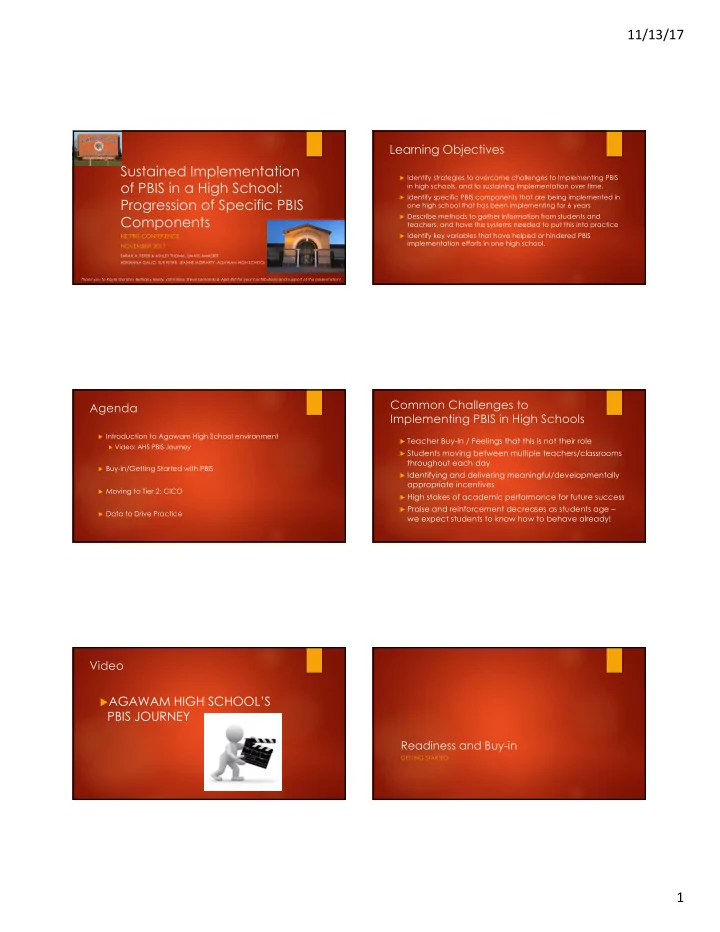
11/13/17 Learning Objectives Sustained Implementation u Identify - - PDF document

11 13 17
SMART_READER_LITE
LIVE PREVIEW

11/13/17 Learning Objectives Sustained Implementation u Identify - - PDF document

11/13/17 Learning Objectives Sustained Implementation u Identify strategies to overcome challenges to implementing PBIS of PBIS in a High School: in high schools, and to sustaining implementation over time. u Identify specific PBIS components


slide-1
SLIDE 1

11/13/17 1

Sustained Implementation

  • f PBIS in a High School:

Progression of Specific PBIS Components

NE PBIS CONFERENCE NOVEMBER 2017

SARAH A. FEFER & ASHLEY THOMA, UMASS AMHERST ADRIANNA GALLO, SUE FEYRE, JEANNE MORIARTY, AGAWAM HIGH SCHOOL Thank you to Kayla Gordon, Bethany Healy, John Elias, Steve Lemanski,& April Rist for your contributions and support of this presentation!

Learning Objectives

u Identify strategies to overcome challenges to implementing PBIS

in high schools, and to sustaining implementation over time.

u Identify specific PBIS components that are being implemented in

  • ne high school that has been implementing for 6 years

u Describe methods to gather information from students and

teachers, and have the systems needed to put this into practice

u Identify key variables that have helped or hindered PBIS

implementation efforts in one high school.

Agenda

u Introduction to Agawam High School environment u Video: AHS PBIS Journey u Buy-in/Getting Started with PBIS u Moving to Tier 2: CICO u Data to Drive Practice

Common Challenges to Implementing PBIS in High Schools

u Teacher Buy-In / Feelings that this is not their role u Students moving between multiple teachers/classrooms

throughout each day

u Identifying and delivering meaningful/developmentally

appropriate incentives

u High stakes of academic performance for future success u Praise and reinforcement decreases as students age –

we expect students to know how to behave already!

Video

uAGAWAM HIGH SCHOOL’S

PBIS JOURNEY

Readiness and Buy-in

GETTING STARTED

slide-2
SLIDE 2

11/13/17 2

Beginning Stages

u In 2005 principal went to PBIS conference and could not see it

being applicable to high school

u Marked the start of PBIS at elementary schools, then later to secondary

schools u AHS was making strides to improve the culture by training

faculty in Capturing Kids Hearts, which targeted student- teacher relationships and set the tone for PBIS implementation

u https://flippengroup.com/education/capturing-kids-hearts-1/

Strategic Planning for Buy-In

u In 2012, AHS received 3-day training from PBIS technical

assistance staff and completed initial PBIS assessment

u Preparing for NEASC visit by establishing a mission statement

and developing academic/social/civic expectations

u PBIS was not presented as a new initiative/not called PBIS

Getting Started

u AHS then worked on having expectations become a part of

the community by making them visible in the building and created monthly raffles to provide recognition/reinforcement

u Discipline form updated to reference the expectations/core

values which gave more exposure to these expectations for staff and students

uPrevention efforts were also encouraged (3:1 ratio) u Each year small steps toward full PBIS implementation

have been taken – slow and steady wins the race J

MOVING TO TIER 2

GLOWS AND GROWS OF CICO

Getting started with CICO

u Team completed TFI in and was pleasantly surprised by how many

Tier 2/Tier 3 components were in place in Feb 2015

u Framed CICO as one additional strategy to add to current practices u Piloted a small number of students in Spring 2015 u In Fall 2015 CICO continued with small pilot sample and added

students referred from the Junior High

Systems to Support CICO

u Importance of informing teachers about CICO

became clear early on and required ongoing collaboration and problem solving

u CICO supported by administration

uTeachers are incentivized to serve as

coordinators/mentors by having CICO responsibilities as their assigned duty

slide-3
SLIDE 3

11/13/17 3

Current CICO Practices

u Two teachers coordinate CICO and actively recruit

volunteer mentors who students have indicated having a relationship with

u Google doc is used so that students do not have to

carry the forms, and to collect/evaluate/share data in

  • ngoing way

u 4 questions that align with 6 expectations/core values u Large amount of time was spent discussing how to

make the incentives relevant for their age group

u Timing, access, and preferred items

CICO Supporting Documents

u Drafted letter for parents, checklist for coordinator, specific

referral form and methods for teachers to document what’s already been tried, description of CICO for all teachers, and task list and description of responsibilities for any teacher who needs to enter data

u For example:

CICO Barriers

u Faculty buy-in to serve as mentors

uBalance between prioritizing student preferences and

faculty volunteers

u Consistency of data entry

uCurrently problem solving around inconsistent data

entry from teachers

PBIS Data

ONGOING CONSIDERATION OF DATA SOURCES AS A KEY TO SUSTAINABILITY

Data Success Team

u Meets regularly to asses data u Academic, discipline, and attendance u Use multiple data sources u Aligned with early warning system to prevent drop-

  • ut

Evaluating Implementation Over Time

u Fidelity tools annually u Student/Staff Surveys annually u Research projects u Continuous improvement process!

slide-4
SLIDE 4

11/13/17 4

Benchmarks of Quality Tiered Fidelity Inventory (TFI) Yearly Staff Surveys: 2017

u Collect, analyze, and disseminate student and staff surveys at

the end of every school year

u 100% of teachers are proud of Agawam High School u 98% of faculty feel they are a part of the school

  • I feel safe at school. 96%
  • Good behavior is often recognized/rewarded.

96%

  • Faculty have a say in important decisions 89%
  • Staff gets along well with administration 100%
  • I have been recognized for something I have accomplished at AHS. 82%
  • This school deals with behavior problems quickly and effectively using fair

judgment and treatment. 92%

Effective Teaching Strategies

  • I post & review an agenda at the outset of the lesson

76%

  • I post the Essential Question(s).

58%

  • I use an activator at the outset of the lesson.

61%

  • I connect what is being learned to the real world.

84%

  • I connect present learning to previous learning.

92%

  • I use a summarizer at the end of the lesson.

66%

u Graduation Rate: 94.2%!

Student Relationships

  • Students trust each other.

96%

  • Students respect one another.

94%

  • Students generally know each other well.

94%

  • Students work well together.

98%

  • I think bullying is a problem at AHS.

51% Students: 51% have witnessed bullying 17% have been bullied on school property (21% 16-17) 13% have been electronically bullied (13% 16-17)

Student –Teacher Relationships

u

“Teachers treat me with respect and kindness.” 83%

u

“I feel like there is at least one adult at my school, in addition to my school counselor, who I can talk to if I have a problem.” 81% (4% increase since 2015) (7% increase since 2014)

  • Students spending 1:1 time with teachers after school 71%
  • Students know what is expected of them in their classes. 94%
  • My teachers use a variety of methods to teach.77%
  • My teachers ask for my input to improve class instruction. 60%
  • Students accessing their Edline account at least once per week.80%
  • Students feel comfortable going to their teacher for help. 80%
slide-5
SLIDE 5

11/13/17 5

AHS Research Partners

uOpen to collaborating for research projects

uSpring 2015 and Spring 2017 – Information about PBIS

Implementation, Discipline History and School Climate uUse the data for meaningful decision making

uExamples: Core values, district-wide climate surveys

77.3% 15.7% 3% 3% How many times have you gotten in trouble for your behavior during this school year? None 1-2 Times 4-5 Times 5+ Times

1 1.5 2 2.5 3 3.5 4

Teacher Student Relationships Student Student Relationships Emotional Engagement Positive Behavioral Techniques Punitive Techniques Clarity of Expectations SEL Techniques Average Response

2015 Data Collection 2017 Data

2.7754 2.5674 2.9361 2.484 2.8655 2.6173 2.7251 2.5165 2.6855 0.5 1 1.5 2 2.5 3 3.5 4

School Climate

47% 41% 8% 4%

My school has positively stated rules, expectations, or core values.

Yes Sometimes No Prefer not to answer

Contact Us

uSarah Fefer

usfefer@educ.umass.edu

Questions? Comments?