
SLIDE 1
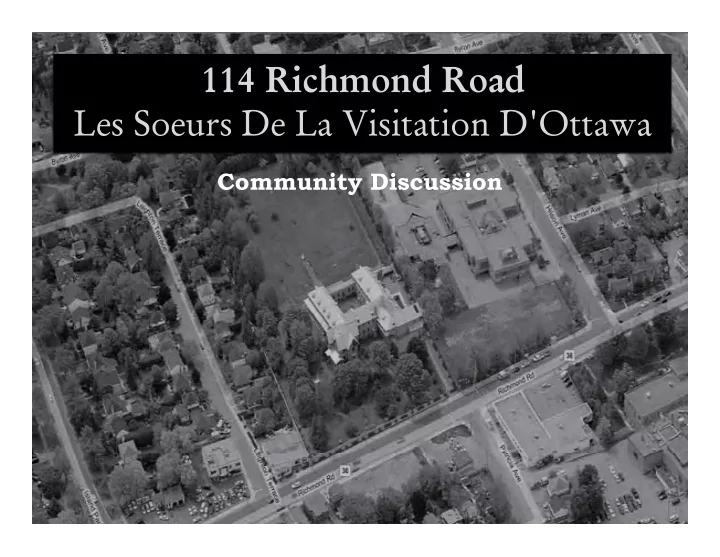
114 Richmond Road Les Soeurs De La Visitation D'Ottawa Community - - PowerPoint PPT Presentation
114 Richmond Road Les Soeurs De La Visitation D'Ottawa Community Discussion i i i Overview of the Proposal Ashcrofts Vision The Development Proposal The Development Proposal Ashcroft has released its proposal a for development (700+
A Mixed-use building fronting Richmond Rd (7-12 Storeys), A Hotel directly behind the convent (8-9 Storeys),
A Senior’s Retirement Building (5-8 Storeys), Senior’s Condominiums (5 Storeys),
Underground parking under all portions of the site except the
The description of “Public Space” in Ashcroft’s proposal
The majority of the spaces identified are in fact private
A large portion of the remaining spaces will be tied to
Ashcroft is proposing to cut through Byron Linear Park
The site was being proposed for heritage designation
Direct sight lines to the convent should be maintained, Two potential site plan options were presented, Appropriate massing of 4-6 storeys along Richmond Road
Preservation of green space and site controls such as Preservation of green space and site controls such as
Richmond Road by 2021 – 800 units are to be built. Richmond Road by 2031 – 1,800 units are to be built.
This is a full 11 years early and provides defense against future This is a full 11 years early and provides defense against future
The entire segment is to have an increase of 608 units over
The recent Ashcroft developments will create 266 units in the The recent Ashcroft developments will create 266 units in the
Consequently, 342 units should be the maximum development
Ashcroft is proposing 700+ units on the site.
The first of its kind Transportation Management
The upgrading of local hard (sewer, roads) and soft (cultural
These measures will provide improvements for the area
The site is primarily bounded by low-rise residential neighbourhoods with
a height limit of 11m to the south and 15-19m to the north (Richmond R d) Th ifi bl f i ibili i h h Road). The specific comparables for appropriate compatibility with the existing community are:
Z d T d l M Z | H h 15
Zoned: Traditional Mainstreet Zone | Height: 15m
Zoned: Traditional Mainstreet Zone | Height: 19m
Ri h d Rd (N th W t)
Zoned: Traditional Mainstreet Zone | Height: 19m
errace (East)
Z
d R id i l Fi D i Z (MM) | H i h 11
Zoned: Residential First Density Zone (MM) | Height: 11m
Zoned: Residential First Density Zone (MM) | Height: 11m
l & Hil A (S th W t)
Zoned: Residential Third Density Zone (S) | Height: 8-11m
“Consider rezoning the Soeurs de la Visitation convent to TM-Traditional Mainstreet for mixed-use development should redevelopment be proposed. Given the lot size, higher building heights may be possible, provided that: redevelopment is p tibl ith d p id pp p i t t iti t th dj t compatible with and provides an appropriate transition to, the adjacent low-rise residential neighbourhood; the convent wall is removed; and adaptive reuse of the convent building, with mixed-use residential/ground floor commercial along Richmond Road incorporating as much of the existing commercial along Richmond Road, incorporating as much of the existing green space as possible is proposed. As part of a redevelopment application, the southern part of the property should be rezoned to a maximum four storey residential zone in order to be compatible with the adjacent low-rise y p j residential area.”
City Council recently revisited the Official Plan that guides development and growth across the City. During the review process significant additions were made to section 4.11 of the plan titled “Urban Design and Compatibility” that clearly requires additional criteria for compatibility of intensification with existing hb h d neighbourhoods. During Ministerial review of the Official Plan, it added the following two sentences that apply for this site:
“Where the existing zoning provisions are sufficient to meet the intensification and density targets in the time frame defined by this OP, these targets shall not be used as a planning rationale for approving additional height or density in excess of the t i ” current zoning.” “Where community design plans and secondary plans contain sufficient development potential to meet intensification and density targets in the time frame defined by this OP these plans shall not be altered for the purpose of achieving this OP, these plans shall not be altered for the purpose of achieving intensification.”
114 Richmond Rd. is undergoing the heritage designation process. If approved the heritage designation will require a Heritage Impact Statement on
h ll h l l f f h how any construction will maintain the cultural significance of the site.
The entire site was recommended to be heritage by both the Advisory and Council
Committees: Thi d d b h l d d b ildi i i l li k d
This was recommended because the lands and building are intricately linked
through its past use.
The proper retention of heritage of the buildings and site itself is predicated
upon the appropriate use of the surrounding lands upon the appropriate use of the surrounding lands.
Artificially dividing or separating the previously inseparable land should not be
undertaken to ensure any redevelopment appropriately modifies the heritage elements.
Ashcroft has already appealed to the Ontario Superior Court to “quash” any form
the property.
Any appeal may not overturn Council although independent boards may advise
Council to do so.
Any application to build on the site will require a re-zoning amendment as
it is changing the use of the site.
Ashcroft has attempted to file a re-zoning application without full
documentation and will likely try to resubmit shortly.
This would come before committee and council after staff review but is
appealable beyond Council control to the Ontario Municipal Board (OMB).
An appeal for building outside established guidelines will prove to be a
test for recent in-force Official Plan and Secondary Plan compatibility improvements.
Particular attention will be made to ensure the community &
transportation/traffic impact studies use proper modal splits to ensure appropriate assumptions of the site on transportation in the community.
The community will be advised on the application throughout with
public comment periods at the start of the process.
The Community and City at large understands and supports
Lower property tax requirements,
Builds lively, vibrant streets and communities, and Is socially and environmentally responsible.
Over-intensification unnecessarily creates significant negative Over-intensification unnecessarily creates significant negative
Ashcroft is not abiding by reasonable design guidelines