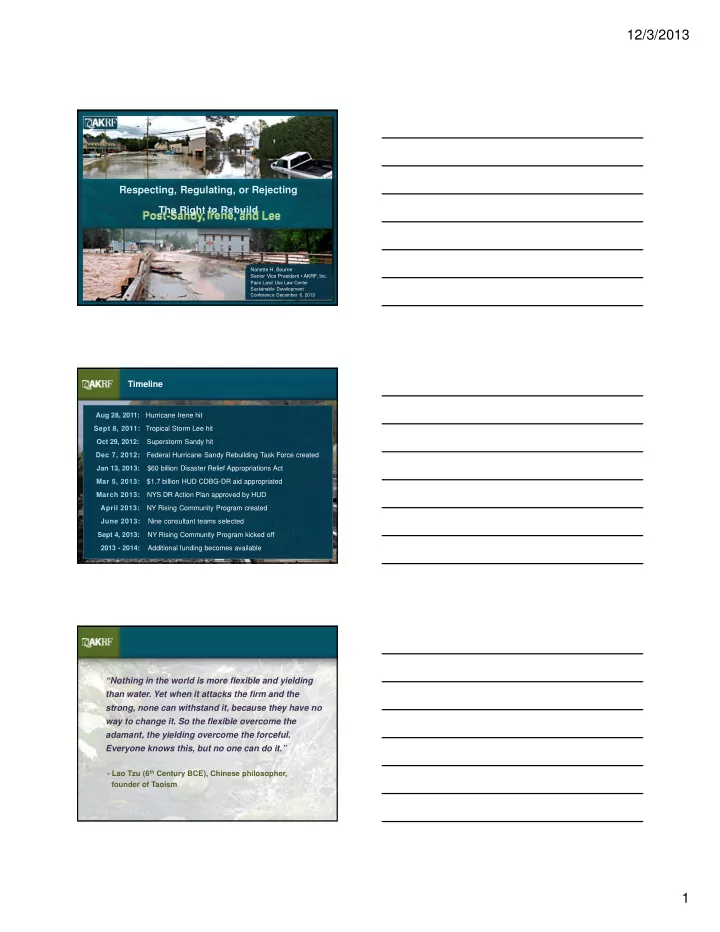
12/3/2013 Respecting, Regulating, or Rejecting The Right to Rebuild - - PDF document

12 3 2013
SMART_READER_LITE
LIVE PREVIEW

12/3/2013 Respecting, Regulating, or Rejecting The Right to Rebuild - - PDF document

12/3/2013 Respecting, Regulating, or Rejecting The Right to Rebuild Nanette H. Bourne Senior Vice President AKRF, Inc. Pace Land Use Law Center Sustainable Development Conference December 6, 2013 Timeline Aug 28, 2011: Hurricane Irene


slide-1
SLIDE 1

12/3/2013 1

Respecting, Regulating, or Rejecting

Nanette H. Bourne Senior Vice President • AKRF, Inc. Pace Land Use Law Center Sustainable Development Conference December 6, 2013

The Right to Rebuild

Oct 29, 2012: Superstorm Sandy hit Jan 13, 2013: $60 billion Disaster Relief Appropriations Act Dec 7, 2012: Federal Hurricane Sandy Rebuilding Task Force created Mar 5, 2013: $1.7 billion HUD CDBG-DR aid appropriated March 2013: NYS DR Action Plan approved by HUD April 2013: NY Rising Community Program created June 2013: Nine consultant teams selected

Timeline

Aug 28, 2011: Hurricane Irene hit Sept 8, 2011: Tropical Storm Lee hit Sept 4, 2013: NY Rising Community Program kicked off 2013 - 2014: Additional funding becomes available

  • Lao Tzu (6th Century BCE), Chinese philosopher,

founder of Taoism

“Nothing in the world is more flexible and yielding than water. Yet when it attacks the firm and the strong, none can withstand it, because they have no way to change it. So the flexible overcome the adamant, the yielding overcome the forceful. Everyone knows this, but no one can do it.”

slide-2
SLIDE 2

12/3/2013 2

What is the New York Rising Community Reconstruction Program?

Provide post-storm rebuilding and revitalization assistance for Sandy, Irene & Lee 102 severely affected communities in 42 areas throughout NY State Initial allotment of $3 million per community; additional funding for implementation Building Back Better!

New York Rising Community Reconstruction Program Team Organization

slide-3
SLIDE 3

12/3/2013 3

Planning Deliverables Schedule

1st Kickoff Meeting

WE ARE HERE

SEP 4 SEP 27 OCT 28 NOV 30 DEC 30 MAR 31 2 1 3 2 1 4 Conceptual Plans Communities’ Priority Projects Work Plans Initial Lists

  • f Strategies

Final Plans Presenting Full List of Project & Actions

Geographic Scope

Where are assets most at risk? Direct and indirect risks factors Where future construction, reconstruction or natural area restoration should be encouraged

Public Engagement

slide-4
SLIDE 4

12/3/2013 4

Public Engagement Strategy

15 - 20 person Planning Committees Identify techniques such as public meetings/ workshops, websites, social media, storyboards, etc. Educate communities on climate change

Community Vision

Short-, Medium-, and Long-Term Capitalize on social and economic assets Reduce risk and increase community resilience Focused and directed towards the future

Realistic and solution-driven Comprehensive yet specific Coordinated Understandable

Assets

Identify Assets

Affected by riverine and coastal hazards Defined as a “critical facility” by FEMA (essential to the health and welfare of the whole community, especially after hazard events)

Asset Types

Housing Infrastructure and Community Facilities Natural and Cultural Resources Economy Health and Social Services Vulnerable Populations

slide-5
SLIDE 5

12/3/2013 5

Risk Assessment

Boardwalk at Rye Playland post-Sandy

Rank assets by level of risk

Medium, high, extreme risk

Factors include:

Landscape attributes Elevation Vulnerable features How long taken out of service from prior events Community value as determined by Planning Committee

Cost Benefit Analysis

New Rochelle waterfront, post-Sandy

Rank potential projects by economic return Factors include:

Feasibility Cost Risk Reduction Potential Co-Benefits Funding Availability Degree of Public Support CDBG Eligible

Regional Coordination

Build on existing work

County comprehensive plans Hazard mitigation plans Regional sustainability plans (Cleaner Greener Communities) Regional economic development strategies Watershed management plans

slide-6
SLIDE 6

12/3/2013 6

Reconstruction Strategies, Projects, Programs and Actions

Identify Priority Projects Evaluate Cost/Benefit Determine Community Benefits Develop Funding Plan

Coastal Communities

Coastal Communities

slide-7
SLIDE 7

12/3/2013 7

Coastal Communities

  • Irene, Lee, and Sandy - Storm Impacts

Irene and Sandy have massive impact (limited impact from Lee) Low-lying areas inundated Major thoroughfares and access points flooded, blocking access by emergency vehicles and rescue teams Significant service interruptions in wastewater, power, telephone Some infrastructure disabled for months

Project Proposals

Soft (Natural) Infrastructure

Natural barriers / sand dunes along coastline Floodplain management in erosion-prone areas Streetscaping with flood-resistant materials

Hard Infrastructure

Seawalls / breakwaters New sanitary sewer connections in unsewered areas Position mobile pumps at strategic points before a storm

Capacity Building

Move emergency facilities (firehouse) to high ground Elevate/waterproof infrastructure and mechanicals Enhance community facilities to serve as shelters (generators, asbestos abatement, large stores of supplies) Civilian Emergency Operations Team Public outreach/education on resilience/disaster management

slide-8
SLIDE 8

12/3/2013 8

Riverine Communities

Riverine Communities

  • Storm Impacts

Creeks and tributaries overflow Many flooded roads and bridges cut off access to services, particularly in rural areas Affordable housing, often situated near creeks, floods –residents in shelters for months Farm fields flooded, crops destroyed Village centers located near waterways are heavily damaged, as are historic resources Emergency communication difficult due to large distances

slide-9
SLIDE 9

12/3/2013 9

Storm Impacts Major Issues

Improve functionality of storm shelters Improve communication infrastructure Identify ways to connect rural isolated communities Identify, protect or relocate critical infrastructure and facilities in 100 year floodplain Economic Development

Project Proposals

Soft (Natural) Infrastructure

Restore eroded creeks beds and banks Holding tanks/constructed wetlands to release floodwater more gradually into treatment systems

Hard Infrastructure

Enlarge culverts, elevate/widen bridges Relocate or protect key infrastructure Power generators for key community services

Capacity Building

Improvements to storm shelters and their surrounding areas Community education for disaster planning Disaster training for community organizations Improve communication infrastructure

slide-10
SLIDE 10

12/3/2013 10

Adaptation Strategies

Adaptation / Building Codes

Building Codes - Vertical Addition

Understand Current BFE’s Minimum Consistency vs. Enhanced Codes Local Codes should consider exceeding NFIP minimum requirements Measure height or FAR

Existing/Vulnerable vs. Rebuilt/Safe

Adaptation / Innovative Building Design

Damaged home rebuilt as two- family post-Irene by Habitat for Humanity and J. Taylor Design Group, Mamaroneck NY

slide-11
SLIDE 11

12/3/2013 11

Adaptation / Zoning Codes

Post-Sandy Retrofitting above BFE - Lindenhurst, Long Island, NY

Make consistent existing zoning code with flood mitigation measures

Adaptation / Zoning Codes Adaptation / Zoning Codes

slide-12
SLIDE 12

12/3/2013 12

Adaptation / Zoning Codes Adaptation / Master Plans and Innovative Zoning

Create Disaster Resistant Communities via Smart Zoning Promote compact and efficient development in new/existing communities Promote walkable and bicycle safe communities Orient new development to capitalize on TOD and system investments

Adaptation / Natural Resource Protection

Enforce Dune and Bluff Protection Measures

Hard construction can undermine natural protective features Permit required for any activity within erosion prone areas per NYS Coastal Erosion Hazard Area (CEHA) Permit (6 NYCRR Part 505). Adopting a Dune Preservation ordinance can increase local protection and local control (Dune Protection Line – 1000’ landward of Mean High Tide)

slide-13
SLIDE 13

12/3/2013 13

Adaptation / Natural Resource Protection and Watershed Management Increase stormwater detention Increase stream buffer protection Increase wetland protection

Adaptation / Tree Preservation

Preserve and protect the right kind

  • f existing trees

Significant energy savings from proper placement of trees Potential conflict with preservation

  • rdinances, which regulate tree

removal or require replacement in kind Potential conflict when trees mature on neighboring properties

  • r within the public right of way

Adaptation / Tree Preservation

slide-14
SLIDE 14

12/3/2013 14

Adaptation / Managed Retreat

Ruins of a house destroyed by Sandy, Oakwood Beach, Staten Island

Buyouts move people out of harm’s way and restore natural floodways

“In a few decades, the relationship between the environment, resources and conflict may seem almost as obvious as the connection we see today between human rights, democracy and peace.”

  • Wangari Maathai (1940 - 2011), environmental activist,

first African woman to receive the Nobel Peace Prize, 2004

After All…Climate Change is Changing Where We Live, Work, and Play

Seaside Heights, NJ, post-Sandy