
SLIDE 1
13 Symbolic MT 2: Weighted Finite State Transducers
The previous section introduced a number of word-based translation models, their parameter estimation methods, and their application to alignment. However, it intentionally glossed
- ver an important question: how to generate translations from them. This section introduces
a general framework for expressing our models graphs: weighted finite-state transducers. It explains how to encode a simple translation model within this framework and how this allows us to perform search.
13.1 Graphs and the Viterbi Algorithm
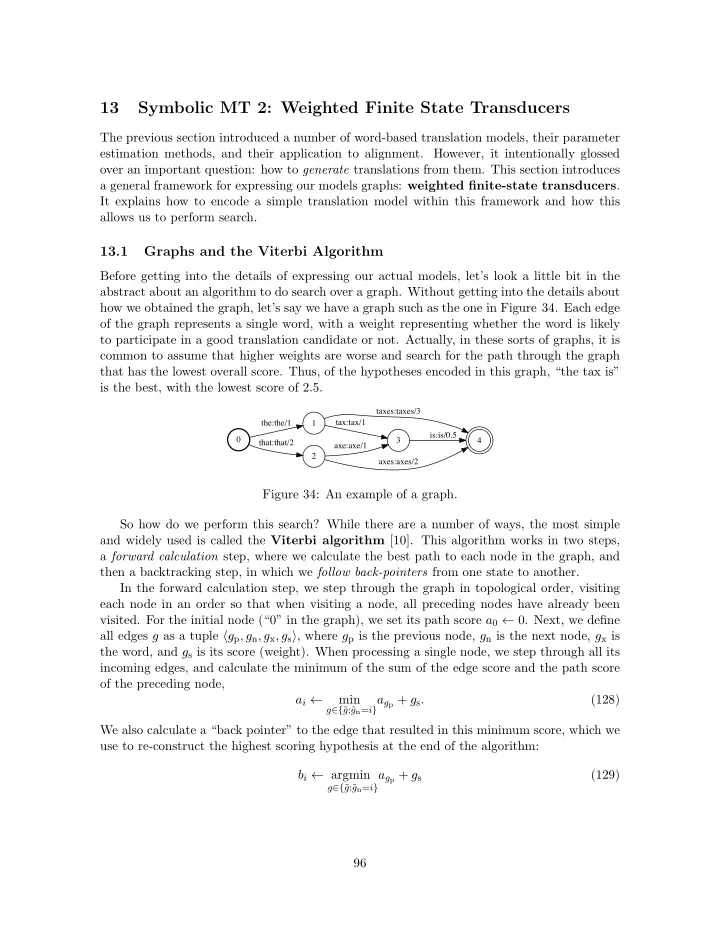
Before getting into the details of expressing our actual models, let’s look a little bit in the abstract about an algorithm to do search over a graph. Without getting into the details about how we obtained the graph, let’s say we have a graph such as the one in Figure 34. Each edge
- f the graph represents a single word, with a weight representing whether the word is likely
to participate in a good translation candidate or not. Actually, in these sorts of graphs, it is common to assume that higher weights are worse and search for the path through the graph that has the lowest overall score. Thus, of the hypotheses encoded in this graph, “the tax is” is the best, with the lowest score of 2.5.
1 the:the/1 2 that:that/2 3 tax:tax/1 4 taxes:taxes/3 axe:axe/1 axes:axes/2 is:is/0.5
Figure 34: An example of a graph. So how do we perform this search? While there are a number of ways, the most simple and widely used is called the Viterbi algorithm [10]. This algorithm works in two steps, a forward calculation step, where we calculate the best path to each node in the graph, and then a backtracking step, in which we follow back-pointers from one state to another. In the forward calculation step, we step through the graph in topological order, visiting each node in an order so that when visiting a node, all preceding nodes have already been
- visited. For the initial node (“0” in the graph), we set its path score a0 0. Next, we define
all edges g as a tuple hgp, gn, gx, gsi, where gp is the previous node, gn is the next node, gx is the word, and gs is its score (weight). When processing a single node, we step through all its incoming edges, and calculate the minimum of the sum of the edge score and the path score
- f the preceding node,