1
14th Meeting of the Jastarnia Group 12-14 March 2018 Copenhagen, - - PowerPoint PPT Presentation
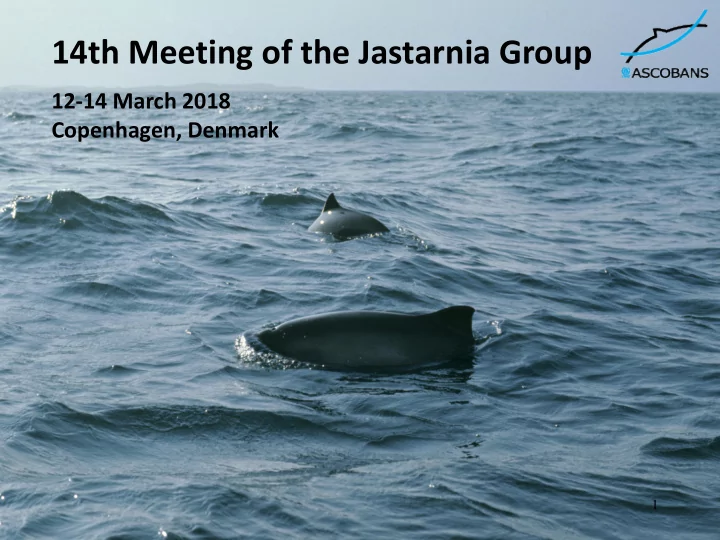
14th Meeting of the Jastarnia Group 12-14 March 2018 Copenhagen, Denmark 1 Implementation and progress of the JP and WBBKP Summary HP coordinator present Participation from HELCOM secretariat Discussion on harbour porpoise
2
Implementation and progress of the JP and WBBKP – Summary
- HP coordinator present
- Participation from HELCOM secretariat
- Discussion on harbour porpoise population
genetics in the Baltic Sea Region
- Discussion on the deployment of Porpoise
Alerting devices (PALs) in German Baltic waters and the need for monitoring of this effort
3
Baltic Sea EBSAs
- 1. Northern Bothnian Bay
- 2. Kvarken Archipelago
- 3. Åland Sea, Åland Islands and
the Archipelago Sea of Finland
- 4. Eastern Gulf of Finland
- 5. Inner Sea of West Estonian
Archipelago
- 6. Southeastern Baltic Sea
Shallows
- 7. Southern Gotland Harbour
Porpoise Area
- 8. Fehmarn Belt
- 9. Fladen and Stora and Lilla
Middelgrund
1. 3. 2. 5. 4. 6. 8. 7. 9.
4
Southern Gotland Harbour Porpoise Area
- Unique offshore banks and varied and
diverse coastal areas
- Shallow areas create conditions for high
productivity of filter-feeding animals that form the food base for flatfish and large amounts of wintering birds – Core distribution area of the critically endangered harbour porpoise (Phocoena phocoena) subpopulation in the Baltic Sea – Important area for harbour seal (Phoca vitulina vitulina) – The main wintering area for the endangered long-tailed duck (Clangula hyemalis)
5
- Preliminary plan to apply for LIFE funding in
spring 2019, earliest possible start date summer 2020 Acoustic follow-up survey
- Improved detection function reduced CI for
the abundance estimate
- Pilot surveys in waters >80 m
- More fine-scale grid in main porpoise area in the
Baltic Proper
SAMBAH II
6
SAMBAH II – Options discussed
- Data collection on spatio-temporal fishing effort
with relevant gears (commercial and recreational)
- Spatio-temporal bycatch risk assessment
- Social impact assessment of fisheries
- High definition digital surveys for detection of
calves
7
Action points
8
Monitor and estimate abundance and distribution
- National monitoring should be established or further
improved, coordinating between countries
- Support SAMBAH II to start in 2020 (fieldwork in 2021),
noting that management authorities are likely to be required as formal partners for a LIFE application
- Continue to cooperate on inter-SCANS surveys of the
WBBK population
9
Monitor, estimate and reduce bycatch
- Establish system to monitor bycatch convering all sizes of
fishing vessels. Discussion at AC24
- Spatio-temporal risk assessment of bycatch
- Continue to develop, conduct research on and implement use
- f alternative fishing gear and pingers not audible to seals
- Assess uncertainty in bycatch rates and estimate the effort
needed for bycatch monitoring
10 10 10 10
Increase involvement, awareness and cooperation
- Coordinating reporting programmes and national
databases for opportunistic sightings, bycatches, strandings and necropsies
- Promote research on consequences of impacts on prey
communities (WBBK)
Investigate habitat use and protect important areas
11 11 11 11 11
Monitor and mitigate impact of underwater noise
- Baseline studies of underwater noise as a reference point
for future impact assessments
- Investigate detrimental effects of various types of sounds
- Adopt regulations on reduction of sounds emissions from
construction of offshore windfarms
12 12 12 12 12
Cross-cutting issues and misc.
- Parties are encourage to take turns hosting the JG
meetings and ensuring that the necessary funding is available
- A plan has been produced for the continuation of the